Congress–NC Alliance Under Strain: Why Senior Congress Leaders Want a Strategic Reset in Jammu & Kashmir
By: Javid Amin | 13 May 2026
Internal Dissent Grows as Congress Reassesses Its Alliance With National Conference Ahead of 2026 J&K Elections
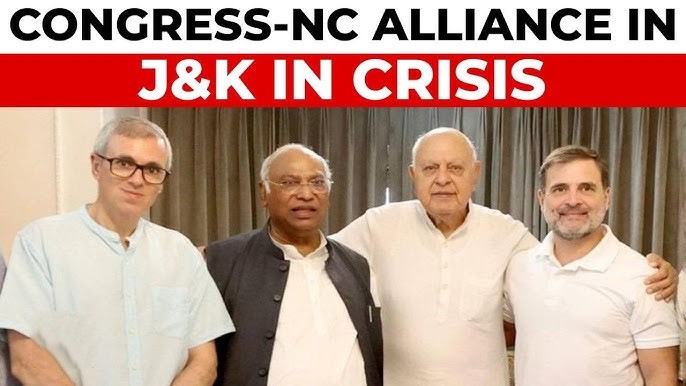
The Congress party’s alliance with the National Conference is facing renewed internal scrutiny, with senior leaders reportedly urging the party high command to rethink its long-term political strategy in Jammu & Kashmir.
The debate comes at a critical moment for the opposition landscape in the Union Territory, where coalition politics, regional identity, and electoral arithmetic continue to shape political outcomes. While the Congress–NC alliance was revived to counter the growing influence of the Bharatiya Janata Party in Jammu & Kashmir, a section within Congress now believes the arrangement may be weakening the party’s independent political identity instead of strengthening it.
The emerging tensions reveal a deeper strategic dilemma inside Congress: should it continue prioritizing opposition unity, or should it rebuild its own grassroots base before the 2026 Jammu & Kashmir Assembly elections?
Why Congress Leaders Are Questioning the Alliance
According to political discussions emerging from within Congress circles, three major concerns are driving the push for reconsideration.
1. Credibility Concerns Around NC’s Political Positioning
Some Congress leaders believe the National Conference’s changing political stances over the years have created trust issues among sections of voters, particularly younger Kashmiris and politically undecided groups.
Critics inside Congress argue that repeated shifts on issues related to autonomy, governance, and Delhi relations have weakened the alliance’s broader appeal. They fear Congress risks inheriting anti-incumbency sentiment attached to previous NC-led governments.
The concern is not merely electoral. Several party voices reportedly feel Congress appears politically secondary in the alliance, limiting its ability to project an independent ideological narrative in Jammu & Kashmir.
2. Congress Cadre Feels Overshadowed in Kashmir
Another major concern revolves around organizational decline.
Congress leaders pushing for change believe the alliance has reduced incentives for rebuilding grassroots structures in the Kashmir Valley. Instead of expanding its cadre network independently, Congress is increasingly dependent on NC’s established political machinery.
This has created unease among local Congress workers who feel politically invisible in many Valley constituencies.
Party insiders reportedly argue that unless Congress begins contesting politics more independently, it may permanently lose relevance in large parts of Kashmir.
In Jammu, where Congress still retains pockets of influence, leaders fear overreliance on NC could weaken the party’s regional balancing role.
3. Questions Over Long-Term Electoral Strategy
The third issue is strategic survival.
Several Congress leaders reportedly believe alliances should be tactical, not permanent. They argue that continuously depending on NC’s traditional vote bank prevents Congress from reconnecting directly with voters — especially youth, first-time voters, and politically disengaged communities.
Their argument is straightforward: while alliances may deliver short-term seat adjustments, they can weaken long-term party growth.
The internal debate reflects a wider national trend within Congress, where regional alliances often create tensions between immediate electoral gains and long-term organizational revival.
The Historical Background of Congress–NC Relations
The Congress–NC relationship has always been politically significant but rarely stable.
From Cooperation to Confrontation: A Long Political History
Sheikh Abdullah Era: Early Cooperation and Distrust
In the 1950s and 1960s, the National Conference under Sheikh Abdullah maintained a complicated relationship with Congress. While periods of cooperation existed, tensions repeatedly emerged over Jammu & Kashmir’s autonomy and Delhi’s political intervention in the region.
The relationship oscillated between partnership and political confrontation for decades.
The 1986 Rajiv Gandhi–Farooq Abdullah Accord
A major turning point came in 1986, when Rajiv Gandhi and Farooq Abdullah forged a political accord that revived Congress–NC cooperation.
While the agreement stabilized governance temporarily, critics accused NC of diluting its autonomy-focused politics to remain aligned with Delhi.
That criticism still shapes political perceptions in sections of Kashmir today.
2008 Coalition Government
The alliance returned to power after the 2008 Assembly elections, with Omar Abdullah becoming Chief Minister while Congress remained a coalition partner.
Although the coalition survived a full term, it also faced criticism over governance challenges, unrest management, and growing public dissatisfaction.
2014: Contesting Separately Changed the Political Landscape
In 2014, Congress and NC contested separately — a move that significantly weakened both parties electorally.
The split opposition created space for the BJP’s rapid expansion in Jammu and allowed the People’s Democratic Party to emerge stronger in Kashmir.
The election reshaped J&K politics permanently.
2024 and Beyond: Alliance Against BJP Expansion
The renewed Congress–NC understanding in recent years has largely been driven by a common political objective: preventing BJP’s deeper electoral consolidation in Jammu & Kashmir.
However, the alliance now faces growing questions from within Congress itself.
The Core Political Dilemma Facing Congress
At the heart of the debate lies a difficult strategic calculation.
Stay Allied or Rebuild Independently?
Option One: Continue the Alliance
Supporters of continuing the alliance argue that opposition unity remains essential in Jammu & Kashmir’s polarized political environment.
Under this formula:
- NC would remain dominant in the Kashmir Valley
- Congress would focus on Jammu constituencies
- Both parties would attempt to avoid splitting anti-BJP votes
This strategy could help maintain a broader opposition front.
However, critics warn Congress may continue losing its independent political identity in the Valley.
Option Two: Congress Goes Solo
A standalone Congress strategy could allow the party to:
- Rebuild local leadership
- Strengthen booth-level organization
- Reconnect with young voters
- Regain credibility as an independent force
But the risks are equally significant.
A divided opposition could split anti-BJP votes among Congress, NC, and PDP — potentially benefiting the BJP electorally, especially in Jammu.
Option Three: A New Opposition Equation
Another possible scenario involves Congress exploring alternative alliances, including potential tactical understandings with PDP or smaller regional players.
Such a shift would dramatically alter Valley politics.
In this scenario:
- NC risks isolation
- Congress attempts a fresh political repositioning
- Voters face a more fragmented opposition landscape
However, this approach carries political uncertainty and could confuse traditional opposition voters.
Why the BJP Could Benefit From Opposition Fragmentation
The BJP’s political growth in Jammu & Kashmir has relied heavily on opposition divisions.
If Congress and NC weaken their alliance or contest separately, BJP’s electoral prospects could improve in several constituencies — particularly in Jammu, where the party already maintains a strong organizational advantage.
Political analysts believe fragmented opposition votes often produce disproportionately larger gains for a consolidated political force.
This is why many within Congress still advocate maintaining the alliance despite internal dissatisfaction.
The Youth Factor: Growing Political Disengagement
One of the most important yet under-discussed aspects of the alliance debate is voter psychology — especially among younger citizens.
Many first-time voters in Jammu & Kashmir increasingly view traditional alliances as transactional arrangements rather than ideological partnerships.
Frequent coalition shifts have created political fatigue among sections of youth who already feel disconnected from mainstream political processes.
Political uncertainty surrounding the Congress–NC relationship may further deepen voter disengagement unless both parties clearly articulate their long-term vision for governance, employment, and regional development.
What Happens Next?
At present, there is no official indication that Congress is preparing to formally break ties with the National Conference. However, the growing internal debate signals that the alliance may face tougher negotiations ahead of the 2026 Assembly elections.
Much will depend on:
- Seat-sharing discussions
- Congress’s organizational assessment in Jammu and Kashmir
- BJP’s evolving electoral strategy
- PDP’s political positioning
- Voter sentiment in both Jammu and the Kashmir Valley
For Congress, the decision ultimately comes down to a difficult balancing act between immediate opposition unity and long-term political revival.
For NC, retaining Congress support remains crucial for preserving broader national legitimacy.
And for Jammu & Kashmir’s voters, the coming months could reshape the region’s opposition politics once again.
Political Scenarios Ahead of 2026 J&K Elections
| Scenario | Political Outcome | Likely Impact |
|---|---|---|
| Congress–NC alliance continues | Unified opposition front | Prevents vote split but Congress remains overshadowed |
| Congress contests independently | Rebuilding party identity | Risks helping BJP through fragmented opposition |
| New opposition bloc emerges | Fresh political equations | Creates uncertainty and voter confusion |