Omar Abdullah Calls J&K UT Model “Worst Form of Government” | Statehood Debate Intensifies
By: Javid Amin | 10 May 2026
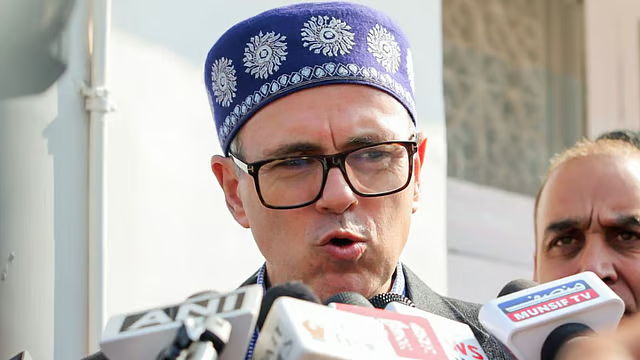
Jammu & Kashmir Chief Minister Omar Abdullah has intensified the debate around governance in the Union Territory, describing the current administrative framework as the “worst form of government” because of what he called its confusing and divided power structure.
His remarks strike at the heart of the ongoing political and constitutional debate surrounding Jammu and Kashmir’s post-2019 governance model and the continued demand for restoration of full statehood.
Omar Abdullah’s Core Argument
Speaking on the functioning of the Union Territory administration, Omar Abdullah argued that authority in J&K is effectively split between:
- The elected government
- The Lieutenant Governor’s office
According to him, this arrangement weakens democratic accountability and creates institutional confusion.
“This dual power structure is the worst form of government. It undermines democracy and leaves citizens caught between two centers of authority.”
The statement reflects growing frustration within elected political circles over the limits placed on executive authority under the Union Territory structure.
Why the UT Model Remains Contentious
Since the reorganization of the former state in 2019, Jammu & Kashmir has functioned as a Union Territory with a legislature — somewhat similar in structure to Delhi, but with important differences.
Under the present framework:
- The Lieutenant Governor retains substantial administrative and security-related powers
- The elected government handles selected governance responsibilities
- Several critical domains remain under central oversight
Critics argue this creates overlapping authority, while supporters say it ensures stability and administrative coordination in a sensitive region.
The “Dual Power Structure” Debate
Omar Abdullah’s criticism centers on a practical governance question:
Who is ultimately accountable?
When governance powers are divided:
- Citizens may not know whether responsibility lies with ministers or the LG administration
- Policy execution can slow due to procedural overlap
- Political leadership may struggle to implement electoral promises fully
This tension has increasingly shaped public and political discourse in Jammu & Kashmir.
Political analysts note that Abdullah is attempting to frame the issue not merely as a constitutional disagreement, but as a day-to-day governance problem affecting ordinary people.
Statehood Demand Gains Fresh Momentum
The remarks are also politically significant because they reinforce the National Conference’s long-standing demand for restoration of full statehood.
For opposition parties in J&K, the argument is now evolving beyond symbolism.
The central claim is:
- Democratic legitimacy must align with administrative authority
- Elected governments should possess meaningful executive control
- Governance cannot function effectively under divided command structures
Omar Abdullah’s statement is likely to become a rallying point for broader opposition mobilization on the statehood issue.
Federalism and Constitutional Questions
The debate around J&K’s governance model has wider implications for Indian federalism.
At the center of the discussion are key constitutional questions:
- How much authority should elected governments in Union Territories possess?
- What balance should exist between central oversight and regional autonomy?
- Can democratic accountability function effectively under shared executive power?
These questions are not unique to J&K alone, but the region’s political sensitivity makes the debate especially significant.
Implications for Citizens
🔹 Administrative Confusion
Residents often face uncertainty over:
- Which authority controls specific departments
- Who is responsible for delays or policy failures
- Whether elected representatives possess sufficient power to intervene
🔹 Political Frustration
Supporters of regional parties argue that:
- Electoral mandates lose meaning without full executive authority
- Decision-making becomes centralized and bureaucratic
🔹 Governance Challenges
Dual structures can sometimes lead to:
- Slower implementation
- Coordination issues
- Public perception of institutional disconnect
The Centre’s Position
The Union Government has consistently defended the post-2019 arrangement as necessary for:
- Stability
- Security management
- Administrative efficiency
- Development-focused governance
The Centre has also repeatedly stated that restoration of statehood remains a commitment at an appropriate stage, though no definitive timeline has yet emerged publicly.
Political Significance of Omar’s Statement
Omar Abdullah’s remarks come at a politically sensitive moment:
- Regional parties are recalibrating strategy
- Statehood remains a central emotional and political issue
- Opposition formations are seeking common ground against centralized governance models
By calling the UT structure the “worst form of government,” Abdullah is positioning the debate in moral and democratic terms rather than purely administrative ones.
The Bigger Picture
The governance debate in Jammu & Kashmir is no longer confined to constitutional experts or political parties. It increasingly touches:
- Democratic representation
- Institutional accountability
- Centre-state relations
- Citizen trust in governance structures
Whether one supports or opposes the UT framework, the growing friction between elected authority and administrative control has clearly become one of the defining political questions in J&K.
Conclusion
Omar Abdullah’s criticism of the Union Territory model adds fresh intensity to the demand for restoration of statehood in Jammu & Kashmir.
His remarks frame the current system not merely as politically unsatisfactory, but structurally flawed — a model where authority is divided, accountability diluted, and democratic governance constrained.
As the debate deepens, the future of J&K’s political structure is likely to remain at the center of national constitutional and federal discussions.


