Omar Abdullah’s Liquor Remarks Trigger Political Storm in J&K, Force Public Clarification
By: Javid Amin | 11 May 2026
A brief roadside comment by Omar Abdullah has snowballed into one of the most politically charged debates currently unfolding in Jammu and Kashmir.
What began as a casual defense of existing liquor policies quickly turned into a fierce confrontation involving the Jammu & Kashmir National Conference, Jammu and Kashmir Peoples Democratic Party, and the Bharatiya Janata Party — exposing deeper tensions over religion, secularism, governance, and cultural identity in the region.
Facing mounting criticism, Omar Abdullah later admitted that his comments were a “mistake,” saying his words had been politically twisted and misinterpreted.
The Remark That Sparked the Controversy
The controversy erupted after Omar Abdullah responded to demands for a liquor ban by saying:
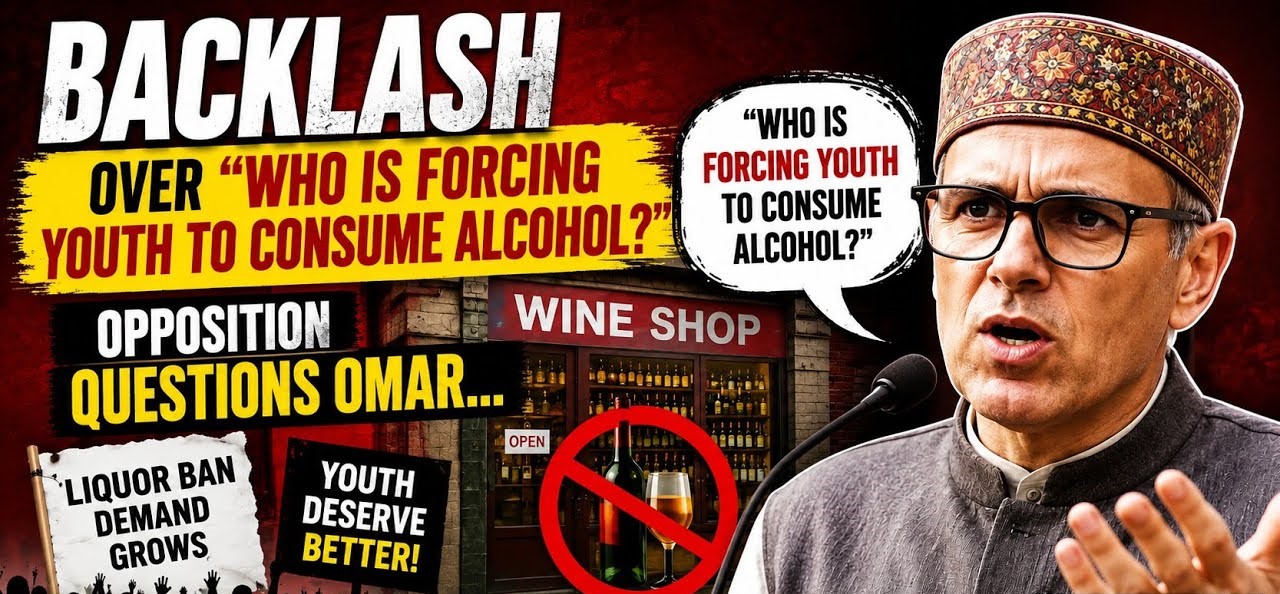
“Who has forced anyone to drink? People are going to these shops of their own. We are not advertising it.”
He also argued that:
- the government had not opened new liquor outlets, and
- existing shops primarily catered to tourists and communities whose religion permits alcohol consumption.
However, the remarks immediately triggered backlash across the political spectrum.
Why the Statement Backfired
In Kashmir’s socio-political environment, alcohol remains a deeply sensitive issue due to:
- Islamic religious teachings,
- cultural conservatism, and
- broader anxieties over changing social norms.
Critics accused Omar Abdullah of:
- appearing dismissive of majority religious sentiment,
- reducing a moral and cultural issue to personal choice, and
- failing to appreciate the emotional sensitivity attached to alcohol in Kashmir society.
The political damage intensified because the remarks appeared spontaneous and uncalculated — allowing rivals to frame them aggressively.
Mehbooba & Iltija Mufti Launch Sharp Attack
Mehbooba Mufti and her daughter Iltija Mufti became some of the strongest critics of Omar Abdullah’s position.
Mehbooba Mufti’s Argument
Mehbooba linked the issue to:
- women’s safety,
- social stability, and
- Kashmir’s traditional social structure.
She argued that historically limited alcohol consumption in Kashmir helped preserve social order and warned against normalization of liquor access.
Iltija Mufti’s Counterattack
Iltija Mufti described Omar Abdullah’s justification as:
👉 “illogical.”
She pointed to states like:
- Gujarat and
- Bihar
where prohibition exists despite Hinduism not forbidding alcohol.
Her argument was aimed at challenging Omar’s secularism-based defense:
If prohibition can exist in non-Muslim-majority states, why dismiss demands in Muslim-majority Kashmir?
BJP Also Enters the Debate
Ravinder Raina echoed demands for prohibition, framing the issue as:
- moral,
- cultural, and
- socially necessary.
This created an unusual political alignment:
👉 PDP and BJP — often ideological opposites — both criticizing Omar Abdullah from different angles.
Omar Abdullah’s Clarification & Partial Backtrack
As criticism intensified, Omar Abdullah attempted to contain the fallout.
He clarified:
- no new liquor shops had been opened under his government,
- existing outlets were long-established, and
- his roadside remarks had been made casually and misunderstood.
Most significantly, he admitted:
making the comment publicly in that manner was “a mistake.”
The acknowledgment was politically important because it reflected:
- recognition of public anger, and
- an attempt to prevent the issue from spiraling further.
The Bigger Debate: Secular Governance vs Religious Sentiment
The liquor controversy has now evolved far beyond alcohol policy itself.
At its core lies a larger question:
👉 How should Jammu and Kashmir balance secular governance with majority religious sentiment?
NC’s Position
The National Conference appears to be defending:
- personal freedom,
- secular governance, and
- coexistence of diverse communities.
Its argument suggests:
the state should not legislate morality solely through religious considerations.
PDP & BJP’s Position
Despite major ideological differences elsewhere, both PDP and BJP argue:
- governance must respect dominant social and cultural values,
- alcohol has wider social consequences, and
- prohibition can be justified as public reform.
Lessons From Other Indian States
The debate intensified because opposition leaders cited examples from other Indian states with prohibition laws.
| State | Status |
|---|---|
| Gujarat | Long-standing prohibition |
| Bihar | Liquor ban since 2016 |
| Nagaland | Partial prohibition |
| Mizoram | Ban reinstated in 2019 |
However, these examples also come with complications:
- black markets,
- smuggling,
- illicit liquor deaths, and
- enforcement challenges.
This has allowed Omar Abdullah’s supporters to argue that prohibition is not always a practical solution.
Economic & Tourism Concerns
Another layer of the debate involves economics.
Arguments Against a Ban
Critics of prohibition warn:
- tourism may be affected,
- hospitality businesses could suffer, and
- illegal alcohol trade may expand underground.
Excise revenue from liquor sales also contributes financially to state operations.
Public Health vs Personal Freedom
The controversy has exposed competing governance philosophies:
| Position | Core Argument |
|---|---|
| Pro-Ban | Protect society, culture & public health |
| Anti-Ban | Preserve personal freedom & secular governance |
This makes the liquor debate:
👉 not merely administrative, but deeply ideological.
Political Fallout for Omar Abdullah
Politically, the episode has created challenges for Omar Abdullah and NC.
Why It Hurt
- The U-turn allowed opponents to portray him as inconsistent
- The issue emotionally resonated with conservative sentiment
- Rivals successfully reframed a casual remark into a cultural controversy
The backlash also disrupted NC’s attempts to reposition itself around:
- governance,
- development, and
- youth-centric politics.
Instead, the party found itself defending secular principles in an emotionally charged environment.
Conclusion: More Than a Liquor Debate
The liquor controversy in Jammu and Kashmir is no longer just about alcohol sales.
It has become a symbolic struggle over:
- identity,
- secularism,
- morality,
- governance, and
- political legitimacy.
For Omar Abdullah, the episode was a reminder that in Kashmir’s sensitive political climate, even off-the-cuff remarks can rapidly evolve into major ideological confrontations.
And for J&K politics overall, the debate has once again revealed how cultural questions often carry far deeper political consequences than policy discussions alone.