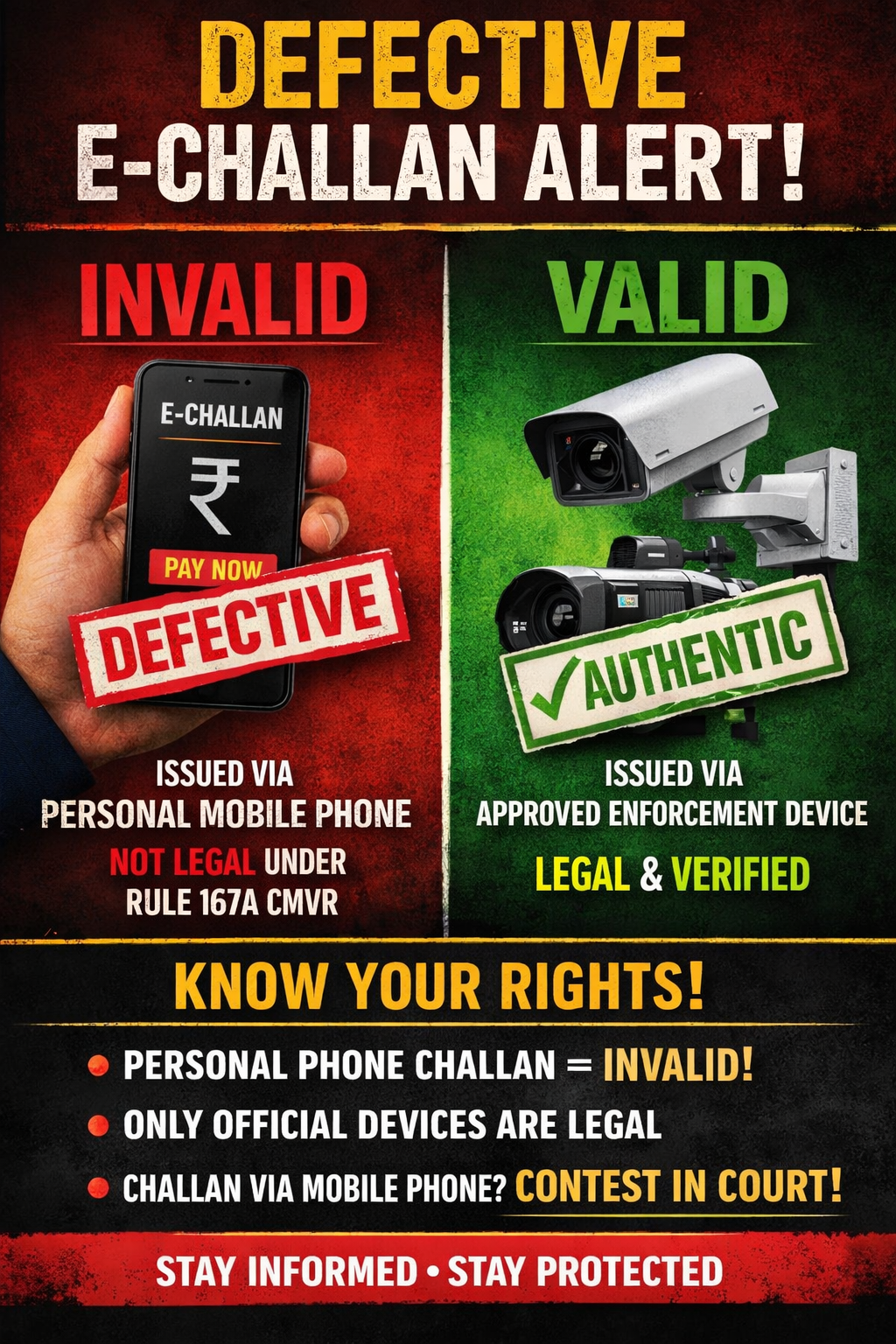
Srinagar Court Declares E-Challans Issued Through Personal Mobile Phones Legally Defective
By: Javid Amin | 09 May 2026
Landmark Ruling Raises Questions Over Digital Traffic Enforcement
In a significant ruling with wide implications for traffic enforcement in Jammu and Kashmir, a court in Srinagar has held that e-challans issued through a police officer’s personal mobile phone are procedurally defective and legally invalid.
The judgment reinforces that electronic challans must strictly comply with Rule 167A of the Central Motor Vehicles Rules (CMVR), 1989, which permits only officially authenticated electronic enforcement devices for issuing traffic violations.
The ruling is being seen as a major development in the debate over digital policing, citizen rights, and procedural accountability.
What the Court Held
The Srinagar trial court and Special Mobile Magistrate (Traffic) observed that:
A police officer’s personal smartphone, irrespective of its technical features, cannot be treated as a prescribed electronic enforcement device under Rule 167A CMVR.
The court emphasized that valid e-challans can only be generated through officially recognized systems such as:
- CCTV surveillance systems
- Automatic Number Plate Recognition (ANPR) cameras
- Speed detection cameras
- Dashboard cameras
- Body-worn cameras
These systems are required to ensure:
- Proper authentication
- Integration with official databases
- Tamper-proof audit trails
- Reliable digital evidence
A personal phone, the court noted, lacks these safeguards.
Why the Challans Were Quashed
The court reportedly quashed multiple e-challans issued against vehicle owners, including a practicing lawyer, after finding serious procedural lapses.
Key Grounds Mentioned by the Court
1. No Functional Traffic Signals
At the alleged violation site, traffic signals were reportedly non-functional, weakening the basis of enforcement.
2. Lack of Clear Evidence
Photographs attached with the challans:
- Did not clearly show stop lines
- Failed to establish actual violations
- Lacked proper contextual proof
3. Mechanically Issued Challans
The court observed that the challans appeared:
- Vague
- Unsupported by credible evidence
- Mechanically generated without due verification
Why This Judgment Matters
The ruling goes beyond a technical defect—it addresses broader concerns about fairness, transparency, and misuse of digital enforcement powers.
For Citizens
Motorists now have legal grounds to challenge e-challans if:
- They were issued via personal smartphones
- Proper evidence is missing
- The challan lacks mandatory details
For Traffic Police
Authorities may now be required to:
- Use only certified enforcement devices
- Maintain proper digital records
- Ensure lawful evidence collection
For Governance
The judgment reinforces that technology-based policing must still operate within the framework of due process and statutory compliance.
Understanding Rule 167A CMVR
Rule 167A of the Central Motor Vehicles Rules, introduced in 2021, was designed to modernize traffic enforcement through electronic monitoring systems.
The rule mandates that traffic violations detected electronically must rely on:
- Authenticated devices
- Verified digital records
- Traceable audit systems
The objective is to prevent:
- Arbitrary penalties
- Evidence manipulation
- Unauthorized challan generation
The Srinagar court ruling effectively clarifies that personal smartphones do not satisfy these legal requirements.
Risks Highlighted by the Court
The judgment indirectly flags several risks associated with personal-device enforcement:
Potential Misuse
- Fake or unauthorized challans
- Selective targeting
- Manipulation of images or timestamps
Lack of Accountability
Without integrated systems, there is:
- No secure audit trail
- No verification mechanism
- Reduced evidentiary reliability
This, the court implied, could undermine public confidence in electronic enforcement systems.
How Citizens Can Challenge a Defective E-Challan
1. Verify the Source
Check whether the challan was generated through:
- CCTV
- ANPR system
- Speed camera
- Official enforcement device
If issued via a personal mobile phone, it may be challengeable under Rule 167A.
2. Preserve Evidence
Keep:
- SMS or email copies of the challan
- Officer details
- Time and location records
- Photos of the site, if possible
3. Submit a Representation
File a written representation before:
- Traffic Police Headquarters
- Regional Transport Office (RTO)
Clearly mention:
- Violation of Rule 167A CMVR
- Use of unauthorized device
- Lack of lawful electronic evidence
4. Approach the Court
If authorities reject the representation, the matter can be challenged before:
- Traffic Magistrate
- Special Mobile Magistrate
Grounds may include:
- Procedural illegality
- Lack of authenticated device
- Absence of reliable evidence
Sample Petition Format
Below is a legally structured draft citizens may use while contesting a defective e-challan:
I respectfully submit that the e-challan issued against my vehicle (No. ________) dated ________ is procedurally defective and contrary to Rule 167A of the Central Motor Vehicles Rules, 1989.
The challan appears to have been generated through a police officer’s personal mobile phone, which does not qualify as an authenticated electronic enforcement device under the applicable rules.
Rule 167A permits issuance of e-challans only through prescribed electronic systems such as CCTV cameras, ANPR systems, speed detection cameras, dashboard cameras, or body-worn cameras integrated with official enforcement infrastructure.
Further, the challan lacks reliable electronic evidence and fails to establish the alleged violation in accordance with law.
In view of the above, I respectfully pray that this Hon’ble Court may kindly quash the defective challan and grant appropriate relief in the interest of justice.
Sincerely,
(Name)
A Defining Moment for Digital Enforcement
The Srinagar court’s ruling is likely to have far-reaching implications for traffic policing not only in Jammu and Kashmir but potentially across India.
At a time when enforcement is becoming increasingly digital, the judgment serves as a reminder that:
Technology cannot replace legality, transparency, or procedural safeguards.
For citizens, it strengthens protections against arbitrary penalties.
For authorities, it signals the urgent need to build a traffic enforcement system that is both modern and legally compliant.

