NC’s ‘Liquor Revenue’ Criticism Faces Mehbooba Mufti’s Counterattack Over NHPC Power Projects
By: Javid Amin | 13 May 2026
PDP Chief Says National Conference “Cannot Cry Over Excise Revenue” After Surrendering J&K’s Hydroelectric Assets
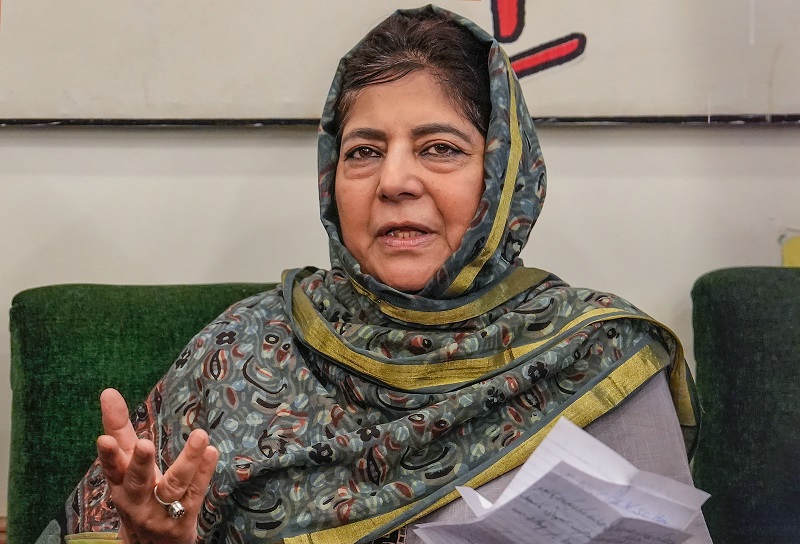
In a fresh escalation of the political battle in Jammu and Kashmir, Mehbooba Mufti has accused the Jammu & Kashmir National Conference (NC) of “political hypocrisy” over its criticism of liquor revenue policies, arguing that the party itself weakened J&K’s economic sovereignty by transferring major hydroelectric projects to the National Hydroelectric Power Corporation (NHPC).
The sharp remarks come amid an intensifying debate over the expansion of liquor vends and the growing dependence on excise revenue in the Union Territory. While NC leaders have recently questioned the government’s reliance on alcohol sales for revenue generation, Mehbooba Mufti countered by reviving a long-standing grievance in Kashmir politics: the transfer of J&K’s key hydropower assets to central control.
According to Mehbooba, the controversy is not merely about liquor policy. Instead, she framed it as a larger issue of “economic sovereignty, political consistency, and the right of Jammu and Kashmir over its natural resources.”
Mehbooba Mufti’s Core Argument: “Economic Sovereignty Was Compromised”
The former Chief Minister argued that the National Conference cannot claim moral authority on social issues like liquor expansion while remaining silent on what she described as the “historic surrender” of J&K’s most valuable revenue-generating assets.
Speaking in the backdrop of growing criticism over excise-driven policies, Mehbooba said the transfer of hydropower projects to NHPC deprived Jammu and Kashmir of sustainable long-term income that could have reduced dependence on liquor taxes and central financial assistance.
Her remarks directly targeted NC’s past governance decisions, particularly agreements that enabled NHPC to control and operate several strategically important hydroelectric projects in Jammu and Kashmir.
Political observers note that this line of attack allows the PDP to reposition itself as a defender of both economic autonomy and social conservatism, especially at a time when debates around identity, culture, and fiscal policy are deeply intertwined in Kashmir politics.
The Hydroelectric Projects at the Centre of the Controversy
Salal Hydroelectric Project (690 MW)
Critics have long argued that the project’s operational control under NHPC reduced J&K’s direct financial benefits while profits largely flowed to the Centre through the PSU structure.
According to analysts and former policymakers, local ownership of projects like Salal could have provided stronger fiscal independence and lower power tariffs for residents and industries.
Dulhasti Hydroelectric Project (390 MW)
The project has historically been projected as a symbol of untapped economic potential in the Chenab Valley. Critics of the transfer agreements argue that despite the region producing electricity, many local areas continued facing power shortages and limited industrial growth.
Mehbooba Mufti’s criticism seeks to revive public debate around whether J&K received adequate economic compensation from such arrangements.
Uri-I Hydroelectric Project (480 MW)

The project has often been central to discussions on resource ownership in Kashmir because of its ability to generate substantial annual power revenue. Political parties advocating greater regional autonomy have repeatedly argued that such assets should primarily benefit local development, employment generation, and industrial expansion.
For Mehbooba Mufti, the issue represents what she describes as a contradiction in NC’s current political messaging: criticizing liquor revenue while remaining associated with decisions that allegedly weakened J&K’s long-term revenue base.
Liquor Revenue Debate: Why It Has Become Politically Explosive
Excise Revenue vs Social Costs
The ongoing liquor policy debate has become increasingly sensitive in Jammu and Kashmir, particularly in the Kashmir Valley where alcohol consumption faces strong cultural and religious opposition.
Government revenue figures indicate that Jammu contributes the overwhelming share of liquor excise collections, while Kashmir’s contribution remains comparatively low.
Estimated Annual Liquor Revenue
| Region | Estimated Revenue |
|---|---|
| Jammu | ₹2,740 crore |
| Kashmir Valley | ₹260 crore |
| Total | ~₹3,000 crore |
NC leaders and several social groups have criticized the increasing dependence on excise revenue, arguing that aggressive expansion of liquor vends could trigger social consequences including addiction, domestic distress, debt, and public health problems.
However, Mehbooba Mufti has attempted to turn that criticism back on the NC by arguing that the Union Territory would not need to depend heavily on liquor taxes if its hydroelectric resources had remained under stronger local control.
Hydro Revenue vs Liquor Revenue: The Bigger Economic Question
Could Hydropower Have Replaced Excise Dependence?
Economic analysts and political commentators frequently argue that Jammu and Kashmir possesses enough hydropower potential to become one of India’s strongest energy economies.
Estimated Annual Revenue Potential from Key Hydroelectric Projects
| Project | Estimated Annual Revenue |
|---|---|
| Salal | ~₹1,200 crore |
| Dulhasti | ~₹800 crore |
| Uri-I | ~₹1,000 crore |
| Other Projects | ~₹2,000–₹3,000 crore |
| Total Potential Hydro Revenue | ~₹5,000–₹6,000 crore |
These estimates have become central to the PDP’s political argument.
According to Mehbooba Mufti’s position, retaining greater control over hydroelectric assets could have enabled Jammu and Kashmir to:
- Reduce dependence on liquor excise
- Generate cleaner and sustainable revenue
- Lower electricity costs for residents
- Improve industrial development
- Strengthen fiscal autonomy
- Increase bargaining power with New Delhi
The comparison between “clean energy revenue” and “socially controversial excise income” has now become a powerful political narrative in the region.
Political Messaging: PDP vs NC Rivalry Intensifies
A Battle Over Consistency and Autonomy
The latest confrontation also reflects the broader rivalry between the PDP and NC over who represents the stronger voice for Jammu and Kashmir’s political and economic interests.
While NC has attempted to position itself as critical of socially harmful revenue models, the PDP is now accusing the party of inconsistency by revisiting older policy decisions linked to NHPC.
For the PDP, the issue helps revive its long-standing narrative around:
- Protection of J&K’s resources
- Greater economic autonomy
- Opposition to policies viewed as culturally damaging
- Fiscal self-reliance
For NC, however, the challenge lies in defending historical decisions that were often presented at the time as necessary for infrastructure investment and power sector development.
Political analysts believe the issue may resonate strongly among voters because it combines three emotionally powerful themes in Jammu and Kashmir:
- Economic rights
- Regional autonomy
- Cultural identity
Why the NHPC Debate Still Matters in Jammu & Kashmir
Resource Ownership Remains a Sensitive Issue
The hydropower debate has remained politically relevant for decades because electricity generation is seen not only as an economic asset but also as a symbol of regional ownership.
Many residents and political groups argue that despite generating large quantities of electricity, Jammu and Kashmir has historically struggled with:
- High winter power shortages
- Expensive electricity imports
- Limited industrialization
- Revenue dependency on the Centre
This contradiction frequently fuels demands for greater control over local natural resources.
The current political clash between Mehbooba Mufti and the National Conference has once again brought these unresolved questions back into public discourse.
Comparative Snapshot: Hydro Revenue vs Liquor Excise
| Revenue Source | Estimated Annual Value | Social/Economic Impact |
|---|---|---|
| Hydroelectric Projects | ₹5,000–₹6,000 crore | Clean energy, industrial growth, autonomy |
| Liquor Excise | ~₹3,000 crore | Social backlash, addiction concerns, cultural opposition |

