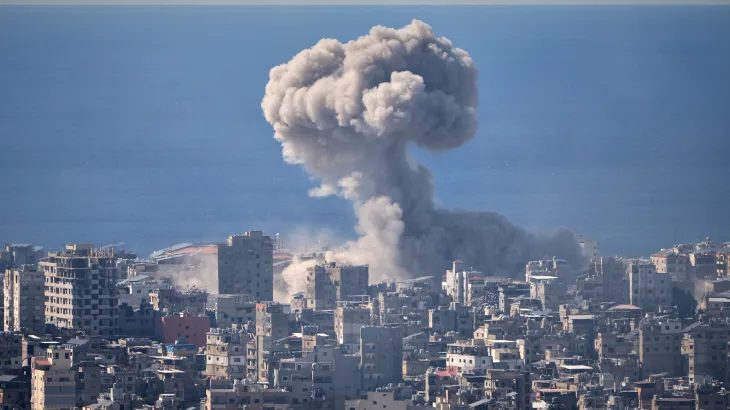
US Strikes Iran Drone Base in Bandar Abbas as Kuwait Intercepts Missiles, Gulf Tensions Push Oil Higher
By: Javid Amin | 01 June 2026
US Strikes Iranian Drone Hub, Kuwait Activates Air Defences as Gulf Crisis Enters Dangerous Phase
The fragile security situation across the Gulf has taken another dramatic turn after American forces launched fresh strikes against Iranian military assets near the strategically vital Strait of Hormuz, while Kuwait confirmed the interception of hostile drones and missiles over its airspace.
The developments mark one of the most serious escalations in recent weeks and have renewed fears that the broader US-Iran confrontation could pull more Gulf nations into an expanding regional conflict.
With oil markets reacting sharply and security alerts rising across the region, governments and investors alike are closely watching whether the latest round of military action will remain contained—or trigger a wider cycle of retaliation.
What Happened: US Forces Target Iranian Drone Operations
According to reports citing US military officials, American forces intercepted four Iranian one-way attack drones that were assessed as an immediate threat near the Strait of Hormuz. US Central Command also carried out a strike on a ground control facility in the southern Iranian port city of Bandar Abbas, preventing the launch of an additional drone.
Washington described the operation as a limited and defensive action designed to protect military personnel, commercial shipping routes, and regional stability. US officials argued that the drones posed an imminent threat to navigation and security in one of the world’s most important maritime corridors.
Bandar Abbas holds major strategic importance for Iran. Located near the Strait of Hormuz, the city serves as a critical military and naval hub for Iranian operations in the Gulf. Any military action in the area carries significant geopolitical implications because of its proximity to shipping lanes that handle roughly one-fifth of global oil trade.
Kuwait’s Air Defences Spring Into Action
Hours after the US operation, Kuwait’s military confirmed that its air defence systems had intercepted incoming hostile drones and missile threats.
Residents across Kuwait City reported hearing loud explosions overnight, sparking concerns about possible strikes on civilian areas. However, the Kuwaiti Ministry of Defence clarified that the sounds were caused by successful interception operations carried out by national air defence systems. Authorities reported no immediate casualties or major damage.
Military spokespersons urged citizens and residents to follow official safety guidance and avoid spreading unverified information during the heightened security situation.
The latest incident underscores Kuwait’s growing role as a frontline state in the regional security environment. The country hosts important US military facilities, making it particularly vulnerable during periods of escalating confrontation between Washington and Tehran.
Iran Signals Retaliation
Iranian officials and media outlets quickly condemned the American strike near Bandar Abbas, describing it as an act of aggression.
Reports indicate that Iranian authorities claimed retaliatory strikes against US military installations in the region following the attack. While details remain limited and independent verification is still developing, the rhetoric from Tehran suggests that Iranian leadership intends to demonstrate that attacks on its military infrastructure will not go unanswered.
The response is consistent with the approach adopted by Iran’s Islamic Revolutionary Guard Corps (IRGC) during previous confrontations, where calibrated military responses have often been used to signal resolve while avoiding a full-scale war.
However, analysts warn that repeated exchanges increase the risk of miscalculation. A single strike causing significant casualties could rapidly push both sides toward a broader military confrontation.
Why the Strait of Hormuz Matters to the Entire World
At the heart of the crisis lies the Strait of Hormuz—a narrow waterway connecting the Persian Gulf to international markets.
The route is one of the world’s most critical energy chokepoints. A significant share of global crude oil and liquefied natural gas shipments passes through the strait every day. Any disruption immediately impacts energy markets, shipping insurance costs, and global inflation expectations.
Recent months have seen repeated tensions surrounding commercial navigation in the area. Negotiations involving regional actors, including Oman, have attempted to stabilize maritime traffic and reduce the risk of accidental clashes.
Yet diplomatic progress remains fragile. Conflicting positions between Tehran and Washington continue to complicate efforts to establish a lasting framework for safe passage through the strait.
Oil Prices Jump as Markets React
Financial markets responded almost immediately to the renewed tensions.
Brent crude prices climbed sharply as traders priced in the growing possibility of supply disruptions in the Gulf. Energy markets remain highly sensitive to any threat involving the Strait of Hormuz because even temporary interruptions can affect global supply chains.
Investors fear that continued military activity could delay the normalization of shipping traffic, increase transportation costs, and reduce available exports from major oil-producing nations.
Analysts note that geopolitical risk premiums have become a major driver of oil prices throughout the ongoing crisis, with markets reacting to every indication of military escalation or diplomatic breakdown.
For importing countries already dealing with inflation pressures, sustained increases in oil prices could create additional economic challenges in the months ahead.
Kuwait Faces Growing Security Challenges
Kuwait’s successful interception of drones and missiles demonstrated the effectiveness of its air defence network, but security experts caution that continued attacks could test the country’s capabilities.
The nation occupies a sensitive position geographically and politically. It maintains close security ties with the United States while remaining within a region heavily influenced by Iran’s military and political reach.
Past months have already seen repeated air defence activations and interception operations over Kuwaiti territory, highlighting the persistent security threat posed by regional instability.
If retaliatory attacks expand, Kuwait may increasingly find itself caught between competing regional powers despite efforts to avoid direct involvement.
Gulf Nations Fear a Wider Regional Conflict
Across the Gulf, governments are increasingly concerned that the latest exchange could trigger a broader escalation.
Regional leaders have repeatedly called for restraint, aware that any prolonged conflict could threaten economic growth, foreign investment, energy exports, and civilian safety.
Security officials are particularly worried about the possibility of attacks on military installations, energy infrastructure, ports, and commercial shipping routes. Such targets have become central to modern regional warfare because they can generate significant economic pressure without necessarily requiring large-scale troop deployments.
The situation remains highly fluid, and diplomatic channels are expected to remain active as international actors seek to prevent another major conflict in the Middle East.
Key Developments at a Glance
| Event | Details | Strategic Impact |
|---|---|---|
| US Military Operation | Four Iranian attack drones intercepted near Hormuz | Reduced immediate threat to shipping and military assets |
| Bandar Abbas Strike | Drone control facility targeted before additional launch | Increased tensions with Tehran |
| Kuwait Air Defence Response | Missiles and drones intercepted over Kuwaiti airspace | Prevented civilian and infrastructure damage |
| Iranian Retaliation Claims | Tehran says it targeted US military facilities | Raises escalation risks |
| Oil Market Reaction | Brent crude moved higher amid supply concerns | Global economic implications |
What Happens Next?
The coming days could prove decisive.
If both Washington and Tehran limit their actions to symbolic military responses, diplomatic efforts may still succeed in preventing a wider war. However, continued attacks on military facilities, shipping routes, or Gulf states could rapidly escalate the crisis.
Three major risks now dominate strategic calculations:
1. Escalation Spiral
Each retaliatory strike increases the chance of miscalculation, drawing additional countries into the conflict.
2. Energy Security Threat
Any disruption in the Strait of Hormuz could impact global oil supplies, pushing prices higher and affecting economies worldwide.
3. Civilian Safety Concerns
While Kuwait’s interception systems have so far prevented major damage, prolonged military exchanges raise the risk of casualties and infrastructure disruptions.
For now, the Gulf remains on high alert. The latest strikes have demonstrated how quickly tensions can reignite around one of the world’s most strategically important waterways—and why the consequences extend far beyond the Middle East.

