Farooq Abdullah Calls for Dialogue on Kashmir, Says Post-Article 370 Promises Remain Unfulfilled
By: Javid Amin | 30 May 2026
NC Chief Says Peace, Trust and Political Engagement Cannot Be Replaced by Administrative Measures Alone
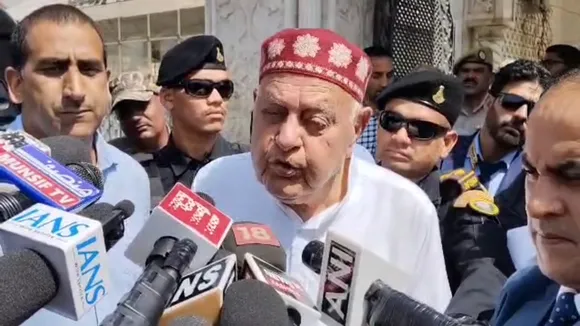
More than six years after the abrogation of Article 370, veteran Kashmiri leader and former Jammu & Kashmir Chief Minister Farooq Abdullah has once again put dialogue at the centre of the political conversation.
The National Conference president has renewed his appeal to New Delhi to engage with stakeholders in Jammu & Kashmir, arguing that many of the promises made after the August 5, 2019 constitutional changes have yet to translate into tangible improvements on the ground. His remarks come amid continuing debates over governance, statehood, political representation and public trust in the Union Territory.
For Abdullah, the issue is no longer confined to constitutional provisions alone. His argument reflects a broader concern: whether political stability can be achieved without meaningful political engagement.
The Core Message: Dialogue Remains the Missing Link
Abdullah’s latest intervention follows a series of statements over recent months in which he has repeatedly stressed the need for restoring political confidence in Jammu & Kashmir.
According to the National Conference leader, dialogue is essential not only between New Delhi and regional political parties but also among different stakeholders who hold varying perspectives on Kashmir’s future. He argues that sustainable peace cannot emerge solely through security measures or administrative restructuring; it requires political participation and trust-building.
His remarks echo a long-standing position maintained by the National Conference since the revocation of Article 370, namely that political issues require political solutions.
Six Years After Article 370: Has the Ground Reality Changed?
When the Centre revoked Article 370 and reorganised the erstwhile state into two Union Territories in August 2019, the move was presented as a historic step that would bring peace, development, investment and integration.
Supporters of the decision argued that the constitutional change would remove barriers to growth, attract private investment and strengthen governance.
However, Abdullah contends that the expected transformation has not materialised in the manner promised.
The Development Debate
One of the central claims made by critics of the post-2019 framework is that economic expectations have outpaced visible outcomes.
While infrastructure projects, road connectivity initiatives and tourism-related investments have expanded in several areas, critics argue that unemployment, economic uncertainty and limited private-sector growth continue to remain major concerns for many residents.
Abdullah and other regional leaders maintain that development cannot be measured solely through infrastructure indicators. They argue that political confidence and public participation are equally important components of long-term stability.
The Question of Democratic Deficit
Perhaps the most significant aspect of Abdullah’s argument concerns what he describes as a growing democratic deficit.
Since 2019, many regional political leaders have repeatedly raised concerns about the shrinking space for political engagement and consultation. The demand for restoration of full statehood remains a central issue in Jammu & Kashmir’s political discourse.
Abdullah has consistently argued that elected institutions need greater authority and autonomy to address public concerns effectively. He has also criticised delays in restoring statehood, saying political uncertainty continues to affect governance and public confidence.
For many observers, the statehood debate has become symbolic of a larger question: how much political authority should local democratic institutions exercise in Jammu & Kashmir?
Why Abdullah’s Statement Matters Beyond Party Politics
Farooq Abdullah’s remarks are significant not simply because they come from a senior political leader, but because they reflect a broader conversation taking place across sections of Kashmiri society.
The demand for dialogue has increasingly been echoed by multiple voices across the political spectrum.
Recently, chief cleric and Hurriyat leader Mirwaiz Umar Farooq emphasised that dialogue remains the most effective path towards peace and coexistence, arguing that force and confrontation cannot create lasting solutions.
Similarly, People’s Democratic Party president Mehbooba Mufti has repeatedly criticised restrictions on political and religious activities while calling for greater democratic engagement.
Although these leaders differ significantly in their political approaches, their recent statements reveal a common theme: the belief that political dialogue remains essential for reconciliation.
The Growing Disconnect Between Promises and Perceptions
One of the most challenging realities in post-2019 Jammu & Kashmir is the gap between official narratives and public perceptions.
The government has highlighted improvements in tourism numbers, infrastructure development and security indicators as evidence of progress.
Critics, however, argue that these achievements have not fully addressed deeper concerns surrounding identity, representation and political participation.
This disconnect is increasingly shaping public discourse.
Online discussions, public debates and political commentary often reveal mixed reactions. While some residents believe the constitutional changes have strengthened integration with the rest of India, others continue to question whether the promised economic and social benefits have arrived at the scale originally projected.
The divergence in perceptions illustrates why the debate around Article 370 remains politically relevant even years after its abrogation.
The Risks of Continued Political Stalemate
Political analysts warn that prolonged disengagement carries several risks.
1. Deepening Alienation
A continued absence of meaningful dialogue could widen the psychological and political distance between institutions and citizens.
When people feel excluded from decision-making processes, trust in governance structures can weaken.
2. Crisis of Mainstream Politics
Repeated calls for engagement without visible outcomes may also undermine mainstream political parties.
Leaders who advocate dialogue risk being viewed as ineffective if their appeals consistently fail to produce substantive responses.
3. Generational Impact
Young Kashmiris who have grown up largely in the post-2019 environment are experiencing politics differently from previous generations.
A prolonged lack of political participation could create a generation increasingly disconnected from democratic institutions and processes.
4. Long-Term Stability Concerns
While security management can address immediate challenges, most conflict-resolution experts argue that durable peace generally requires political reconciliation alongside economic development.
This remains one of the central themes behind Abdullah’s latest remarks.
Statehood, Article 370 and the Road Ahead
Farooq Abdullah has repeatedly maintained that the restoration of Article 370 remains a core objective of the National Conference and that the party will continue pursuing its political agenda through democratic means.
At the same time, the immediate political focus increasingly appears to be shifting towards statehood restoration and political engagement.
Whether New Delhi chooses to expand dialogue mechanisms remains uncertain. However, Abdullah’s latest statement underscores a reality that continues to shape Kashmir’s political landscape: constitutional changes alone have not ended the debate about representation, identity and governance.
Political Significance: More Than a Routine Statement
Farooq Abdullah’s appeal is not merely another political remark in an already crowded debate.
It reflects a deeper concern shared by many political actors in Jammu & Kashmir — that peace cannot be sustained through administrative measures alone and that democratic legitimacy requires continuous engagement.
As discussions around statehood, governance and political rights continue, Abdullah’s call serves as a reminder that the Kashmir question remains as much about trust and participation as it is about policy.
Six years after Article 370 was revoked, the central challenge remains unchanged: whether meaningful dialogue can bridge the gap between political promises and public expectations.
Key Takeaway
Farooq Abdullah’s renewed demand for dialogue highlights a persistent reality in Jammu & Kashmir. While the constitutional landscape changed dramatically in 2019, debates over political representation, statehood, democratic participation and public trust continue to dominate the region’s discourse. His remarks, reinforced by similar concerns raised by Mirwaiz Umar Farooq and Mehbooba Mufti, suggest that for many stakeholders, dialogue remains the missing component in Kashmir’s post-Article 370 journey.