Eid-ul-Adha 2026 in India: Fear, Restrictions and a Festival Under Surveillance
By: Javid Amin | 27 May 2026
As Muslims across India observed Eid-ul-Adha in May 2026, the festival arrived not with its usual atmosphere of joy, sacrifice and community bonding, but under the shadow of heightened restrictions, police surveillance, economic hardship and growing anxiety.
From Uttar Pradesh and Delhi to Rajasthan, Haryana and parts of Maharashtra, authorities imposed strict controls on public prayers, animal transport and sacrificial practices. Governments defended the measures as necessary for maintaining law and order, public hygiene and animal welfare. However, many Muslim organizations, civil society activists and opposition leaders described the developments as part of a broader climate of fear and shrinking religious freedoms.
In several regions, Eid celebrations remained visibly subdued. Livestock markets reported poor sales, mosque committees issued cautionary advisories, and families quietly scaled down traditional celebrations to avoid unwanted attention.
The atmosphere reflected not merely administrative caution, but a deeper socio-political reality shaping Muslim life in India in 2026.
A Festival Traditionally Rooted in Sacrifice and Charity
Eid-ul-Adha, also known as Bakrid, is one of the most significant festivals in Islam. It commemorates the willingness of Prophet Ibrahim to sacrifice what was most precious to him in obedience to God. The festival emphasizes sacrifice, compassion, charity and community solidarity.
Traditionally, families gather for prayers, distribute meat among relatives and the poor, and participate in public celebrations filled with warmth and festivity.
But this year, in many Indian cities and towns, the public mood appeared restrained.
In several Muslim-majority localities, residents reported avoiding loud celebrations, limiting outdoor gatherings and refraining from recording videos or social media posts linked to sacrifices or prayers. Mosque committees in some areas reportedly instructed worshippers to disperse quickly after prayers and avoid congregating outside Eidgahs.
For many families, the concern was not just about official restrictions, but the unpredictability of local tensions.
Animal Sacrifice Restrictions Intensify Across States
The most visible restrictions this Eid revolved around animal sacrifice and transportation.
Authorities in several states reiterated bans on cow slaughter, which already exists under various state laws, while also tightening scrutiny on camel slaughter and livestock transport. Goats and sheep were permitted only at authorized slaughter points in many districts.
Police and municipal authorities carried out inspections of livestock markets and temporary holding spaces ahead of Eid. Highway checks increased sharply in northern states, especially along routes commonly used by livestock transporters.
In Uttar Pradesh and Delhi, officials warned of strict legal action against unauthorized slaughter, illegal transport of animals and violations of municipal regulations. Local administrations also monitored waste disposal and sanitation arrangements near slaughter areas.
While governments framed the steps as preventive and administrative, traders and transporters described the situation as deeply intimidating.
Many livestock vendors reported significant drops in sales compared to previous years. Some traders alleged that transporters avoided long-distance movement out of fear of harassment, confiscation or attacks by vigilante groups.
As a result, numerous families opted for smaller sacrifices or pooled resources collectively instead of purchasing larger animals.
Vigilantism and the Fear Along Highways
Beyond official enforcement, the fear of vigilante action remained one of the most sensitive issues during Eid-ul-Adha 2026.
In multiple northern states, animal protection groups and self-styled cow vigilantes were reportedly active along highways and transport corridors during the days leading up to Eid. Videos circulating on social media showed vehicles carrying livestock being stopped and questioned in some areas, though authorities repeatedly urged citizens not to take the law into their own hands.
For many transporters and traders, however, memories of previous incidents of mob violence and harassment remained fresh.
Muslim community members in several regions privately described the atmosphere as tense and unpredictable. Some families deliberately avoided visible transportation of sacrificial animals through mixed neighborhoods, preferring late-night movement or local purchases.
The fear was often less about formal law and more about social vulnerability.
Human rights activists and opposition voices argued that unchecked vigilantism creates a chilling effect on constitutional freedoms and deepens communal mistrust. Government supporters, meanwhile, maintained that strict monitoring was necessary to prevent illegal slaughter and communal flare-ups.
The divide once again exposed the widening polarization surrounding religious practices and identity politics in contemporary India.
Public Namaz Restrictions Spark Debate
Restrictions on Eid prayers became another major flashpoint this year.
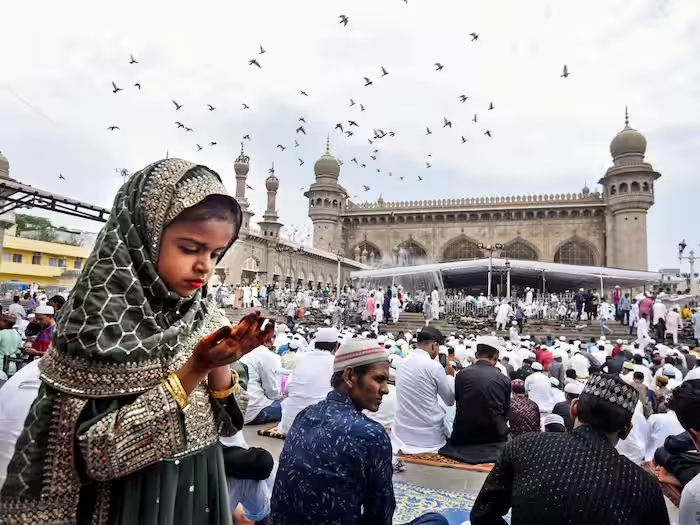
Authorities in Uttar Pradesh directed that Eid prayers should be conducted only within designated mosques and Eidgahs, prohibiting prayers on roads, parks or open public spaces. Similar advisories emerged in parts of Delhi, Haryana and other states.
Officials argued that such measures were aimed at preventing traffic disruptions, maintaining public order and avoiding communal tensions.
Police deployments around sensitive areas increased significantly on Eid day. Barricades, surveillance teams and drone monitoring were reportedly used in several urban centers.
Mosque committees responded by organizing prayers in multiple shifts to manage crowd sizes. In some places, worshippers were advised to arrive early, avoid parking congestion and leave immediately after prayers concluded.
Critics argued that the restrictions disproportionately affected Muslims because many localities lack sufficient mosque capacity for large Eid congregations. Civil liberties advocates questioned whether blanket bans on open-air prayers undermined constitutional guarantees related to religious practice.
Supporters of the restrictions countered that public spaces should remain neutral and that similar rules apply to all communities regarding unauthorized gatherings.
The debate quickly evolved into a wider political and constitutional discussion about religious visibility in public life.
Economic Hardship Adds to the Gloom
Beyond politics and policing, economic realities also shaped Eid-ul-Adha 2026.
Inflation, rising food prices and stagnant household incomes had already weakened consumer spending before the festival season began. Traders in Srinagar, Delhi, Lucknow, Patna and Mumbai reported lower footfall in markets compared to previous years.
Apparel sellers, footwear dealers and livestock traders described sluggish business conditions during what is usually one of the busiest commercial periods for Muslim communities.
In Kashmir, where Eid markets traditionally remain crowded late into the night, shopkeepers reported subdued activity. Families prioritized essential purchases over festive spending.
Many households reduced the scale of celebrations altogether, choosing modest meals and smaller gatherings rather than elaborate festivities.
The economic slowdown amplified the emotional weight of the restrictions already being felt on the ground.
Eviction Notices and Local Crackdowns Raise Anxiety
Reports from some towns indicated that local authorities issued notices against unauthorized animal shelters, temporary livestock holding areas and informal prayer spaces ahead of Eid.
Municipal officials maintained that the actions were aimed at maintaining sanitation and enforcing civic regulations. However, community organizations viewed the timing of such drives as particularly sensitive.
In densely populated urban areas, the crackdown created additional logistical problems for families arranging sacrificial rituals.
Civil society observers warned that aggressive enforcement during religious festivals risks deepening alienation and mistrust between communities and local administrations.
Political Battle Over Bakrid Restrictions
Opposition parties strongly criticized the handling of Eid-ul-Adha arrangements in several states, accusing ruling governments of transforming a religious festival into a law-and-order spectacle.
Leaders from opposition blocs argued that selective enforcement and hyper-visible policing contributed to fear among minorities. Some also accused authorities of allowing vigilante narratives to shape public policy indirectly.
Ruling party leaders rejected those allegations, insisting that the measures were administrative, legal and necessary for maintaining peace.
They argued that animal slaughter laws, traffic regulations and public safety rules must apply uniformly irrespective of religion.
The political confrontation reflected the larger ideological divide dominating Indian politics: one side framing restrictions as governance and legality, the other seeing them as symbolic marginalization.
Kashmir, Bihar and Maharashtra Report Muted Celebrations
Several states witnessed notably restrained Eid celebrations.
In Kashmir, economic strain and wider uncertainty reportedly dampened festive enthusiasm despite large prayer gatherings in major mosques and shrines.
In parts of Bihar and Maharashtra, residents spoke of quieter celebrations and reduced public visibility compared to earlier years.
Community elders in some cities urged restraint and calm, emphasizing peace, charity and social responsibility amid rising tensions.
The emotional character of the festival this year appeared shaped as much by caution as by celebration.
Timeline: Eid-ul-Adha Restrictions Across India — May 2026
Early May 2026
- States including Uttar Pradesh, Delhi and Rajasthan intensified checks on livestock transport.
- Restrictions on cow and camel slaughter reiterated ahead of Eid.
- Highway monitoring increased in sensitive districts.
Mid-May 2026
- Public advisories issued restricting Eid prayers to mosques and Eidgahs.
- Police departments warned against road prayers and unauthorized gatherings.
- Surveillance and deployment plans finalized in major cities.
Late May 2026 — Eid Eve
- Livestock markets reported weak sales and lower customer turnout.
- Fear among transporters increased amid reports of vigilante activity.
- Notices issued in some towns regarding unauthorized shelters and prayer sites.
Eid Days — May 26–27, 2026
- Heavy police deployment witnessed in several cities.
- Prayers remained largely confined to designated spaces.
- Protests and criticism emerged in parts of Uttar Pradesh and Delhi.
- Muted celebrations reported from Kashmir, Bihar and Maharashtra.
The Larger Question: Security or Shrinking Space?
The events surrounding Eid-ul-Adha 2026 highlight a broader national debate about religion, public space, identity and state power in India.
For governments, the emphasis remains on law enforcement, public order and regulatory compliance.
For many Muslims and civil liberties advocates, however, the cumulative effect of restrictions, surveillance and vigilante pressure has created a growing perception of exclusion and insecurity.
The result is a festival increasingly shaped by caution rather than collective joy.
At its core, Eid-ul-Adha symbolizes sacrifice, compassion and community welfare. Yet in many parts of India this year, the dominant public emotions surrounding the festival appeared to be restraint, uncertainty and fear.
How India balances security concerns with constitutional freedoms and communal harmony may continue to define not only future festivals, but the broader social fabric of the country itself.


