US Launches Fresh Strikes on Iran as Gulf Crisis Enters Dangerous New Phase
By: Javid Amin | 14 July 2026
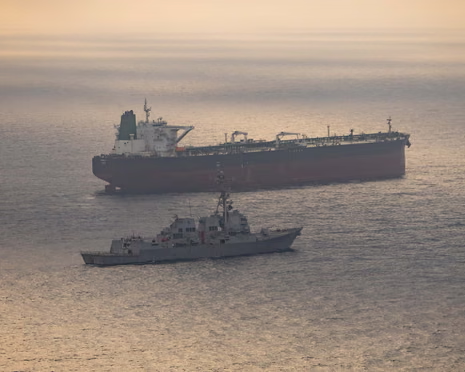
The military confrontation between the United States and Iran has intensified dramatically, pushing the Middle East closer to a wider regional conflict. In one of the most significant escalations in recent weeks, U.S. forces launched another round of coordinated air and missile strikes against Iranian military infrastructure after Iranian missiles reportedly struck two UAE oil tankers in the Strait of Hormuz.
The latest exchange of attacks underscores the growing volatility in one of the world’s most strategically important waterways, raising concerns over global energy security, commercial shipping, and the possibility of broader international military involvement.
Analysts warn that with diplomacy stalled and both sides continuing military operations, the crisis has entered an increasingly unpredictable phase.
US Targets Iranian Military Infrastructure
According to U.S. Central Command and multiple international reports, American fighter aircraft, naval vessels and long-range precision weapons carried out fresh strikes against Iranian military positions along the country’s southern coastline.
The operation reportedly focused on:
- Iranian radar installations
- Coastal air-defense systems
- Drone launch facilities
- Military command infrastructure supporting operations around the Strait of Hormuz
Washington said the strikes were intended to reduce Iran’s capability to threaten international commercial shipping following repeated attacks on vessels transiting the strategic waterway.
Military analysts note that these strikes are part of a broader effort to secure international shipping lanes rather than a full-scale invasion, although the repeated military exchanges significantly increase the risk of unintended escalation.
UAE Confirms Missile Strike on Two Oil Tankers
One of the most alarming developments came after the United Arab Emirates confirmed that two Emirati oil tankers were struck by Iranian cruise missiles while transiting the southern Strait of Hormuz in Omani territorial waters.
Authorities reported that:
- Both vessels sustained significant damage.
- One Indian crew member was killed and several others were injured, according to the UAE Ministry of Defence.
- Emergency rescue teams evacuated surviving crew members.
- The ships remained afloat despite the damage.
The incident marks one of the most serious direct attacks on Gulf commercial shipping in recent months and has heightened concerns over the safety of one of the world’s busiest maritime trade corridors.
Iran Condemns US Offensive
Iran strongly condemned the American strikes, describing them as an act of aggression and a violation of its sovereignty.
Iranian officials warned that any further attacks would be met with a stronger military response, while state media asserted that Iranian forces would continue to defend the country’s territorial waters and strategic interests in the Gulf.
The exchange highlights the collapse of earlier efforts to reduce tensions through indirect negotiations.
Why the Strait of Hormuz Matters
The Strait of Hormuz remains one of the world’s most critical energy chokepoints.
Located between Iran and Oman, the narrow passage connects the Persian Gulf with the Gulf of Oman and the Arabian Sea.
Key Facts
- Nearly 20% of global oil shipments pass through the Strait of Hormuz.
- Millions of barrels of crude oil and LNG move through the route every day.
- Major exporters including Saudi Arabia, the UAE, Kuwait, Iraq and Qatar depend on the passage.
- Any disruption immediately affects international shipping costs and global energy prices.
Because of its strategic importance, even limited military incidents can have worldwide economic consequences.
Oil Markets React to Rising Tensions
Energy markets reacted quickly as investors assessed the growing geopolitical risks.
Concerns over possible shipping disruptions and supply shortages pushed crude oil prices higher while increasing volatility across financial markets. Analysts cautioned that prolonged instability around the Strait of Hormuz could further tighten global energy supplies.
Higher oil prices could eventually translate into:
- Increased fuel prices
- Higher transportation costs
- Rising inflation
- Greater pressure on energy-importing economies
Maritime Security Concerns Intensify
International shipping companies are closely monitoring developments in the Gulf.
The latest attacks may prompt:
- Diversion of commercial shipping routes
- Higher marine insurance premiums
- Increased naval escorts for merchant vessels
- Delays in global supply chains
Several international naval forces are already maintaining a significant presence in the region to safeguard commercial traffic, and additional deployments remain a possibility if attacks continue.
Diplomatic Efforts Face Fresh Setback
The renewed military exchanges have further weakened hopes for an immediate diplomatic breakthrough.
Recent attempts to restore negotiations between Washington and Tehran have stalled amid continued attacks on shipping and retaliatory military operations. Regional governments continue urging restraint, warning that prolonged conflict could destabilize the wider Middle East and threaten international trade.
Regional Impact at a Glance
| Aspect | Latest Development | Potential Impact |
|---|---|---|
| US Military Operations | Fresh strikes on Iranian military infrastructure | Higher risk of direct confrontation |
| UAE Tanker Incident | Two oil tankers struck by Iranian missiles | Maritime security concerns intensify |
| Iran’s Response | Strong condemnation and retaliation warning | Escalation remains likely |
| Strait of Hormuz | Strategic shipping lane under threat | Global energy supplies at risk |
| Oil Markets | Prices rise amid supply concerns | Inflationary pressure worldwide |
Strategic Outlook
Security experts believe the Strait of Hormuz is becoming the central flashpoint in the latest phase of the U.S.-Iran confrontation.
While Washington says its operations are designed to protect freedom of navigation, Tehran argues that foreign military activity in the Gulf threatens regional stability. The missile attack on UAE oil tankers and the subsequent U.S. strikes have increased fears that further incidents could draw additional regional and international actors into the conflict.
Although diplomatic channels remain open in principle, the current trajectory points toward continued military posturing unless meaningful negotiations resume. For now, governments, shipping companies, and global energy markets remain on high alert as one of the world’s most critical maritime corridors faces renewed uncertainty.