August 5 ‘Black Day’: Altaf Bukhari Puts Article 370 and J&K Statehood Back at Centre of Political Debate
By: Javid Amin | 29 July 2026
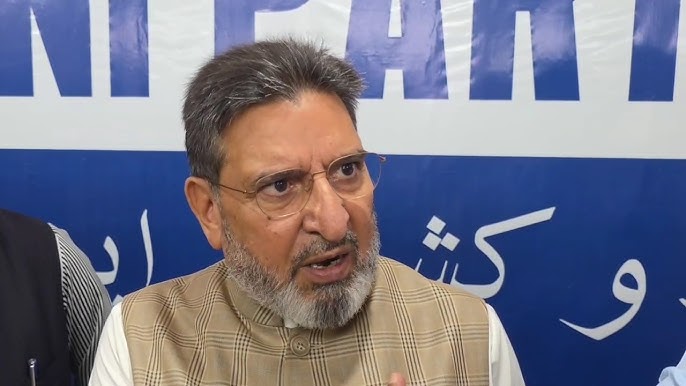
August 5 is once again emerging as a politically charged date in Jammu and Kashmir, with Apni Party president Altaf Bukhari describing the day as a “black day” and reaffirming his party’s commitment to the restoration of Article 370 and full statehood to Jammu and Kashmir.
Bukhari’s remarks add another layer to an increasingly active political debate in J&K, where different opposition parties are pursuing distinct strategies on the constitutional and political issues that have dominated the region since the changes of August 2019.
The National Conference (NC) has placed restoration of statehood at the forefront of its current political campaign. The People’s Democratic Party (PDP) continues to insist that the restoration of Article 370 and Article 35A must remain central to the political discourse. The Jammu and Kashmir People’s Conference (JKPC) has also argued for a political response to the post-2019 changes, including the importance of the elected Assembly’s position on Article 370.
Against this backdrop, Bukhari’s latest statement attempts to position the Apni Party around a dual demand: restoration of Jammu and Kashmir’s statehood as well as a reversal of the constitutional changes associated with Article 370.
The message is politically significant because the Apni Party has traditionally sought to distinguish itself from the region’s older political formations through an approach that emphasises development, governance and engagement with New Delhi. Yet on the question of Article 370 and statehood, Bukhari’s latest position places the party firmly within the broader debate over Jammu and Kashmir’s constitutional future.
Why August 5 Remains a Defining Date in Jammu and Kashmir
For Jammu and Kashmir’s political parties, August 5 is much more than an anniversary.
On August 5, 2019, the Union government announced a series of constitutional measures that effectively ended Jammu and Kashmir’s special status under Article 370. The former state was subsequently reorganised into the Union Territories of Jammu and Kashmir and Ladakh.
The move fundamentally changed the region’s constitutional, administrative and political structure.
For supporters of the government’s decision, the changes represented greater integration with the Indian Union and opened the way for the extension of laws and constitutional provisions applicable elsewhere in the country.
For parties opposing the move, August 5 marked the loss of Jammu and Kashmir’s special constitutional position and a major alteration in the relationship between the region and New Delhi.
That divide continues to shape political discourse.
The Supreme Court, in December 2023, upheld the Union government’s decision on Article 370 and directed that statehood be restored to Jammu and Kashmir at the earliest.
However, the legal conclusion did not end the political debate.
Instead, it created two parallel political conversations—one focused on restoration of statehood, and the other on the broader question of Article 370 and the constitutional changes of 2019.
Bukhari’s latest statement brings both questions together.
Altaf Bukhari’s Message: Article 370 and Statehood Cannot Be Separated
The central message emerging from Bukhari’s position is that the Apni Party does not view the restoration of statehood as an adequate substitute for the constitutional safeguards associated with Article 370.
This distinction is politically important.
The NC has increasingly made statehood the most immediate and achievable demand around which opposition parties can potentially unite.
The PDP, meanwhile, has argued that the political debate cannot be reduced to statehood alone.
Bukhari’s position appears to occupy a space between these approaches.
The Apni Party is demanding statehood, but at the same time maintaining that the political struggle must also include Article 370.
That gives the party a two-track political narrative:
- Statehood as an immediate democratic and administrative demand.
- Article 370 restoration as a larger constitutional and political objective.
By calling August 5 a “black day”, Bukhari has also attached a strong symbolic meaning to the date.
The terminology reflects the party’s opposition to the events of August 2019 and seeks to communicate that the political issue remains unresolved from the perspective of those demanding restoration.
Apni Party’s Position Marks a Shift in Political Optics
The Apni Party was formed in 2020, months after the abrogation of Article 370 and the reorganisation of Jammu and Kashmir.
From its early days, the party attempted to project itself as a pragmatic political alternative, emphasising governance, economic development, investment and engagement with the Union government.
That political positioning often differentiated it from the NC and PDP.
However, the Article 370 question has remained unavoidable in J&K politics.
The latest statement from Bukhari indicates that the Apni Party is seeking to establish a clearer political position on the issue.
By publicly committing to the restoration of both Article 370 and statehood, the party is attempting to demonstrate that pragmatic engagement with New Delhi does not mean accepting the permanent status quo created after August 2019.
This could be an important effort to redefine the Apni Party’s political identity.
The party appears to be saying that dialogue and development can coexist with a demand for constitutional restoration.
August 5 and the Emerging Opposition Divide
The political landscape in Jammu and Kashmir is increasingly defined by different interpretations of what should come first.
The parties broadly agree that the post-2019 political arrangement remains a major issue, but their priorities and methods differ.
| Party | Primary Political Position | August 5 Approach |
|---|---|---|
| Apni Party | Restoration of Article 370 and full statehood | Bukhari describes August 5 as a “black day” |
| National Conference | Immediate restoration of statehood; broader constitutional issues remain part of its political position | Focused recent campaign on statehood |
| PDP | Restoration of Article 370 and Article 35A as central demands | Called for protests across J&K on August 5 |
| JKPC | Political and constitutional response to the post-2019 changes | Has emphasised the role of the elected Assembly and opposed a statehood-only narrative |
The differences are not merely rhetorical.
They reflect competing calculations about what is politically achievable, what resonates with different constituencies and how the opposition should engage with New Delhi.
NC’s Statehood Campaign vs PDP’s Article 370 Push
The National Conference has increasingly sought to build a political campaign around statehood.
That strategy has an obvious advantage.
Statehood is a demand that can potentially unite a wider section of political opinion because it is linked to the restoration of Jammu and Kashmir’s status as a full-fledged state and the return of greater democratic autonomy to an elected government.
The PDP, on the other hand, believes that statehood alone does not address the fundamental constitutional changes introduced in 2019.
This difference became particularly visible around the NC’s Delhi protest, where the PDP did not join on the grounds that Article 370 restoration and the release of political prisoners should be part of the central agenda.
Bukhari’s latest remarks now add another voice to the debate.
While the Apni Party’s political approach has often differed from both the NC and PDP, its stated demand for both statehood and Article 370 restoration creates potential overlap with elements of the opposition’s broader agenda.
The question is whether that common ground can translate into political coordination.
The Bigger Question: Can Opposition Parties Find Common Ground?
The August 5 debate exposes a persistent challenge for Jammu and Kashmir’s opposition politics.
There is broad agreement among several regional parties that the political situation created after 2019 should not be treated as the final word on the region’s political future.
But there is no complete agreement on the roadmap.
One party may prioritise statehood.
Another may insist on Article 370.
A third may focus on constitutional safeguards, political detainees and civil liberties.
The differences become especially important when parties attempt to organise joint protests or build a common campaign.
For the opposition to present a united front, it would need to identify a minimum common programme.
That could potentially include:
- Restoration of statehood.
- Protection of democratic institutions.
- Greater political representation.
- Restoration of civil liberties.
- Review of detention-related policies.
- Continued political debate over Article 370.
However, the more ambitious the common agenda becomes, the harder it may be to build a unified platform.
This is where the political significance of Bukhari’s statement becomes clearer.
By explicitly linking statehood with Article 370, the Apni Party is effectively narrowing the distance between its position and that of other regional parties on at least one important question.
‘Black Day’ Politics: Symbolism Still Matters
Political symbolism carries unusual weight in Jammu and Kashmir.
August 5 has become a date around which competing narratives of the region’s political history are constructed.
For the Union government and its supporters, the 2019 changes are associated with constitutional integration and the extension of equal legal and constitutional provisions.
For opponents, the same date represents what they regard as the unilateral alteration of Jammu and Kashmir’s constitutional relationship with India.
Bukhari’s description of August 5 as a “black day” places the Apni Party firmly within the second narrative.
The language is emotionally powerful and politically deliberate.
It communicates to the party’s supporters that the events of 2019 remain a defining grievance and that the party does not intend to allow the issue to disappear from political discourse.
At the same time, the statement avoids presenting the party’s position as identical to that of every other opposition formation.
The Apni Party’s approach remains rooted in its own political identity and strategy.
What Does This Mean for New Delhi?
Bukhari’s statement also carries a message for the Union government.
The demand for restoration of statehood has been repeatedly raised by political parties in Jammu and Kashmir, and the Supreme Court’s 2023 judgment also directed that statehood be restored at the earliest.
The Article 370 question, however, occupies a different legal and political space following the Supreme Court’s ruling upholding the 2019 constitutional changes.
As a result, the two demands have different political trajectories.
Statehood remains a politically active issue with constitutional and administrative implications.
Article 370 restoration, meanwhile, remains a demand pursued by parties such as the PDP and now reiterated by Bukhari’s Apni Party, but faces a fundamentally different legal and constitutional reality.
This distinction is likely to remain central to the debate.
The more regional parties link the two issues, the greater the pressure on New Delhi to respond to them separately rather than treating statehood as the sole outstanding political question.
Public Sentiment: A Complex and Evolving Picture
It would be difficult to describe public opinion across the entire Jammu and Kashmir region as uniform.
Political attitudes differ between the Kashmir Valley and Jammu, and even within individual regions there are differences based on geography, age, political affiliation and local concerns.
For some sections of the population, Article 370 remains a deeply significant political issue.
For others, immediate concerns such as jobs, investment, development, statehood, administrative accountability and restoration of democratic institutions may carry greater weight.
This complexity is important for understanding the political significance of August 5.
A successful mobilisation cannot be measured solely by the strength of political rhetoric.
The real test will be whether parties can convert their demands into sustained public engagement and whether those demands influence future electoral politics.
Apni Party’s Political Challenge
For the Apni Party, Bukhari’s statement represents both an opportunity and a challenge.
The opportunity lies in differentiating the party from the NC and PDP while simultaneously moving closer to the broader regional demand for restoration of constitutional safeguards.
The challenge is to convince voters that the party’s strategy of pragmatic engagement with New Delhi can coexist with its demand for Article 370 restoration.
That balancing act will be crucial.
The party cannot simply repeat the positions of the NC or PDP if it wants to preserve its distinct political identity.
At the same time, if its position on Article 370 and statehood is seen as too close to the Centre’s established position, it risks losing political space among voters who remain opposed to the post-2019 changes.
Bukhari’s “black day” declaration can therefore be read as an attempt to address precisely that political space.
August 5 Could Become a Test of Opposition Politics
With the PDP calling for protests, the NC pursuing statehood, the JKPC pushing its own constitutional narrative and the Apni Party now publicly linking Article 370 restoration with statehood, August 5 could become an important test of opposition politics in Jammu and Kashmir.
The central question is not whether the parties agree that August 5 was politically significant.
They clearly do.
The question is whether they can agree on what should come next.
That is where the divisions remain.
A united opposition could potentially generate greater political pressure around statehood and democratic rights.
A fragmented opposition, however, may allow each party to maintain its own political identity while reducing the collective impact of the campaign.
The Road Ahead: August 5 Remains a Political Flashpoint
Seven years after the constitutional changes of 2019, August 5 continues to occupy a central place in Jammu and Kashmir’s political discourse.
Altaf Bukhari’s decision to call it a “black day” and reaffirm the Apni Party’s commitment to both Article 370 and statehood demonstrates that the issue remains politically relevant beyond the traditional NC-PDP divide.
The statement also reveals an important shift in the region’s political conversation.
The debate is no longer simply about whether Article 370 should be discussed.
It is increasingly about which political demand should take priority, how the opposition should campaign, and what constitutional future the region’s political parties envision.
For the Apni Party, Bukhari’s message is an attempt to establish a clear political identity: pragmatic in its method, but firm in its demand for restoration.
For the NC, statehood remains the most immediate political battle.
For the PDP, Article 370 remains the defining constitutional question.
And for the JKPC, the emphasis lies on maintaining a political and constitutional challenge to the post-2019 arrangement.
As August 5 approaches, these competing strategies are likely to shape the political conversation across Jammu and Kashmir.
The bigger question is whether the anniversary will produce greater opposition unity—or further expose the differences that have increasingly come to define the region’s post-2019 political landscape.
For now, one thing remains evident: August 5 is still far from being an ordinary date in Jammu and Kashmir’s political calendar. It remains a powerful symbol around which competing visions of the region’s constitutional future continue to collide.


