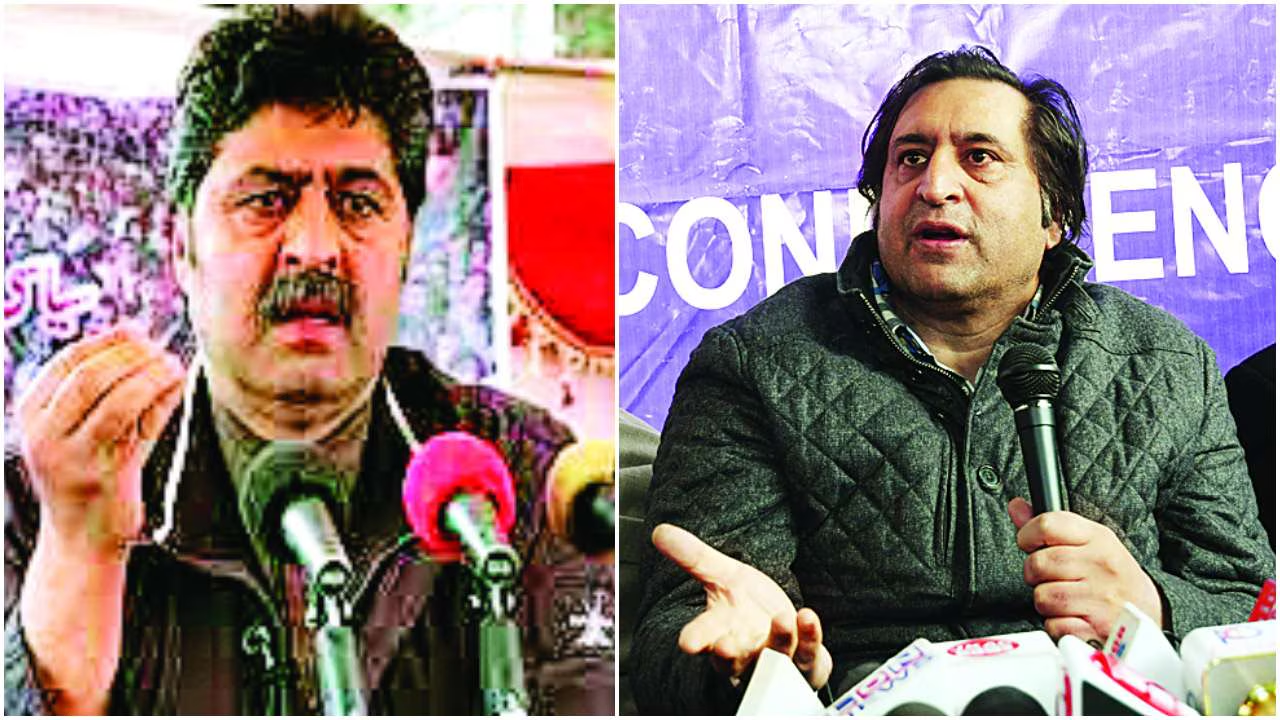
Bilal Gani Lone Joins Mainstream Politics, Challenges Sajjad Lone for Abdul Gani Lone’s Political Legacy in Kashmir
By: Javid Amin | 02 Aug 2026
Bilal Gani Lone’s Political Shift Opens a New Chapter in Kashmir Politics
In a significant political development for Jammu and Kashmir, former Hurriyat leader Bilal Gani Lone has formally stepped into mainstream politics, signalling the end of his long association with separatist politics. His public rally in Dard Hari village of Handwara in north Kashmir’s Kupwara district marked more than just a political gathering—it announced the beginning of a direct contest over one of Kashmir’s most influential political legacies.
By invoking the vision of his late father, Abdul Gani Lone, Bilal has positioned himself as the rightful political heir to a legacy that has shaped north Kashmir politics for decades. The move immediately places him in direct competition with his younger brother Sajjad Gani Lone, president of the People’s Conference and the sitting MLA from Handwara.
The development is being viewed as one of the most consequential realignments in Kashmir’s opposition politics ahead of future electoral contests.
A Symbolic Rally with a Strong Political Message
Bilal Lone’s first major public outreach after distancing himself from separatist politics was carefully planned.
Addressing supporters in Handwara, he spoke less about ideology and more about reconnecting with people, governance and safeguarding the interests of Jammu and Kashmir within the existing constitutional framework.
Rather than presenting himself as a newcomer, Bilal framed his political journey as a continuation of the vision championed by his father.
The location of the rally also carried political significance. Handwara has traditionally been the Lone family’s political stronghold and remains the core constituency of Sajjad Lone’s People’s Conference.
Political observers believe Bilal’s decision to begin his campaign from this region was a deliberate signal that he intends to compete for the same political space.
Who Was Abdul Gani Lone? Why His Legacy Still Matters
Abdul Gani Lone remains one of the most influential political figures in modern Kashmir’s history.
Originally a mainstream politician, he later became one of the founding leaders of the All Parties Hurriyat Conference (APHC) during the separatist movement in the 1990s. Over time, however, he was increasingly viewed as a moderate voice who favoured dialogue and political engagement over prolonged confrontation.
His assassination on May 21, 2002, during a public gathering in Srinagar shocked Kashmir and permanently altered the region’s political landscape.
More than two decades later, his political legacy continues to command respect across sections of Kashmiri society, making it a valuable political asset for both his sons.
Today, that legacy has become the centrepiece of an emerging political contest.
Bilal Lone Distances Himself from Hurriyat Politics
Bilal’s transition has not happened overnight.
Over the past few years, he has repeatedly indicated that the Hurriyat Conference had become politically irrelevant and ineffective.
He has publicly described the separatist platform as “non-functional,” arguing that it no longer reflects the aspirations or realities of present-day Kashmir.
In several public interactions, Bilal has also criticised Pakistan’s role in Kashmir politics, saying that external interference contributed to divisions among political groups and weakened indigenous political institutions.
These remarks represented a marked departure from traditional separatist positions and were widely interpreted as preparation for a mainstream political role.
His latest rally effectively formalizes that transition.
A Direct Challenge to Sajjad Lone
Perhaps the most striking aspect of Bilal’s political entry is that it creates an unprecedented contest within one of Kashmir’s best-known political families.
Sajjad Lone has spent years transforming the People’s Conference into a mainstream regional political party after his own departure from separatist politics in the early 2000s.
Today, he is among the Valley’s most recognised opposition leaders and continues to command considerable influence in north Kashmir.
Bilal’s arrival creates overlapping political identities:
Both claim Abdul Gani Lone’s political inheritance
Each projects himself as the true custodian of their father’s ideals and political philosophy.
Both appeal to the same electorate
The political battle is expected to be concentrated in Handwara and surrounding areas where the Lone family has traditionally enjoyed substantial support.
Both seek to represent moderate Kashmiri politics
While their political styles differ, both advocate engagement through democratic institutions rather than separatist mobilisation.
This overlap is likely to intensify electoral competition in north Kashmir.
Accepting Political Reality While Protecting Kashmiri Interests
One of Bilal Lone’s central messages has been that politics in Jammu and Kashmir has fundamentally changed since the constitutional changes of August 2019.
He urged people to acknowledge the current political realities while continuing to protect the region’s identity, dignity and developmental interests.
This approach attempts to balance pragmatism with regional aspirations.
Rather than revisiting old political positions, Bilal has projected governance, public participation and representation as the path forward.
That messaging may appeal to voters seeking practical political engagement rather than ideological confrontation.
How Bilal’s Entry Could Reshape North Kashmir Politics
Bilal Lone’s emergence could have implications beyond the Lone family.
1. Competition for Opposition Space
The People’s Conference has long occupied an important space within Kashmir’s opposition politics.
Bilal’s entry introduces another influential face capable of attracting sections of the same support base.
2. Vote Division in Handwara
If both brothers contest from overlapping political territories, the opposition vote may become fragmented.
Such a split could benefit rival political parties depending on constituency-level electoral arithmetic.
3. Declining Influence of Separatist Politics
Bilal’s mainstream shift adds to the broader decline of organised separatist politics in Jammu and Kashmir.
Several former separatist leaders have either withdrawn from public life or moved toward democratic participation, reflecting changing political dynamics in the Valley.
4. Revival of Family-Centric Politics
Political families have historically played an important role in Kashmir.
The Lone family’s internal contest could become one of the defining political narratives in north Kashmir over the coming years.
Challenges Before Bilal Lone
Despite the attention surrounding his political debut, Bilal faces several immediate challenges.
Winning Public Trust
Many voters will assess whether his shift represents a genuine ideological transformation or merely a strategic political decision.
Building an Organisational Network
Unlike established political parties, Bilal currently lacks a large grassroots organisational structure capable of sustaining long-term electoral campaigns.
Differentiating Himself from Sajjad Lone
Sharing the same family legacy makes it essential for Bilal to present a distinct political vision rather than relying solely on his father’s memory.
Expanding Beyond Symbolism
Public rallies generate headlines, but sustained political relevance will depend on consistent public engagement, organisational growth and electoral performance.
Political Analysis: A Family Contest with Wider Consequences
The contest between Bilal and Sajjad Lone is about much more than sibling rivalry.
It reflects the transformation of Kashmir’s political landscape, where former separatist leaders increasingly seek legitimacy through democratic participation instead of separatist platforms.
Bilal’s criticism of the Hurriyat and his acceptance of mainstream politics indicate how significantly political discourse has shifted in Jammu and Kashmir over recent years.
Whether he succeeds will depend on his ability to convert symbolic political capital into a credible electoral organisation capable of competing with established regional parties.
Fact Check & Ground Reality
- Bilal Gani Lone recently held a public rally in Dard Hari, Handwara (Kupwara district), signalling his formal entry into mainstream politics.
- He has publicly described the Hurriyat Conference as ineffective and has criticised Pakistan’s role in deepening political divisions in Jammu and Kashmir.
- Abdul Gani Lone, founder of the People’s Conference and later a senior Hurriyat leader, was assassinated on 21 May 2002 in Srinagar.
- Sajjad Gani Lone currently leads the People’s Conference and remains one of north Kashmir’s prominent mainstream political leaders.
- While Bilal has declared his political intentions, the long-term impact of his entry will depend on future electoral participation and organisational strength.
Conclusion
Bilal Gani Lone’s formal move into mainstream politics marks one of the most notable political shifts in Jammu and Kashmir in recent years. By claiming the legacy of Abdul Gani Lone and openly challenging the political dominance of his brother Sajjad Lone in Handwara, he has introduced a new dimension to north Kashmir’s political landscape.
His transition also reflects the broader evolution of Kashmir’s politics, where democratic participation is increasingly replacing separatist mobilisation as the principal avenue for political engagement. Whether Bilal can transform his symbolic entry into lasting political influence will depend on his ability to build public confidence, create a credible grassroots organisation and offer a distinct political vision beyond family legacy. As future elections approach, the Lone family’s internal contest is likely to become one of the Valley’s most closely watched political stories.


