Iran’s Mojtaba Khamenei Calls for Muslim Unity Against ‘Real Enemy’: What Tehran’s Message Means for West Asia
By: Javid Amin | 30 August 2026
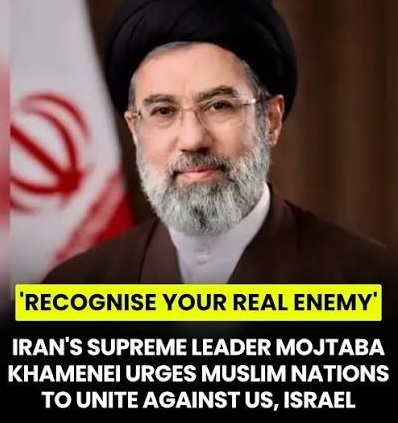
Iran’s Supreme Leader Mojtaba Khamenei has issued a pointed appeal to Muslim countries, particularly governments in West Asia and the Gulf, urging them to overcome internal divisions and confront what he described as the “real enemy.”
The message, released on August 30 during Islamic Unity Week, names the United States and Israel as enemies of Muslim unity and argues that greater cooperation, mutual defence and solidarity are essential if the Islamic world is to protect its interests. Khamenei also invoked the suffering of Palestinians, asking in effect whether the situation would have become so severe had Muslim countries been united.
On the surface, the statement sounds like another familiar expression of Iran’s long-standing resistance-oriented foreign policy. But the timing makes it more significant.
It comes as West Asia is undergoing a major security realignment, Iran’s relationship with its Gulf neighbours remains deeply strained, and Saudi Arabia, Türkiye and Pakistan have just created a new mutual-defence framework through the Mecca Joint Defence Agreement.
That makes Khamenei’s call for Muslim unity more than a rhetorical appeal. It can also be read as Tehran’s attempt to shape the emerging regional order before new alliances harden into permanent blocs.
What Did Mojtaba Khamenei Actually Say?
Khamenei’s August 30 message was issued to mark the birth anniversary of Prophet Muhammad and Islamic Unity Week. Iranian state-linked reporting published the full text, while his Telegram channel carried related material.
In the message, Khamenei presented Muslim unity as a central requirement for the future of the Islamic world. He called for cooperation in areas including security, economic activity, science and development and argued that Muslims should defend one another rather than allow internal disputes to weaken them.
His strongest language was directed at the rulers of Muslim countries, especially those in West Asia and the Persian Gulf.
He urged them to identify what he called their “real enemy”, understand its plans and confront it.
Khamenei explicitly identified the United States and Israel as enemies of Muslim unity. He also argued that those who encourage division within the Muslim community — whether deliberately or unintentionally — ultimately serve the interests of Islam’s adversaries.
The Palestinian issue was another important element.
Khamenei questioned whether Palestinians would have been left in such a vulnerable position if Muslim countries had acted together. That framing places Palestine at the centre of Tehran’s broader argument that Muslim states should develop greater political and strategic independence from Western powers.
The message in simple terms
Khamenei’s argument can essentially be reduced to four points:
- Muslim countries should overcome political and sectarian divisions.
- Gulf states should reconsider who represents their principal security threat.
- Muslim nations should cooperate in defence and other strategic sectors.
- Palestine should remain a central cause around which Muslim solidarity can be built.
But there is an important distinction between calling for unity and achieving political unity.
That distinction lies at the heart of the challenge facing Tehran.
Why Khamenei’s ‘Real Enemy’ Message Matters Now
The timing of the statement is particularly important.
Iran’s appeal comes at a moment when the traditional security architecture of West Asia is under considerable pressure. The region has seen direct confrontation involving Iran, the United States and Israel, while Gulf states have been forced to reconsider how much they can depend on outside military protection.
At the same time, countries that share religious and regional interests with Iran do not necessarily share Tehran’s strategic worldview.
Saudi Arabia, for example, has its own security priorities. Türkiye is a NATO member with longstanding ties to the West. Pakistan maintains deep relationships with both Gulf countries and major Western powers.
So while all three countries can support the broad idea of Muslim solidarity, that does not mean they are prepared to adopt Iran’s concept of regional resistance.
This is where Khamenei’s statement becomes strategically interesting.
He is not simply speaking to Muslim populations. He is also speaking to governments that are themselves constructing new security arrangements.
The Mecca Pact Changes the Strategic Context
The most important development surrounding Khamenei’s appeal is the Mecca Joint Defence Agreement, signed on August 7 by Saudi Arabia, Türkiye and Pakistan.
The agreement says that an armed attack against one of the three signatories will be regarded as an attack against all three. The pact also envisages deeper defence cooperation, joint mechanisms and greater coordination in security and defence industries.
The agreement has inevitably attracted comparisons with NATO’s collective-defence principle.
But calling it an “Islamic NATO” would be premature.
The three governments themselves have not formally presented the pact as an Islamic military bloc directed against Iran or any other particular country. Türkiye’s Foreign Minister Hakan Fidan specifically said that the agreement did not identify Iran, or another country, as a common threat. President Recep Tayyip Erdoğan also described it as a defensive arrangement open to other countries seeking regional stability.
That distinction matters.
Why?
Because the Mecca pact could represent two things at once.
First, it is a practical attempt by three Muslim-majority powers to strengthen their own security capabilities.
Second, it could eventually contribute to a broader regional security architecture that reduces dependence on traditional Western security guarantees.
The second possibility is particularly interesting for Iran.
Tehran has spent years arguing that regional countries should develop their own security mechanisms rather than relying on Washington.
Yet the emerging arrangement does not currently place Iran at its centre.
That creates a geopolitical paradox.
Iran is calling for Muslim unity at precisely the moment when other Muslim-majority powers are building a security framework without Tehran.
Is Iran Joining the Mecca Pact?
This is one area where the original summary needs particularly careful qualification.
Reports emerged in August that Iran may have been invited to join the Mecca defence arrangement. The claim was attributed to Mehdi Rahimi, head of Iran’s parliamentary news agency, and was subsequently reported by several outlets.
However, the Iranian Foreign Ministry later denied that Tehran had received an official invitation.
That means the claim should not be presented as an established fact.
As of the latest available reporting, the confirmed members are:
- Saudi Arabia
- Türkiye
- Pakistan
Iran is not a confirmed member of the Mecca Joint Defence Agreement.
There is also an important political contradiction here.
Türkiye, Saudi Arabia and Pakistan have stressed that their agreement is not aimed at any particular country. Yet analysts have inevitably examined it against the backdrop of the Iran conflict and Tehran’s increasingly difficult relations with some Gulf states.
So the pact’s official language and its geopolitical interpretation are not necessarily identical.
Iran and the Gulf: The Deep Contradiction Behind the Unity Appeal
Khamenei’s message asks Gulf governments to unite with the wider Muslim world.
But Iran’s relationship with several Gulf countries remains complicated by decades of strategic mistrust.
Since the 1979 Islamic Revolution, Gulf Arab monarchies have viewed Iran’s revolutionary ideology, regional influence and support for allied armed groups with considerable concern.
The situation became even more complicated during the current conflict, when Iranian attacks targeted U.S. military facilities and other infrastructure in Gulf states. Those events deepened the security concerns of governments that already had reservations about Tehran’s regional ambitions.
This creates perhaps the biggest obstacle to Khamenei’s vision.
Iran sees external powers as the principal source of regional instability.
Several Gulf governments see Iran’s military capabilities and regional activities as part of their own security problem.
Both narratives can exist simultaneously.
And that is why a call for Islamic unity does not automatically translate into a common strategic position.
Palestine Remains Iran’s Most Powerful Unifying Argument
Despite these contradictions, Tehran has one issue capable of generating broad public resonance across the Muslim world: Palestine.
Iran has consistently attempted to place the Palestinian question at the centre of its foreign-policy narrative.
Khamenei’s latest message follows that established pattern.
By connecting Palestinian suffering to Muslim disunity, Tehran turns the Palestinian issue into an argument for regional political coordination.
The logic is straightforward:
If Muslim countries possess significant economic, military and diplomatic resources but remain divided, their collective influence remains weaker than it could otherwise be.
For Iran, Palestine therefore serves both as a moral cause and as a geopolitical argument.
But there is another side to this.
Many Muslim governments support Palestinian rights while simultaneously maintaining diplomatic, economic or security relationships with the United States and other Western countries.
This means there is widespread agreement on the importance of Palestine, but much less agreement on how the Palestinian issue should shape foreign policy.
That distinction is crucial.
Khamenei’s Message Is Also About Iran’s Own Isolation
There is another layer to the statement that should not be overlooked.
Khamenei’s appeal is directed outward, but it also serves an internal purpose.
He has recently called for greater social cohesion inside Iran, urging authorities and citizens not to allow divisions to weaken national morale. His August 28 message similarly emphasised cohesion and resistance.
That suggests a broader political strategy.
The message is effectively:
Iran must remain united internally, while the wider Muslim world should become united externally.
For a government facing military pressure, economic problems and uncertainty over its relationship with the United States, such rhetoric can help reinforce national mobilisation.
It also allows Tehran to present Iran not merely as a country defending its own interests, but as part of a much larger struggle involving the wider Islamic world.
The Timing Is Especially Significant Because Khamenei Has Remained Out of Public View
Another reason the statement has attracted attention is the unusual manner in which Iran’s Supreme Leader has communicated.
Khamenei has not appeared publicly since being injured in U.S.-Israeli airstrikes earlier in the year that killed his father and predecessor, Ayatollah Ali Khamenei, according to multiple reports. His continued absence has generated considerable speculation about his health and whereabouts.
The latest message was therefore delivered in written form rather than through a public appearance.
That does not necessarily diminish its political importance. Iran’s leadership structure gives the Supreme Leader enormous influence over strategic matters, and his statements are closely watched both inside the country and abroad.
But the absence itself remains significant.
A visible Supreme Leader addressing Muslim leaders personally would carry a different political weight from a written message circulated online.
For now, Tehran is relying on the authority of the office and the message itself.
Can Iran Actually Build a New Islamic Security Order?
This is the larger question behind Khamenei’s statement.
Iran has long advocated some form of regional security arrangement that reduces the role of external powers.
On paper, there is an opening for such an idea.
West Asian governments have legitimate reasons to question whether the existing security architecture is sustainable. Regional states increasingly want greater control over their own defence capabilities, military technology and diplomatic choices.
But a truly collective security system requires something Iran currently struggles to secure: trust.
Saudi Arabia, Iran and other regional powers have competing interests.
Türkiye has its own strategic calculations and remains a NATO member.
Pakistan has to balance relations with Saudi Arabia, Iran, China, Türkiye and Western countries.
The Gulf monarchies want security without becoming completely dependent on any single external power.
Israel remains a central security factor.
And the United States continues to possess enormous military and economic influence in the region.
Creating an alternative regional system is therefore much easier to announce than to implement.
The ‘Islamic NATO’ Idea Needs Caution
The phrase “Islamic NATO” is attractive because it immediately communicates the idea of collective defence.
But it can also oversimplify the reality.
The Mecca pact currently involves three countries and has no NATO-style institutional structure comparable to the decades-old transatlantic alliance.
Its signatories have also avoided naming Iran or any other country as the agreement’s formal adversary.
There have been discussions about possible expansion, including interest from other Muslim-majority countries. But expansion is not the same as the creation of a unified military bloc.
The more accurate description at this stage is a new regional defence arrangement with potentially wider implications.
Calling it an “Islamic NATO” should be treated as an analytical shorthand, not an established institutional reality.
What This Means for Saudi Arabia
For Saudi Arabia, Khamenei’s message presents a complicated choice.
Riyadh has strong religious, economic and strategic influence across the Muslim world. It also has a longstanding relationship with Washington while simultaneously seeking greater strategic autonomy.
The Saudi leadership therefore has an interest in regional stability and Muslim solidarity, but that does not mean it will accept Tehran’s definition of the region’s “real enemy.”
The Mecca pact itself demonstrates Riyadh’s approach: build stronger regional partnerships while retaining broader international relationships.
That is different from joining an Iran-led resistance axis.
What This Means for Türkiye
Türkiye occupies perhaps the most strategically complicated position.
Ankara is simultaneously:
- a NATO member;
- a major Muslim-majority regional power;
- an important actor in the Middle East;
- a partner of Saudi Arabia and Pakistan;
- and a country that maintains channels of communication with Iran.
Türkiye has therefore repeatedly promoted strategic autonomy without formally abandoning its Western alliances.
That makes Ankara central to any future regional security architecture.
If the Mecca pact expands, Türkiye could become one of the principal bridges between Gulf security structures and wider regional diplomacy.
What This Means for Pakistan
Pakistan’s position is equally important.
Islamabad has longstanding military and strategic ties with Saudi Arabia and close defence relations with Türkiye. At the same time, Pakistan shares a border with Iran and has strong historical, cultural and economic links with its western neighbour.
Pakistan therefore has little incentive to become an openly anti-Iranian member of a regional alliance.
The Mecca agreement’s decision not to name a common enemy gives Islamabad room to maintain this balancing strategy.
Khamenei’s call for Muslim unity may therefore find some rhetorical sympathy in Pakistan, but translating that sentiment into alignment with Tehran would be considerably more complicated.
The Bigger Geopolitical Picture: A Region Searching for Strategic Autonomy
The most important takeaway from Khamenei’s latest message may not be its rhetoric about the United States or Israel.
It may be the broader debate about who should provide security in West Asia.
For decades, the United States has played the dominant external military role in the region.
That model is increasingly being questioned.
Regional powers are experimenting with their own defence arrangements. Saudi Arabia is strengthening partnerships. Türkiye is expanding its regional role. Pakistan is deepening Gulf defence cooperation. Iran continues to advocate a regional security system based on local powers.
These developments point towards a more fragmented but potentially more autonomous Middle East.
The irony is that greater regional autonomy does not necessarily mean greater regional unity.
It could instead produce competing blocs.
And that is precisely the risk.
Three Possible Futures for Iran’s Muslim Unity Strategy
1. A broader regional dialogue
The most optimistic possibility is that Iran’s appeal contributes to greater dialogue between Tehran and its neighbours.
If Gulf states and Iran can separate economic and diplomatic cooperation from their security disagreements, the region could gradually move towards a more inclusive security framework.
2. Competing Muslim alliances
A less optimistic possibility is the emergence of rival security groupings.
One group could increasingly revolve around Saudi Arabia, Türkiye and Pakistan, while Iran strengthens its own network of partners and allies.
In such a scenario, the language of Muslim unity could coexist with deeper strategic competition.
3. A fragmented regional order
The third possibility is that no major bloc becomes dominant.
Instead, countries could pursue flexible partnerships depending on the issue — defence with one country, energy cooperation with another, diplomacy with a third.
That may actually be the most realistic outcome.
Modern Middle Eastern diplomacy is increasingly about strategic flexibility rather than permanent alignment.
What Khamenei’s ‘Real Enemy’ Message Really Signals
Mojtaba Khamenei’s appeal should therefore be understood on several levels.
It is certainly ideological. Iran’s leadership continues to frame the United States and Israel as central threats to the Islamic world.
It is also political. By highlighting Palestine and Muslim solidarity, Tehran is reinforcing its traditional resistance narrative.
It is diplomatic. The message reaches directly towards Gulf governments at a moment when the region is restructuring its security relationships.
And it is strategic.
Iran is signalling that it does not want the emerging regional security order to be designed entirely without Tehran.
The message is effectively an invitation — but also a warning.
Iran wants Muslim countries to cooperate, but it wants that cooperation to take place within a regional order less dependent on Washington and more resistant to Israeli military influence.
Whether other Muslim-majority governments accept that vision is another matter.
For Saudi Arabia, Türkiye, Pakistan and the Gulf states, the calculation will ultimately be driven less by religious rhetoric and more by national security, economic interests and the practical question of who can provide stability.
That is where Tehran’s challenge begins.
Conclusion: Unity Is the Message — Trust Is the Real Test
Mojtaba Khamenei’s call for Muslim countries to “identify” their real enemy comes at a pivotal moment for West Asia.
The region is no longer simply debating Iran versus its adversaries. It is debating what kind of security system should emerge after years of conflict, intervention and strategic uncertainty.
Iran wants a greater regional role.
Saudi Arabia wants security and strategic autonomy.
Türkiye wants influence without abandoning its wider alliances.
Pakistan wants deeper defence partnerships while preserving room for manoeuvre.
And the Gulf states want protection without becoming trapped in another major regional confrontation.
Their interests overlap in some areas, but they diverge sharply in others.
That is why Khamenei’s call for Muslim unity should not be dismissed as merely another ideological speech — nor should it be interpreted as evidence that a unified Islamic military bloc is already emerging.
The real story is more complicated.
West Asia is entering a period in which Muslim-majority powers are increasingly trying to shape their own security architecture. The unresolved question is whether that process will produce cooperation — or simply create new lines of rivalry.
And in that contest, Iran’s latest call for unity is as much about shaping the future regional order as it is about confronting the enemies Tehran has named.