Omar Abdullah Expands J&K Cabinet to Full Strength as Four NC Leaders Take Oath
By: Javid Amin | 27 October 2026
Srinagar Jammu and Kashmir Chief Minister Omar Abdullah on Tuesday expanded his Council of Ministers by inducting four National Conference (NC) legislators, completing a long-awaited reshuffle that brings the Cabinet to its maximum permitted strength of nine members, including the Chief Minister.
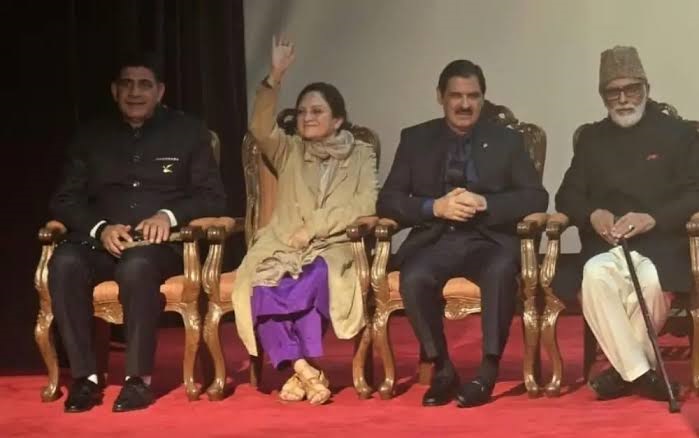
Lieutenant Governor Manoj Sinha administered the oath of office and secrecy to Ali Mohammad Sagar, Shamima Firdous, Mir Saifullah and Altaf Ahmad Wani, popularly known as Altaf Kaloo, at Lok Bhavan in Srinagar. The expansion marks the first major restructuring of the NC-led government since it assumed office in October 2024.
The reshuffle also involves the removal of Satish Sharma, an Independent MLA from Chhamb in the Jammu region, from the Council of Ministers. With four new inductions and one minister dropped, the ministry has reached its constitutionally permitted size under the Jammu and Kashmir Reorganisation Act, 2019. <Cite refs={[“turn509728search3″,”turn739597view1”]}/>
The expansion follows weeks of speculation, consultations and competition among legislators seeking ministerial positions. It also comes against the backdrop of continued demands for the restoration of Jammu and Kashmir’s statehood and the Congress’s decision to remain outside the Cabinet despite extending support to the NC-led government.
For Omar Abdullah, the reshuffle is more than a change in personnel. It is an attempt to balance experience, regional representation, party expectations and administrative responsibilities within a ministry that has had limited room for expansion since the government took office.
The immediate question is whether the reshuffled Cabinet can translate this political rearrangement into stronger governance and more visible progress on the issues affecting residents across Jammu and Kashmir.
Who Are the Four New Ministers?
The four inductees bring different levels of legislative and ministerial experience to the government. Two are senior NC figures with previous ministerial experience, while the other two are entering the Council of Ministers for the first time.
Ali Mohammad Sagar: The experienced party organiser
Sagar, the MLA from Khanyar in Srinagar, is a senior National Conference leader and a seven-time legislator. He has previously held ministerial responsibilities and is among the party’s most experienced figures in legislative and administrative affairs. His return to the Cabinet brings institutional experience at a time when the government is seeking to strengthen its political and administrative team.
Shamima Firdous: A stronger role for women’s representation
Firdous, the three-time MLA from Habba Kadal in Srinagar, is a senior NC leader who heads the party’s women’s wing. She has entered the Council of Ministers for the first time, according to reports on the expansion. Her induction makes her the second woman in the Cabinet alongside Sakina Itoo. Her role will be watched both for its administrative responsibilities and for what it signals about women’s representation in the government.
Mir Saifullah: Experience from North Kashmir
Saifullah, who represents Trehgam in Kupwara district, is a four-time MLA and a former minister. His induction brings previous ministerial experience and representation from North Kashmir into the expanded Council. His appointment also gives the government another senior legislator with a constituency in a politically important border district.
Altaf Kaloo: A first ministerial assignment
Altaf Ahmad Wani, popularly known as Altaf Kaloo, represents Pahalgam in Anantnag district. A two-time MLA, he has entered the ministry for the first time. His induction gives South Kashmir a place in the reshuffled Cabinet and creates an opportunity for a legislator from a constituency associated with tourism, horticulture and other local economic activities to take on a wider administrative role.
The new ministers’ actual administrative impact will depend on the portfolios assigned to them, the responsibilities they receive and the priorities they establish. The allocation of departments is therefore an important next step in assessing the reshuffle.
Why the Cabinet Expansion Matters
The NC-led government assumed office in October 2024 after the Assembly election, but the Council of Ministers remained smaller than the maximum strength permitted by law.
Before the latest expansion, the Cabinet had six members, including Omar Abdullah. The available space for additional appointments was limited by the legal ceiling on the number of ministers in Jammu and Kashmir.
Under Section 53 of the Jammu and Kashmir Reorganisation Act, 2019, the Council of Ministers cannot exceed 10 per cent of the total strength of the Legislative Assembly. With 90 elected Assembly seats, the maximum permitted strength is nine, including the Chief Minister. <Cite refs={[“turn509728search1″,”turn509728search3”]}/>
The expansion therefore completes the Cabinet numerically. But filling all available positions does not automatically resolve the political pressures that made the reshuffle difficult.
The Chief Minister had to consider the expectations of senior legislators, the demands of different regions, the representation of women and the need to retain a workable balance within the ruling party. Each appointment also carries consequences for those who were not selected.
A full Cabinet gives the Chief Minister a larger team to distribute responsibilities across government. At the same time, it removes the option of filling another ministerial vacancy without first making a change to the existing composition, unless the legal framework itself changes.
That makes the present arrangement a consequential political decision. The government has completed its expansion, but it must now demonstrate that the additional ministerial capacity improves coordination and delivery.
Satish Sharma’s Removal and the Politics of Representation
One of the most significant elements of the reshuffle is the removal of Satish Sharma, an Independent MLA from Chhamb in the Jammu region.
Sharma had been part of the Council of Ministers despite not belonging to the National Conference. His removal means that the government’s expanded Cabinet is now composed of National Conference legislators, while the Congress continues to remain outside the ministry.
The decision also changes the Cabinet’s regional and political composition. Reports following the expansion indicate that seven ministers, including the Chief Minister, are from the Kashmir division and two are from the Jammu division.
This distribution will inevitably form part of the political debate. Representation in a Cabinet is not only about the number of ministers from each region. It also concerns the communities, constituencies and interests that ministers are expected to represent, alongside the responsibilities of their departments.
The inclusion of legislators from Srinagar, North Kashmir and South Kashmir broadens the representation of the Valley within the Council. However, the change also invites questions about how the interests of Jammu’s diverse constituencies will be reflected in government decisions.
The number of ministers from a region cannot, by itself, establish whether that region is being treated fairly. A more useful assessment would examine budget allocations, project implementation, recruitment, public services and the distribution of development opportunities across districts.
For the government, maintaining public confidence will require showing that the reshuffled Cabinet can serve the entire Union Territory, not only the constituencies represented by its members.
Congress Stays Out Over Statehood Demand
The Congress has once again declined to join the Council of Ministers, maintaining that it will not accept a Cabinet berth until Jammu and Kashmir’s statehood is restored.
The party contested the 2024 Assembly election in alliance with the National Conference and has continued to support the NC-led government from outside. However, Congress leaders have repeatedly said that joining the ministry before restoration of statehood would compromise their political position on the issue.
Jammu and Kashmir Congress president Tariq Hameed Karra reiterated the party’s position before the reshuffle. The NC leadership reportedly made a final effort to persuade Congress to participate, but the party did not change its stance.
The decision reflects a political calculation: Congress wants to maintain its support for the elected government while keeping the demand for statehood at the centre of its public position.
For the National Conference, the absence of Congress ministers means the expanded Cabinet remains a party-led ministry rather than a broader coalition arrangement. The NC must therefore manage its own legislators’ expectations while continuing to rely on outside support from an alliance partner.
This arrangement also creates a distinction between legislative support and participation in executive government. Congress can support the government from outside without taking responsibility for ministerial decisions in the same way as Cabinet members.
The statehood question remains larger than the Cabinet reshuffle. It concerns the institutional status of Jammu and Kashmir and the powers available to its elected representatives. The Congress’s decision to stay out ensures that the issue continues to shape the relationship between the alliance partners.
Omar Abdullah’s Balancing Act Within the National Conference
The weeks preceding the expansion were marked by speculation about ministerial appointments and the aspirations of legislators who hoped to join the government.
A Cabinet position carries political visibility, influence over departmental decisions and responsibility for policy implementation. In a party with many experienced elected representatives but only a handful of available positions, selecting ministers can become a difficult exercise in internal management.
The Indian Express described the expansion as a balancing act for Omar Abdullah, with competing expectations involving senior and younger leaders, regional interests and different sections of the party.
Sagar and Saifullah bring prior ministerial experience. Firdous and Kaloo, entering the Cabinet for the first time, represent a different stage in their political careers. The combination suggests that the NC leadership has sought to mix experience with new ministerial appointments, although the precise political reasoning behind each selection should not be assumed without direct confirmation from the party.
The reshuffle also demonstrates the limits of political accommodation under the existing legal ceiling. With nine positions available, the Chief Minister cannot meet every legislator’s aspirations through Cabinet appointments.
Those left out may remain loyal to the leadership, but dissatisfaction is a possibility in any party where ministerial expectations are high. The significance of such dissatisfaction will depend on how the leadership manages internal communication and whether disagreements affect legislative or administrative functioning.
The challenge for Omar Abdullah is to ensure that the reshuffle strengthens the government rather than simply redistributing positions within the party.
What the Expanded Cabinet Means for Governance
The practical test of the reshuffle begins with the work of the departments that the new ministers will oversee.
Jammu and Kashmir faces a range of governance challenges, including youth unemployment, recruitment concerns, public-service delivery, economic development and the need to strengthen opportunities for local businesses. These issues require sustained administrative attention rather than periodic changes in ministerial composition.
The allocation of portfolios will be important because it determines the areas in which the new ministers can exercise direct responsibility. Until those assignments are formally announced, it would be premature to predict which policy areas each minister will influence.
Once portfolios are allocated, residents and political observers will be able to assess whether the new ministers establish clear priorities, address pending matters and improve the responsiveness of their departments.
Three indicators will be particularly important.
First, delivery on public commitments. The government needs to show measurable progress on promises made during the election, including those relating to employment, welfare and economic opportunity.
Second, administrative coordination. A larger Cabinet should improve the division of responsibilities and the pace of decision-making. If departments continue to face delays or unclear accountability, the numerical expansion will have limited practical value.
Third, regional responsiveness. The reshuffled team must demonstrate that local concerns across Jammu, Kashmir and different districts receive attention through policy decisions, development programmes and public services.
These measures provide a more meaningful basis for evaluating the expansion than the number of ministers inducted or the political status of individual appointees.
The Wider Context: Statehood, Autonomy and Public Expectations
The Cabinet reshuffle is taking place within a political framework shaped by Jammu and Kashmir’s reorganisation in 2019, when the former state was reorganised into the Union Territories of Jammu and Kashmir and Ladakh.
The elected government operates within the Union Territory framework, which divides responsibilities between elected institutions and the Lieutenant Governor under the applicable legal arrangements. The restoration of statehood remains a major political demand for the NC, Congress and other political actors, although their positions and strategies differ.
For the elected administration, this creates a dual challenge. It must deliver on matters within its authority while continuing to pursue broader political demands that cannot be resolved through ministerial appointments alone.
The Cabinet expansion does not alter Jammu and Kashmir’s constitutional status. Nor does the induction of four ministers, by itself, settle the debate over the powers of the elected government.
Instead, the reshuffle changes the team responsible for administering the Union Territory within the existing framework.
That distinction matters for public expectations. Residents may judge the government on issues such as employment, welfare, roads, healthcare and education, while also looking to it for progress on statehood and other major political commitments. The administration must communicate what it can deliver directly, what requires coordination with other authorities and what remains subject to broader political or legal processes.
A clearer division between promises, powers and practical outcomes would help make the government’s performance easier to evaluate.
What Happens Next?
With the Council of Ministers now at its maximum permitted strength, the next major step is the allocation or reallocation of portfolios. The distribution of departments will determine the new ministers’ responsibilities and reveal how Omar Abdullah intends to organise the government’s priorities.
The reshuffle may also prompt further political discussion over regional representation, the removal of Satish Sharma and the Congress’s continuing absence from the ministry.
Within the National Conference, attention will turn to whether the leadership can keep excluded aspirants aligned with the government’s decisions. Outside the ruling party, the BJP and other opposition groups are likely to judge the expanded ministry against its performance and the government’s handling of public concerns.
For Congress, remaining outside the Cabinet preserves its stated position on statehood but also leaves it without direct ministerial responsibility for policy implementation. The party will need to balance its support for the elected government with its role in pressing for restoration of statehood.
The broader political impact will emerge over time. Cabinet changes can provide fresh direction, but their success depends on whether the new team can work together, make decisions and deliver outcomes that are visible to residents.
Conclusion: A Full Cabinet, but a Larger Test of Delivery
Omar Abdullah’s Cabinet expansion marks a significant political milestone for the National Conference-led government. Four legislators have joined the ministry, Satish Sharma has been dropped, the Council has reached its maximum permitted strength, and Congress has maintained its decision to stay out until Jammu and Kashmir regains statehood.
The reshuffle gives the Chief Minister a complete ministerial team and brings experienced legislators back into government alongside first-time ministers. It also reshapes the Cabinet’s regional composition and closes the immediate question of how many ministers can be accommodated under the current legal framework.
Yet the central challenge remains unchanged: translating political authority into effective governance.
The new ministers will be judged by their departmental performance, their response to public concerns and their ability to advance the government’s commitments. The NC leadership will have to manage internal expectations, while Congress will continue to pursue its statehood position from outside the ministry.
For the people of Jammu and Kashmir, the most important measure of the expansion will not be the ceremony at Lok Bhavan. It will be whether the reshuffled Cabinet can improve public services, expand economic opportunities, respond to local needs and provide clearer accountability for government decisions.
The Cabinet is now full. The test of its performance begins with the work that follows.