J&K Bank Lending Grows 30.9% Outside J&K Against 9.3% in UT: Altaf Bukhari Raises Questions Over Bank’s Regional Role
By: Javid Amin | 01 September 2026
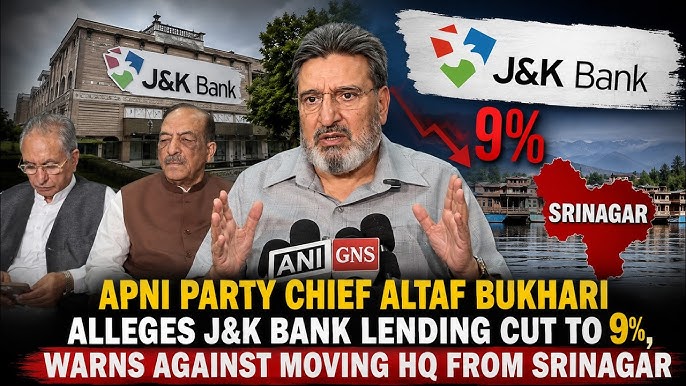
J&K Bank lending growth has opened a fresh political and economic debate after former Jammu & Kashmir finance minister Altaf Bukhari questioned the bank’s lending strategy, recruitment policy, board representation and institutional focus. Official financial data shows that advances outside J&K and Ladakh grew more than three times faster than lending within the Union Territory during 2025-26.
The debate over the future direction of Jammu & Kashmir Bank has moved beyond politics and into the numbers.
The bank had a record financial year in 2025-26, reporting its highest-ever annual profit of ₹2,363.47 crore, up from ₹2,082.46 crore a year earlier. Its total gross advances also rose sharply, from ₹1,06,985 crore in March 2025 to ₹1,24,981 crore in March 2026, a growth of 16.8%.
But the growth was not evenly distributed.
Within Jammu & Kashmir, gross advances increased from ₹69,694 crore to ₹76,159 crore, a rise of 9.3%.
Across the Rest of India, including Ladakh, advances increased from ₹37,292 crore to ₹48,822 crore, a much faster 30.9%.
That geographical difference has prompted former J&K finance minister and Apni Party president Altaf Bukhari to question whether the bank’s expansion strategy is adequately aligned with the economic interests of Jammu & Kashmir.
His concerns cover lending, employment, board representation and the bank’s institutional identity.
The numbers provide the starting point for understanding the controversy.
J&K Bank’s lending growth shows a clear geographical divide
The official March 2026 earnings data presents a sharp contrast between the bank’s two principal geographical portfolios.
| Region | March 2025 | March 2026 | Growth |
|---|---|---|---|
| J&K UT | ₹69,694 crore | ₹76,159 crore | 9.3% |
| Rest of India, including Ladakh | ₹37,292 crore | ₹48,822 crore | 30.9% |
| Whole Bank | ₹1,06,985 crore | ₹1,24,981 crore | 16.8% |
J&K nevertheless remains the bank’s largest lending market, accounting for more than ₹76,000 crore of gross advances.
But the additional lending generated during the year tells a different story.
The J&K portfolio added ₹6,465 crore, while the Rest of India portfolio added ₹11,530 crore.
The result is a bank whose overall balance sheet is expanding strongly, but whose fastest growth is increasingly coming from outside its traditional home market.
This is the central issue behind the current political debate.
The composition of J&K Bank’s loan book explains much of the difference
The two geographical portfolios have markedly different structures.
Inside J&K, personal loans account for 49% of advances. Corporate lending accounts for only 7%, while SME lending represents 14%, trade 12% and agriculture 15%.
Outside J&K and including Ladakh, the picture is almost the reverse.
Corporate lending accounts for 79% of advances, while personal loans account for 12%. SME, trade and agriculture together represent a relatively small proportion of the portfolio.
This distinction is important when assessing the growth rates.
A corporate banking portfolio can expand rapidly through a relatively limited number of large-ticket accounts. A retail-heavy regional portfolio is built through thousands of individual borrowers, businesses, farmers, traders and households.
J&K Bank’s March 2026 figures show that its national expansion is being driven heavily by corporate banking, while its home-market business remains substantially more diversified across personal finance, agriculture, SMEs and trade.
The bank’s overall corporate loan share increased from 29% to 35% during the year, while personal lending declined from 38% to 35% of the total portfolio.
That marks a significant change in the composition of the institution’s balance sheet.
Altaf Bukhari questions whether J&K is receiving enough credit
It is this shift that has attracted Bukhari’s criticism.
The former finance minister has questioned why credit expansion outside Jammu & Kashmir is occurring at such a substantially faster rate while the Union Territory remains the bank’s largest market and the institution has historically been closely associated with the region.
Bukhari has also raised concerns over the bank’s recruitment policy and the employment opportunities available to young people from J&K.
His intervention comes at a time when employment remains one of the central economic concerns in the Union Territory.
For decades, J&K Bank has occupied a special place in the region’s economic structure. It is not simply another commercial bank operating in Jammu & Kashmir. It was established in 1938 and became deeply integrated with the region’s households, businesses, government institutions and financial system.
The bank itself describes its mission as pursuing sustainable and profitable growth while expanding its geographical footprint and emerging as a prominent national financial brand.
That creates two objectives that now have to operate alongside each other:
national expansion and regional economic responsibility.
J&K Bank is expanding nationally while retaining a dominant home-market position
The bank’s own strategy makes clear that expansion beyond J&K is not incidental.
J&K Bank currently operates across 18 states and four Union Territories and serves retail customers, farmers, artisans, government employees, businesses and corporate clients.
Its official mission specifically speaks of acquiring an enhanced business footprint across geographies and becoming a prominent national brand.
The national expansion therefore forms part of the bank’s stated strategic direction.
At the same time, the scale of the J&K operation remains substantial.
The Union Territory continues to account for the majority of the bank’s gross advances.
The question raised by Bukhari is therefore about the balance of growth, rather than whether J&K Bank is still lending in J&K.
Official figures show that it is.
The issue is that lending outside the UT is currently growing much faster.
NPA levels put the lending debate in sharper perspective
The geographical distribution of stressed assets is another important part of the discussion.
The March 2026 data shows that the gross NPA ratio in J&K was around 3.1%, compared with approximately 1.6% in the Rest of India portfolio.
In absolute terms, gross NPAs stood at approximately ₹2,332 crore in J&K and ₹793 crore outside J&K.
The larger absolute figure in J&K corresponds with its larger loan book.
The difference in ratios also shows that the home-market portfolio carried a higher reported gross NPA ratio than the Rest of India portfolio during the period.
That makes asset quality a key part of the bank’s regional lending challenge.
The answer is not simply to increase credit volumes.
For J&K’s economy, the more important objective is productive credit that reaches businesses and individuals capable of generating sustainable economic activity and repayment.
Recruitment has become another sensitive issue
The employment question has added another layer to the controversy.
J&K Bank has historically been an important source of employment for educated young people in the region. Its recruitment and career opportunities therefore carry significance beyond the banking sector.
Bukhari has questioned reports of a shift towards recruiting candidates locally in states where the bank operates outside J&K.
The issue has particular resonance because the bank is now building a larger national business.
The institution’s current recruitment approach also reflects the geographical nature of its expansion.
For example, the bank’s 2026 apprenticeship programme included positions across J&K, Ladakh and locations outside the two Union Territories, with local-language requirements attached to outstation positions.
That reflects the practical demands of operating across different parts of India.
At the same time, the question of how much employment opportunity should remain accessible to candidates from J&K is a legitimate regional policy concern.
The answer ultimately lies in a clearly defined recruitment framework rather than informal expectations.
Board representation adds to the debate over J&K Bank’s identity
Bukhari has also questioned the composition of the bank’s board and the level of representation from Jammu & Kashmir.
The issue is politically significant because the bank’s ownership structure gives the J&K and Ladakh governments a substantial stake.
At the same time, board appointments have to meet the requirements of banking regulation, securities law, corporate governance and professional expertise.
J&K Bank’s recent disclosures show appointments of directors under different categories, including rotational and independent directors. In April 2026, the bank disclosed the appointment of Ashish Kundra, IAS, as an additional rotational director and Pravin Raghavendra as an additional independent director, subject to shareholder approval.
The wider question is whether the board adequately combines professional banking expertise with an understanding of the region in which the institution has its historic roots.
That is ultimately a governance issue.
Srinagar remains J&K Bank’s corporate headquarters
The question of the bank’s headquarters has also entered the political discussion.
Bukhari has raised concerns over reports of a possible move away from Srinagar.
Official records currently provide a clear picture.
As of the latest update on August 31, 2026, J&K Bank’s official website lists its Registered Office and Corporate Headquarters at M.A. Road, Srinagar.
The bank’s recent operational records also continue to identify its Srinagar premises as the Corporate Headquarters.
In June 2026, for example, the bank issued a tender for renovation work at its Corporate Headquarters in Srinagar.
Another 2026 tender concerned redevelopment of the bank’s auditorium at the same Srinagar headquarters.
The official record therefore places the bank’s corporate headquarters firmly in Srinagar.
Government ownership gives the debate a wider economic dimension
The relationship between the J&K government and the bank is another important part of the story.
J&K Bank has a distinctive ownership history, and the government remains a substantial shareholder.
That creates a legitimate public interest in how the bank supports the regional economy.
But ownership does not mean individual lending decisions can be politically directed.
A commercial bank must balance economic development with credit quality, capital requirements, profitability and regulatory obligations.
The government’s role is therefore particularly important at the level of strategy and accountability.
The central question is whether the bank’s expansion is strengthening its ability to finance the J&K economy or gradually reducing the relative importance of the home market.
What J&K businesses need from the bank
The debate ultimately returns to the ground-level economy.
For a small entrepreneur in Srinagar, a trader in Jammu, a tourism operator in Pahalgam, a farmer in south Kashmir or a young person trying to start a business, the key issue is not the bank’s national strategy.
It is access to affordable and timely credit.
That makes sectors such as tourism, agriculture, handicrafts, transport, hospitality, MSMEs and youth entrepreneurship particularly important.
J&K’s economy has faced repeated disruptions from security incidents, weather events and economic uncertainty.
In such an environment, banks have an important role in keeping viable businesses financially alive and helping new enterprises get started.
The quality of lending matters as much as its volume.
A ₹1,000-crore increase in lending that produces productive investment and employment can have a much greater economic impact than a larger amount concentrated in low-employment financial activity.
The bank’s national ambitions are now part of its identity
J&K Bank is no longer operating only as a regional financial institution.
Its official profile describes a bank with operations across much of India and an explicit ambition to strengthen its national footprint.
Its FY2025-26 results show that strategy producing strong financial results.
The bank reported its highest-ever annual profit of ₹2,363.47 crore, marking the fourth consecutive year of record annual profits.
Its gross advances crossed ₹1.24 lakh crore, with the Rest of India portfolio recording particularly strong growth.
From a purely commercial perspective, those numbers represent expansion.
From a regional perspective, they raise a different question.
How much of that growing financial strength is flowing back into Jammu & Kashmir?
That is the question now confronting the bank’s management, shareholders and political leadership.
J&K Bank’s next challenge is balancing growth with regional responsibility
The current debate should not be reduced to whether the bank should expand outside Jammu & Kashmir.
It already has.
The more important issue is how that expansion is managed.
The official numbers show a bank with strong profitability, rapidly growing advances and a clear national expansion strategy.
They also show a significant geographical difference in credit growth.
J&K remains the bank’s largest lending market, but its 9.3% growth rate is substantially below the 30.9% growth recorded in the Rest of India portfolio.
That gap deserves serious attention because J&K Bank’s historical importance to the region is different from that of an ordinary commercial lender.
The bank has to remain commercially competitive.
It also has to remain deeply relevant to the economy of Jammu & Kashmir.
That means expanding credit for viable local businesses, strengthening MSME and agriculture finance, supporting tourism and entrepreneurship, maintaining meaningful employment opportunities and ensuring transparent corporate governance.
The debate sparked by Altaf Bukhari has therefore arrived at an important moment for J&K Bank.
The institution is financially stronger than it has ever been.
Its national footprint is growing.
Its headquarters remains in Srinagar.
Its home market remains its largest lending market.
But the growth pattern is changing.
And the real test for J&K Bank will be whether its national expansion ultimately strengthens its historic role in Jammu & Kashmir rather than weakening it.
That question will be answered not by political speeches, but by the bank’s lending, employment, investment and regional economic numbers in the years ahead.


