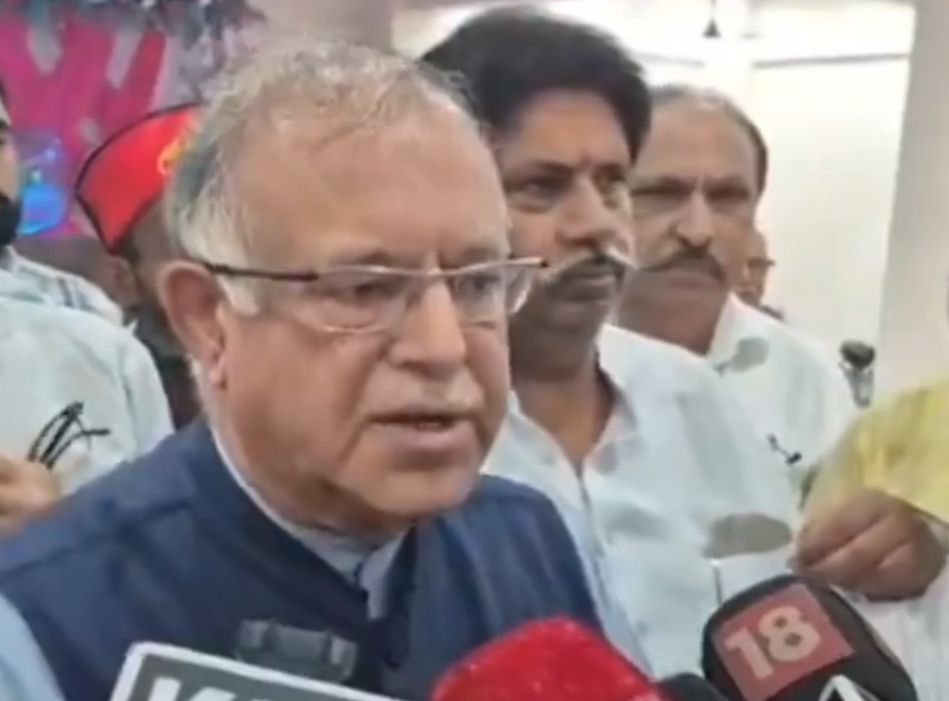
J&K Congress Won’t Join Cabinet Until Statehood Restored, Says Tariq Karra
By: News Desk | 27 Aug 2026
Congress has once again rejected the possibility of joining the Omar Abdullah-led Jammu & Kashmir government, with JKPCC president Tariq Hameed Karra declaring that the party will not enter the Cabinet until statehood and other constitutional rights are restored.
The decision is significant because Congress is not withdrawing its support to the National Conference government. Instead, it is choosing a politically unusual middle path: support the government when its stability is threatened, but remain outside the government when it comes to sharing executive responsibility.
Karra’s latest statement, delivered in Reasi on August 27, puts an end—at least for now—to speculation that Congress could accept ministerial berths as part of a proposed Cabinet expansion. Multiple reports confirm that Karra reiterated the party’s longstanding position that statehood is a precondition for joining the Council of Ministers.
The decision also exposes a deeper question for J&K politics:
Can Congress remain a reliable partner of the NC government while simultaneously refusing to become part of the government?
The answer could shape the political equation between the two parties for the remainder of the Assembly’s term.
Congress Says: Cabinet Is Not the Priority—Statehood Is
Karra’s message was unusually categorical.
According to reports from his Reasi interaction, he said Congress had maintained the same position for the past two years and would not become part of the Cabinet until the rights taken away from the people of J&K were restored.
For Congress, therefore, the issue is not the number of ministerial berths on offer.
It is the principle behind accepting them.
Karra has linked the party’s position to the restoration of statehood and other constitutional rights, including concerns over land, jobs and natural resources.
The political message is clear:
Congress does not want ministerial office in a Union Territory while continuing to demand restoration of J&K’s statehood.
That gives the party a degree of political distance from the NC government while allowing it to remain part of the broader anti-BJP political arrangement.
This Is Not a New Decision
One important correction to the current political narrative is that Congress has not suddenly discovered this position in August 2026.
It took the same stand when Omar Abdullah formed his government in October 2024.
After the Assembly election, Congress won six seats, while the NC emerged as the dominant party in the alliance. The NC-Congress alliance crossed the majority mark with 48 seats, but Congress declined to join the Council of Ministers.
At the time, Karra said Congress was unhappy that J&K’s statehood had not been restored and therefore would not enter the ministry.
That means the latest declaration is better understood as a reaffirmation, rather than a fresh bargaining tactic.
Congress has maintained the same red line since the formation of the government.
Why Is Congress Supporting Omar Abdullah From Outside?
This is perhaps the most interesting part of the arrangement.
If Congress believes the political structure created after August 5, 2019, is unacceptable, why continue supporting a government operating within that very structure?
Karra’s answer is political rather than constitutional.
He has said Congress will support the NC government whenever the BJP attempts to destabilise it.
In other words:
Congress is distinguishing between supporting a government and endorsing the political framework in which that government operates.
That distinction allows Congress to say:
“We support the elected government of J&K, but we do not accept the Union Territory arrangement as the final political settlement.”
It is a delicate balancing act.
The 2024 Election Produced an Unusual Alliance
The NC-Congress relationship has always contained an element of contradiction.
The two parties fought the 2024 Assembly election as allies.
The NC emerged as the principal force in the alliance, while Congress won six seats. Together, the alliance secured enough seats to form the government.
Yet Congress immediately chose not to enter the Cabinet.
That created a peculiar arrangement:
NC governs.
Congress supports.
But Congress does not share executive responsibility.
This arrangement has survived for almost two years.
And Karra’s latest statement suggests Congress has no intention of changing it unless the statehood question is resolved.
Omar Abdullah Has a Cabinet Problem of His Own
Congress’s decision comes at a particularly important moment for the Omar government.
The J&K government can have a maximum of nine ministers, including the Chief Minister.
The ministry currently has six members, leaving three positions vacant. Reports in July indicated that Omar Abdullah was considering a Cabinet expansion and possibly a reshuffle.
Congress’s six MLAs naturally make it an obvious political partner for ministerial representation.
But that option remains blocked by Karra’s statehood condition.
The consequence is that Omar has to make a choice:
- expand the Cabinet with NC legislators;
- accommodate independent MLAs supporting the government;
- reshuffle existing ministers;
- or continue operating with vacancies.
The first two options could create their own political complications.
Every ministerial berth carries political expectations.
Congress Has Chosen Political Leverage Over Ministerial Power
There is another way of looking at Karra’s position.
By remaining outside the Cabinet, Congress retains something that ministers inevitably lose:
political distance.
If Congress ministers joined Omar’s government, the party would become directly responsible for decisions involving:
- electricity tariffs;
- recruitment;
- administration;
- infrastructure;
- finances;
- law and order;
- welfare schemes;
- governance failures.
But outside the Cabinet, Congress can support the government on major political questions while criticising individual policies.
Karra’s recent comments on the electricity tariff hike illustrate precisely this strategy.
Congress supports the government’s stability but has opposed the proposed 6.83% electricity tariff increase, arguing that consumers should not be burdened further and calling for relief through an amnesty scheme.
This gives Congress a politically useful position:
Support the government when necessary; oppose the government when politically advantageous.
That may be uncomfortable for Omar, but it is valuable for Congress.
The Power Tariff Issue Shows How This Strategy Works
The electricity dispute provides a perfect example.
Omar Abdullah has defended the tariff revision as necessary for the financially stressed power sector.
Congress, meanwhile, has opposed placing an additional burden on ordinary consumers.
Karra has demanded a comprehensive electricity amnesty scheme.
If Congress were part of the Cabinet, its ministers would have to defend or explain the government’s decision.
Outside the Cabinet, Karra can challenge it.
This allows Congress to present itself as a supporter of political stability but an independent watchdog on governance.
That distinction could become increasingly important as the government faces difficult economic decisions.
But There Is a Political Cost for Congress Too
The arrangement is not without risks.
Congress cannot indefinitely support the NC government and simultaneously wash its hands of everything the government does.
At some point, voters may ask:
If you support the government, why are you not taking responsibility for its decisions?
And the opposite question could also emerge:
If you disagree with so many policies, why continue supporting the government?
Congress therefore has to maintain a carefully defined threshold.
It needs to distinguish between:
issues on which government stability must be protected
and
issues on which the party has the right—and responsibility—to disagree.
Karra’s formulation suggests Congress intends to do exactly that.
Statehood Has Become Congress’s Political Red Line
The deeper story is the transformation of statehood from a constitutional demand into a political condition for participation in government.
Congress has repeatedly argued that the restoration of statehood should precede its entry into the Cabinet.
Karra said in July that the party had begun its statehood campaign before other parties and welcomed the fact that the NC had subsequently adopted the demand more strongly.
That allows Congress to claim:
“We were demanding statehood before it became politically fashionable.”
There is obvious electoral logic behind that claim.
The NC Has Also Made Statehood a Major Demand
But Congress cannot claim exclusive ownership of the statehood issue anymore.
The NC government has repeatedly demanded restoration of J&K’s statehood.
Omar Abdullah has also made restoration of statehood a central political demand of his administration.
This creates another interesting contradiction.
Congress says:
“We will not join the government until statehood is restored.”
NC says:
“We are the government fighting for statehood.”
Both can make a political argument from the same issue.
But they approach it differently.
For Congress, statehood is a condition for participation.
For NC, statehood is a demand to be pursued while governing.
That difference may look subtle, but politically it is substantial.
The Bigger Constitutional Question
The dispute cannot be separated from the events of August 2019.
On August 5, 2019, the Union government changed J&K’s constitutional and administrative status, and the former state was subsequently reorganised into the Union Territories of Jammu & Kashmir and Ladakh.
The Supreme Court upheld the constitutional validity of the Centre’s 2019 decisions in December 2023, while also directing that J&K’s statehood be restored at the earliest and setting a deadline for Assembly elections.
That judgment changed the political landscape.
The constitutional dispute over Article 370 was largely settled by the court.
Statehood, however, remained an unresolved political demand.
That is precisely the space Congress is occupying.
Why Land, Jobs and Resources Matter
Karra has not limited Congress’s demand to a ceremonial restoration of statehood.
He has linked statehood with the rights of J&K residents over land, employment and natural resources.
That expands the political argument.
Statehood becomes more than a change in administrative status.
It becomes a question of:
- who controls policymaking;
- who determines recruitment rules;
- who frames land policies;
- who manages resources;
- how much authority rests with elected representatives;
- and how much remains with the Union government.
For Congress, these issues provide a stronger political narrative than simply demanding the restoration of a constitutional label.
Is Congress Putting Pressure on Both Omar and Delhi?
Effectively, yes.
Karra’s strategy creates pressure on two fronts.
Pressure on the Centre
Congress can argue that statehood must be restored before it participates fully in the J&K government.
Pressure on the NC
Congress can simultaneously tell Omar Abdullah:
Your government has our support, but you cannot assume our silence.
That is exactly what Karra signalled when he said Congress’s support would not prevent it from raising governance issues or questioning the government’s fulfilment of commitments.
This makes Congress neither a conventional coalition partner nor a conventional opposition party.
It occupies the middle ground.
The “Outside Support” Model Could Become Politically Important
The arrangement may appear temporary, but it could actually become a model for how J&K’s coalition politics evolves.
Congress can remain outside government until statehood is restored.
If statehood is eventually restored, it can reconsider joining.
If statehood is delayed, Congress can continue building its independent political identity.
That gives the party considerable flexibility.
And there is another advantage.
Congress can campaign against the BJP nationally while simultaneously criticising the NC locally.
That gives it room to compete for political space without immediately breaking the alliance.
But Will This Hurt the NC?
Potentially.
The NC may find itself governing without the full institutional participation of its principal national ally.
That means every difficult decision becomes more politically expensive.
If the NC increases electricity tariffs, Congress can oppose it.
If unemployment becomes an issue, Congress can demand answers.
If governance disappoints voters, Congress can distance itself.
Yet when the BJP attacks the government, Congress can return to its role as a stabilising ally.
This is a remarkably flexible arrangement.
But it also creates a question about accountability:
Who exactly is responsible for the government’s performance?
The NC will argue that it is the ruling party.
The BJP will argue that Congress supports the NC.
Congress will argue that it is not part of the Cabinet.
For voters, the lines may not always be so clear.
Could Congress Eventually Join?
Karra’s latest statement suggests the answer is yes—but only after statehood.
He has not permanently rejected participation in the government.
He has established a condition.
That distinction matters.
If New Delhi restores statehood, Congress would have a political basis to reconsider Cabinet participation without appearing to abandon its stated principle.
Until then, the party can remain outside.
The BJP Will Watch This Equation Closely
For the BJP, the Congress-NC relationship presents both an opportunity and a challenge.
The BJP can argue that Congress is effectively supporting the NC government while avoiding responsibility for its decisions.
The Congress response is that it is supporting an elected government against destabilisation, not endorsing every policy.
The BJP can also use Congress’s participation—or non-participation—to question the opposition alliance’s coherence.
This is particularly relevant because J&K’s political competition is increasingly moving beyond the traditional NC-PDP axis.
The BJP remains a major political force in Jammu, while regional parties are competing to define the political narrative in Kashmir.
Congress is attempting to carve out its own space within that contest.
Karra’s Position Also Protects Congress From Being Swallowed by NC
This may be one of the most important strategic calculations.
The NC is the dominant regional party in the current government.
If Congress entered the Cabinet, its political identity could become blurred.
Congress could increasingly be perceived simply as an extension of the NC-led administration.
By staying outside, it preserves a separate political brand.
That could matter when the next election arrives.
Congress can tell voters:
We helped prevent instability, but we did not compromise on statehood.
Whether voters accept that argument is another question.
The Real Test Will Be the Next Election
Political alliances are rarely judged by what leaders say in press conferences.
They are judged at the ballot box.
Congress’s strategy will ultimately be tested against three questions:
1. Did it successfully establish itself as the strongest advocate of statehood?
2. Did its outside-support strategy protect it from the government’s unpopular decisions?
3. Can it convert that political positioning into additional Assembly seats?
If the answer to all three is yes, Karra’s strategy could prove highly effective.
If not, critics will say Congress sacrificed ministerial influence without gaining meaningful political dividends.
A Delicate Triangle: Delhi, NC and Congress
J&K’s current politics can increasingly be understood as a three-way negotiation.
New Delhi controls the constitutional and administrative framework within which the Union Territory operates.
NC controls the elected government.
Congress supports that government but refuses to enter its Cabinet until statehood is restored.
This creates an unusual political equilibrium.
Nobody has everything they want.
And nobody is willing to completely walk away.
What Karra’s Statement Really Means
At one level, the statement is about Cabinet berths.
At another, it is about political legitimacy.
Congress is effectively saying:
We did not enter politics simply to occupy ministerial chairs. We want the political status of J&K restored first.
Whether one agrees with that argument or not, it gives Congress a clear and easily understood position.
And in politics, clarity can be valuable.
Conclusion: Congress Wants the Power to Support—and the Freedom to Oppose
Tariq Hameed Karra’s latest declaration has clarified an arrangement that has been evolving since October 2024.
Congress will support the Omar Abdullah government when its stability is threatened. But it will not share Cabinet responsibility until J&K’s statehood is restored.
This is not simply a disagreement over ministerial berths.
It is a strategic choice.
Congress wants to remain close enough to the NC to prevent the government from being destabilised, but far enough away to retain its independence on governance and public issues.
For Omar Abdullah, that means running a government with an ally that supports him—but does not sit beside him at the Cabinet table.
For Congress, it means keeping its statehood demand alive while preserving political leverage.
For the BJP, it provides another opportunity to question the opposition’s coherence.
And for the people of Jammu and Kashmir, the more fundamental question remains unanswered:
When will statehood actually return—and what political price will every party be willing to pay before it does?
Until that question is settled, Karra’s red line is likely to remain firmly in place.


