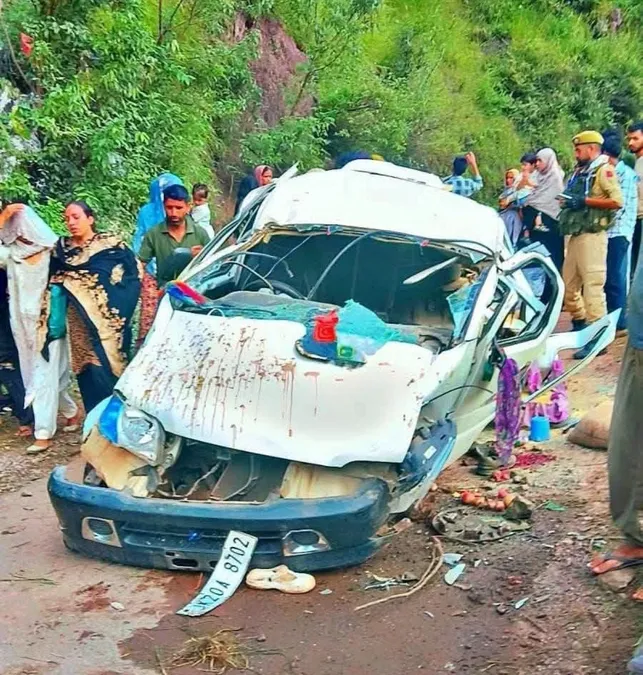
Poonch Road Accident: 6 Killed, 3 Injured as Van Falls Into Gorge in Surankote
By: News Desk | 27 August 2026
Six Lives Lost on a Mountain Road: What Happened in the Poonch Crash?
A routine journey home turned into a devastating tragedy in Poonch district on Wednesday evening, when a passenger vehicle veered off a road in the Surankote area and plunged into a deep gorge.
Six people were killed and three others injured. The crash occurred at around 5:30 pm on August 26, near Sheindhara/Shiendhara in Surankote, with the victims reported to be residents of the nearby Seri Chouhana village.
The tragedy has once again put the spotlight on a problem that is far bigger than a single crash: road safety in Jammu & Kashmir’s mountainous districts.
The immediate police assessment points to loss of control. But investigators are still working to establish the precise circumstances. And one emerging detail deserves particular scrutiny: reports indicate that the vehicle may have been operating without the required transport permit.
That could turn the conversation from a simple “driver lost control” narrative into a wider examination of vehicle fitness, regulatory enforcement and passenger safety.
Poonch Accident: What We Know So Far
According to officials and multiple local reports, a Maruti Eeco van, registration JK20A-8702, was travelling towards the Seri Chouhana area when it went out of control and plunged down a roadside gorge.
The accident happened in the Sheindhara area of Surankote tehsil, on a hilly stretch where a mistake at a curve can have catastrophic consequences.
The initial reports indicate that the driver failed to negotiate a sharp curve. However, police have not declared that as the final cause.
Traffic authorities have said the circumstances remain under investigation.
That distinction is important.
A vehicle leaving a mountain road can result from several interacting factors:
- excessive speed;
- driver fatigue or error;
- poor visibility;
- road geometry;
- inadequate curve protection;
- mechanical failure;
- defective brakes or tyres;
- overloading; or
- non-compliance with commercial-vehicle regulations.
At this stage, it would be premature to assign blame to any one factor.
Six Victims, Three Injured
The crash claimed the lives of four men and two women, according to district-level reports.
The deceased were identified in reports as Mohammad Shafiq, Nazakat Hussain, Sheraz Ahmed, Musarat Naz, Mohammad Fareed and Zulfat Bi. All were reported to be from Seri Chouhana.
Three people survived but suffered injuries.
Among them was a child, whose condition was initially described as critical. Two injured people were subsequently referred to Government Medical College, Jammu, for advanced treatment, while another remained under treatment locally.
The human cost is therefore continuing beyond the six deaths.
For the injured and their families, the accident has moved from a rescue operation into a medical and financial crisis.
Rescue Operation: Locals and Authorities Rushed to the Spot
In mountainous areas, the first few minutes after a crash can be decisive.
Following information about the accident, police personnel, local residents and emergency teams began rescue and evacuation operations.
The difficult terrain meant that reaching the wreckage itself was part of the challenge.
The Poonch administration mobilised multiple ambulances, with the Chief Medical Officer arranging emergency resources from District Hospital Poonch and the Sub-District Hospital at Surankote.
The injured were brought out and transported for treatment, while the bodies were shifted to District Hospital Poonch for medico-legal formalities.
Deputy Commissioner Ashok Kumar Sharma and other officials visited the hospital and reviewed arrangements for the injured.
The response appears to have been rapid.
But the incident also demonstrates a recurring reality of mountain emergencies: saving lives depends not only on medical facilities but also on how quickly rescuers can physically reach a crash site.
Why Mountain Roads Turn Small Driving Errors Into Fatal Crashes
The geography of Poonch changes the consequences of a road accident.
On a relatively flat road, a vehicle leaving its lane might collide with another vehicle or roadside object.
On a mountain road, the same loss of control can mean a fall of dozens of metres.
Reports put the gorge involved in Wednesday’s accident at roughly 150 feet deep.
That changes the safety equation completely.
A combination of:
sharp curves + narrow carriageways + steep drops + inadequate protection + speed
can produce a disproportionately deadly crash.
This is why road engineering matters just as much as driver behaviour.
It Is Too Early to Blame the Driver Alone
The phrase “driver lost control” appears repeatedly in initial accident reports.
It is useful as a preliminary description, but it is not a complete explanation.
A proper investigation should establish:
Was the vehicle mechanically fit?
Investigators need to examine the brakes, steering, tyres, suspension and other critical components.
Was the driver authorised to operate the vehicle?
Commercial passenger vehicles are subject to licensing and regulatory requirements.
Was the vehicle carrying the permitted number of passengers?
The reports themselves are not completely consistent about passenger numbers, making an official clarification important.
Was the vehicle properly permitted?
This is potentially significant.
Hindustan Times reported that the vehicle was allegedly being operated without a transport-department permit.
If confirmed, that raises questions extending beyond individual driver behaviour.
Was the road adequately protected?
A steep drop beside a road should trigger examination of guardrails, parapets, delineators, warning signs and curve geometry.
These questions should be answered before the accident is reduced to “human error.”
A Regulatory Question Is Already Emerging
The alleged absence of a permit is perhaps the most important new detail in the emerging investigation.
A commercial passenger vehicle is not simply another private car.
The regulatory system exists because passengers are placing their lives in the hands of a professional transport operator.
Permit requirements, fitness certificates, driver credentials and inspections are intended to create a basic safety filter.
The J&K Police itself advises commercial and transport vehicle drivers to carry permits and vehicle fitness certificates, while warning drivers against risky overtaking and manoeuvres on hill roads and near curves.
If investigators establish that this vehicle was indeed operating outside the required regulatory framework, the case raises an uncomfortable question:
How did an allegedly non-compliant passenger vehicle continue operating on a public road?
That question is as important as determining how the crash happened.
Poonch Is Not an Isolated Road-Safety Problem
The latest tragedy comes against a much broader pattern.
Official J&K statistics show the scale of the road-safety challenge.
The J&K Road Safety Policy 2025 cited 6,092 road accidents and 805 deaths in 2022, followed by 6,298 accidents and 893 deaths in 2023.
Those numbers are not confined to mountainous districts.
But they demonstrate that road crashes remain a substantial public-safety issue across the Union Territory.
Official traffic data also show repeated accidents in Poonch itself. For example, J&K Traffic Police recorded 17 accidents, three deaths and 34 injuries in Poonch during June 2024.
One month does not establish a trend by itself.
But it reinforces the point that the latest crash is occurring within a larger road-safety problem.
J&K Already Has a Road Safety Policy — The Challenge Is Implementation
The government notified the Jammu & Kashmir Road Safety Policy 2025 with an ambitious objective: reducing road accidents and fatalities by 50% by 2030.
The policy recognises several important interventions.
These include:
- regular identification of accident-prone areas;
- black-spot mapping;
- time-bound corrective action;
- better road engineering;
- warning and speed-limit signage;
- curve treatment;
- improved traffic enforcement;
- accountability for defective road construction and maintenance; and
- greater coordination between the Transport Department and Traffic Police.
On paper, that is the right direction.
The question is whether those measures reach roads like the one where Wednesday’s accident occurred.
A policy document cannot install a crash barrier.
A road-safety target cannot repair a dangerous curve.
The effectiveness of the policy will ultimately be measured in places such as Poonch, Doda, Kishtwar, Ramban, Rajouri and Reasi, where road geometry and terrain can make crashes especially severe.
Black Spots: The Engineering Fix That Can Save Lives
One of the most important concepts in modern road safety is the black spot — a location with a recurring concentration of fatal or serious crashes.
The Union government has made black-spot rectification a major road-safety programme, using measures including:
- crash barriers;
- road markings;
- road studs;
- delineators;
- improved signage;
- traffic calming;
- geometric improvements;
- junction redesign; and
- carriageway widening where necessary.
This approach matters in mountain districts.
If the same curve repeatedly produces crashes, telling drivers to “be careful” is not enough.
The road itself needs to become more forgiving.
A well-designed curve should provide:
adequate sight distance + appropriate banking/superelevation + warning signs + speed control + delineation + roadside protection.
Where a mistake can send a vehicle into a gorge, a properly engineered crash barrier can mean the difference between a minor collision and multiple deaths.
The Missing Piece: Crash Barriers and Edge Protection
Mountain roads require particular attention to roadside safety.
A vehicle does not necessarily have to remain perfectly on the road to survive.
Good road design anticipates human mistakes.
Where a steep drop exists, authorities should assess whether the location needs:
- reinforced crash barriers;
- concrete parapets;
- reflective markers;
- edge lines;
- speed calming;
- rumble strips;
- warning signs;
- improved drainage; and
- better night-time visibility.
J&K authorities have already undertaken black-spot rectification works on other mountain routes. For example, NHIDCL has listed interventions on the Batote-Khellani stretch of NH-244, including metallic crash barriers and road signage.
The broader lesson is clear:
Mountain-road safety cannot depend exclusively on driver discipline.
Infrastructure has to compensate for predictable human mistakes.
Why Commercial Passenger Vehicles Need Extra Scrutiny
The Poonch crash involved a passenger vehicle carrying local residents.
That makes regulatory enforcement especially important.
Commercial vehicles should undergo systematic checks covering:
Vehicle fitness
Brakes, tyres, steering, lights and other safety systems.
Permit compliance
Whether the vehicle is authorised for the route and passenger service being provided.
Driver credentials
Licensing, experience and fitness.
Passenger capacity
Overloading can alter vehicle stability and braking performance.
Maintenance history
A commercial vehicle operating repeatedly on mountain roads experiences substantial mechanical stress.
These are not bureaucratic technicalities.
They are the safety system between passengers and disaster.
The Evening Timing Also Matters — But Not in the Way People Assume
The accident occurred at around 5:30 pm.
It would be wrong to automatically label the timing as a cause.
There is no evidence yet that darkness caused this crash.
However, evening travel can introduce additional challenges in mountain terrain, particularly when visibility begins to deteriorate, shadows obscure road edges or drivers misjudge curves.
The solution is not necessarily to restrict evening travel.
It is to ensure:
adequate lighting where required, reflective signage, functioning vehicle lights, speed discipline and sufficient sight distance.
What Investigators Should Establish Now
A thorough inquiry should go beyond the standard accident case file.
1. Vehicle inspection
Was the Eeco mechanically sound?
2. Permit verification
Was the alleged lack of a transport permit confirmed?
3. Fitness certificate
Was the vehicle legally certified as roadworthy?
4. Passenger count
How many people were actually travelling in the vehicle?
5. Driver history
Was the driver licensed and experienced for the vehicle category?
6. Road inspection
Was the curve properly engineered and protected?
7. Speed evidence
Can investigators establish the vehicle’s approximate speed?
8. Eyewitness accounts
What did people nearby observe immediately before the crash?
9. Mobile-phone evidence
If legally obtained, was distraction involved?
10. Mechanical failure
Could brake, steering or tyre failure have contributed?
Until these questions are answered, “loss of control” should remain a preliminary finding rather than the final explanation.
Government Response: Condolences Must Be Followed by Prevention
Lieutenant Governor Manoj Sinha expressed grief over the deaths and directed the district administration to provide immediate assistance to affected families.
Chief Minister Omar Abdullah also conveyed condolences and directed authorities to ensure treatment and assistance for the injured and bereaved families.
Those immediate measures matter.
But tragedies like this inevitably raise a second question:
What changes after the condolences?
If the investigation finds a dangerous road design, fix it.
If illegal passenger operations are discovered, enforce the permit regime.
If the vehicle was unfit, strengthen inspections.
If speeding was responsible, improve enforcement.
If the curve was already known to be dangerous, identify why corrective action had not been taken.
That is how a fatal accident becomes a road-safety lesson rather than simply another statistic.
The Poonch Tragedy and J&K’s Larger Development Challenge
There is an uncomfortable contradiction in Jammu & Kashmir’s road story.
Better roads are essential for development.
They connect remote villages with:
- schools;
- hospitals;
- markets;
- administrative centres;
- employment opportunities; and
- tourism destinations.
But new roads can also bring higher traffic volumes and faster vehicles into terrain where safety engineering has not kept pace.
J&K Police itself acknowledges that growing traffic and infrastructure constraints have created significant road-management challenges.
The answer cannot be to stop road development.
It is to make road safety an integral part of road development.
What Happens Next?
The immediate priority is the injured.
One child was reported to be in critical condition and was among those requiring advanced medical treatment.
The second priority is the investigation.
Authorities need to establish the exact cause and determine whether any traffic, transport or criminal violations occurred.
The third is compensation and family support.
For six households, the accident has removed earners, parents, spouses or children.
Financial assistance can never replace a life, but delays can deepen the trauma.
The fourth is prevention.
The crash location should be inspected for road-engineering deficiencies, particularly if the road has a history of similar incidents.
The Bigger Lesson From the Poonch Road Accident
The six deaths in Surankote should not be written off as another unavoidable mountain accident.
Some crashes are unavoidable.
Many are not.
The difference often lies in the details:
a worn tyre, an unprotected curve, excessive speed, an overloaded vehicle, inadequate signage, poor enforcement or a missing crash barrier.
That is why road safety is best understood as a system, not a single driver’s responsibility.
The driver has a duty.
The vehicle owner has a duty.
The transport authorities have a duty.
The road agency has a duty.
Traffic enforcement has a duty.
And emergency medical services have a duty.
When any one of those layers fails, the consequences can be severe. When several fail simultaneously, a routine journey can become fatal within seconds.
Final Takeaway
The Poonch road accident of August 26, 2026, in which six people died and three were injured after a Maruti Eeco plunged into a gorge in Surankote, is a tragedy for the families of Seri Chouhana and the wider community.
The preliminary explanation is loss of control on a mountain road, but the final cause remains under investigation.
The reported question over the vehicle’s permit status makes the inquiry particularly important.
More broadly, the crash arrives as J&K attempts to implement its Road Safety Policy 2025, which targets a 50% reduction in accidents and fatalities by 2030.
The real test of that policy will not be the number of meetings held or advisories issued.
It will be whether a driver approaching a dangerous curve in a remote part of Poonch has a safer road, a properly regulated vehicle, adequate warning, effective roadside protection and rapid emergency support.
Because in the mountains, a few metres of road can determine whether a mistake ends with a frightening moment — or a funeral.

