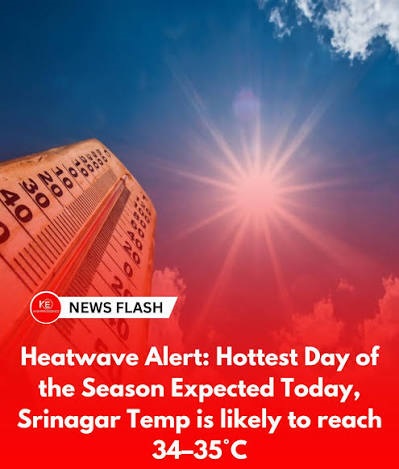
Kashmir Heatwave-Like Spell: Plains Could Approach 35°C as August Ends
By: News Desk | 26 August 2026
Kashmir is bracing for an unusually hot end to August, with temperatures expected to climb further across the Valley’s plains over the next few days. Srinagar and other lower-lying areas could approach 35°C, while the higher tourist destinations of Gulmarg and Pahalgam are expected to remain considerably cooler.
The unusual warmth is emerging after a predominantly dry spell across the Valley.
Srinagar recorded a maximum temperature of 32.7°C on August 26, around 3.4°C above normal, while Qazigund reached 31.6°C and Kupwara 32.3°C. Weather forecasts indicate that the hottest conditions are likely around Friday and Saturday, when some plains could see temperatures close to or around 35°C.
For a region better known for its cool summers and pleasant mountain climate, the numbers are striking.
But this is not simply a story about a hot afternoon.
The late-August spell offers another glimpse into the increasingly complicated relationship between Kashmir’s weather, water availability, agriculture, tourism and a changing Himalayan climate.
Kashmir Temperatures Rising as Dry Weather Persists
The immediate reason for the heat is relatively straightforward: dry weather and strong sunshine are allowing daytime temperatures to climb.
According to recent forecasts, the dry and warm conditions are expected to continue toward the end of August, with the plains experiencing the strongest rise while higher elevations remain comparatively cooler.
On August 26, the contrast across the Valley was already clear:
- Srinagar: 32.7°C
- Kupwara: 32.3°C
- Qazigund: 31.6°C
- Kukernag: 30.8°C
- Pahalgam: 26.8°C
- Gulmarg: 23.4°C
The pattern demonstrates the influence of elevation.
As the terrain rises, temperatures generally fall, making Kashmir’s famous hill destinations significantly more comfortable than the valley floor during a hot spell.
Could Srinagar Really Touch 35°C?
It is possible, but the wording matters.
Local weather reports say Srinagar and several other plains could approach 35°C during the peak of the hot spell.
At the same time, the official IMD Srinagar city forecast currently available shows maximum temperatures around 32°C for August 27–29, with a possibility of more cloudiness and rain later in the period.
That means the most responsible forecast is:
Temperatures may approach 35°C in parts of the plains, but 35°C should not be presented as a guaranteed Valley-wide maximum.
This distinction is important for accurate weather journalism.
Why Does Kashmir Feel So Hot in Late August?
Kashmir’s elevation normally provides a degree of natural relief from extreme summer temperatures.
But elevation does not make the Valley immune to heat.
When skies remain clear and rainfall is limited, intense solar heating can rapidly raise daytime temperatures.
The effect can be particularly noticeable in urban areas, where concrete, asphalt and buildings absorb and retain heat.
This creates a local urban heat effect, making built-up areas feel warmer than surrounding rural or vegetated locations.
Srinagar’s recent reading of 32.7°C was already significantly above its normal maximum for the date.
The Rainfall Deficit Matters Too
The temperature rise is occurring against a backdrop of relatively dry conditions.
Less rainfall means less evaporative cooling at the surface.
When soil and vegetation have less available moisture, more incoming solar energy can contribute directly to heating rather than being used in evaporation.
This creates a feedback that can make dry spells feel increasingly uncomfortable.
Recent climate-monitoring data also show how unusual the broader August pattern has been, although datasets differ in their precise rainfall and temperature calculations. One monitoring dataset recorded substantially below-normal precipitation through the month and a warmer-than-normal monthly mean.
For agriculture, this is potentially more important than the headline temperature itself.
What the Heat Means for Kashmir’s Farmers
Kashmir’s agricultural economy depends heavily on predictable water and weather conditions.
An isolated hot afternoon will not necessarily damage crops.
The concern arises when high temperatures combine with prolonged dryness.
Potential effects include:
- Greater irrigation requirements
- Faster soil moisture loss
- Stress on vegetable crops
- Increased water demand for orchards
- Heat stress on livestock
- Greater pressure on local water sources
Apple orchards could also be affected by weather variability, although the effect depends on crop stage, irrigation availability and local microclimate.
This is why farmers need to look beyond the temperature forecast.
The duration of the dry spell may ultimately matter more than one day’s maximum temperature.
Water Demand Could Become a Growing Concern
Heat changes human behaviour.
People drink more water.
Gardens require more irrigation.
Livestock need additional water.
Agricultural fields dry faster.
That increases demand at precisely the time when dry conditions may be reducing natural replenishment.
Kashmir’s lakes, springs, streams and groundwater systems are already under pressure from pollution, urban expansion and changing precipitation patterns.
A hotter and drier late summer can therefore expose weaknesses in local water management.
Rising Temperatures Could Increase Electricity Demand
The electricity implications are also worth watching.
Kashmir does not experience the same level of air-conditioning demand as India’s hottest plains, but unusually warm weather can still increase electricity consumption through:
- Fans
- Coolers
- Refrigeration
- Commercial cooling
- Water pumping
- Household appliances
If the hot spell lasts several days, peak demand can rise.
That creates an additional challenge for a power system already dealing with seasonal fluctuations and infrastructure constraints.
Gulmarg, Pahalgam and Sonamarg Offer Cooler Conditions
For tourists, the weather divide between the plains and higher reaches could become a major attraction.
Recent observations showed:
Gulmarg — 23.4°C
Pahalgam — 26.8°C
Those temperatures are dramatically lower than the 32–35°C conditions possible in the plains.
This could encourage visitors already in Srinagar to shift toward higher-altitude destinations.
That may benefit tourism businesses in Gulmarg, Pahalgam and other mountain areas, including hotels, restaurants, transport operators and local activity providers.
Could the Heat Change Kashmir’s Tourism Pattern?
Possibly.
Kashmir’s tourism appeal has traditionally included its relatively mild summer climate.
When Srinagar becomes unusually hot, visitors seeking cooler weather may spend more time in the mountains.
This could strengthen demand for:
- Gulmarg stays
- Pahalgam excursions
- Sonamarg trips
- Higher-altitude trekking
- Mountain resorts
- Early-morning and evening outdoor activities
However, tourism operators should not assume that every hot spell automatically translates into a major booking surge.
Travel decisions also depend on rainfall, road conditions, hotel prices, holidays and wider travel trends.
This Is Unusual—but It Is Not Kashmir’s First Extreme Heat Event
Kashmir has experienced several notable heat episodes in recent years.
In June 2026, Srinagar reached 35.3°C, its hottest temperature of that summer at that point, according to reports.
In June 2025, Srinagar recorded 35.2°C, one of its highest June temperatures in decades and around 6.8°C above normal.
Those events provide important context.
A single hot spell does not prove that Kashmir’s entire climate has fundamentally changed.
But repeated unusually warm episodes are worth monitoring because they can indicate shifts in the frequency and duration of extreme temperature events.
Is Climate Change Making Kashmir Hotter?
The answer needs nuance.
Climate change is contributing to long-term warming across the Himalayan region, but it would be scientifically incorrect to say that this specific August hot spell was caused solely by climate change.
Daily weather is influenced by atmospheric circulation, cloud cover, rainfall, soil moisture, winds and regional weather systems.
Climate change operates more slowly by shifting the underlying probability and intensity of certain extremes.
In simple terms:
Weather determines what happens today. Climate change influences the conditions under which today’s weather occurs.
That distinction is crucial.
The Himalayan Climate Is Changing
The broader evidence of Himalayan warming is much stronger than any single temperature event.
Scientific assessments have documented major changes in the region’s glaciers, snow cover and water systems.
ICIMOD’s recent assessment found that glaciers across the Hindu Kush Himalaya have been losing ice at an accelerating rate, with the rate of loss since 2000 approximately twice that recorded during the previous decades.
This matters for Kashmir because its rivers, streams and agricultural systems are connected to the wider Himalayan cryosphere.
Changes in snow and ice affect the timing and availability of water.
At the same time, rainfall variability can create a strange contradiction:
More intense rainfall events can occur alongside longer dry periods.
That makes water management increasingly difficult.
Hotter Does Not Always Mean Drier
Another common misconception is that climate change simply means less rain.
The reality is more complicated.
A warmer atmosphere can hold more moisture, potentially supporting heavier precipitation when suitable weather systems develop.
At the same time, changes in atmospheric circulation can produce extended dry periods.
For Kashmir, this could mean greater variability:
dry spells → intense rainfall → flooding → renewed dry weather.
Such swings are more difficult for farmers, cities and water managers to handle than predictable seasonal rainfall.
Srinagar’s Urban Heat Challenge
The temperature story also has an urban dimension.
As Srinagar expands, more land is covered by:
- Concrete
- Asphalt
- Buildings
- Parking areas
- Roads
These surfaces absorb solar radiation and release heat slowly.
Vegetation and open soil provide evaporative cooling, but dense construction reduces those natural cooling mechanisms.
That means future urban planning should consider heat resilience alongside flood management.
Measures such as urban trees, green spaces, shaded public areas, reflective surfaces and better building design can help reduce heat exposure.
Kashmir Needs to Think About Heat and Water Together
Heat management and water management are usually treated as separate policy issues.
They should not be.
Hot weather increases water demand.
Dry weather can reduce water availability.
Higher temperatures increase evaporation.
Agriculture needs additional irrigation.
Urban populations consume more water.
The result is a single interconnected challenge.
Kashmir’s future climate planning needs to manage temperature, rainfall and water as one system.
What Residents Can Do During the Hot Spell
Even temperatures in the low-to-mid 30s can be uncomfortable for people unaccustomed to prolonged heat.
Residents can reduce heat stress by:
- Drinking water regularly.
- Avoiding unnecessary midday outdoor activity.
- Wearing light, breathable clothing.
- Using shade during peak afternoon hours.
- Checking on elderly people and young children.
- Avoiding strenuous outdoor work during the hottest part of the day.
- Keeping homes ventilated where practical.
- Taking extra care with outdoor workers and livestock.
People with existing health conditions should follow medical advice during unusually hot weather.
A Changing Tourism Calendar?
The late-August heat also raises a longer-term tourism question.
Kashmir’s tourism economy has traditionally benefited from its reputation as a cool summer destination.
If hot spells become more frequent, visitors may increasingly favour higher-altitude destinations, particularly during the warmest periods.
That could redistribute tourism rather than simply reduce it.
But this comes with another environmental challenge.
More visitors moving toward fragile mountain areas can increase pressure on:
- Water resources
- Roads
- Waste systems
- Forests
- Local accommodation
- Mountain ecosystems
Climate adaptation therefore needs to be accompanied by sustainable tourism planning.
The Real Warning Behind Kashmir’s Late-August Heat
The most important point is not whether Srinagar reaches exactly 34°C or 35°C.
The larger issue is the frequency, duration and combination of unusual weather events.
Kashmir has experienced extreme heat, intense rainfall, cloudbursts and flash floods in recent years.
When those events become more variable, infrastructure designed around historical averages can struggle.
A drainage system must cope with intense rain.
A water system must survive dry periods.
Agriculture must manage heat and irregular rainfall.
Tourism must adapt without damaging the landscapes visitors come to see.
And cities must prepare for both flooding and heat.
What Kashmir Needs Next
The response should go beyond issuing weather forecasts.
Better Local Weather Monitoring
More high-resolution observations can improve district-level warnings.
Climate-Resilient Agriculture
Farmers need efficient irrigation, soil-moisture management and crop planning suited to changing weather.
Urban Greening
Trees and green spaces can reduce local heat while providing wider environmental benefits.
Water Conservation
Rainwater harvesting, spring protection and efficient irrigation can strengthen water security.
Tourism Planning
Higher visitor numbers should not overwhelm fragile mountain ecosystems.
Heat-Health Awareness
Residents need practical guidance when temperatures rise unusually high.
Conclusion: Kashmir’s Heat Is More Than a Temperature Story
The late-August heatwave-like spell is a striking reminder that Kashmir’s climate is not defined by cool mountain weather alone.
With Srinagar already reaching 32.7°C on August 26 and forecasts suggesting that parts of the Valley’s plains could approach 35°C, the next few days are likely to feel unusually hot for late August.
At the same time, the higher reaches will continue to offer a much cooler environment, with recent readings of 23.4°C in Gulmarg and 26.8°C in Pahalgam highlighting the sharp elevation-driven contrast.
The immediate advice is simple: stay hydrated, limit strenuous activity during the hottest hours and keep an eye on updated forecasts.
But the longer-term lesson is bigger.
Kashmir needs to prepare for a future in which heat, drought, intense rainfall and water stress can occur in increasingly unpredictable combinations.
The question is no longer whether Kashmir can experience extreme weather.
It already can.
The challenge is making sure its cities, farms, tourism economy and fragile Himalayan ecosystems are resilient enough to cope with what comes next.


