Yasin Malik’s Two Big Decisions From Tihar: Divorce From Mushaal, Death Penalty Plea in Sarla Bhat Case
By: Javid Amin | 03 September 2026
Jailed JKLF chief Yasin Malik has announced his decision to separate from his Pakistani wife Mushaal Hussein Mullick and, in the 1990 Sarla Bhat murder case, said he will not contest the proceedings while asking the court to impose capital punishment on him. The developments have brought his personal life and one of Kashmir’s most painful unresolved cases back into public focus.
The latest developments involving jailed Jammu Kashmir Liberation Front (JKLF) chief Yasin Malik have opened two very different but deeply consequential chapters at the same time.
From Tihar Jail, Malik has announced his decision to divorce his Pakistani wife, Mushaal Hussein Mullick. At the same time, in the long-pending case concerning the abduction and killing of Kashmiri Pandit nurse Sarla Bhat in 1990, he has told a Srinagar court that he does not wish to contest the proceedings further and has asked for capital punishment.
The legal development is particularly striking because Malik has denied any involvement in Sarla Bhat’s killing and has maintained that he was falsely implicated. His request for the death penalty, therefore, is not an admission of guilt. In his affidavit, he specifically said that his decision not to contest the proceedings should not be treated as acceptance of the prosecution’s allegations.
The case has now entered another dramatic phase, 36 years after Bhat’s killing.
Sarla Bhat case: What exactly has Yasin Malik said?
The central issue is not that Malik has demanded punishment for other people convicted in the case. Rather, he has asked the court to award capital punishment to him.
In a 25-page affidavit submitted before the Srinagar court, Malik said that, after what he described as deep reflection, he had decided not to contest the trial proceedings further. At the same time, he insisted that this decision did not mean he accepted the allegations against him.
He has described the case as politically motivated and disputed the prosecution’s allegations connecting him to the killing.
That distinction matters because the legal proceedings are still pending. Malik’s statement does not itself amount to a judicial finding of guilt, nor does his request automatically result in a death sentence. The court will have to consider the prosecution’s case, evidence and applicable law before reaching any conclusion.
The next hearing has been listed for September 19, 2026, according to current reports.
Who was Sarla Bhat?
Sarla Bhat was a 27-year-old Kashmiri Pandit nurse associated with the Sher-i-Kashmir Institute of Medical Sciences (SKIMS) in Srinagar.
She was abducted in April 1990, during one of the darkest periods of militancy in Kashmir. Her body was subsequently recovered in Srinagar, and her killing became one of the cases associated with the violence that accompanied the exodus of Kashmiri Pandits from the Valley.
The case remained unresolved for decades.
In June 2026, the State Investigation Agency (SIA) filed a 737-page chargesheet before the special court in Srinagar. Malik was named among five JKLF operatives accused in the case. Three of the other accused have since died, while Khursheed Ahmad Chalkoo has been reported absconding.
The chargesheet reopened a painful chapter for Bhat’s family, who had waited decades for the case to move forward.
Her family has previously expressed frustration over the extraordinary delay and demanded the harshest punishment for those found responsible.
Malik disputes the prosecution’s case
Malik’s affidavit goes beyond a simple denial.
He has challenged the prosecution’s account and questioned evidence that, according to him, has surfaced decades after the killing. Among the issues he has raised is an alleged handwritten JKLF note said to have been recovered from the crime scene.
According to reports on his affidavit, Malik questioned why such evidence and allegations linking him to the killing were not part of the original investigation if they were available at the time. He also denied ordering the killing or treating Bhat as someone working for security agencies.
His position is therefore unusual: he denies involvement, says he has been falsely implicated, but simultaneously refuses to contest the proceedings and asks for capital punishment.
That contradiction is now at the centre of the public debate surrounding the case.
Why the death-penalty request has attracted attention
Malik’s request has generated considerable attention because it departs from the conventional legal strategy of an accused person facing a serious criminal prosecution.
Instead of seeking more time to build a defence, he has said he will not contest the proceedings further.
Yet his affidavit also makes clear that he does not regard this as an admission of guilt.
The difference between the two positions is legally important. A refusal to contest proceedings and a confession are not automatically the same thing. The court still has to determine the case on the basis of the law and evidence before it.
Politically, however, the statement carries a much larger weight.
For critics of Malik and the separatist movement, the episode reinforces longstanding questions about accountability for the violence of the 1990s. For those who continue to defend Malik’s political position, his affidavit is likely to be viewed through the larger dispute over Kashmir’s history, militancy and the criminal justice system.
The court, rather than political narratives, will ultimately determine the legal consequences.
The personal decision: Malik announces divorce from Mushaal
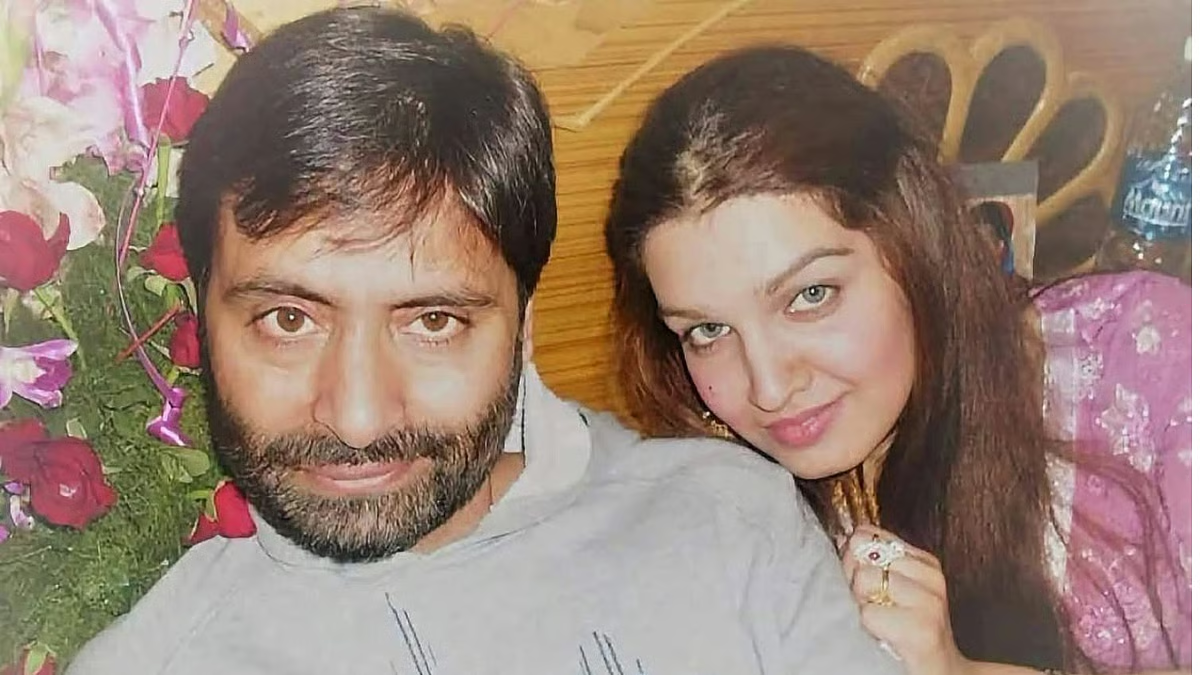
Alongside the courtroom development came another striking announcement: Malik has decided to divorce his Pakistani wife, Mushaal Hussein Mullick.
Reports quoting his statement say Malik referred to the long separation between the couple. He has been lodged in Tihar Jail since 2019, while Mushaal has remained in Pakistan. Reports say Malik stated that they had not met or communicated for years.
The couple married in 2009 and have a daughter, Raziya Sultana.
The decision has inevitably attracted public attention because Mushaal herself has been a visible figure in discussions surrounding Malik’s imprisonment and Kashmir.
But beyond the political symbolism, the decision is also a personal matter involving a family that has spent years separated by imprisonment, geography and political circumstances.
Malik’s statement reportedly presents the divorce as an attempt to release Mushaal from a relationship affected by his prolonged incarceration and circumstances.
A personal decision entering a highly political space
In Kashmir, the private and political have often overlapped.
Malik’s marriage had itself once attracted considerable media attention because Mushaal was from Pakistan and later became publicly associated with campaigns surrounding her husband’s imprisonment.
His latest decision is therefore unlikely to remain purely private.
Yet there is also a risk in treating every personal development involving a political figure exclusively through a political lens.
The divorce concerns a family relationship. The Sarla Bhat proceedings, by contrast, concern a criminal case involving allegations dating back to the early years of militancy.
Keeping those two questions separate is important even though they have emerged from the same statement.
The larger significance of the Sarla Bhat case
The Sarla Bhat case is not simply another old criminal investigation.
It is connected to one of the most traumatic periods in modern Kashmir’s history.
The early 1990s saw the escalation of militancy, targeted killings, fear and the eventual large-scale displacement of Kashmiri Pandits from the Valley. Individual cases from that period have continued to carry emotional and political significance for displaced families.
For Bhat’s family, the passage of 36 years has itself become part of the story.
When the SIA filed the chargesheet in June, relatives described the development as long overdue. The family had already spent decades waiting for accountability.
The renewed proceedings therefore carry significance beyond the fate of one accused person.
They also test whether old cases from Kashmir’s insurgency era can still be pursued through the criminal justice system after decades of delay.
What happens next?
The immediate focus will now shift back to the court.
Malik has stated that he will not contest the proceedings, but he has simultaneously denied the allegations. The prosecution will still have to establish its case according to law.
The next hearing is scheduled for September 19.
The court will ultimately have to examine the chargesheet, evidence and legal submissions before deciding Malik’s culpability, if any, and the appropriate legal consequence.
His request for capital punishment does not bypass that process.
A moment that carries three different meanings
Yasin Malik’s latest statement has effectively brought three narratives together.
There is the legal narrative — an accused person denying involvement while declining to contest proceedings and asking for capital punishment.
There is the historical narrative — the reopening of a 36-year-old case involving the killing of a young Kashmiri Pandit nurse during the turbulent beginnings of militancy.
And there is the personal narrative — a jailed man announcing the end of a marriage after years of separation from his wife and daughter.
All three are now unfolding simultaneously.
For the Sarla Bhat family, the most important question remains whether the judicial process can finally establish accountability after more than three decades.
For Malik, his affidavit represents a dramatic new chapter in his long legal battle.
And for Kashmir’s wider political discourse, the case once again brings the unresolved legacy of the 1990s into focus — where questions of justice, memory, militancy, displacement and political identity remain closely intertwined.
Whatever the political interpretations, the decisive question now belongs to the court: what does the evidence establish, and what does the law require?
