Kashmir Jama Masjid Peace Prayers: Mirwaiz Calls for Public Support to MMU Social Reform Drive
By: News Desk | 17 September 2026
From global wars to Kashmir’s social problems, Friday congregation hears call for collective action on addiction, youth distress, family breakdown and environmental damage
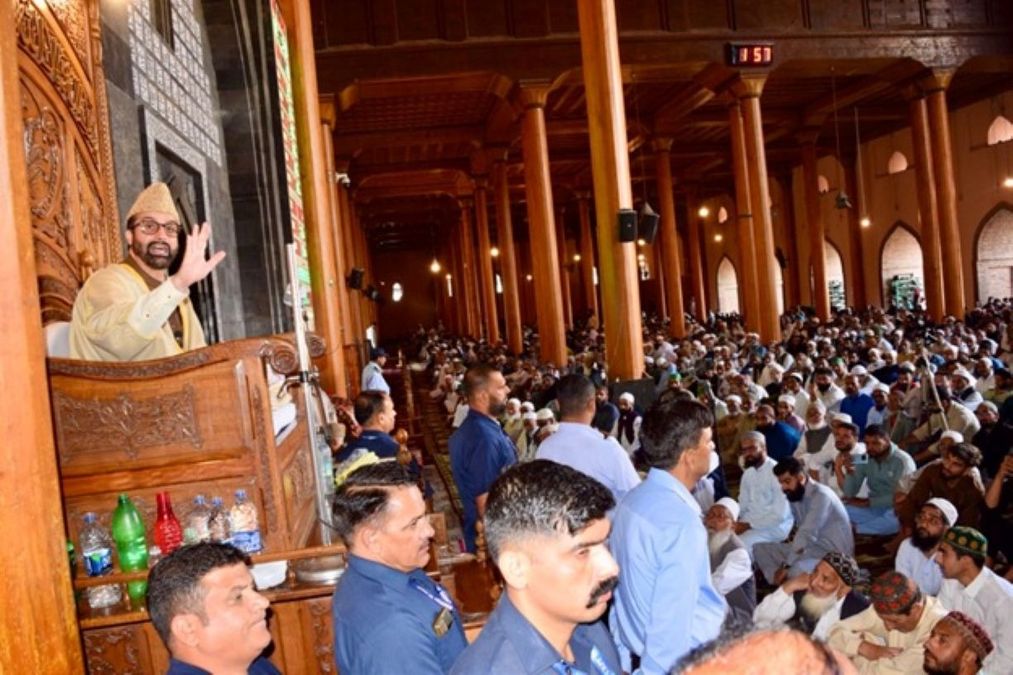
Srinagar: The historic Jama Masjid in Srinagar became a setting for two conversations on Friday that might appear geographically distant but are closely connected by one idea: the search for peace.
As worshippers gathered for Friday prayers on September 18, special prayers were offered for people caught in conflicts in Iran, Palestine, Lebanon, Yemen, Ukraine and other conflict-affected parts of the world.
But the address by Mirwaiz Umar Farooq quickly turned the congregation towards problems closer to home.
The Kashmir chief cleric urged people to actively participate in a newly renewed social-reform initiative of the Muttahida Majlis-e-Ulema (MMU) Jammu and Kashmir, calling for collective action against drug abuse, suicide and self-harm, emotional distress among young people, irresponsible social-media use, weakening family relationships and environmental degradation.
The message was significant not simply because it came from the pulpit of Kashmir’s most prominent historic mosque.
It followed an MMU conference held only days earlier, where more than 70 ulema and religious scholars from Jammu and Kashmir and Ladakh adopted two resolutions aimed at turning religious institutions into more active participants in addressing social problems.
The proposed campaign goes beyond occasional sermons.
The MMU says participating mosques will take up common social issues during designated Friday sermons, while regular district-level meetings involving ulema, imams, mosques and madrasas are also planned.
That makes the September 2026 initiative less about a single speech and more about an attempt to build a coordinated community network.
From a prayer for global peace to Kashmir’s social crisis
The Friday congregation began with prayers for victims of conflicts beyond Kashmir.
Worshippers prayed for peace, justice and relief for people suffering in Iran, Palestine, Lebanon, Yemen, Ukraine and other conflict zones.
Mirwaiz then turned to the social challenges facing Kashmir.
His central argument was straightforward: resolutions and conferences cannot change society unless ordinary people participate.
The appeal was directed not only at religious scholars, but also at parents, young people, mosque committees, madrasas and neighbourhoods.
The MMU’s stated objective is to move social reform from discussion into everyday community life.
That includes talking about issues that are often difficult to discuss publicly, particularly suicide, emotional distress, addiction and family problems.
It is an important shift in emphasis.
Instead of treating social problems as matters for government departments alone, the initiative seeks to place prevention and early intervention within communities themselves.
What exactly has the MMU decided?
The September 15 conference in Srinagar adopted two broad resolutions.
The first focused on contemporary social challenges and the role of ulema, mosques and madrasas.
The second dealt with unity within the Muslim Ummah, sectarian harmony and respect for differences among schools of thought. More than 70 scholars and religious representatives from different parts of J&K and Ladakh attended the gathering.
The social-reform resolution identified several concerns:
- drug and substance abuse
- suicide and self-harm
- depression and emotional distress among youth
- irresponsible social-media use
- weakening family bonds
- social alienation
- moral concerns
- environmental degradation
The MMU also stressed that condemnation alone is not enough, particularly in relation to suicide and mental-health problems.
It called for communities to create spaces where people experiencing loneliness, anxiety, emotional distress and family pressure can speak without fear of stigma, while encouraging referral to professional mental-health services when required.
That qualification is important.
The initiative does not position religious institutions as replacements for doctors, psychiatrists or counsellors.
Instead, the proposed role is one of awareness, early identification, support and referral.
Why drug addiction has become a central issue
The focus on drugs is not new.
Mirwaiz said earlier this year that an MMU campaign against drug abuse began around 2014, with an emphasis on the role mosques and imams could play in confronting addiction.
What has changed is the scale of the discussion.
Drug addiction is increasingly being viewed not only as a policing issue but as a public-health and social problem.
For families, addiction can mean debt, domestic conflict, educational disruption and social isolation. For young people, it can intersect with unemployment, anxiety and a lack of constructive opportunities.
The MMU’s 2026 resolution therefore calls for a consistent response to addiction rather than isolated awareness programmes.
The organisation has also criticised the availability and promotion of alcohol in J&K, arguing that a campaign against narcotics should not ignore other intoxicants. That position is a religious and policy argument advanced by the MMU, rather than an established causal conclusion about alcohol and suicide.
Suicide and emotional distress: a particularly sensitive part of the campaign
Perhaps the most consequential element of the MMU initiative is its decision to openly discuss suicide and self-harm.
That is significant in a society where stigma can make conversations about mental illness extremely difficult.
The MMU resolution argues that simply condemning suicide does not address the underlying problem. Instead, religious leaders should help families recognise emotional distress and encourage people experiencing serious difficulties to seek professional assistance.
That approach is consistent with an important principle in suicide prevention: moral judgement can drive vulnerable people further into isolation, while early recognition and access to appropriate care can create an opportunity for intervention.
For mosques, the practical challenge will be maintaining that balance.
A sermon can encourage someone to seek help.
An imam can notice a young person withdrawing from community life.
A family can be encouraged to listen rather than shame.
But serious depression, suicidal behaviour and psychiatric illness still require trained professionals.
The MMU’s own resolution acknowledges that distinction.
The social-media problem is moving into the pulpit
Another feature of the 2026 campaign is its focus on irresponsible social-media use.
This reflects a growing concern among parents, educators and religious leaders about the way online platforms influence young people’s social lives.
The issue is broader than screen time.
Social media can amplify comparison, harassment, misinformation, addictive behaviour and social pressure. At the same time, it can provide valuable access to education, communication and support.
The MMU’s position is therefore better understood as a call for responsible use rather than a simple rejection of digital technology.
That distinction will matter if the initiative is to connect with Kashmir’s younger generation.
A campaign aimed at young people cannot simply tell them to abandon the digital world.
It has to help them navigate it.
Family breakdown is another target
The MMU has also identified weakening family bonds as a growing social concern.
This is not the first time the organisation has addressed family and social reform.
In 2019, the MMU coordinated Ramadan sermons focusing on women’s rights, women’s participation in mosques and domestic violence, an initiative reported at the time as cutting across different religious traditions within Kashmir’s Muslim community.
In 2022, an MMU resolution called for broader social reform and raised concerns about excessive spending at weddings and celebrations, while urging assistance for poorer sections of society.
The 2026 initiative builds on that broader approach.
The emphasis is no longer restricted to individual religious observance.
It includes relationships, family responsibilities, addiction, mental health and community welfare.
The environmental issue is a new dimension
Perhaps the most notable expansion of the MMU’s agenda is the inclusion of environmental degradation.
The September resolution treats environmental damage as a social concern rather than merely an administrative or scientific issue.
That reflects a wider change in Kashmir’s public conversation.
Pollution, waste, shrinking water bodies and ecological damage increasingly affect ordinary life. The environmental question is therefore not separate from social wellbeing.
For religious institutions, environmental stewardship can be framed through ideas of responsibility, cleanliness and protection of shared resources.
The practical question will be whether sermons eventually translate into sustained local action.
A Friday sermon about waste management is useful.
A mosque community organising regular neighbourhood clean-ups is more consequential.
A coordinated Friday sermon campaign could change the scale
The most ambitious part of the MMU plan is the proposal for common social themes to be discussed in participating mosques on designated Fridays.
This could give the campaign something that many awareness drives lack: repetition and reach.
Kashmir’s mosques are deeply embedded in neighbourhood life.
An issue discussed once at a conference may reach hundreds.
An issue discussed repeatedly across hundreds of mosques can become part of everyday conversation.
The MMU also plans regular meetings at district and local levels involving religious scholars, imams, mosques and madrasas. The stated purpose is to identify local concerns and develop responses suited to individual communities.
That is potentially the most practical part of the initiative.
Social problems do not look identical in Srinagar, Shopian, Kupwara, Kargil, Doda or Rajouri.
A community dealing with drug addiction may require a different response from one primarily concerned with domestic violence or environmental degradation.
Local consultation could therefore make the campaign more relevant.
A history that is more complicated than the supplied timeline
The MMU has been active in social and religious issues for years, but the evidence does not support presenting a neat sequence of formal campaigns in 2010, 2016, 2019, 2022 and 2024 as though each year marked a separate officially titled MMU programme.
The documented record is more uneven.
Around 2014: anti-drug campaign
Mirwaiz said in 2026 that the MMU’s campaign against drug abuse had begun around 2014, with emphasis on involving mosques and imams.
2019: women and domestic violence
The MMU coordinated Ramadan sermons on women’s rights, including domestic violence and the role of women in mosques.
2021-22: social reform and addiction
MMU meetings during this period raised concerns about drug use, suicide, domestic violence and problems affecting children and youth. In 2022, the organisation also called for broader social reform and greater community support for vulnerable people.
2023: crime, addiction and youth concerns
During Ramadan in 2023, MMU urged religious preachers to focus on crime, drug addiction, domestic violence, suicide and youth waywardness.
2024: unity and social reform
An MMU-linked conference in Shopian focused on “Unity of the Ummah and Social Reform”, again demonstrating that social reform and communal unity remained part of the organisation’s agenda.
2026: coordinated, wider social programme
The September 2026 initiative goes further by explicitly combining addiction, suicide prevention, youth distress, social media, family relationships and environmental degradation with a proposal for coordinated sermons and regular district-level follow-up.
The evolution is therefore real, but it is better described as a gradual expansion of the MMU’s social-reform agenda rather than a rigid annual campaign timeline.
Why the initiative matters beyond the mosque
The MMU is not a government agency.
It cannot run hospitals, create jobs or enforce environmental regulations.
Its influence comes from something different: access to communities.
A mosque can be among the first places where a family notices a young person’s withdrawal, an addiction problem or a growing dispute at home.
That proximity can be useful.
But it also creates responsibilities.
If religious leaders discuss suicide, they need to avoid language that increases shame.
If they address addiction, they need to encourage treatment rather than simply condemnation.
If they speak about family breakdown, victims of domestic violence must not be encouraged to remain in dangerous situations simply to preserve social appearances.
And if mental health becomes part of the sermon, professional psychiatric and psychological care should be presented as compatible with seeking spiritual guidance, not as its opposite.
The MMU’s 2026 resolution appears to recognise this distinction by explicitly referring people towards professional counselling and mental-health support where necessary.
The politics cannot be completely separated from the social message
The Jama Masjid has never been merely an ordinary place of worship in Kashmir’s public life.
Mirwaiz Umar Farooq is both a religious leader and a prominent political figure, and the Jama Masjid has historically been an important platform for religious, social and political discourse.
That history means even an explicitly social campaign can have a wider public resonance.
The current initiative, however, is framed primarily around community reform rather than a political programme.
Its stated concerns are addiction, mental health, families, youth, environment and religious unity.
The political context remains relevant because public institutions in Kashmir often operate within a highly sensitive social environment.
But it would be misleading to automatically treat every community initiative from the Jama Masjid as political mobilisation.
The more immediate question is whether the campaign can deliver measurable social outcomes.
What success would actually look like
For the MMU initiative to become more than another series of Friday sermons, the results will need to be visible beyond the pulpit.
Success could mean:
More young people reaching treatment for addiction before a crisis develops.
Families seeking counselling instead of hiding mental-health problems.
Victims of domestic violence being connected with appropriate services.
Mosques developing referral links with doctors, counsellors and rehabilitation centres.
District-level ulema identifying specific local social problems.
Community groups taking sustained action on waste and environmental degradation.
And perhaps most importantly, young people themselves becoming participants rather than simply the subjects of sermons.
The MMU resolution specifically speaks of youth engagement and community welfare, suggesting that the initiative will have to build trust with a generation whose relationship with traditional institutions is changing.
From the mimbar to the neighbourhood
The most revealing line in Mirwaiz’s September 18 appeal was not about any individual social problem.
It was the insistence that conferences and resolutions alone cannot produce change.
That is the real test facing the MMU now.
Kashmir has held countless conferences about drugs, unemployment, mental health, family problems and environmental degradation.
The challenge has rarely been identifying the problems.
The challenge is sustaining action after the microphones are switched off.
The 2026 MMU initiative is attempting to close that gap by taking common themes into Friday sermons and establishing regular local meetings.
If implemented consistently, it could give religious institutions a more structured role in community welfare.
But it will also require collaboration.
Imams cannot replace psychiatrists.
Religious guidance cannot replace addiction treatment.
Sermons cannot replace effective policing against drug networks.
Mosques cannot replace government environmental agencies.
And moral advice cannot substitute for employment, education or social services.
The strongest version of the initiative would recognise those limits while using the enormous community reach of Kashmir’s religious institutions to connect people with the help that already exists.
Kashmir’s social reform debate enters a new phase
The prayers at Jama Masjid on September 18 connected two forms of suffering: people caught in wars far from Kashmir and families confronting problems inside their own homes.
That connection is perhaps what makes the latest MMU initiative notable.
The organisation is attempting to place global peace, personal wellbeing and community responsibility within the same moral conversation.
The broader social landscape will determine whether that message gains lasting traction.
Kashmir’s drug problem will not disappear through sermons alone.
Suicide cannot be prevented through moral warnings alone.
Family breakdown cannot be solved without addressing economic and emotional pressures.
Environmental degradation requires action beyond religious institutions.
But the mosque occupies a unique position in Kashmiri society.
If that position is used to reduce stigma, encourage treatment, bring families together, engage young people and turn environmental concern into practical community action, the impact could extend well beyond Friday prayers.
For now, the September 2026 initiative represents an important evolution in the MMU’s documented social-reform work: from individual appeals and periodic resolutions towards a more coordinated attempt to make social issues a regular part of community life.
The real measure of its success will not be how many people hear the message.
It will be what happens after they leave the mosque.


