Mirwaiz-led MMU Turns Spotlight on Kashmir’s Social Crisis, Calls for Muslim Unity and Community Reform
By: News Desk | 15 September 2026
Drug abuse, youth distress, family problems, social media misuse and environmental degradation emerge as major concerns as religious scholars call for coordinated community action across J&K
Srinagar: The Muttahida Majlis-e-Ulema (MMU) Jammu and Kashmir has placed some of the Valley’s most pressing social concerns at the centre of religious discourse, adopting two broad resolutions on drug and substance abuse, youth distress, weakening family bonds, environmental degradation and unity among Muslims.
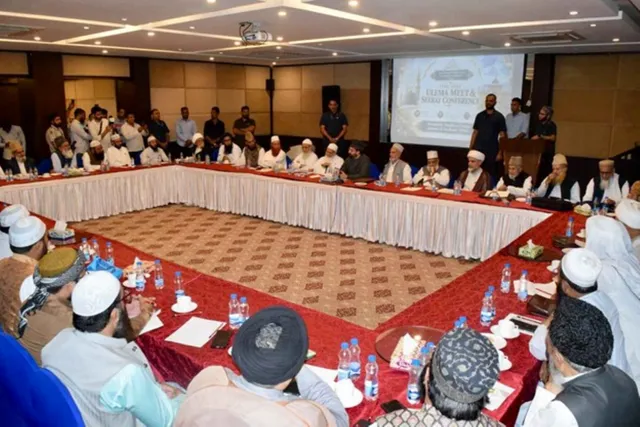
The resolutions were adopted at a one-day Ulema Meet and Seerat Conference in Srinagar on September 15, chaired by Mirwaiz Umar Farooq. The gathering brought together more than 70 Ulema and Mashaikh from Jammu and Kashmir and Ladakh, including religious scholars from Kashmir as well as Jammu, Poonch, Rajouri, Kargil and Doda. The conference was held after a gap of more than two years following permission from the authorities.
What makes the meeting significant is not simply the number of religious scholars who participated, but the breadth of issues placed before the MMU. Its resolutions moved beyond conventional religious messaging and addressed addiction, suicides and self-harm, mental and emotional distress among young people, social-media behaviour, family pressures, environmental degradation and the relationship between different schools of Islamic thought.
The message was essentially that social problems cannot be addressed only through government institutions or individual families; religious institutions, according to the MMU, also have a responsibility to participate in prevention, awareness, counselling and community welfare.
From the mosque to the wider community
One of the most notable aspects of the resolutions is the proposed expansion of the role of mosques and madrasas.
The MMU called for religious institutions to function not only as places of worship and religious education but also as centres for youth engagement, family support, guidance and community welfare.
The conference particularly highlighted the need to respond more sensitively to young people experiencing loneliness, anxiety, family pressure and emotional distress.
Rather than treating suicide and self-harm simply as moral or religious failures, the resolution stressed the importance of creating spaces where people can speak about their difficulties without fear of stigma. It also urged Ulema and Imams to recognise signs of emotional distress and encourage families to seek professional counselling and mental-health assistance where necessary.
That emphasis is significant because it places religious leadership alongside, rather than necessarily in place of, professional support systems.
The MMU’s proposal also acknowledges a practical reality of Kashmiri society: mosques and religious institutions remain deeply embedded in neighbourhood life. Their proximity to families gives local religious leaders an opportunity to identify social problems early, provided they have the necessary awareness and are prepared to refer serious cases to qualified professionals.
Drug abuse becomes a community concern
Drug and substance abuse was another major concern at the conference.
The MMU called for a consistent approach to addiction and expressed concern about the impact of substance abuse on young people and families.
The organisation also questioned the expansion of alcohol availability in the name of tourism, arguing that efforts to combat addiction could be undermined if alcohol availability simultaneously expands.
This part of the resolution moves the MMU’s intervention into the realm of public policy. While the organisation’s position is rooted in its religious and social outlook, the issue it has raised intersects with broader questions about addiction prevention, public health, tourism policy and the availability of intoxicating substances.
The larger question is therefore not merely what religious leaders say about addiction, but how community awareness, rehabilitation, policing, healthcare and government policy can operate together.
A sermon can raise awareness, but sustained recovery requires medical, psychological and social support. The MMU’s reference to professional counselling in the context of emotional distress points towards precisely this need for a wider support network.
Youth alienation and the changing social landscape
The resolutions also drew attention to what the MMU described as an increasing disconnect between young people and religious and community institutions.
That concern comes at a time when young Kashmiris increasingly receive information, entertainment and social interaction through digital platforms rather than traditional community structures.
The conference specifically identified irresponsible social-media use as one of the challenges affecting society.
The issue is therefore larger than the question of religious observance. It concerns how families, schools, religious institutions and young people negotiate an increasingly digital social environment.
The MMU’s proposed response — common Friday sermons, community programmes and regular district-level meetings — suggests an attempt to take religious guidance beyond occasional public addresses and turn it into a more coordinated grassroots effort.
Common Friday sermons: an attempt at coordinated intervention
One of the practical proposals emerging from the conference was the use of designated Friday sermons to address common social issues across participating mosques.
The idea is straightforward: rather than individual religious institutions addressing social problems in isolation, participating Ulema could focus on a common issue on a designated Friday and create a region-wide awareness campaign.
The MMU also proposed regular, preferably monthly, meetings in different districts and areas involving local Ulema, Imams, mosques and madrasas.
If implemented consistently, this would give the organisation a more structured community-outreach mechanism rather than limiting its role to issuing statements during crises.
The effectiveness of such an initiative, however, would ultimately depend on implementation — including the quality of awareness material, coordination with professionals, local participation and whether vulnerable individuals are actually connected with appropriate services.
Environment enters the religious discourse
The conference also extended its social agenda to environmental protection.
The MMU urged people to reduce the use of plastic and polythene, avoid littering and dumping waste into rivers, lakes and other water bodies, and oppose encroachment and destruction of wetlands.
Specific concern was expressed over Dal Lake, Wular Lake, Nigeen Lake and other wetlands and water bodies.
The MMU framed environmental conservation not merely as a civic responsibility but as a moral and religious obligation.
This is an important development in the evolution of community messaging because Kashmir’s environmental problems increasingly affect everyday life — from water quality and waste management to shrinking wetlands and pressure on the Valley’s lakes.
By taking these concerns into Friday sermons and mosque-based programmes, religious institutions could potentially become another channel for environmental awareness.
But here too, awareness alone cannot replace enforcement, scientific management or government action. The challenge is converting moral messaging into changes in public behaviour.
The second resolution: unity despite differences
The conference’s second resolution focused on unity within the Muslim Ummah and mutual respect between different schools of thought.
The MMU acknowledged that differences in Maslak and religious interpretation have historically existed and will continue to exist. The emphasis, however, was that such differences should not become a source of hatred, hostility or social division.
The resolution urged Ulema to promote dialogue, mutual respect and brotherhood and warned against using mosque pulpits to ridicule or attack followers of another school of thought.
This is not an entirely new theme for the organisation.
In January 2024, the MMU had similarly appealed to scholars, preachers, Imams and Khateebs from different schools of thought to avoid sectarian criticism and focus public religious discourse on fundamental Islamic teachings and broader unity.
In July 2024, a Shia-Sunni coordination meeting held under the MMU banner also called for dialogue, mutual respect and restraint in sermons and social-media discourse during Muharram.
The latest resolution therefore appears less like an isolated appeal and more like a continuation of the MMU’s recent emphasis on sectarian harmony.
From religious unity to social responsibility
The recent meeting also illustrates how the MMU’s public interventions increasingly overlap with broader questions of social welfare.
In 2024, the organisation was active on issues ranging from sectarian harmony to the Waqf Amendment Bill and alleged hate speech.
In 2026, its messaging has again placed considerable emphasis on social cohesion and community concerns.
That does not mean that the organisation has abandoned religious questions. Rather, its recent public agenda demonstrates an effort to connect religious leadership with issues affecting everyday life.
The September 15 resolutions are particularly notable because they bring together several problems that are often treated separately: addiction, mental distress, family instability, social-media influence, environmental decline and sectarian tensions.
The MMU’s underlying argument is that these problems have a community dimension and therefore require collective responses.
A changing role for religious institutions
The developments also raise a broader question about the role of religious institutions in contemporary Kashmir.
For decades, mosques and religious scholars have been important sources of spiritual guidance and community mobilisation. But the social environment facing young Kashmiris has changed dramatically.
Drug addiction, online influence, family pressures, mental-health challenges and environmental degradation cannot be addressed through religious instruction alone.
At the same time, religious institutions have a degree of social reach that government agencies and formal institutions may not always possess.
The challenge is therefore one of coordination.
Religious leaders can contribute to awareness and reduce stigma. Families can provide support. Schools and colleges can identify vulnerable students. Healthcare professionals can provide diagnosis and treatment. Rehabilitation centres can address addiction. Civil society can assist with outreach. Government agencies can provide policy, funding and enforcement.
The MMU’s latest resolution can be read as an attempt to bring at least one part of that wider network into a coordinated conversation.
The political context cannot be ignored
Although the September 15 conference was primarily framed around religion and social reform, the MMU operates within Kashmir’s broader and highly sensitive socio-political environment.
Mirwaiz Umar Farooq is simultaneously a religious leader and a prominent public figure whose statements have frequently entered political and constitutional debates.
That context means that major gatherings under his chairmanship inevitably attract attention beyond the purely religious sphere.
Yet the specific resolutions adopted this time were predominantly focused on social and community issues rather than electoral politics. The documented agenda centred on addiction, mental and emotional distress, family problems, environmental degradation and Muslim unity.
That distinction matters.
It would be too simplistic to interpret every MMU gathering primarily through a political lens. At the same time, it would also overlook the social influence of religious institutions in Kashmir to treat such resolutions as merely internal religious matters.
The more useful reading is that the MMU is seeking to exercise influence through community reform and social guidance at a time when Kashmir’s public institutions are confronting a range of social challenges.
The significance of the two-year gap
The conference was also notable because it took place after a gap of more than two years following permission from the authorities.
More than 70 religious scholars and spiritual figures from different parts of J&K and Ladakh attended, giving the gathering a wider geographical character.
The participation of scholars from Jammu, Poonch, Rajouri, Kargil and Doda alongside those from Kashmir also allowed the MMU to present its message as one extending beyond a single district or sectarian constituency.
Whether this translates into sustained coordination remains to be seen.
The proposed monthly district meetings and coordinated Friday sermons provide a mechanism for testing that commitment.
Beyond resolutions: the test of implementation
The most important question now is what happens after the conference.
A resolution against drug abuse does not by itself reduce addiction.
A sermon about mental health does not substitute for counselling.
An appeal for environmental responsibility does not clean a lake.
A call for Muslim unity does not automatically eliminate sectarian tensions.
The real measure will therefore be whether the MMU can turn its resolutions into sustained programmes.
That could include structured awareness campaigns, collaboration with addiction-treatment and mental-health professionals, youth counselling initiatives, family-support programmes, environmental drives and mechanisms for dialogue among different schools of thought.
The proposal for regular district-level meetings and common Friday sermons provides an initial framework.
A broader message for Kashmir
The September 15 meeting reflects a changing understanding of what community leadership can mean in Kashmir.
The issues raised by the MMU are not confined to religious institutions. They touch public health, education, family welfare, youth development, environmental protection and social cohesion.
Its appeal for Muslim unity is similarly significant because Kashmir’s religious landscape contains multiple schools of thought and traditions. The organisation’s emphasis is not that differences should disappear, but that differences should not become a source of hostility.
That distinction forms an important part of the latest resolution.
The MMU is effectively calling for disagreement without hatred, religious guidance without stigma, community intervention alongside professional support, and environmental responsibility as part of everyday social ethics.
Whether these principles become sustained grassroots action will determine the practical significance of the Srinagar conference.
For now, the meeting has placed a wide range of social concerns firmly inside Kashmir’s religious discourse — and signalled an effort by the MMU to position religious institutions not only as centres of worship, but also as participants in the region’s wider conversation about social wellbeing, youth, environment and community cohesion.

