18% Kashmir Representation in Latest J&K Civil-Service Recruitment Triggers Political Storm: What the Numbers Really Mean
By: Javid Amin | 16 September 2026
Sajad Lone questions reservation framework after only 10 of 55 new JKAS and Accounts officers come from Kashmir Valley; controversy opens a larger debate over regional representation, merit and administrative fairness
The appointment of 55 new civil-service officers in Jammu and Kashmir was supposed to be a routine milestone in the Union Territory’s administrative system.
Instead, the recruitment has opened another politically sensitive debate over Jammu-Kashmir regional representation, reservation and the meaning of equitable governance.
Chief Minister Omar Abdullah on September 15 distributed appointment orders to 55 candidates selected through the Combined Competitive Examination—28 Junior Scale officers of the Jammu and Kashmir Administrative Service and 27 Accounts Officers of the J&K Accounts (Gazetted) Service.
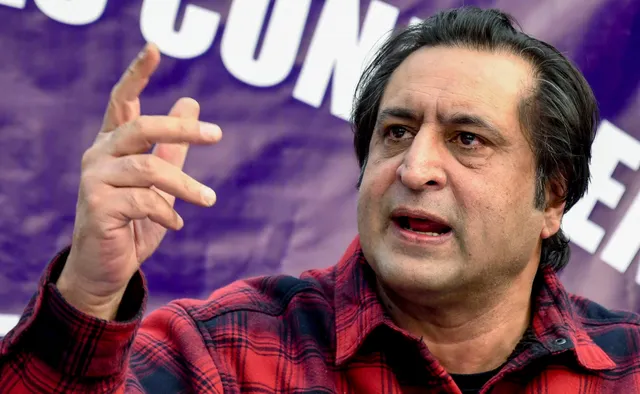
A day later, Peoples Conference president and Handwara MLA Sajad Gani Lone challenged the regional composition of those appointments.
According to Lone, only 10 of the 55 selected officers are from the Kashmir Valley, meaning roughly 18% of the appointments went to candidates from the Valley. He contrasted that figure with what he described as Kashmir’s approximately 56% share of J&K’s population.
Lone described the situation using the term “recruitment apartheid” and argued that the existing reservation framework was contributing to the political and administrative marginalisation of Kashmir’s population. He said he intended to raise the matter in the Legislative Assembly.
The controversy now reaches far beyond 55 appointment letters.
It touches one of J&K’s oldest political questions:
Should government recruitment and administration reflect the demographic composition of the two regions, or should appointments be determined entirely through the applicable reservation framework and competitive selection process?
And behind that question lies another:
Can a single recruitment result establish regional discrimination—or does it require a much broader dataset?
What the 18% Figure Actually Represents
The arithmetic is straightforward.
Of the 55 candidates appointed to the two gazetted services:
- 10 are reported to be from the Kashmir Valley;
- 45 are from outside the Valley;
- Kashmir’s share therefore works out to approximately 18.2%.
That is the basis for the “18%” figure being circulated.
But there is an important distinction.
This is not a figure showing that only 18% of all J&K officers are from Kashmir.
Nor is it evidence that only 18% of government jobs in J&K are held by Valley residents.
It relates specifically to one recent batch of 55 appointments to two services.
That distinction is essential if the controversy is to be understood accurately.
A single recruitment cycle can reveal a significant disparity, but determining whether the disparity reflects a structural pattern requires examination of multiple recruitment batches, the category-wise reservation roster, the applicant pool, examination results and the domicile and category composition of successful candidates.
Omar Abdullah’s Role Has Added a Political Dimension
The timing has also made the controversy politically sharper.
Chief Minister Omar Abdullah personally distributed the appointment orders at a function at the Sher-i-Kashmir International Convention Centre in Srinagar.
Addressing the newly selected officers, Omar urged them to use their positions to improve governance and serve people with integrity. The 55 appointments consisted of 28 JKAS Junior Scale officers and 27 Accounts Officers.
Lone specifically questioned the Chief Minister’s participation in the ceremony, arguing that Omar should ideally have stayed away from the appointment process.
That criticism, however, should be separated from the substantive recruitment issue.
The distribution of appointment orders by the Chief Minister does not itself establish responsibility for the regional composition of the selected candidates.
The more consequential question is the recruitment and reservation framework under which those candidates were selected.
The Reservation Question Is at the Heart of the Dispute
Lone’s criticism is directed principally at the existing reservation system.
This is significant because J&K’s reservation structure is not simply a Jammu-versus-Kashmir quota system.
The current framework includes reservations for several socially, economically and geographically defined categories.
The 2024 amendments to the J&K Reservation Rules expanded and revised the reservation structure, including provisions involving Scheduled Castes, Scheduled Tribes, Other Backward Classes and categories such as residents of areas adjoining the Line of Actual Control/International Border and backward areas.
That means a candidate’s regional origin is only one part of a much larger selection framework.
This is precisely why the political argument requires careful examination.
If a recruitment roster is legally structured around category reservations rather than a fixed Jammu-Kashmir regional quota, then regional outcomes can differ substantially from population proportions without necessarily proving that a region was deliberately excluded.
At the same time, if repeated recruitment data shows a persistent regional disparity, policymakers may reasonably be asked whether the existing system is producing the intended balance.
Those are two different questions.
J&K Government Has Already Been Reviewing Reservation Policy
The controversy also comes against the backdrop of an ongoing review of J&K’s reservation framework.
In March 2026, the J&K government told the Legislative Assembly that a Cabinet sub-committee constituted to examine and rationalise the reservation policy had submitted its report to the Council of Ministers.
The report was then under consideration by the competent authority, with no specific implementation timeline announced. The government said the existing reservation policy would continue until the recommendations were approved.
This gives the current controversy a much wider context.
The argument is not emerging in a vacuum.
J&K’s elected government itself has been examining whether the reservation framework needs modification.
Lone has argued that even the proposed changes would not fundamentally alter the Valley’s representation, claiming the figure could rise only to around 19% against his cited 56% population share. That is his assessment of the proposal, rather than an independently established government projection.
The Population Argument Needs Context Too
Lone’s comparison is based on the proposition that Kashmir Valley accounts for approximately 56% of J&K’s population.
The broader demographic imbalance between the two regions is real, but population share and administrative representation are not automatically interchangeable.
Government recruitment is governed by eligibility rules, reservation categories, competitive examination results and roster arrangements.
In other words:
56% population does not legally mean 56% of every recruitment batch.
If such proportionality were the policy objective, it would require an explicit legal mechanism.
That is why the central policy question is not simply whether 18% is lower than 56%.
It is whether the recruitment and reservation framework is producing a pattern that policymakers consider fair and sustainable across time.
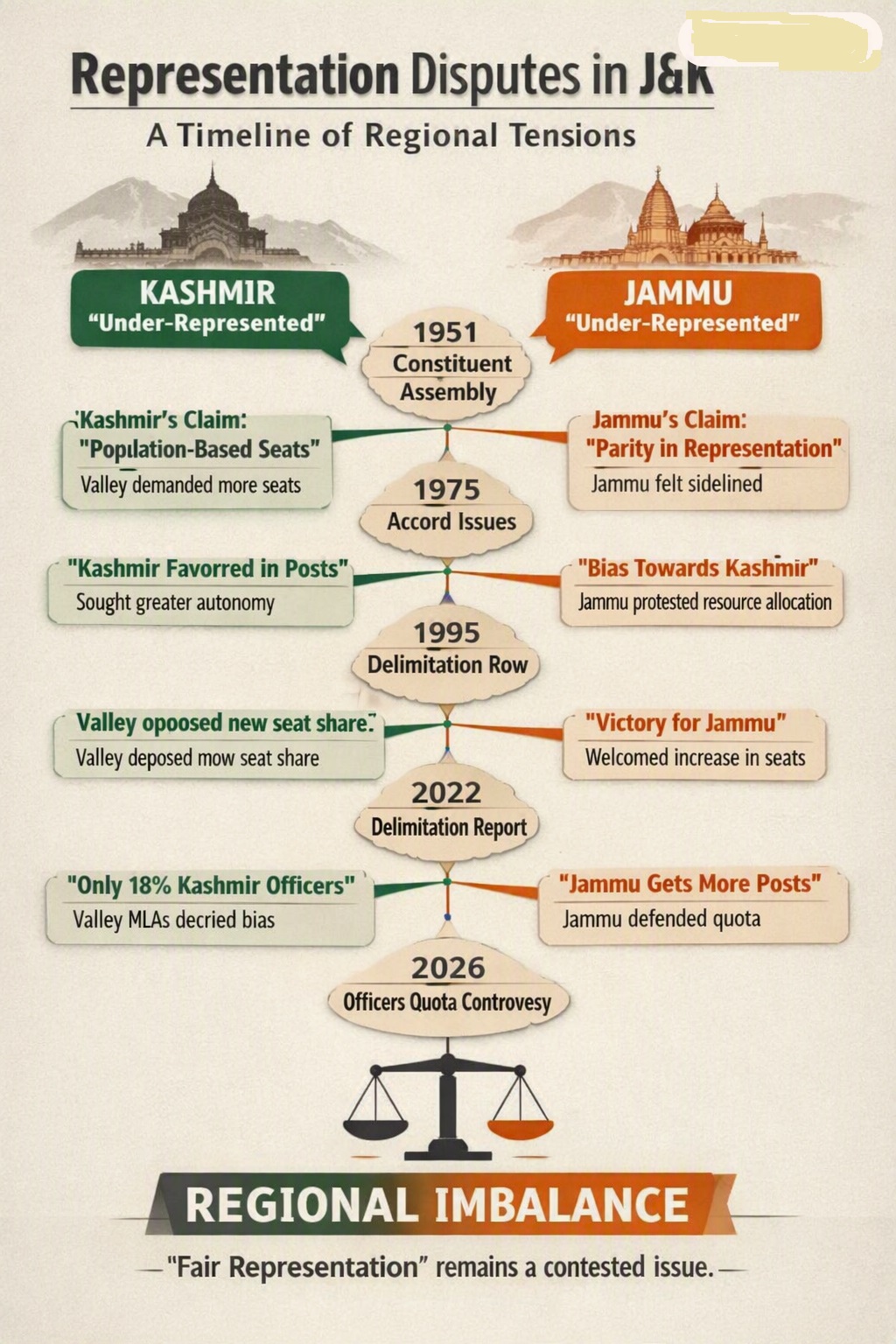
Jammu and Kashmir Has a Long History of Representation Disputes
The present controversy also fits into a much older pattern.
Regional representation has been politically sensitive in J&K for decades, particularly in relation to:
- Assembly seats;
- delimitation;
- government employment;
- development expenditure;
- administrative postings;
- education;
- political power;
- and access to institutions.
But some of the historical details in the supplied timeline need correction.
For example, the Assembly was not last delimited in 2002.
The last pre-reorganisation delimitation was conducted in 1995, based on the 1981 Census, and it formed the basis for the 1996 Assembly elections. In 2002, the then J&K Assembly amended the relevant law to freeze further delimitation until 2026. That freeze was subsequently upheld by the courts.
After the 2019 reorganisation, a new Delimitation Commission was constituted for the Union Territory.
Its 2022 final order allocated:
- 43 Assembly constituencies to Jammu region
- 47 to Kashmir region
The Commission also created nine seats reserved for Scheduled Tribes, six in Jammu and three in the Valley.
That exercise generated another intense regional political debate.
The important point is that regional representation has never been a settled issue in J&K.
The present recruitment controversy is therefore entering an already highly sensitive political landscape.
From Assembly Seats to Government Jobs
The underlying argument is similar even though the institutions are different.
In delimitation, the question is:
How should political representation be distributed between regions?
In recruitment, the question becomes:
How should access to public employment be structured among different categories and communities?
And in administration, another question arises:
Should the composition of the bureaucracy broadly reflect the population it serves?
There is no simple constitutional formula that says every government department must mirror regional demographics.
But representation has political significance.
When citizens repeatedly see one region underrepresented in an institution, perceptions of exclusion can develop even when individual appointments have been made through formally prescribed procedures.
That is why representation is partly a statistical question and partly a question of public confidence.
The Difference Between Merit and Representation
The political debate becomes particularly difficult when merit and representation are presented as opposing concepts.
Competitive examinations are designed to select candidates according to predetermined eligibility, examination performance and reservation rules.
Regional representation, meanwhile, is concerned with broader distributional outcomes.
A government can therefore face two competing demands:
Merit-based selection
Candidates should be selected according to examination performance and legally prescribed eligibility and reservation rules.
Representative administration
The public administration should not develop persistent demographic or regional imbalances that undermine public confidence.
These principles do not necessarily have to conflict.
The real policy challenge is designing a system in which competitive recruitment, constitutionally permissible reservation and public confidence coexist.
Why One Recruitment Batch Is Not Enough
The most important factual caution in the current controversy is the sample size.
There are only 55 officers in this particular batch.
If 10 are from Kashmir, the Valley’s representation is approximately 18%.
But small batches can produce large percentage fluctuations.
For example, if another 55-member batch had 25 Valley candidates, the regional share would suddenly be around 45%.
That does not necessarily mean the recruitment system changed dramatically overnight.
It illustrates why a meaningful assessment requires multi-year data.
A serious government review would ideally publish recruitment data for several years, showing:
| Indicator | Why it matters |
|---|---|
| Total applicants from Jammu/Kashmir | Shows the size of the candidate pool |
| Qualified candidates | Measures performance through stages |
| Final selections | Shows the eventual outcome |
| Open-merit selections | Helps assess competitive performance |
| Reserved-category selections | Shows reservation effects |
| Gender composition | Identifies another representation dimension |
| Region-wise results | Shows whether a persistent regional pattern exists |
| Service-wise results | Prevents one batch from dominating conclusions |
| Multi-year trends | Distinguishes structural patterns from statistical variation |
Without this data, the 18% figure is a real description of this particular batch, but it cannot by itself establish a permanent regional bias.
Why Kashmir’s Political Parties Are Sensitive to the Issue
For Valley-based political parties, government employment carries significance beyond salaries.
Public employment has historically been one of the most visible routes into the middle class in J&K.
Administrative services, in particular, carry prestige and influence because officers can serve in key positions across districts and departments.
Consequently, a perceived reduction in access to these services can quickly become a political issue.
Sajad Lone’s language reflects that concern.
He has framed the issue not merely as an examination outcome but as a question of regional political empowerment.
Whether that interpretation is supported by the larger recruitment record remains a question for the Assembly, government data and the reservation review.
The Jammu Perspective Cannot Be Ignored
A complete account also has to acknowledge the other side of J&K’s historical representation debate.
Jammu political groups have for decades argued that the region was underrepresented in political institutions despite its population, geographical size and administrative needs.
The pre-2019 Assembly had 46 seats for Kashmir Valley and 37 for Jammu, excluding the four seats allotted to Ladakh and the 24 seats reserved for Pakistan-occupied territory.
The 2022 Delimitation Commission increased Jammu’s Assembly seats by six and Kashmir’s by one, resulting in the current 43–47 regional distribution among the 90 constituencies.
Jammu’s long-standing argument has therefore been that regional fairness cannot be measured only through population.
Geography, difficult terrain, border areas, tribal populations, historically underserved communities and administrative accessibility also matter.
That makes the J&K representation debate considerably more complicated than a simple population-versus-quota equation.
The Reservation Debate Has Also Changed Since 2019
The post-2019 institutional framework has introduced another layer.
Jammu and Kashmir is now a Union Territory with a legislature rather than the former state structure.
The reservation framework has also undergone major changes, particularly after the expansion of Scheduled Tribe recognition and other category adjustments.
The 2024 rules, for example, provide substantial reserved shares for Scheduled Tribes and other categories.
That means today’s recruitment outcomes cannot simply be compared with recruitment patterns from the pre-2019 period without accounting for changes in law and category composition.
Any serious regional analysis must therefore compare like with like.
The Coming Assembly Session Could Put the Issue Under a Microscope
Lone has said he intends to raise the matter in the Legislative Assembly.
That could turn the controversy from a political exchange on social media into a formal debate over government recruitment policy.
The Assembly could seek answers to several concrete questions:
How many candidates from Jammu and Kashmir applied for the CCE?
How many qualified at each stage?
How many were selected under open merit?
How many benefited from each reservation category?
How many candidates from each region have entered JKAS and Accounts services over the past five or ten recruitment cycles?
What exactly does the Cabinet sub-committee recommend?
Does the government propose a regional mechanism, or does it intend to retain category-based reservation?
These questions would transform the argument from political accusation into measurable public policy.
What the Government Needs to Explain
The administration does not necessarily need to defend every individual selection.
What it needs to explain is the system.
If the government can demonstrate that:
- the examination was conducted according to prescribed rules;
- the reservation roster was correctly applied;
- selection was based on the notified criteria;
- all regions had equal access to the examination;
- and the 18% figure is not part of a persistent multi-year pattern,
then the present controversy can be understood as an outcome of a particular recruitment cycle.
If, however, government data shows a sustained and unexplained regional disparity over multiple years, then the reservation review becomes considerably more consequential.
Either way, transparent data would be more useful than political rhetoric.
The Bigger Issue Is Administrative Trust
The most important consequence of the controversy may not be the number 18%.
It is trust.
In a politically sensitive region such as J&K, citizens evaluate government institutions not only by the legality of decisions but also by whether those decisions appear fair.
A candidate from Kashmir who believes that regional circumstances have reduced his or her chances may view the system differently from a candidate in Jammu who believes that previous arrangements disadvantaged the Jammu region.
Both perceptions can coexist.
That is why governments need to demonstrate fairness through rules, data and transparency.
Representation Should Not Become Another Jammu-vs-Kashmir Binary
There is also a danger in reducing every employment dispute to a Jammu-versus-Kashmir contest.
J&K’s reservation structure includes communities that cut across regional boundaries.
Scheduled Tribes, Scheduled Castes, OBCs, residents of border areas, economically weaker sections and other categories have distinct claims.
A policy that focuses exclusively on regional arithmetic could therefore create another layer of competition between communities that are already covered by separate reservation provisions.
The more durable approach would be to examine the entire framework together.
A Better Way to Measure Fairness
Rather than asking only:
“Why did Kashmir get 18%?”
the policy debate could ask:
“Does the recruitment system produce equitable outcomes over time while remaining consistent with merit, law and constitutionally permitted reservation?”
That is a much more useful question.
It can be answered with evidence.
And it avoids turning every individual recruitment batch into a referendum on regional identity.
The 18% Figure Is Politically Powerful—But Its Meaning Needs Evidence
There is no dispute over the basic arithmetic reported by Lone: 10 of the 55 newly selected JKAS and Accounts officers are from the Kashmir Valley, approximately 18%.
What remains contested is what that number means.
For Lone and his supporters, it is evidence of a structural regional imbalance produced by the reservation system.
For a neutral administrative assessment, it is first a statistic from one recruitment batch that needs to be placed alongside:
- the regional applicant pool;
- examination results;
- reservation categories;
- roster rules;
- previous recruitment cycles;
- and the government’s pending reservation-rationalisation proposal.
Until that larger evidence is available, neither “mere coincidence” nor “systematic discrimination” can be established from the 55 appointments alone.
The Real Test Will Be the Data, Not the Slogan
Jammu and Kashmir has spent decades arguing about representation.
The argument has moved from Assembly seats to delimitation, from government employment to reservations, and now into a post-2019 administrative structure that is still evolving.
The latest 18% Kashmir representation controversy is therefore unlikely to be the last such dispute.
But it could become an opportunity for something more constructive.
Instead of another round of competing regional narratives, the government could publish a comprehensive, anonymised dataset showing how candidates from different regions and reservation categories have performed across several recruitment cycles.
That would answer the question that political slogans cannot:
Is the present system producing a temporary statistical outcome—or a persistent regional imbalance?
Until that evidence is placed in the public domain, the 18% figure should be treated as a significant political allegation based on a real recruitment outcome, not as proof by itself of an overall bureaucratic bias against Kashmir.
And that distinction matters—not only for Jammu and Kashmir’s politics, but for public confidence in its civil-service institutions.
Historical Timeline: Regional Representation Disputes in J&K
| Period | Issue | What the record shows |
|---|---|---|
| 1950s–70s | Political representation and regional balance | Jammu and Kashmir’s internal regional balance remained a recurring political issue amid debates over autonomy, representation and governance. |
| 1995 | Assembly delimitation | The last pre-reorganisation Assembly delimitation was carried out in 1995, based on the 1981 Census. |
| 2002 | Delimitation freeze | The J&K Assembly amended relevant law to freeze fresh delimitation until 2026; the freeze was upheld by the courts. |
| 2019 | Reorganisation | J&K became a Union Territory with a legislature; Ladakh became a separate Union Territory. |
| 2022 | New delimitation | The Commission allocated 43 Assembly constituencies to Jammu and 47 to Kashmir; nine seats were reserved for STs. |
| 2024 | Reservation changes | J&K’s reservation rules were amended, including changes involving ST and other reserved categories. |
| March 2026 | Reservation review | The J&K government said a Cabinet sub-committee’s reservation-rationalisation report was under consideration. |
| September 2026 | JKAS/Accounts recruitment controversy | Of 55 newly selected officers, 10 were reported by Sajad Lone to be from Kashmir Valley, prompting his 18% representation claim. |


