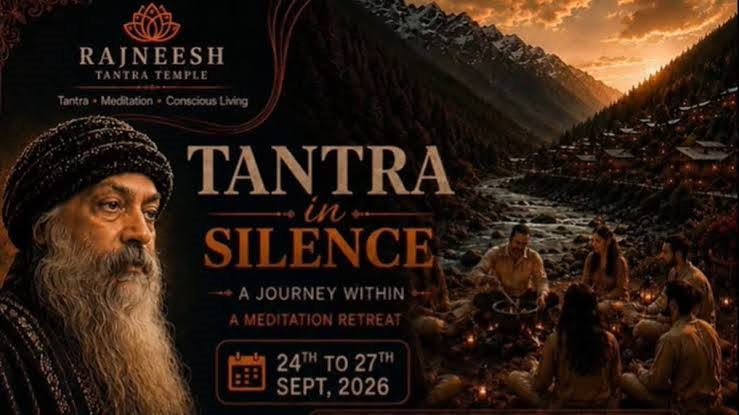
‘Gurez Is No Playground for Experiments’: Tantra Retreat Sparks Political and Religious Row in Kashmir
By: Javid Amin | 19 September 2026
Srinagar: A proposed four-day meditation retreat in Jammu and Kashmir’s picturesque Gurez Valley has triggered a political and religious controversy, after promotional material for an event titled “Tantra in Silence – A Journey Within” began circulating online.
The programme, advertised for September 24 to 27, was presented as a meditation and spiritual retreat featuring meditation, sound healing, conscious living, “love and awareness” and inner transformation. Promotional material identified Swami Dhyan Sumit as facilitator and said the programme was inspired by the teachings of Bhagwan Shree Rajneesh. The advertised package was priced at ₹11,995 per participant, including accommodation, food and retreat sessions.
The proposed event immediately drew objections from PDP president Mehbooba Mufti, Mirwaiz Umar Farooq and Grand Mufti of Jammu and Kashmir Mufti Nasir-ul-Islam, who questioned its suitability for Gurez and called for official intervention.
But the controversy took an important turn when the administration clarified that the event had not been authorised at all.
The Tourism Department said it had neither received nor processed an application for the programme and had neither granted permission nor issued authorisation. The Bandipora administration separately described the proposed retreat as unauthorised and advised the public and tourists not to rely on its promotional claims.
That clarification changes the nature of the controversy.
The immediate question is no longer simply whether authorities should permit a controversial spiritual event in Gurez.
It is also how an event came to be publicly advertised for a sensitive border-region destination without the relevant tourism or district authorities having authorised it.
What was advertised for Gurez?
According to the promotional material circulated online, the retreat was planned as a four-day programme from September 24 to 27.
It was advertised under the title:
“Tantra in Silence – A Journey Within.”
The poster identified the organiser as Rajneesh Tantra Temple and Swami Dhyan Sumit as facilitator. It described the programme as being inspired by Rajneesh’s teachings and offered a package combining accommodation, food and retreat activities.
The advertised activities included:
- meditation;
- sound healing;
- “love and awareness”;
- conscious living;
- inner transformation.
The promotional material also reportedly required participants to wear white and maroon robes and advertised transportation arrangements from Srinagar to Gurez. Some reports said the programme included accommodation at a riverside camp.
In other words, the advertised programme was not presented simply as a one-hour meditation session.
It was packaged as a multi-day commercial retreat, combining spiritual activities with travel and accommodation in Gurez.
That is one reason the event attracted attention.
Then came the government’s clarification
The Tourism Department’s response was unusually clear.
The Assistant Director Tourism, Gulmarg, said the department had not granted permission or issued authorisation for the event. The department also said it had no information or official communication about the proposed programme and that no application seeking permission had been received or processed.
The department further clarified that it had no association with the organisation or the conduct of the event.
The Bandipora district administration issued a separate clarification, stating that no permission had been granted by the district administration and advising the public and tourists not to rely on or circulate unauthorised promotional claims.
This is perhaps the most important established fact in the controversy.
Whatever the organisers intended to conduct, the event did not have official tourism or district authorisation at the time of the government’s clarification.
Mehbooba Mufti: ‘Gurez is no playground for experiments’
PDP president Mehbooba Mufti was among the first prominent political figures to raise the issue publicly.
Sharing the promotional material, she urged Chief Minister Omar Abdullah and the J&K Police to intervene and take appropriate action.
Her objection was not directed at meditation as such.
Instead, she questioned the nature of the programme, its facilitator and the suitability of such an event for Gurez.
Her strongest line was:
“Gurez is no playground for experiments in the name of spirituality or tourism.”
She also appealed to Mirwaiz Umar Farooq and Mufti Nasir-ul-Islam to raise awareness about the issue.
Mehbooba also referred to an earlier controversy involving a similar retreat associated with Swami Dhyan Sumit in Goa.
According to her account, that programme was cancelled after controversy over its promotional material and police intervention.
Because this claim is being used politically to establish a precedent, it is important to retain the attribution: Mehbooba made the claim, and subsequent reports referred to the Goa episode, but that does not establish that the Gurez programme itself would have involved the same material or activities.
Mirwaiz backs the objection
Mirwaiz Umar Farooq subsequently endorsed Mehbooba’s concern.
He described the issue as deserving immediate attention and questioned why a programme of this nature was being advertised in Gurez.
His argument was framed around Kashmir’s established spiritual and cultural traditions.
He described Kashmir as “the land of Sufis and saints”, arguing that spirituality in the region should be experienced rather than marketed as a commercial product.
He also warned that tourism promotion should not become a justification for ignoring the region’s religious, cultural and social sensibilities.
That intervention gave the controversy a different dimension.
What began as a tourism advertisement quickly became a debate over cultural space, religious identity and the limits of commercialised spirituality in Kashmir.
Grand Mufti calls for scrutiny
Grand Mufti Nasir-ul-Islam also expressed concern over the proposed programme.
His position was somewhat more focused on verification and regulatory scrutiny.
He called for authorities to examine the organisers, the complete programme and promotional material, establish what permissions—if any—had been obtained and ensure that activities contrary to law or legitimate local sensitivities were not permitted.
He also emphasised that Gurez is not merely a tourist destination but part of Kashmir’s broader cultural and spiritual landscape.
That distinction is important.
Gurez has increasingly been promoted as a tourism destination, but it is also a strategically sensitive border region with its own communities, traditions and administrative considerations.
Gurez is not an ordinary tourism destination
Gurez’s location adds another layer to the debate.
The valley lies in Bandipora district close to the Line of Control, and its emergence as a major tourism destination has accelerated in recent years.
The opening of Gurez to a larger tourism economy has brought homestays, adventure tourism, camping and other tourism activities into greater prominence.
But tourism development in a region such as Gurez involves more than attracting visitors.
There are questions of:
security, local consent, environmental capacity, cultural compatibility, regulation and the nature of tourism being promoted.
The retreat controversy has brought those questions into a single political conversation.
The real issue is not ‘meditation versus Islam’
It would be simplistic to portray the dispute as opposition to meditation or spiritual practice itself.
Kashmir has a long history of meditation, mysticism, Sufi traditions and spiritual scholarship.
The objections being voiced by political and religious figures are instead focused on the specific nature of the advertised retreat, its commercial presentation, its facilitator, its promotional material and its suitability for Gurez.
That distinction matters.
A meditation retreat is not inherently incompatible with tourism or with Kashmir’s cultural history.
The question in this case is whether a particular commercial programme, promoted under the banner of “Tantra,” meets applicable legal and administrative requirements and whether its activities are compatible with the local context.
And on the first question, the authorities have already given a clear answer:
No permission had been granted.
The meaning of ‘Tantra’ also needs context
The word “Tantra” itself can create confusion because it has a long and complex history within Indian religious and philosophical traditions.
Tantric traditions are diverse and have existed within Hindu, Buddhist and other religious-philosophical contexts for centuries.
Modern commercial “tantra retreats,” however, can use the term in very different ways, sometimes combining meditation, relationships, body practices, sexuality, spirituality and personal development.
The advertised Gurez programme described itself in terms of meditation, sound healing, conscious living and inner transformation.
Therefore, it would be inaccurate to assume from the word “Tantra” alone what activities were intended to take place.
Any assessment of the programme would have to be based on the actual itinerary, organisers’ stated practices, venue arrangements and applicable regulations, rather than the label alone.
That is precisely why the demand for scrutiny raised by the Grand Mufti and others is different from simply declaring the event objectionable without examining its contents.
Why the commercial angle matters
The ₹11,995 price tag has also become part of the discussion.
The retreat was not advertised as a free religious gathering.
It was a paid package incorporating food, accommodation and retreat sessions.
That makes it part of the broader phenomenon of experience-based and wellness tourism.
Across India and internationally, travellers increasingly pay for yoga retreats, meditation programmes, wellness camps and spiritual experiences.
There is nothing inherently unusual about that tourism model.
But when such an event enters a region with strong religious traditions and distinct social norms, organisers need to navigate local expectations and regulatory requirements carefully.
In Gurez, that becomes even more important because the valley is simultaneously a tourism destination and a sensitive border area.
The political dimension arrived quickly
The controversy also demonstrates how rapidly tourism issues in Kashmir can acquire a political dimension.
Mehbooba Mufti’s intervention placed the issue directly before the Omar Abdullah government.
Mirwaiz’s backing brought religious authority into the debate.
The Grand Mufti’s intervention broadened the call for administrative scrutiny.
The government then responded by clarifying that no permission had been granted.
The result is an unusual convergence:
political leaders, religious figures and the administration are all questioning the advertised event—but for somewhat different reasons.
Mehbooba has emphasised cultural and political sensitivity.
Mirwaiz has focused on religious and social ethos.
The Grand Mufti has called for scrutiny of the organisers, programme and permissions.
The government has focused on the straightforward administrative fact that the event was unauthorised.
Tourism cannot operate outside regulation
The controversy also raises a basic principle applicable far beyond this particular event.
Tourism promotion does not mean that every privately advertised programme automatically receives official legitimacy.
An organiser can advertise a retreat, camp, workshop or festival.
But if the programme requires permissions relating to the venue, tourism, local administration, security, environment or other applicable regulations, those permissions still have to be obtained.
The Gurez episode illustrates what happens when promotional material appears before such authorisation is established.
It can create confusion among tourists and potential participants.
That is why the Bandipora administration specifically advised people not to rely on the promotional claims.
The Goa precedent—and the need for caution
The reference to Goa has become central to the controversy.
Mehbooba and Mirwaiz both pointed to an earlier event involving the same facilitator or organisation that they said was cancelled following public objections.
Reports have repeated that account, describing controversy over promotional material and police intervention.
But the Goa episode should not automatically be treated as proof of what the Gurez retreat would have contained.
There is a difference between saying:
“A similar programme previously faced controversy in Goa.”
and saying:
“The Gurez programme would have repeated the same conduct.”
The first is a claim about an earlier event.
The second is an inference that requires evidence.
That distinction is particularly important in a story already carrying strong religious and political emotions.
A broader debate about Kashmir’s tourism identity
The Gurez controversy comes at a time when Kashmir is seeking to expand its tourism footprint beyond traditional destinations such as Gulmarg, Pahalgam and Srinagar.
Gurez has become one of the newer destinations being promoted to visitors seeking mountains, rivers, meadows, trekking and relatively less commercialised landscapes.
As tourism expands, so will the variety of businesses and experiences seeking access to the valley.
That could include wellness retreats, adventure camps, cultural programmes and specialised travel experiences.
The question for policymakers is therefore larger than this one retreat:
What kind of tourism does Kashmir want to encourage, and what boundaries should apply to activities operating in culturally sensitive areas?
Those rules need to be clear enough to apply consistently rather than being created in response to individual controversies.
The cultural-sensitivity question
Kashmir’s tourism industry has traditionally relied heavily on the region’s cultural image.
Visitors come not only for mountains and lakes but also for Kashmiri hospitality, cuisine, handicrafts, architecture, Sufi shrines and historical traditions.
That creates an unusual relationship between tourism and culture.
Culture is itself a tourism asset.
But turning culture into a tourism product can also generate anxiety about commercialisation and loss of authenticity.
Mirwaiz’s criticism essentially comes from this concern.
His argument is that Kashmir’s spiritual traditions should not be reduced to something that can simply be packaged, marketed and sold.
That is a value-based political and religious position, not a finding that every wellness or spiritual retreat is inherently exploitative.
Where the controversy stands now
As of September 20, the administrative position is straightforward:
The proposed Gurez retreat has not been authorised by the Tourism Department or Bandipora district administration.
The Tourism Department says no application was received or processed, while the district administration has explicitly described the event as unauthorised.
The political and religious opposition is equally clear.
Mehbooba Mufti has called for intervention.
Mirwaiz Umar Farooq has backed her concerns.
Grand Mufti Nasir-ul-Islam has demanded scrutiny.
The organisers’ promotional material, meanwhile, continues to provide the basis on which the controversy has been debated publicly.
But there is an important distinction between an advertised programme and an approved programme.
At present, the former exists in the public domain; the latter does not.
What this episode says about Kashmir’s evolving tourism model
The “Tantra in Silence” controversy is unlikely to be remembered simply as a dispute over one four-day retreat.
It has exposed a larger fault line.
Kashmir wants more tourists.
New destinations such as Gurez are being opened to visitors.
Private operators will naturally seek to introduce new experiences.
But tourism does not operate in a cultural vacuum.
In a place where religion, identity, history and community sensitivities remain deeply intertwined, the type of tourism being introduced can matter as much as the number of visitors arriving.
The challenge for the administration is to establish a predictable framework:
What is permitted? What requires prior approval? What standards apply to private retreats? Who verifies organisers? What safeguards apply in sensitive locations? And how are local communities’ legitimate concerns addressed?
Those questions are more useful than allowing every controversy to become a political confrontation after promotional material has already circulated.
The Gurez question is bigger than one retreat
The immediate controversy began with a poster.
It grew after Mehbooba Mufti objected.
Mirwaiz Umar Farooq backed her concern.
The Grand Mufti demanded scrutiny.
And the government clarified that the event had never received official permission.
The result is a striking intersection of tourism, religious identity, commercial spirituality, local sensitivities and administrative regulation.
The government has not endorsed the programme.
The political and religious leadership has opposed it.
And the advertised event, at least in its present form, lacks the official authorisation that would be required for it to be treated as a government-approved tourism activity.
The broader lesson for Kashmir’s tourism planners is equally clear: opening new destinations to the world also means deciding what kind of experiences are compatible with the places being opened.
Gurez can welcome visitors without becoming culturally undefined.
Tourism can expand without ignoring local sensibilities.
And spiritual experiences can be offered without assuming that every landscape is an appropriate venue for every commercial retreat.
For now, however, the immediate administrative question has already been answered:
“Tantra in Silence” may have been advertised for Gurez, but it was not authorised by the authorities responsible for the area.


