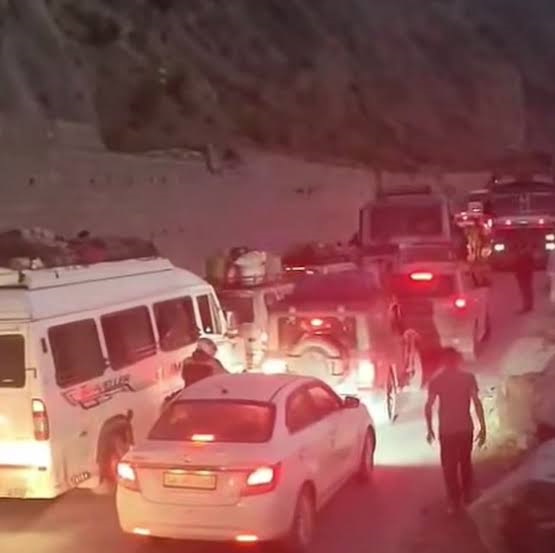
‘What Fault Have Our People Committed?’ Sakina Itoo Questions Prolonged Security Convoy Halts on NH-44
J&K minister flags ambulances stranded, students missing classes and commuters waiting for hours; appeals to LG Manoj Sinha for public-friendly traffic management
By: Javid Amin | 29 October 2026
Srinagar: Jammu and Kashmir Health and Social Welfare Minister Sakina Masood Itoo has raised concerns over repeated traffic disruptions caused by security convoy movements along the Srinagar-Anantnag-Kulgam-Qazigund stretch of National Highway 44, questioning why ordinary citizens should have to endure prolonged delays while travelling on one of the Valley’s most important roads.
In a post on X on Thursday, Itoo described the situation as deeply distressing, pointing to reports and experiences of ambulances being stranded, students missing classes and commuters waiting for extended periods whenever traffic is regulated for convoy movement.
“What fault have our people committed to endure such hardships?” she asked, highlighting the difficulties faced by people who depend on the highway for medical treatment, education, employment and everyday travel.
The minister said that during her frequent journeys along the Srinagar-Anantnag-Kulgam-Qazigund highway, she had observed people waiting between 15 and 30 minutes and, at times, even several hours because of traffic stoppages linked to security convoys.
Her intervention has brought renewed attention to a long-standing public concern in Kashmir: how to maintain the security arrangements considered necessary for the movement of armed forces while ensuring that civilian life is not unnecessarily disrupted.
Itoo has appealed to Lieutenant Governor Manoj Sinha and the concerned authorities to examine practical traffic management measures that preserve essential security protocols while reducing inconvenience to commuters and ensuring priority passage for emergency vehicles.
“Security is paramount, but so is the well-being of our people. Security and compassion must go hand in hand,” she said.
Ambulances, students and daily commuters bear the burden
The issue is particularly significant because NH-44 is not simply a route for long-distance travel. It is a vital transport corridor connecting Srinagar with south Kashmir and, through the Banihal-Qazigund section, with Jammu and the rest of the country.
Thousands of people use different stretches of the highway every day for work, education, healthcare, business and other essential activities. Even a relatively short traffic stoppage can affect people whose journeys are tied to fixed schedules or urgent needs.
The difficulties highlighted by Itoo concern several sections of society.
Patients and emergency medical services: For patients travelling to hospitals in Srinagar or other medical centres, unexpected delays can create anxiety and complications. Ambulances require special consideration because emergency medical care often depends on reaching a hospital without avoidable interruption.
Students: School and college students travelling between towns and educational institutions can lose valuable classroom time when traffic remains halted. Those appearing in examinations or attending scheduled academic activities may face additional pressure.
Employees and daily wage earners: Office-goers, labourers, traders and other workers often depend on predictable travel times. Repeated delays can affect attendance, wages, appointments and household responsibilities.
Transporters and businesses: The highway also carries commercial traffic and essential supplies. Disruptions can affect delivery schedules, vehicle operations and the movement of goods, particularly when stoppages are prolonged.
The minister’s remarks have therefore raised a question that extends beyond commuter inconvenience: whether traffic arrangements can become more responsive to the everyday needs of people living and working along the highway.
Security requirements and public convenience: Finding the balance
Security convoy movements are an established part of the operational arrangements in Jammu and Kashmir. Such movements are undertaken for administrative and operational purposes, and authorities have to account for security risks, route conditions and the protection of personnel.
However, the existence of legitimate security requirements does not remove the need for effective coordination with civilian traffic.
The challenge is to ensure that traffic regulation is proportionate, properly coordinated and sensitive to emergencies. The objective is not to obstruct security movements but to reduce unnecessary waiting and ensure that people are not left uncertain about when they can resume their journeys.
Itoo’s appeal reflects this distinction. She has not called for security convoys to be stopped or for essential protocols to be abandoned. Instead, she has asked the authorities to explore practical arrangements that can protect security interests while reducing the hardship experienced by ordinary commuters.
That could involve better coordination between traffic police and security agencies, timely communication about expected restrictions, effective management of traffic at junctions and crossing points, and clear procedures for dealing with medical emergencies.
These are possible areas for administrative review, rather than measures that the minister has announced as approved government policy.
What does the Centre’s earlier position say about ambulance movement?
The debate over convoy-related traffic restrictions is not new. In November 2024, the Ministry of Defence addressed the issue in a written reply to a question raised in the Lok Sabha by Srinagar MP Aga Syed Ruhullah Mehdi.
Minister of State for Defence Sanjay Seth said regular security convoy movements between Jammu and Srinagar take place for operational and administrative reasons. He explained that road-opening parties are deployed before convoy movements and that civilian traffic is temporarily regulated at certain points, particularly where connecting roads meet NH-44 and at U-turns.
The government also stated that the Indian Army does not stop civilian movement on the highway and that ambulances are always accorded priority. It said responsibility for regulating civilian traffic rests with the Jammu and Kashmir authorities and police.
The 2024 response provides important context, but it does not settle the concerns raised by Itoo in October 2026. Her remarks focus on the actual experience of commuters, including the delays they report during convoy movements.
The distinction is important: official procedures may provide for temporary traffic regulation and ambulance priority, but their effectiveness depends on how consistently and efficiently they are implemented on the ground.
The latest appeal therefore places renewed emphasis on coordination and practical implementation, particularly when emergency vehicles and students are affected.
A politically significant intervention by a serving minister
Itoo’s statement is notable because it comes from a serving minister in the Omar Abdullah-led government rather than solely from opposition politicians or civil society groups.
Her public appeal to the Lieutenant Governor and the concerned authorities brings the issue into the wider debate over civilian convenience, security arrangements and administrative accountability in Jammu and Kashmir.
It also highlights the need for coordination between different institutions responsible for security and traffic management. Since convoy movements involve security agencies while civilian traffic regulation falls within the jurisdiction of the local administration and police, effective solutions require cooperation rather than isolated decisions.
The minister’s intervention does not necessarily indicate a confrontation between the elected government and security agencies. Her statement is framed as an appeal for practical improvements while recognising the importance of security.
Nevertheless, it places a public expectation on the authorities to examine whether existing arrangements are working as intended and whether avoidable hardships can be reduced.
What practical measures could ease the problem?
A review of traffic management along the Srinagar-Qazigund corridor could consider several steps without compromising essential security requirements.
-
Priority passage for ambulances: Emergency vehicles should have a clear and consistently implemented procedure for passage during traffic regulation.
-
Better inter-agency coordination: Traffic police and security agencies could improve communication to reduce unnecessary delays and confusion at checkpoints and junctions.
-
Timely public advisories: Where restrictions are planned or anticipated, advance information could help commuters adjust their travel schedules wherever operational conditions permit.
-
Improved traffic regulation: Authorities could examine whether stoppages can be managed in a more coordinated manner, avoiding unnecessarily long queues.
-
Special attention to essential travel: Medical emergencies, school transport and other urgent civilian requirements should be considered within established security procedures.
These measures would require assessment by the competent authorities. Security arrangements cannot be reduced to a single traffic-management formula because operational conditions and risks may vary from one movement to another.
However, transparent procedures and better coordination could help reduce the uncertainty that makes such disruptions especially difficult for commuters.
The larger question: Can security and everyday life move together?
For residents of south Kashmir and commuters travelling between Srinagar and Qazigund, the issue is part of a broader concern about the relationship between security arrangements and everyday life.
People understand that Jammu and Kashmir has specific security requirements. But they also expect essential services, medical emergencies, education and routine travel to receive appropriate consideration.
The difficulty arises when temporary restrictions become unpredictable or when commuters feel they have no information about the duration of a stoppage. Even when a delay lasts only 15 to 30 minutes, its impact can be significant for someone rushing to a hospital, attending an examination or reporting for work. Longer waits can intensify those difficulties.
Itoo’s question, “What fault have our people committed?” captures this public frustration. Her appeal is ultimately about making traffic management more humane without weakening the security measures required for the region.
The response from the Lieutenant Governor’s office, traffic authorities and security agencies will be important in determining whether the concerns translate into practical changes.
For now, the minister has put a familiar but unresolved issue back in the spotlight. The challenge for the administration is to ensure that security and civilian convenience are treated not as competing priorities, but as responsibilities that must be managed together.


