Akeel Tantray ABVP Kashmir: A 25-Year-Old Kashmiri Muslim Leading a Hindu Nationalist Student Body
By: Javid Amin | 13 April 2026
A 25-Year-Old at the Center of a Political Shift
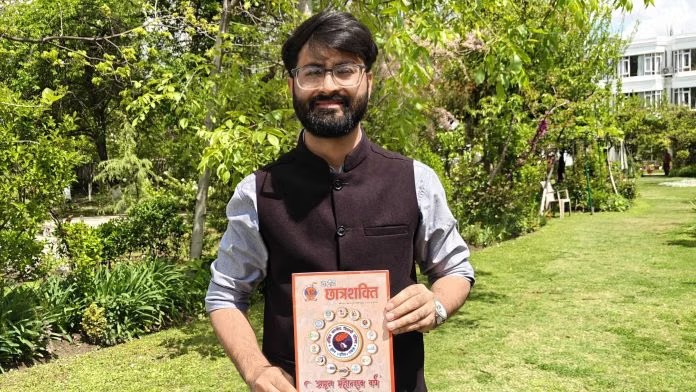
In a region where political affiliations often carry deep social and personal consequences, the emergence of Akeel Tantray stands out. At just 25, Tantray is leading the Kashmir unit of the Akhil Bharatiya Vidyarthi Parishad—a student body traditionally linked to the Rashtriya Swayamsevak Sangh.
His leadership is not just about age or ambition. It reflects a subtle but noteworthy shift in the political and social landscape of the Kashmir Valley, a Muslim-majority region where organizations like ABVP historically had minimal visible presence.
From Silence to Assertion: A Changing Climate Post-2019
Before the abrogation of Article 370 Abrogation in 2019, openly associating with ABVP in Kashmir was widely considered risky. Students often avoided public identification with national-level organizations perceived as ideologically distant from local sentiment.
Tantray himself acknowledges this shift. Where once such affiliations were kept private, he now speaks openly—and confidently—about his role.
This transition reflects broader changes in the Valley since 2019, including increased central governance, restructured political spaces, and evolving narratives around youth engagement.
Who Is Akeel Tantray? A Ground-Level Profile
Akeel Tantray’s journey is rooted in local realities. Raised in Kashmir, he entered student activism through campus issues rather than ideological mobilization.
Profile Highlights:
- Age: 25
- Region: Kashmir Valley
- Position: Head of ABVP Kashmir
- Core Focus: Student welfare, campus engagement, grievance redressal
Unlike traditional political leaders, Tantray positions himself less as an ideologue and more as a facilitator for student concerns—ranging from academic infrastructure to administrative challenges.
ABVP’s Strategy in Kashmir: From Ideology to Issues
Historically, ABVP has been perceived as a student wing aligned with broader nationalist politics. However, its approach in Kashmir appears more calibrated.
Key Strategic Shifts:
1. Campus-Centric Engagement
Rather than leading with ideology, ABVP is focusing on everyday student issues—hostel conditions, scholarships, exam delays, and campus facilities.
2. Grassroots Expansion
The organization is gradually building a presence in colleges and universities through direct interaction rather than large-scale political mobilization.
3. Rebranding as a Student Welfare Platform
Tantray emphasizes that ABVP in Kashmir is positioning itself as a platform for student voices, not just a political extension.
This pragmatic approach appears designed to reduce resistance and build credibility in a region where political trust deficits run deep.
A Symbol Beyond Politics: Cross-Identity Leadership
Tantray’s leadership carries symbolic weight. A Kashmiri Muslim heading a body associated with Hindu nationalist thought challenges conventional political binaries in the Valley.
Notably:
- There are no widely verified instances of Kashmiri Muslims leading major organizations like the Bharatiya Janata Party, Shiv Sena, or Vishva Hindu Parishad within Kashmir.
- Leadership in such organizations has largely remained with non-local cadres or minority communities like Kashmiri Pandits.
In this context, Tantray’s role is both unusual and strategically significant.
Ground Reality: Acceptance, Curiosity, and Skepticism
Despite this development, ABVP’s presence in Kashmir remains complex.
Mixed Student Reactions:
Supporters Say:
- The organization addresses real student problems.
- It offers access to national-level platforms.
- It creates opportunities for engagement beyond regional politics.
Skeptics Argue:
- ABVP’s ideological roots may not align with local sentiment.
- Its expansion could be seen as political rather than purely academic.
- Trust-building will take time given the Valley’s history.
Ground-level observations suggest that while curiosity is growing, widespread acceptance is still a work in progress.
Kashmir’s Student Politics: A Changing Landscape
Traditionally, student politics in Kashmir has been shaped by:
- Regional political narratives
- Separatist influences (historically)
- Issue-based campus activism
The entry and gradual expansion of ABVP introduce a new dynamic—linking local student concerns with national political frameworks.
This shift aligns with broader changes in governance and political participation after 2019, where new actors are testing space in previously closed ecosystems.
Challenges Ahead: Can ABVP Sustain Its Momentum?
The road ahead for ABVP in Kashmir—and for Akeel Tantray personally—is not without obstacles.
Key Challenges:
- Building Trust: Overcoming skepticism tied to ideological perceptions
- Maintaining Local Relevance: Keeping focus on student issues rather than national politics
- Navigating Polarization: Operating in a politically sensitive environment
- Sustaining Grassroots Work: Ensuring consistent campus engagement
Success will depend on whether the organization can maintain its current issue-based approach without triggering political backlash.
The Larger Question: A Trend or an Exception?
Akeel Tantray’s rise raises a broader question: Is this an isolated case, or the beginning of a larger shift in Kashmir’s youth politics?
At present, it appears to be an exception rather than a trend. However, it signals the possibility of:
- More cross-identity participation
- Expanded political diversity in campuses
- Gradual normalization of previously stigmatized affiliations
Conclusion: A Subtle but Significant Transition
Akeel Tantray’s leadership of ABVP in Kashmir does not represent a dramatic transformation—but it does mark a quiet, meaningful shift.
It reflects:
- Changing political realities post-2019
- Evolving youth priorities
- New experiments in engagement and representation
Whether this experiment succeeds or fades will depend not on symbolism alone, but on sustained, credible work on the ground.
For now, Tantray stands as a rare figure—navigating identity, politics, and student activism in one of India’s most complex regions.