Aga Ruhullah’s ‘Slap on the Face’ Remark Sparks Debate as Ladakh Secures Constitutional Safeguards Breakthrough
By: Javid Amin | 23 May 2026
Srinagar MP Says Ladakh’s Success Exposes Failures of J&K’s Mainstream Leadership After Article 370 Abrogation
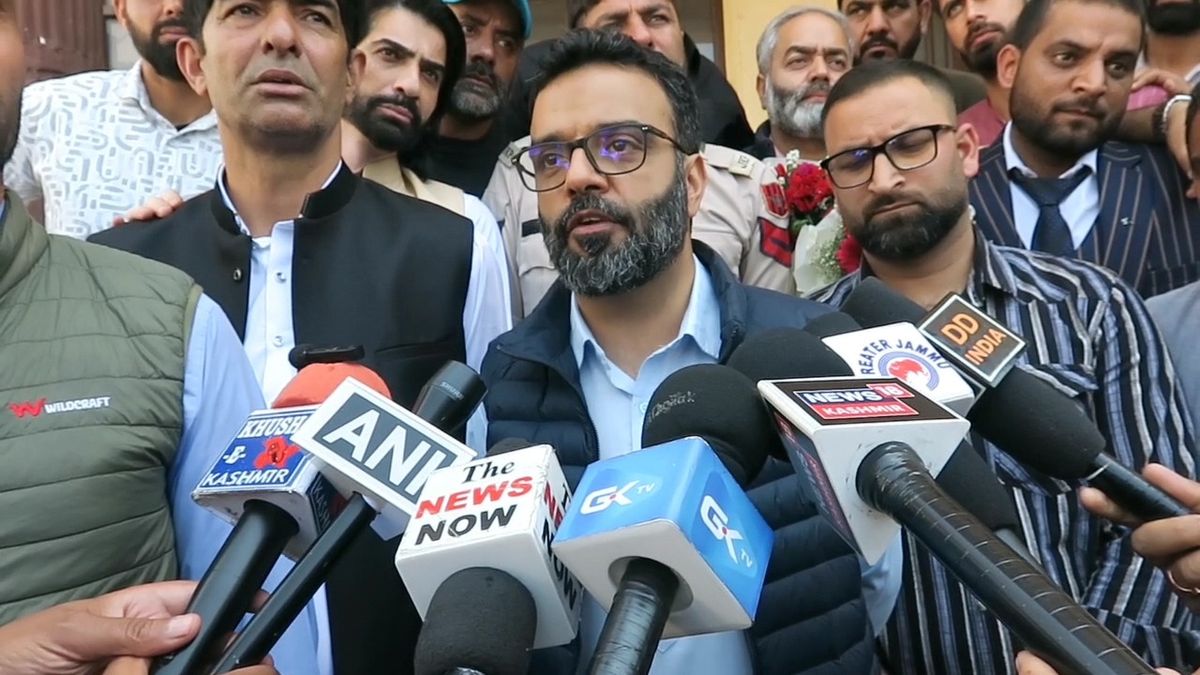
A sharp political intervention by Aga Ruhullah Mehdi has reignited debate over the performance of Jammu and Kashmir’s mainstream political leadership in the post-2019 era.
The National Conference MP drew attention to the recent breakthrough achieved by Ladakh’s civil society leadership in negotiations with the Centre, describing it as a “slap on the face” of Jammu and Kashmir’s political class.
His remarks came after the Leh Apex Body (LAB) and the Kargil Democratic Alliance (KDA) reportedly secured an “in-principle” understanding with the Union government on key demands related to democratic restoration and constitutional safeguards.
For Ruhullah, the development is more than a Ladakh success story—it is an uncomfortable comparison that raises difficult questions about the strategy, effectiveness, and political will of Kashmir’s mainstream parties since the abrogation of Article 370.
Ladakh’s Long Campaign Reaches a Turning Point
Years of Mobilisation Yield Results
- Constitutional safeguards
- Democratic representation
- Land protection
- Employment security
- Cultural preservation
- Administrative accountability
The LAB and KDA, representing diverse political, social, and regional interests across Leh and Kargil, emerged as the principal platforms leading negotiations with New Delhi.
Their demands have broadly included:
- Constitutional protections similar to Article 371 provisions
- Sixth Schedule safeguards
- A dedicated public service commission
- Enhanced parliamentary representation
- Restoration of democratic institutions
The reported breakthrough is being viewed by many in Ladakh as validation of years of organized, issue-based political engagement.
Aga Ruhullah’s Sharp Critique
“If Ladakh Can Do It, Why Not J&K?”
For Aga Ruhullah Mehdi, Ladakh’s achievement carries implications far beyond the Union Territory itself.
The Srinagar MP argued that if a smaller and less populous region could sustain pressure and secure meaningful negotiations with the Centre, Jammu and Kashmir’s mainstream leadership has little justification for failing to achieve comparable political gains since 2019.
His criticism appears directed not only at rival parties but also at sections of the broader political establishment, including leaders within his own political ecosystem.
The statement reflects growing frustration among sections of Kashmir’s political class who believe that post-Article 370 politics has become overly cautious, reactive, and ineffective.
Observers note that Ruhullah has increasingly positioned himself as one of the most outspoken voices demanding a more assertive political strategy on issues of constitutional rights, democratic restoration, and regional representation.
The Post-2019 Question
What Has J&K Achieved Politically?
What tangible political gains has Jammu and Kashmir secured since the constitutional changes of August 2019?
Critics argue that despite electoral participation and political engagement:
- Statehood has not yet been restored.
- Constitutional protections remain absent.
- Key political demands remain unresolved.
- Governance authority continues to be debated.
- Public confidence in mainstream politics remains fragile.
Supporters of mainstream parties counter that political realities in Jammu and Kashmir differ significantly from those in Ladakh and require a different strategy based on gradual engagement rather than confrontation.
However, Ladakh’s apparent success has complicated that argument by providing a visible example of sustained negotiation yielding results.
A Growing Challenge for Mainstream Parties
Pressure Mounts on NC, PDP and Other Political Forces
Ruhullah’s remarks are likely to intensify pressure on major regional parties, including the Jammu & Kashmir National Conference and the Jammu and Kashmir Peoples Democratic Party.
For years, these parties have positioned themselves as defenders of constitutional rights and regional interests.
Yet many voters increasingly ask:
- What has been achieved since 2019?
- Has engagement with New Delhi produced results?
- Are current strategies effective?
- Should political approaches change?
Ladakh’s breakthrough may strengthen demands for:
- More assertive negotiations,
- Clearer political roadmaps,
- Stronger public mobilization,
- Greater accountability from elected leaders.
Political analysts say this debate could become one of the defining issues in Jammu and Kashmir’s future electoral and constitutional discourse.
A Rare Internal Challenge Within NC
Ruhullah’s Comments Highlight Emerging Fault Lines
One of the most significant aspects of the controversy is that the criticism comes from within the National Conference itself.
While Ruhullah remains a prominent NC leader, his public interventions have increasingly reflected an independent political voice.
His remarks may be interpreted as an indirect challenge to the leadership style and political strategy of figures such as Omar Abdullah.
Although the party has generally maintained a united public position on key issues, Ruhullah’s statements highlight growing internal debates regarding:
- Negotiation strategies,
- Constitutional advocacy,
- Public mobilization,
- Relations with the Centre.
Such discussions are not uncommon within large political organizations, but public criticism of this nature inevitably attracts attention.
Why Ladakh’s Success Resonates in Kashmir
Symbolism Matters in Politics
For many observers, the development symbolizes:
- Persistence,
- Strategic negotiation,
- Grassroots mobilization,
- Political clarity.
In contrast, critics argue that Kashmir’s political discourse has often appeared trapped between symbolism and uncertainty.
Whether that perception is entirely fair is open to debate, but politics is often shaped by narratives as much as outcomes.
Ladakh’s achievement therefore carries symbolic weight that could influence public expectations across Jammu and Kashmir.
The Centre’s Approach Under Scrutiny
Why Dialogue in Ladakh and Not J&K?
Another question emerging from the debate concerns New Delhi’s engagement strategy.
The Centre’s willingness to hold sustained negotiations with Ladakh’s representative bodies has prompted some political observers to ask why similar structured political dialogue has not emerged in Jammu and Kashmir.
Critics argue that:
- Regional equity requires consistent engagement.
- Democratic aspirations should be addressed across regions.
- Political dialogue should not be selective.
Others contend that Ladakh’s demands are administrative and constitutional in nature, while Jammu and Kashmir’s issues involve broader political and security dimensions, making direct comparisons difficult.
Regardless of interpretation, the contrast has become a powerful political talking point.
Editorial Perspective: A Mirror Held Up to J&K Politics
More Than a Criticism of Leaders
Aga Ruhullah’s remarks are significant because they transform Ladakh’s achievement into a mirror reflecting broader questions about political effectiveness in Jammu and Kashmir.
The real issue may not be whether one agrees with his criticism, but whether the region’s political leadership can convincingly demonstrate progress, strategy, and results in a rapidly changing political environment.
Ladakh’s breakthrough has created a benchmark—fairly or unfairly—against which future political performance in Jammu and Kashmir is likely to be measured.
That reality may prove more consequential than the controversy itself.
Conclusion
Aga Ruhullah Mehdi’s description of Ladakh’s constitutional breakthrough as a “slap on the face” of Jammu and Kashmir’s leadership has injected fresh urgency into debates about political strategy, representation, and accountability in the post-2019 era.
As Ladakh moves closer to securing constitutional and democratic safeguards through sustained negotiations, pressure is mounting on mainstream parties in Jammu and Kashmir to explain their own political roadmap and achievements.
Whether Ruhullah’s intervention leads to meaningful introspection or deeper political divisions remains to be seen. What is clear, however, is that Ladakh’s success has altered the regional political conversation—and Jammu and Kashmir’s leadership can no longer ignore the comparison.


