‘Electricity Is a Right, Not a Commodity’: Ladakh Erupts Over Power Sector ‘Privatisation’ Plan
By: Javid Amin | 09 May 2026
A major political and public confrontation is unfolding in Ladakh after the administration proposed a joint venture between the Ladakh Power Development Department (LPDD) and the Rural Electrification Corporation (REC).
What officials describe as a step toward “modernisation” and “efficiency” is being fiercely opposed by local political and civil society groups, who see the proposal as a hidden route toward privatisation of one of Ladakh’s most critical public services.
The controversy has rapidly evolved from a technical administrative issue into a wider debate about:
- autonomy,
- local control,
- economic centralisation, and
- Ladakh’s political future.
Rare Unity: LAB and KDA Join Hands Against the Proposal
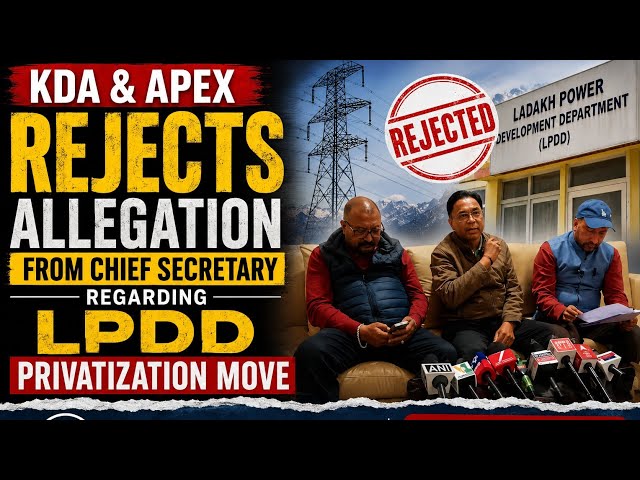
In a significant political development, the Leh Apex Body (LAB) and the Kargil Democratic Alliance (KDA) have jointly opposed the proposal.
The alliance is politically notable because:
- LAB and KDA have historically differed on multiple regional and political questions,
- yet both now appear united against what they call the “corporatisation” of essential services.
In a joint statement, the groups warned that:
“Electricity is not a commodity — it is a right.”
They accused the administration of attempting to:
- dilute public ownership,
- bypass local institutions, and
- introduce corporate influence into a sector considered vital for survival in Ladakh’s harsh terrain.
What Exactly Is the LPDD-REC Proposal?
According to administrative discussions, the proposal seeks to create a joint venture between LPDD and REC for:
- power generation,
- transmission, and
- distribution management in Ladakh.
Government’s Position
Officials argue the partnership could:
- modernize outdated infrastructure,
- improve electricity reliability,
- attract investment, and
- bring technical expertise to the region.
Given Ladakh’s:
- difficult geography,
- harsh winters, and
- increasing energy demand,
the administration says reforms are necessary to stabilize the power sector.
Why Opponents Fear ‘Privatisation Through Partnership’
Critics are unconvinced by official assurances.
They argue that joint ventures often become:
the first step toward gradual privatisation.
Their Key Concerns Include:
1. Loss of Local Control
Residents fear decisions affecting:
- tariffs,
- infrastructure priorities, and
- service delivery
could shift away from Leh and Kargil into the hands of corporate or bureaucratic management structures.
2. Rising Electricity Costs
Activists warn that profit-driven models frequently lead to:
- higher consumer tariffs,
- increased service charges, and
- reduced affordability for remote communities.
In a region where electricity is essential for:
- heating,
- healthcare,
- tourism, and
- survival during extreme winters,
any tariff increase becomes politically explosive.
3. Employment Insecurity
Local engineers, technicians, and workers fear:
- outsourcing,
- contractual employment models, and
- weakening of government job protections.
The anxiety is especially significant in Ladakh, where public sector employment remains a major source of economic stability.
4. Lack of Consultation
Opposition groups claim:
- there was no meaningful public consultation,
- no legislative debate, and
- limited transparency surrounding the proposal.
This has intensified distrust toward the administration’s intentions.
Why Electricity in Ladakh Is Different
Unlike many urban regions where electricity is viewed primarily as a utility service, in Ladakh power infrastructure is directly tied to:
- survival,
- connectivity, and
- economic continuity.
Electricity sustains:
- homes during sub-zero winters,
- hospitals in remote terrain,
- tourism infrastructure, and
- strategic defense installations near sensitive borders.
For many locals, this makes electricity:
not merely an economic sector, but a strategic public necessity.
A Deeper Political Message: Development vs Self-Governance
The controversy reflects a broader tension emerging in post-2019 Ladakh politics.
Since becoming a Union Territory, many local groups have increasingly voiced concerns about:
- centralized decision-making,
- weakening local participation, and
- policies imposed without regional consent.
The power sector debate has therefore become symbolic of a larger fear:
that Ladakh’s resources and institutions may gradually move beyond local control.
What the Two Sides Are Arguing
| Administration’s Argument | Opposition’s Argument |
|---|---|
| Modernisation needed | Privatisation by stealth |
| Technical expertise from REC | Loss of local autonomy |
| Better efficiency & investment | Corporate control over essentials |
| Infrastructure upgrade | Rising tariffs & weakened accountability |
Why This Issue Could Reshape Ladakh Politics
Political analysts believe the LPDD-REC controversy could become a defining issue in Ladakh for several reasons:
1. Rare Leh–Kargil Consensus
LAB and KDA standing together signals:
- widening regional concern,
- stronger collective bargaining, and
- growing political coordination.
2. Resource Governance Debate
The confrontation may expand into larger questions involving:
- land,
- water,
- environment, and
- local administrative powers.
3. Centre–Region Relations
The issue directly tests how far New Delhi’s administrative model aligns with local aspirations in Ladakh.
Beyond Electricity: A Debate About Trust
At its core, the power sector row is not just about transformers, tariffs, or transmission lines.
It is about:
- who controls essential resources,
- who benefits from development, and
- whether modernization can happen without eroding public ownership and local agency.
For many in Ladakh, the concern is not opposition to development itself.
The concern is:
development without participation.
Conclusion: Ladakh Draws a Line
The LPDD-REC proposal has exposed a widening fault line in Ladakh’s evolving political landscape.
While the administration frames the plan as necessary modernization, opponents see it as:
- economic centralisation,
- creeping privatisation, and
- dilution of local rights.
The rare unity between LAB and KDA suggests that the resistance is no longer isolated activism—it is becoming a broader regional assertion about autonomy, accountability, and control over public resources.
In Ladakh, where electricity powers survival itself, the debate has become deeply personal:
Should essential services remain public lifelines—or become part of a corporate governance model shaped far from the mountains they serve?


