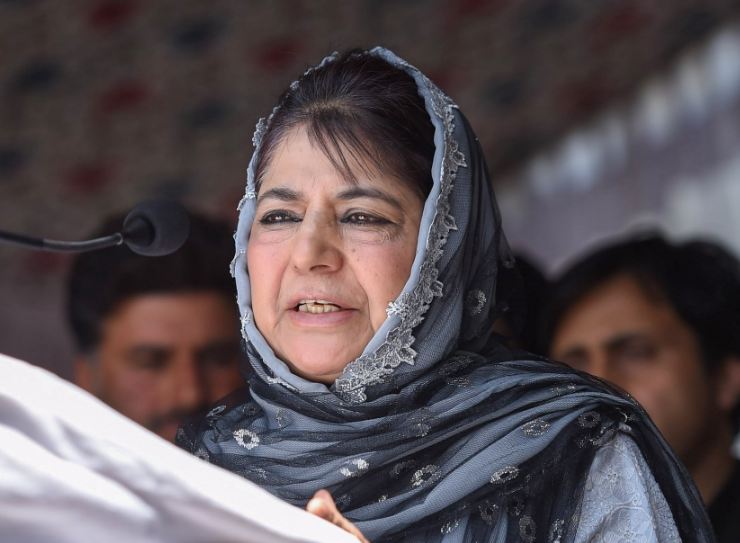
Mehbooba Mufti Alleges NC Minister Sought ₹30 Lakh for Transfer in J&K
By: Javid Amin | 09 May 2026
Fresh Corruption Allegation Rocks J&K Politics as Mehbooba Targets NC Government
A fresh political controversy has erupted in Jammu and Kashmir after former Chief Minister and Peoples Democratic Party president Mehbooba Mufti alleged that a minister in the Jammu and Kashmir National Conference-led government demanded ₹30 lakh in exchange for a transfer order.
Without naming the minister involved, Mehbooba described the alleged incident as evidence of “deep-rooted corruption” within the present administration, accusing the ruling establishment of betraying public trust.
The allegation has intensified political tensions in the Union Territory and revived longstanding concerns over what is often described as the “transfer industry” in Jammu & Kashmir.
The Core Allegation: ‘₹30 Lakh for a Transfer’
Addressing the issue publicly, Mehbooba Mufti claimed that a government employee was allegedly asked to pay ₹30 lakh to secure a routine administrative transfer.
She argued that the incident reflects a governance structure where influence and money allegedly override merit and institutional fairness.
“This is the level of corruption prevailing in the present government,” Mehbooba said while criticizing the administration.
According to her, such practices destroy public confidence and reinforce perceptions that governance has become transactional rather than service-oriented.
The ‘Transfer Industry’ Debate in Jammu & Kashmir
The controversy has once again drawn attention to a sensitive and longstanding issue in Jammu and Kashmir — the alleged politicisation and monetisation of transfers and postings.
Why Transfers Matter Politically
In the administrative structure of Jammu & Kashmir:
- Transfers often determine access to influential postings
- Certain departments are viewed as strategically important
- Political patronage has historically been linked to postings
Critics across party lines have repeatedly alleged that:
- Transfers are influenced by money and connections
- Merit-based systems are frequently bypassed
- Employees face pressure from political intermediaries
The latest allegation has therefore resonated beyond routine political rhetoric because it touches a deeply familiar public grievance.
Governance Under Scrutiny
The accusation comes during a period when the ruling dispensation is already facing criticism on multiple governance fronts.
Issues Already Triggering Public Debate
- Outsourcing of recruitment processes
- Administrative dismissals
- Demolition drives in parts of J&K
- Growing unemployment concerns
- Delays in recruitment and regularisation
By raising corruption allegations now, Mehbooba Mufti appears to be attempting to consolidate opposition sentiment around governance failures and accountability.
Political Messaging Behind Mehbooba’s Statement
The statement is politically significant for several reasons.
Positioning as Anti-Corruption Voice
Mehbooba’s remarks attempt to project the Peoples Democratic Party as:
- A watchdog against administrative abuse
- A defender of ordinary employees
- A critic of patronage politics
At the same time, the allegations place the Jammu and Kashmir National Conference government on the defensive, especially among sections of the electorate already frustrated with unemployment and governance issues.
Public Sentiment: Frustration and Distrust
The allegations have found traction among sections of civil society and government employees who increasingly perceive the administrative system as opaque and inaccessible.
Common Public Concerns
- Fear that opportunities are “sold” rather than earned
- Declining trust in institutional fairness
- Perception that political influence dictates administrative decisions
- Frustration among unemployed youth and lower-rung employees
For many citizens, corruption in transfers is viewed not as an isolated problem, but as a symbol of deeper systemic dysfunction.
Why the Allegation Matters Beyond Politics
Analysts say the controversy reflects a broader governance crisis where institutions risk losing credibility if corruption allegations repeatedly emerge without transparent investigation.
Potential Consequences
| Issue | Possible Impact |
|---|---|
| Corruption Allegations | Erosion of public trust |
| Politicised Transfers | Administrative inefficiency |
| Lack of Accountability | Increased public alienation |
| Perceived Patronage Networks | Democratic distrust |
In conflict-sensitive and politically fragile regions, governance credibility often plays a critical role in maintaining public confidence.
Administrative Silence and Demand for Transparency
As political reactions intensify, opposition voices and sections of civil society are demanding:
- Transparent transfer policies
- Digital monitoring of postings
- Independent inquiry into corruption allegations
- Greater accountability mechanisms within departments
So far, no official public clarification has emerged regarding the specific allegation raised by Mehbooba.
The Larger Narrative: Governance Becoming Transactional?
The controversy also feeds into a larger public perception that governance in Jammu and Kashmir is increasingly becoming transactional.
Critics argue that when:
- Jobs are outsourced,
- Transfers allegedly require money, and
- Public services appear politicised,
citizens begin to lose faith in institutions meant to function impartially.
This sentiment is especially powerful among young people who already face economic uncertainty and shrinking opportunities.
Editorial Analysis
Mehbooba Mufti’s allegation is not merely another political accusation in Jammu & Kashmir’s highly charged environment. It reflects a growing public anxiety over whether governance mechanisms are being shaped by transparency and merit — or by influence and financial power.
If transfers, one of the most routine administrative functions, are perceived as purchasable commodities, the damage extends beyond a single department or minister. It strikes at the legitimacy of governance itself.
For any administration claiming reform and accountability, credibility depends not only on denying corruption but on demonstrating transparent systems that leave little room for suspicion.
In Jammu & Kashmir, where public trust remains fragile, even allegations of institutional corruption carry consequences far beyond immediate politics.
Key Highlights
| Aspect | Details |
|---|---|
| Main Allegation | ₹30 lakh allegedly demanded for transfer |
| Accuser | Mehbooba Mufti |
| Target | Minister in NC-led government |
| Core Concern | Corruption in administrative transfers |
| Broader Issue | Governance transparency and accountability |
| Public Reaction | Calls for inquiry and reform |


