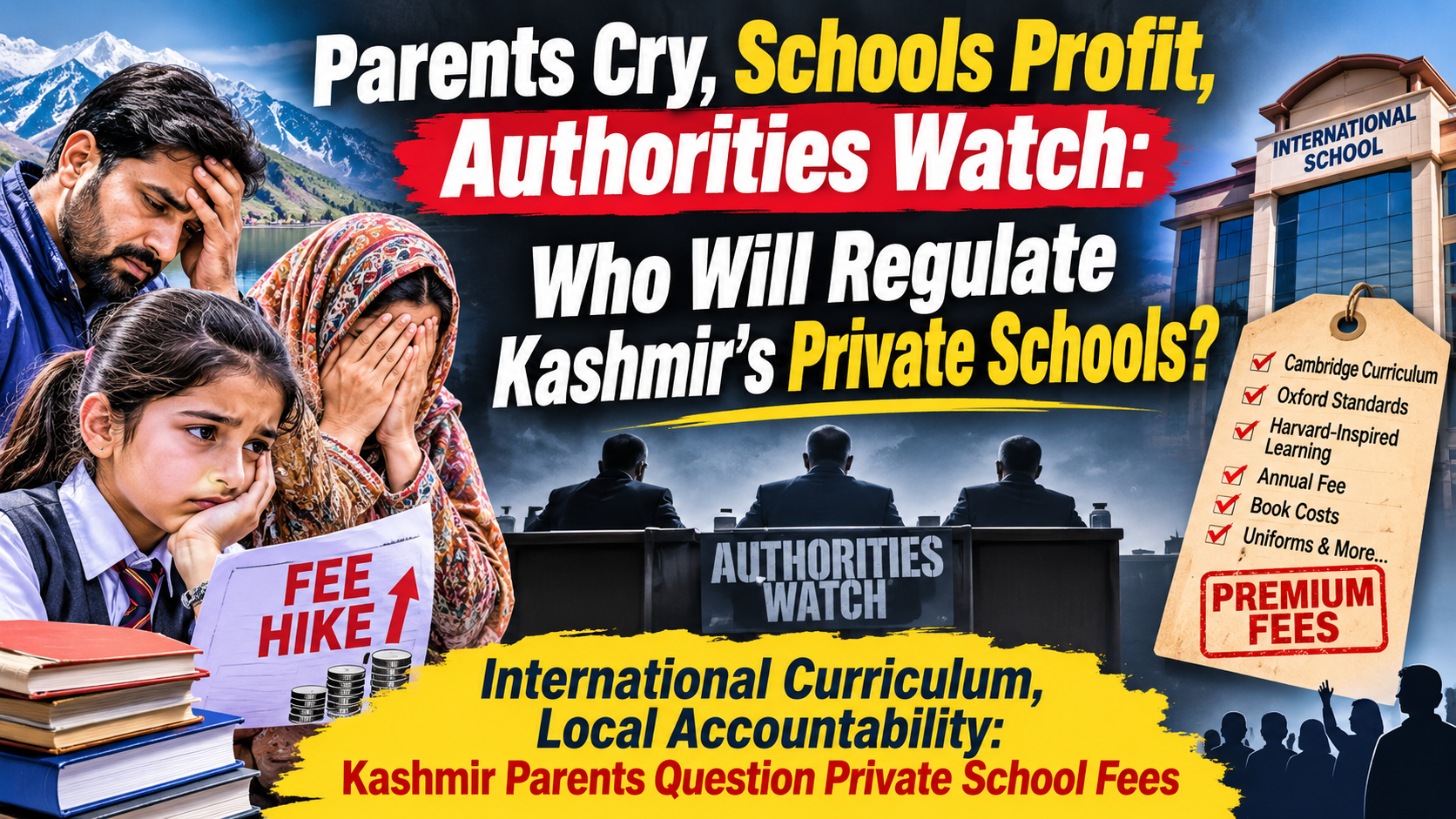
Editorial | Parents Cry, Schools Profit, Authorities Watch: Who Will Regulate Kashmir’s Private School Business?
08 November 2026 : From self-designed curricula and expensive international branding to annual fee hikes and unexplained charges, parents are being asked to pay more while receiving too few answers. If schools want premium fees, they must prove that they are delivering premium education.
Every academic session brings familiar promises from the authorities.
Private schools are told not to increase fees arbitrarily. They are warned against forcing parents to purchase books and uniforms from particular shops. Circulars are issued, committees are constituted and officials assure families that complaints will be examined.
Then the new session begins.
Parents receive fresh booklists, revised fee schedules, uniform requirements and a series of additional charges. Some are described as annual fees, others as activity charges, development expenses or technology costs. Families are expected to pay, often without being given a clear explanation of how these amounts were calculated.
For many middle-class households in Kashmir, educating a child has become a continuous financial struggle.
The question is no longer whether private schools should be allowed to charge fees. They have legitimate operating expenses, employ teachers and maintain infrastructure. The real question is whether the money collected from parents is justified, properly accounted for and reflected in the quality of education being delivered.
And there are three questions the government must answer.
If schools prescribe their own curriculum, where are the properly trained teachers? If fees are regulated, under what authority are they increased every year? And what exactly is the annual fee that parents are being asked to pay?
These are not unreasonable questions. They go to the heart of accountability in education.
The international education business: Where is the international standard?
One of the most noticeable trends in private schooling is the growing use of international branding.
Parents are attracted by promises of Cambridge curriculum, Oxford standards, Harvard-inspired learning, global classrooms and international teaching methods.
The language is impressive. The fees are often considerably higher than those of conventional schools.
But an important question remains unanswered: what exactly makes the classroom international?
Is it the textbook? The school building? The smartboard? The prospectus? Or the qualifications and teaching ability of the person standing in front of the students?
A foreign publisher’s logo does not automatically produce international-quality education. Nor does the use of an international curriculum guarantee that students are receiving the teaching methods, academic support and assessment standards associated with it.
A school that chooses a specialised or international curriculum must also demonstrate that its teachers understand that curriculum and have received appropriate training to deliver it.
Teachers need subject knowledge, pedagogical training, classroom-management skills and continuing professional development. They must understand how to assess students, encourage independent thinking and adapt lessons to different learning abilities.
This is particularly important when schools move away from conventional textbooks and introduce their own academic structures.
You cannot introduce a different curriculum and expect teachers to deliver it effectively without investing in their training.
This is not an attack on teachers. In fact, teachers are often among the most underappreciated participants in the education system. Some work under demanding conditions, handle large classes, perform administrative duties and receive salaries that do not reflect the expectations placed upon them.
The responsibility lies with school management to ensure that its academic ambitions are supported by qualified and adequately trained staff.
The legal position is not ambiguous on basic qualifications. Section 19 of the J&K School Education Act, 2002, states that the academic and other qualifications of teaching and non-teaching staff in private schools cannot be lower than those prescribed for corresponding government posts. CBSE-affiliated schools also have prescribed teacher-qualification standards and training requirements.
So why should parents not be entitled to know:
-
How many teachers in a school hold the required professional qualifications?
-
How many have received training in the curriculum being taught?
-
Does the school conduct regular teacher-development programmes?
-
Are teachers adequately paid and provided with proper working conditions?
-
Are international curricula being implemented properly, or merely advertised?
If a school charges premium fees because it claims to offer international education, it should be prepared to demonstrate the academic standards behind that claim.
The curriculum question: If you choose your own books, prove your academic quality
Another source of frustration is the growing number of booklists and additional learning materials prescribed by private schools.
Parents complain that some institutions introduce different books, publishers and supplementary material, sometimes changing entire sets even when the academic content has undergone little revision.
The financial burden is obvious. But there is a deeper academic question.
If a school wants to prescribe additional books or follow a curriculum different from the standard one, what is the educational justification? Who evaluates the content? Are teachers trained to teach it? Does it offer a measurable academic advantage to students?
Schools cannot simply add books to a list and expect parents to accept the additional expense without explanation.
There is also a legal dimension. In its June 6, 2026 judgment in LPA No. 241 of 2023, the Jammu and Kashmir High Court upheld JKBOSE’s statutory authority to prescribe curricula and textbooks for affiliated schools. The case specifically concerned Classes VI to VIII and the relevant Board notifications. The judgment reaffirmed that schools which voluntarily obtain Board affiliation must comply with the applicable affiliation conditions, including prescribed curricula and textbooks.
This does not mean every school follows an identical curriculum. Different recognised boards and permitted academic frameworks may have different requirements. But schools cannot use the phrase “our own curriculum” as a blanket justification for disregarding the conditions of their affiliation.
The government must establish a clear distinction between legitimate academic flexibility and commercially motivated booklist expansion.
And if a school is permitted to follow a particular curriculum, it should also be required to disclose the academic rationale, teacher-training arrangements and quality-assurance mechanisms behind it.
The annual fee mystery: What exactly are parents paying for?
This is perhaps the most persistent question in the private-school fee debate.
Almost every parent recognises the term “annual fee”. But how many can confidently explain what it covers?
Maintenance? Building repairs? Infrastructure? Administration? Technology? Library facilities? Development?
Schools may have legitimate expenses under these heads. But parents deserve more than a broad label.
They already pay tuition fees. They may also pay transport charges, examination-related expenses and other approved fees. Then comes the annual fee, often collected as a separate amount.
What is its precise purpose? How much is allocated to each expense? Is it calculated according to actual costs? Does it vary according to the facilities available? And what happens if the promised facilities are not provided?
The legal framework does permit private schools to collect an annual fee. Section 20E of the J&K School Education Act specifies the permissible categories of fees, including tuition, annual and transport fees, along with completely voluntary special-purpose charges and other fees approved through the prescribed process. It also prohibits schools from collecting unauthorised amounts under different names.
Therefore, the issue is not that every annual fee is automatically illegal. The issue is whether the particular amount being collected has been approved by the FFRC and whether the school can justify it.
The FFRC’s own orders demonstrate that annual fees are considered as part of school-specific fee structures. In an order dated February 25, 2026, concerning Public Educational Trust Model School, Ari Mendhar, Poonch, the Committee examined audited revenue and expenditure, infrastructure, maintenance, staff salary obligations, student-teacher ratio and other factors before approving the fee structure. The order also specified a one-time annual fee for new entrants in the nursery class and separate annual-fee amounts for other classes.
This illustrates why annual fees should not be treated as a standard, unexplained charge. Their approval and amount must be examined in the context of each institution’s financial and academic circumstances.
Parents should be able to see the approved annual fee, the relevant fee order and the basis on which the amount was determined.
Why should a family pay an annual charge without knowing what it is meant to fund?
And why should a school be allowed to collect it without making the approved details readily available?
The annual fee must not become a convenient way of adding another payment to the academic calendar.
Parents have started joking that schools have introduced a thirteenth and fourteenth month into the year. The joke is funny only until the bill arrives.
Annual fee hikes: What do government orders actually say?
This is where the debate becomes even more serious.
Parents repeatedly complain that tuition fees and other charges increase from one academic session to another. Schools may cite rising salaries, inflation, maintenance, electricity, technology and infrastructure costs.
Some of these expenses are genuine. But a school’s explanation is not the same as regulatory approval.
Under Rule 6 of the Jammu and Kashmir Private Schools (Fixation, Determination and Regulation of Fee) Rules, 2022, the fee fixed by the FFRC is binding on the school and remains valid for three years. If a school seeks modification during that period, it must apply to the Committee.
The government reinforced this position in March 2026. While replying to a question in the Legislative Assembly, it stated that private schools cannot revise or impose fees without prior FFRC approval. The government also said that fee fixation involves financial scrutiny, including infrastructure, administrative expenditure and other relevant factors.
That makes the issue straightforward.
A school cannot simply announce a hike because a new academic session has started. It must follow the prescribed process and obtain the required approval.
If a school has increased fees without authorisation, parents should be able to approach the FFRC with the previous and revised fee schedules, receipts and other relevant documents.
But the government must go further. It should publish a simple, school-wise online record showing:
-
The current FFRC-approved fee structure.
-
The date of approval and period of validity.
-
The approved tuition and annual fee for each class.
-
Any subsequent modification granted by the Committee.
-
The date and grounds of the approved revision.
Why should parents have to search through complicated orders or depend on informal information to find out whether a fee hike is legal?
The information should be available on the school’s website and the regulator’s portal.
What is the government doing, and why are the complaints continuing?
It would be inaccurate to say that Jammu and Kashmir has no regulatory framework.
The FFRC exists. The School Education Act provides statutory powers. The 2022 rules prescribe procedures for fee determination and regulation.
The problem is the gap between the existence of rules and their visible enforcement.
Consider the record.
In July 2025, the FFRC issued a notice to 153 private schools in Baramulla for failing to submit the documents required for regulation and determination of tuition and annual fees. The notice warned that action could include suspension of recognition, recommendation for withdrawal of NOC and even restraining schools from collecting fees until approval was granted.
In January 2026, the government constituted a committee under the chairmanship of the JKBOSE Secretary to examine complaints about private-school fees and the cost of books, uniforms and shoes. It was also asked to examine the legal basis for transport charges during winter vacations in Kashmir. The committee was given 30 days to submit its report.
The FFRC’s official circular records also list directions concerning advance fees, late fees, transport charges, mandatory disclosure of fee heads in receipts and action against schools that fail to submit their fee-regulation documents.
These are not insignificant interventions.
But parents want to know what happened after the orders were issued.
How many schools were penalised? How many unauthorised fee increases were reversed? How many complaints were resolved? What happened to the findings of the January committee? How many schools are still operating without an approved fee structure?
The public should not have to wait for another academic session to discover that the same problems remain.
If the government has the rules, the regulator has the powers and the complaints are already on record, why are parents still struggling to obtain basic answers?
Books, uniforms and the alleged vendor nexus
The textbook controversy adds another layer to the problem.
Parents have alleged that certain schools direct them towards specific booksellers or designated outlets. Some complain that books are changed frequently, even when previous editions could still serve their purpose.
Such claims require school-wise verification. Not every school is necessarily involved in improper practices, and a school may have legitimate academic reasons for changing a textbook.
But the government cannot ignore the possibility of commercial arrangements influencing book selection.
The FFRC’s February 2026 order concerning Public Educational Trust Model School provides a clear example of the regulatory approach. It prohibited the school from selling books and uniforms on its premises and barred tie-ups with specific vendors, directing that parents must retain the freedom to purchase from the open market.
That is the kind of practical protection parents need.
The government should publish school-wise booklists, require advance disclosure of publishers and editions, investigate complaints about compulsory purchases and ensure that parents are not directed towards a particular shop without a legitimate academic reason.
A school should be free to recommend educational material. It should not be allowed to turn that recommendation into a compulsory commercial arrangement.
Fear prevents parents from speaking openly
There is another side to this issue that rarely appears in official reports.
Many parents hesitate to complain publicly because they fear that their children could face uncomfortable consequences.
They worry about being singled out, treated differently or drawn into disputes with school management. Whether every such fear is justified is a separate matter. But the perception itself can discourage complaints.
This creates an unequal relationship.
The school controls the child’s daily academic environment. The parent depends on the school for education, assessment and progression. A complaint can therefore feel like a risk that the family is unwilling to take.
The solution is not to encourage parents to fight individual school managements one by one.
The government should provide a confidential, accessible and independent complaint mechanism. Complaints should be acknowledged, investigated and resolved within a fixed timeframe. Students should be protected from retaliation, and schools should be required to cooperate with regulatory inquiries.
Parents should not have to choose between defending their financial rights and protecting their children’s peace of mind.
The real cost: Parents are sacrificing more than money
Behind every fee receipt is a family budget.
Some parents postpone household repairs. Others take loans, cut personal expenses or use savings meant for emergencies. Mothers and fathers make sacrifices that rarely appear in school advertisements.
Education is an investment in a child’s future. But that investment should not become a source of constant financial anxiety.
The government must also recognise that affordability is not simply about whether a family can make one payment. It is about the cumulative burden of tuition, annual fees, books, uniforms, transport, technology and other approved expenses over an entire academic year.
A school may defend each charge separately. Parents experience them together.
That is why fee regulation must consider the total cost of schooling, not merely the tuition figure printed on a receipt.
What the government must do now
The authorities should move beyond general warnings and establish an enforcement system that parents can actually use.
First, publish every school’s approved fee structure. Parents should be able to search by school name and class and immediately see the authorised tuition fee, annual fee, transport fee and other permitted charges.
Second, investigate annual fee calculations. Every school should disclose the purpose and basis of its annual fee. The regulator should examine whether the amount is supported by audited expenditure and approved under the prescribed process.
Third, stop unauthorised annual increases. Schools must not revise approved fees without prior FFRC permission. Violations should attract action under the applicable law.
Fourth, audit curriculum claims. Schools advertising international or specialised curricula should disclose the recognised academic framework they follow, their affiliation status and the qualifications and training of their teaching staff.
Fifth, protect teachers. The government should verify professional qualifications, working conditions and training arrangements. A school cannot claim premium academic standards while neglecting the people responsible for delivering education.
Sixth, investigate book and uniform complaints. Schools should not compel parents to purchase books or uniforms from particular vendors where such arrangements violate applicable directions.
Seventh, publish enforcement reports. The FFRC should disclose the number of complaints received, inspections conducted, schools found in violation, penalties imposed and cases resolved.
Eighth, protect parents and students who complain. A transparent complaint mechanism must ensure that students are not subjected to unfair treatment because their parents have raised legitimate concerns.
The final question: Who will hold the schools accountable?
Private schools have an important place in Jammu and Kashmir’s education system. They provide employment, serve thousands of families and offer educational choices that many parents value.
There is no justification for treating every private institution as an offender.
But neither should the contribution of private schools place them beyond scrutiny.
If a school charges higher fees, it must justify them. If it advertises an international curriculum, it must demonstrate the teaching standards behind it. If it collects an annual fee, it must explain what that money pays for. If it changes books, it must provide an academic reason. If it expects parents to meet rising expenses, it must also show that teachers, infrastructure and learning outcomes are improving.
And if the government has issued regulations, it must enforce them.
Years pass. Governments change. Committees are formed. Circulars are issued. Yet parents continue to raise many of the same complaints.
The question is no longer whether the authorities know about the problem. The question is what they intend to do about it.
Parents are not asking for charity. They are asking for accountability. They are not demanding that private schools operate without revenue. They are demanding that education should not become an excuse for unexplained charges, arbitrary decisions and unchecked commercial interests.
A school is not merely a business operating from a building. It carries a responsibility towards children, families and society.
If education is supposed to build futures, why are so many families being pushed into financial distress just to secure one?
Until the government answers that question through visible enforcement, the annual spectacle will continue: parents complain, schools defend their charges, and authorities issue another circular.

