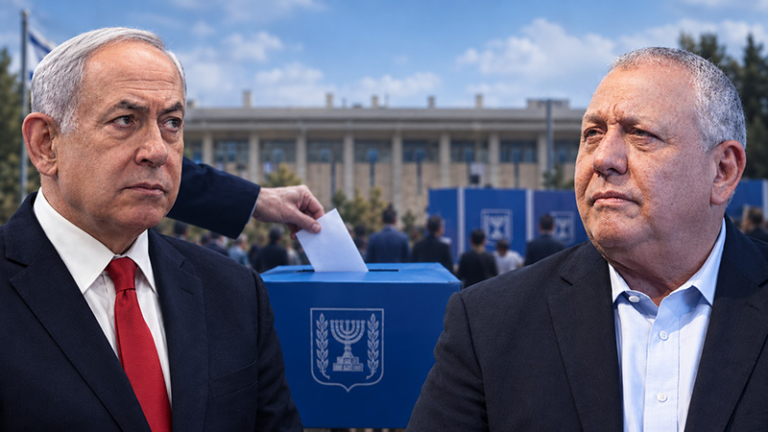
The Israeli president has chosen Netanyahu’s strongest challenger to form the next government. But 67 parliamentary recommendations do not automatically translate into a governing majority. The real battle is now over Arab support, ultra-Orthodox parties, military conscription and the future of Netanyahu himself.
By: Javid Amin | 08 November 2026
Jerusalem, November 8: Benjamin Netanyahu has suffered another major political setback. But his removal from office is not yet assured.
President Isaac Herzog has selected former military chief Gadi Eisenkot to form Israel’s next government following the October 27 parliamentary election. The decision, announced on November 7, gives the opposition leader the first opportunity to end Netanyahu’s tenure as prime minister.
Eisenkot enters the process with an important political advantage: 67 members of the 120-seat Knesset recommended him to the president, compared with 46 who recommended Netanyahu. The remaining seven lawmakers, from the ultra-Orthodox United Torah Judaism party, did not recommend either candidate.
Gadi Eisenkot has received President Isaac Herzog’s mandate to form Israel’s next government after securing recommendations from 67 lawmakers. But with no agreed coalition, the former military chief faces a difficult battle involving Arab parties, ultra-Orthodox factions and Netanyahu’s remaining political allies.
On paper, 67 is a majority. Politically, however, those 67 lawmakers do not represent a united governing coalition.
That is the contradiction at the heart of Israel’s current crisis. Eisenkot has enough support to receive the mandate, but he does not yet have an agreed coalition capable of governing the country.
The president’s decision is therefore a victory for the opposition, not the end of Netanyahu’s political career.
Reuters, the Associated Press and Israeli media reporting all point to the same difficulty: Eisenkot must negotiate between parties that agree on removing Netanyahu but disagree sharply over who should govern with whom, and on what terms.
1. First, understand the actual election result
The October 27 election produced a fragmented Knesset. The final official results show that Likud remained the largest individual party, but Netanyahu’s wider political bloc failed to secure a majority.
The following figures are based on the official Knesset election results.
Final distribution of the 120-seat Knesset | Netanyahu-aligned bloc – 53 seats | Eisenkot-led Jewish opposition – 48 seats | Arab-led parties – 19 seats | Majority benchmark – 61 seats
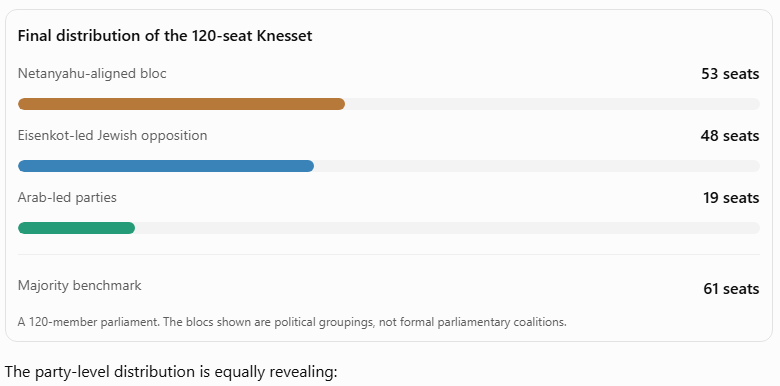
A 120-member parliament. The blocs shown are political groupings, not formal parliamentary coalitions.
The party-level distribution is equally revealing:
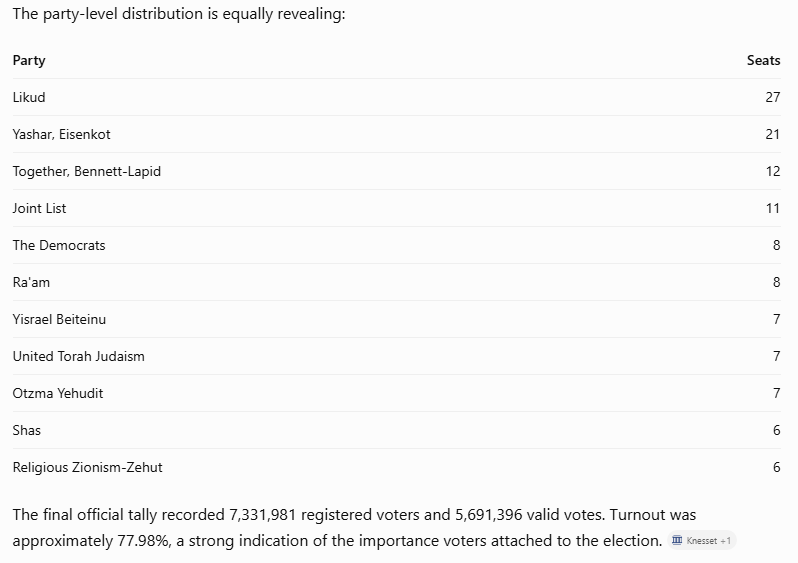
| Party | Seats |
|---|---|
| Likud | 27 |
| Yashar, Eisenkot | 21 |
| Together, Bennett-Lapid | 12 |
| Joint List | 11 |
| The Democrats | 8 |
| Ra’am | 8 |
| Yisrael Beiteinu | 7 |
| United Torah Judaism | 7 |
| Otzma Yehudit | 7 |
| Shas | 6 |
| Religious Zionism-Zehut | 6 |
The final official tally recorded 7,331,981 registered voters and 5,691,396 valid votes. Turnout was approximately 77.98%, a strong indication of the importance voters attached to the election.
There are three important conclusions.
-
Likud won the largest number of seats, but it cannot govern alone.
-
Eisenkot’s four-party Jewish-led opposition has 48 seats, 13 short of the conventional majority threshold.
-
The Arab-led parties hold 19 seats, making them decisive in several possible coalition arrangements.
The election did not give either Netanyahu or Eisenkot a straightforward mandate to govern. It transferred the decisive bargaining power to smaller parties.
2. Why Eisenkot received the presidential mandate
Israel’s president does not simply appoint the leader of the largest party as prime minister.
After an election, the president consults parliamentary factions and chooses the lawmaker considered most likely to assemble a government.
During the consultations concluded on November 5, Eisenkot received recommendations from factions representing 67 lawmakers. Netanyahu received 46. United Torah Judaism, with seven seats, declined to recommend either.
Herzog made clear that the numerical result was not the only consideration. He said that mutual political vetoes within and between the blocs made it difficult to establish who could actually form a stable government.
After further discussions, Herzog announced on November 7 that Eisenkot would receive the first opportunity. The formal mandate ceremony is scheduled for November 8 at 5 pm at the President’s Residence in Jerusalem.
Eisenkot will have 28 days to form a government. Herzog can grant an extension of up to 14 additional days.
If he fails, another candidate, potentially Netanyahu, could be given an opportunity. If the parliamentary process ultimately fails within the applicable timeframe, another election could follow.
This is why Eisenkot’s appointment matters, but should not be mistaken for a transfer of power.
3. The biggest obstacle: 67 recommendations are not 67 coalition partners
This is where the political arithmetic becomes complicated.
The 67 recommendations for Eisenkot consist of:
-
48 lawmakers from four Jewish-led opposition parties.
-
11 lawmakers from the Joint List.
-
Eight lawmakers from Ra’am.
Together, they provide a parliamentary majority on paper.
But the four Jewish-led opposition parties have not agreed to form a government dependent on Arab-party support.
The distinction is fundamental.
The Joint List and Ra’am recommended Eisenkot because they want Netanyahu removed. That does not mean they have agreed to enter his cabinet, accept every condition he proposes or support every policy his government might introduce.
The Joint List has indicated that it could support an alternative government from outside the coalition. Ra’am has also signalled willingness to cooperate, although its precise role would depend on the eventual agreement.
Eisenkot, meanwhile, has faced pressure over his campaign commitments and the position of his prospective partners.
Reuters reported that the opposition leader has resisted joining forces with Arab parties, while his potential partners have their own objections to depending on them.
The 67-seat figure therefore measures support for Eisenkot’s nomination, not a signed coalition agreement.
That is the first major weakness in his position.
4. The four realistic routes to government
There are four broad scenarios worth examining. They are not equally likely, and each carries serious political costs.
Scenario One: A minority government backed by Arab parties
This is one of the most direct routes to replacing Netanyahu.
Eisenkot’s four-party bloc has 48 seats. The two Arab parties together have 19.
If the Arab parties provide parliamentary support, the combined grouping reaches 67.
But the arrangement would not necessarily require Arab parties to hold cabinet positions. They could remain outside the government and support it on confidence votes, budgets or selected legislation.
This distinction could make an agreement more politically manageable.
The Joint List has indicated that it would consider supporting an alternative government without necessarily joining it. Ra’am has experience of participating in a governing coalition: it joined Naftali Bennett’s government in 2021, the first independent Arab party to do so in Israel’s history. That government collapsed after 18 months amid political disagreements, including over the occupied West Bank.
However, there is a serious obstacle.
Avigdor Liberman, leader of Yisrael Beiteinu, has repeatedly rejected a minority government dependent on Arab-party support. His seven seats are part of Eisenkot’s 48-seat Jewish-led opposition bloc.
This means Eisenkot cannot simply add 19 Arab lawmakers to his 48 and assume that all 67 will cooperate.
Political assessment: This route is numerically attractive but politically difficult. It would require Liberman to reconsider a central campaign commitment or Eisenkot to find a different arrangement with the Arab parties.
Scenario Two: Eisenkot brings ultra-Orthodox parties into his coalition
This may be the most interesting development in the current negotiations.
The two ultra-Orthodox parties, Shas and United Torah Judaism, together hold 13 seats.
Add those 13 to Eisenkot’s 48 and the total becomes exactly 61.
The 61-seat coalition calculation
Eisenkot’s opposition bloc – 48
Shas – 6
United Torah Judaism – 7
This is a politically remarkable possibility because both ultra-Orthodox parties have traditionally been associated with Netanyahu’s political camp.
Shas recommended Netanyahu during the presidential consultations. United Torah Judaism, however, declined to recommend either candidate.
That difference matters. UTJ has left itself more room to negotiate.
The problem is military conscription.
For years, ultra-Orthodox students have benefited from arrangements that defer or exempt them from compulsory military service. The issue has become particularly explosive following the prolonged wars and the burden placed on Israeli reservists.
Eisenkot and his allies have campaigned for broader military or national service and an end to sweeping exemptions. They cannot easily abandon that promise without angering voters who supported them partly because of the conscription issue.
Liberman has nevertheless indicated greater willingness to consider a compromise with ultra-Orthodox factions rather than depend on Arab parties. Reuters reported that he had softened his position on negotiating over the issue, although the precise terms remain unsettled.
The potential bargain is clear:
-
Ultra-Orthodox parties receive negotiations over military-service arrangements.
-
Eisenkot’s bloc gains the parliamentary numbers it needs.
-
Liberman avoids relying on Arab-party votes.
-
Netanyahu loses some of his traditional political partners.
But the price could be substantial. If Eisenkot accepts broad exemptions for ultra-Orthodox men, he risks undermining one of his most important campaign commitments.
Political assessment: This route deserves serious attention. It offers a direct path to 61 seats, but the conscription dispute could make or break the negotiations.
Scenario Three: A national unity government with Likud
A unity arrangement could bring together Eisenkot’s 48-seat opposition bloc and Netanyahu’s 27-seat Likud.
That would produce 75 seats if the full groups joined.
A narrower arrangement involving Eisenkot’s 48 and Likud’s 27 would therefore be more than sufficient for a parliamentary majority.
Reuters has also described a potential 67-seat arrangement involving Eisenkot’s Yashar, the Together party and Likud.
But the political problem is obvious.
Eisenkot campaigned against Netanyahu and has repeatedly said he would not serve in a government with him. He has also criticised Netanyahu’s handling of the Gaza war and argued that those responsible for the October 7, 2023 security failures should leave public life.
Netanyahu, meanwhile, has called for a unity government, but wants to retain his political allies. Eisenkot’s camp has indicated that Likud members could potentially join a government without the far-right figures associated with Netanyahu’s current coalition.
That is a very different proposal from a traditional national unity government.
The question is whether enough Likud lawmakers would be prepared to break with Netanyahu and whether Eisenkot could accept them without destroying the opposition alliance.
Political assessment: A unity government could provide stability, but it would require a major political reversal from both camps. At present, it appears less likely than the other negotiating routes.
Scenario Four: Negotiations fail and Netanyahu gets another opportunity
Netanyahu’s most important advantage is that he remains prime minister while the government-formation process continues.
He does not need to win the first round of negotiations. He needs Eisenkot to fail.
If Eisenkot cannot build a coalition within his mandate, Herzog could give Netanyahu the opportunity to try.
Netanyahu’s bloc has 53 seats, eight short of the conventional majority threshold. He could attempt to persuade opposition lawmakers to defect, attract parties through negotiations or wait for disagreements within Eisenkot’s alliance to become unmanageable.
This is not a straightforward path. Eisenkot’s bloc has publicly united around replacing Netanyahu, and the opposition has already shown that it can coordinate on certain parliamentary matters.
But Netanyahu has extensive political experience in coalition negotiations and has previously exploited divisions among his opponents. Reuters has specifically identified the possibility of him trying to attract opposition defectors if Eisenkot fails.
Political assessment: Netanyahu’s return is not the leading scenario at this stage, but his political survival depends heavily on whether Eisenkot’s alliance can overcome its internal contradictions.
5. What is Netanyahu actually doing?
Netanyahu is in a difficult position, but it would be a mistake to treat him as politically finished.
He has three main interests.
First, keep his 53-seat political bloc intact.
His coalition includes Likud, Shas, United Torah Judaism, Otzma Yehudit and Religious Zionism-Zehut.
Although this grouping has lost its majority, it remains the largest established bloc in the Knesset. Its members have strong political and ideological reasons to resist an Eisenkot-led government.
Second, exploit disagreements inside the opposition.
The opposition’s main vulnerability is not a shortage of seats among all anti-Netanyahu parties. It is the absence of agreement about how to use those seats.
Liberman’s refusal to rely on Arab-party support, the disagreements over ultra-Orthodox military exemptions and the different expectations of the Arab parties provide Netanyahu with opportunities.
Third, promote a unity government.
Netanyahu has publicly advocated a unity arrangement. But the political details matter more than the slogan.
If a unity government includes Netanyahu and all his existing allies, Eisenkot’s camp is unlikely to accept it. If it requires Netanyahu to leave office and excludes the far-right partners, it would be a very different arrangement.
The most important thing Netanyahu can do now is wait for the opposition to negotiate against itself.
His political survival may depend less on building a new majority than on preventing Eisenkot from assembling one.
6. The Arab parties: The biggest political winners, but not necessarily government partners
The combined 19 seats won by the Joint List and Ra’am represent a historic result for Arab-led parties in Israel.
They have become central to the government-formation process, despite being excluded from or marginalised in many previous national coalition arrangements.
Their influence is particularly significant because they can help decide whether Netanyahu returns to power or whether a new government emerges.
But it is important not to exaggerate what this means.
The Arab parties are not a single political organisation. They have different leaderships, ideological traditions and expectations.
Their common interest in preventing Netanyahu’s return does not mean they agree on every policy question.
The Joint List has stressed the need to address the treatment of Arab citizens, including police protection, crime, municipal investment, education and discrimination. Its leadership has also indicated that it would not necessarily join a government while the occupation of Palestinian territories continues.
Ra’am has a different political approach and has previously participated in a governing coalition.
Their support could be decisive, but they will expect political commitments in return.
There is also a wider social challenge. Netanyahu and his allies have portrayed reliance on Arab lawmakers as unacceptable, and public attitudes towards Arab political participation remain deeply contested after the October 7 attacks.
The next government, if Eisenkot succeeds, would have to manage not only parliamentary arithmetic but also a sensitive question about political representation and citizenship.
7. What could change if Eisenkot becomes prime minister?
A change of prime minister would not automatically mean a complete change in Israeli foreign or security policy.
Eisenkot is a former chief of the Israel Defense Forces and a security establishment figure. He is not a political outsider advocating the abandonment of Israel’s military doctrine.
His campaign emphasised national security, stronger military readiness, changes to the handling of the Gaza war and opposition to settler violence against Palestinians.
Reuters has also reported his support for a forceful military response to attacks, including his association with the so-called Dahiyeh doctrine, developed during his military career.
The likely differences would be more visible in the conduct and political management of government than in an immediate abandonment of Israel’s security priorities.
| Policy area | Possible change under Eisenkot |
|---|---|
| Gaza | Greater emphasis on political accountability and a revised approach to the war’s management |
| Iran | Continued hard security posture, but with different political leadership |
| West Bank | Potentially stronger opposition to settler violence |
| Arab citizens | Greater scope for negotiations over public services and discrimination |
| Military service | Stronger pressure for ultra-Orthodox conscription |
| Relations with the West | Potentially less friction over far-right ministers and settler violence |
These are assessments based on Eisenkot’s public positions and the likely composition of a coalition. They are not confirmed government policies.
The biggest question may be whether he can maintain a coherent security policy while depending on parties with sharply different positions on the Palestinian issue, military service and religion in public life.
8. My political assessment: Who is actually most likely to become prime minister?
As of the morning of November 8, Eisenkot is clearly the front-runner in the government-formation process.
He has the presidential mandate, the largest number of parliamentary recommendations and the support of the four Jewish-led opposition parties and both Arab parties in the nomination process.
But his path to a functioning government remains difficult.
The most revealing development is the possibility of bringing the ultra-Orthodox parties into the negotiations. A combination of Eisenkot’s 48 seats and the 13 seats held by Shas and UTJ would produce 61.
That route could reduce dependence on Arab-party votes, but it would require a major compromise on military conscription.
The alternative is a minority government with external Arab support, which is mathematically possible but faces Liberman’s explicit opposition.
A unity government with Netanyahu is also difficult because Eisenkot has made replacing him a central political commitment.
My assessment is therefore that Eisenkot is more likely than Netanyahu to receive the first opportunity to lead the next government, but the outcome of his negotiations remains genuinely uncertain.
It would be irresponsible to attach precise probability percentages to the competing scenarios. The parties have not finalised agreements, and one change in the position of a seven-seat faction could reshape the entire equation.
The next meaningful evidence will not be another recommendation to Herzog. It will be a signed political agreement, a public commitment to support the government and enough votes to survive the Knesset’s confidence process.
9. What happens next? The milestones to watch
The immediate timetable is important.
-
November 8: Eisenkot is scheduled to receive the formal mandate from Herzog.
-
November 10: The new Knesset is expected to be sworn in.
-
Next 28 days: Eisenkot negotiates with potential coalition partners.
-
Possible extension: Herzog can grant an additional 14 days.
-
If Eisenkot fails: Netanyahu could receive an opportunity to form a government.
-
If the process ultimately fails: Israel could face another election.
The new Knesset’s election of a speaker is also worth watching. The opposition has been discussing replacing Likud’s Amir Ohana, which could give it greater influence over parliamentary proceedings even before a new government is formed.
Final verdict: Eisenkot has the mandate, but Netanyahu still has a way back
Israel’s political crisis has entered a new phase.
Netanyahu’s bloc has fallen from its original 64-seat parliamentary strength to 53. Eisenkot has secured the first opportunity to form a government after receiving recommendations from 67 lawmakers. The Arab parties have achieved unprecedented parliamentary influence, while the ultra-Orthodox factions have become potential partners for both sides.
But the decisive issue is not who has the most recommendations. It is who can assemble a coalition without breaking the political promises that brought its members into parliament.
Eisenkot has the advantage because he has the mandate and a broader parliamentary base. Netanyahu has the advantage of experience, a loyal political bloc and the possibility of benefiting if the opposition fails.
For now, the strongest conclusion is this: Eisenkot is the leading candidate to replace Netanyahu, but Israel has not yet secured a new government.
The real test begins when the negotiations move from political statements to actual agreements.


