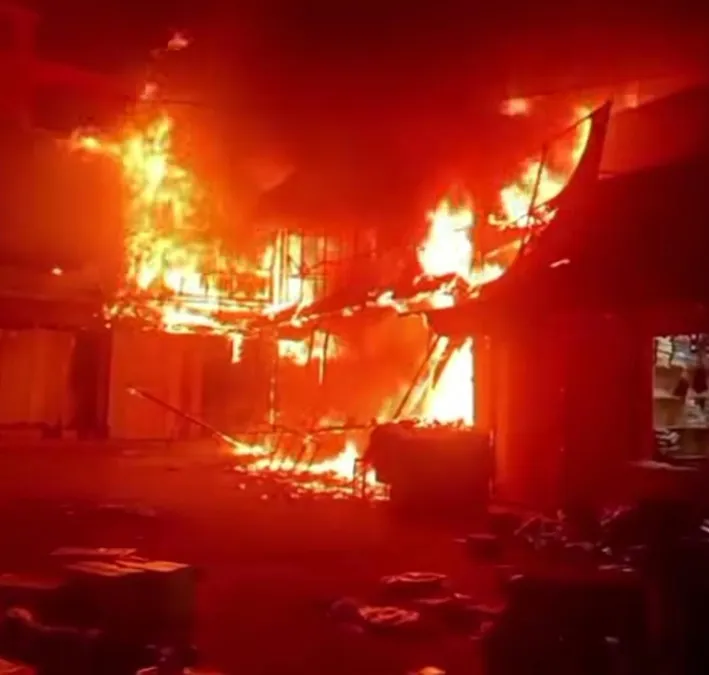
After Shiv Market, Nehru Market: Why Does Jammu Keep Witnessing Devastating Fires?
By: News Desk | 09 November 2026
A historic wholesale market has been badly damaged, dozens of traders face uncertain losses, and allegations of delayed firefighting response have brought Jammu’s emergency preparedness under scrutiny. With 64 fire incidents reported across the Jammu region during Diwali celebrations, the question extends beyond one market: is the city’s commercial infrastructure equipped to deal with a major fire emergency?
The flames that engulfed Warehouse Nehru Market in Jammu on Sunday night, November 8, 2026, did more than destroy shops and merchandise. They exposed the vulnerability of one of the city’s oldest commercial centres and revived concerns that have followed previous market fires without producing enough visible improvements.
For traders, the devastation represents lost stock, damaged property and an uncertain business future. For the administration, it presents a difficult question about emergency response, firefighting capacity and the safety of congested commercial establishments.
The timing makes the incident particularly concerning. The Nehru Market blaze was among 64 fire incidents reported across the Jammu region during Diwali celebrations, according to Fire and Emergency Services officials. Jammu district alone recorded 30 incidents, the highest among the districts in the region.
But the numbers tell only part of the story. Behind them lies a larger issue involving the city’s ability to prevent fires, reach affected locations quickly and contain an emergency before it turns into a commercial disaster.
Nehru Market Fire: How a Small Blaze Turned Into a Major Commercial Disaster
The fire broke out at approximately 9:15 pm on November 8, at Warehouse Nehru Market in the Bikram Chowk area of Jammu. According to Fire and Emergency Services officials, it originated in one of the shops before spreading to adjoining establishments.
The market has been serving traders, retailers and consumers since the 1950s. Its wholesale trade includes food grains, edible oil, ghee, dry fruits, pulses, spices and other essential commodities. These are products that move through the supply chain to retailers and consumers across the city and surrounding areas.
The nature of the stored merchandise made the situation particularly difficult. Officials said large quantities of edible oil contributed to the intensity of the fire. Other reports described stocks of ghee, oil, dry fruits, pulses and groceries inside the affected shops.
In a tightly packed wholesale market, a fire can travel rapidly from one establishment to another. Merchandise, packaging materials, wooden fixtures and other combustible stock can accelerate the spread, while closely positioned structures make it difficult for firefighters to reach the source directly.
The operation eventually involved firefighting teams from several stations across Jammu. Divisional Commissioner Jammu Vikas Kundal said the fire had been largely brought under control, with personnel continuing efforts to extinguish the remaining flames.
At least a dozen shops were reported gutted in initial accounts. However, Warehouse Association president Deepak Gupta put the number of affected establishments at around 15, while BJP MLA Vikram Randhawa referred to at least eight shops destroyed. The final figure and the financial value of the losses remain subject to an official assessment.
No casualties were reported, an important relief amid the scale of the destruction.
The immediate question is no longer simply how many shops were damaged. It is how quickly the fire was detected, how effectively it was contained and whether the market had adequate protection against a disaster of this scale.
The Disputed Fire Brigade Response: Traders Allege 90-Minute Delay, Department Rejects Claim
One of the most contentious aspects of the Nehru Market fire concerns the response time of the Fire and Emergency Services Department.
Deepak Gupta, president of the Warehouse Association, alleged that the firefighting response was delayed despite the proximity of a fire station. According to his account, the first two fire engines reached the market nearly 90 minutes after the emergency call.
He argued that the fire was initially small and could have been contained before it spread to neighbouring shops. He described the incident as gross negligence and demanded accountability, including action against the officials concerned. He also threatened an indefinite closure of the market if his demands were not addressed.
But the department has strongly disputed this account.
According to the official version reported by The Tribune and Amar Ujala, two fire tenders from the nearest station were immediately dispatched after the call. Additional vehicles and teams were subsequently mobilised from other stations as the scale of the emergency became clear.
The department also reportedly explained that firefighting teams were already dealing with another fire when the Nehru Market emergency occurred, creating pressure on available resources. It rejected the claim of a 90-minute delay as contrary to the actual sequence of events.
This disagreement deserves more than competing statements.
The relevant evidence should include:
-
The exact time the first emergency call was received.
-
The time the first fire tender was dispatched.
-
The time the first vehicle reached the market.
-
The number and type of vehicles initially deployed.
-
The time additional firefighting teams arrived.
-
The sequence of other simultaneous emergency calls.
These records would help establish whether the response was delayed, whether the department faced an unusual shortage of available vehicles, or whether the initial resources were insufficient for the nature of the fire.
A serious allegation should not be treated as an established fact without evidence. Equally, an official denial should not end the inquiry.
The fairest way forward is an independently verifiable response-time audit. The question is not merely whether fire engines were dispatched, but whether the right equipment and adequate manpower reached the affected market in time to prevent the fire from spreading.
64 Fire Incidents Across Jammu: A Festival Emergency or a Wider Warning?
The scale of the emergency becomes clearer when the figures are examined district by district.
According to Fire and Emergency Services officials, 64 fire incidents were reported across the Jammu region during Diwali celebrations. Of these, 11 occurred before 5 pm on Sunday, while 53 were reported between 5 pm and 3 am, a period that coincided with widespread firecracker use.
Jammu district recorded the highest number, with 30 incidents. The reported district-wise distribution was:
| District / Area | Fire incidents |
|---|---|
| Jammu | 30 |
| Samba and Kathua | 10 |
| Doda | 9 |
| Udhampur and Reasi | 8 |
| Kishtwar | 3 |
| Rajouri and Poonch | 3 |
| Ramban | 1 |
| Total | 64 |
Source: Fire and Emergency Services figures reported by PTI on November 9, 2026.
The figures also reveal that the Nehru Market blaze was not the only serious fire emergency in Jammu city that evening.
Among the other major incidents reported in Jammu district were:
-
Pahari Mohalla: A five-storey commercial building housing cloth and footwear shops, along with a basement, was gutted.
-
Shalimar: Fire damaged the third and fourth floors of a five-storey building housing a medical store.
-
Gangyal: A hardware godown was affected by fire.
These incidents underline the pressure placed on emergency services when several commercial properties catch fire within a relatively short period.
There is an important distinction here. The fact that 53 incidents occurred between 5 pm and 3 am establishes a strong temporal association with Diwali celebrations. It does not establish that firecrackers caused all 53 fires.
In the case of Nehru Market, the initial PTI report explicitly stated that the cause had not been established. A separate report by Amar Ujala, citing eyewitness accounts, described sparks near shops and suggested that a firecracker spark may have ignited cotton and brooms stored outside shops numbered 51 and 52.
That account provides a possible explanation, but it should not be confused with a confirmed forensic finding. The exact ignition source remains a matter for investigation.
This distinction matters because blaming firecrackers without establishing the cause can distract attention from other potential contributing factors, including electrical faults, combustible storage, inadequate separation between shops and the absence of effective early-warning systems.
The investigation must establish what started the fire. The safety audit must establish why it was able to spread.
Shiv Market Fire: Why Has Jammu Not Learned From Previous Disasters?
Perhaps the most disturbing aspect of the Nehru Market incident is its timing.
Just 13 days earlier, on October 25-26, another massive fire had destroyed approximately 40 shops at Shiv Market, opposite Jammu Railway Station.
The blaze broke out at around 10:30 pm on October 25 and continued for nearly five hours before being brought under control at approximately 3:15 am on October 26. The affected businesses included shops selling dry fruits, food supplies, blankets and other merchandise.
Preliminary investigations suggested that a short circuit in one of the shops may have triggered the fire. Strong winds reportedly contributed to its rapid spread.
Firefighters also faced difficulties because of the narrow approach to the market. Emergency teams had to tackle the blaze from the rear side of the affected establishments.
The destruction left dozens of traders facing substantial losses.
On November 2, Chief Minister Omar Abdullah visited the affected Shiv Market traders, inspected the damage and assured them of government assistance. The district administration had forwarded relief cases for consideration and sanction of financial assistance, according to the subsequent report.
Yet, before the business community could fully recover from that tragedy, another major market fire struck Jammu.
The two incidents are different in their immediate circumstances. A short circuit was suspected in the Shiv Market blaze, while the cause of the Nehru Market fire remains under investigation. They should not be treated as identical events.
However, both raise a common urban safety concern: the vulnerability of densely packed commercial establishments where large quantities of merchandise are stored and emergency access can become difficult.
The problem is not simply the age of these markets. Traditional commercial centres can remain economically important while being upgraded to meet modern safety requirements.
What cannot continue is allowing their infrastructure to remain vulnerable simply because the markets have existed for decades.
The Fire Department’s Manpower Shortage: A Critical Governance Concern
The debate over the Nehru Market response also brings attention to the operational capacity of Jammu and Kashmir’s Fire and Emergency Services Department.
An RTI reply reported by PTI in January 2026 revealed that the department was facing a manpower shortage of nearly 41 per cent.
Against a sanctioned strength of 3,639 employees, only 2,149 personnel were in position, leaving 1,490 posts vacant.
The shortage was particularly serious in operational cadres. Of 1,619 sanctioned posts for firemen and firemen drivers, only 804 were occupied, leaving 815 vacant. In other words, more than half of the sanctioned posts in this category were unfilled.
These figures deserve serious attention.
Firefighting is not simply about having a vehicle parked at a station. An effective emergency response requires trained personnel, drivers, station officers, communication operators, equipment maintenance staff and teams capable of operating simultaneously at multiple locations.
A major fire can require several specialised vehicles and a sustained deployment of personnel. When multiple emergencies occur across different districts, the department must distribute its available resources according to the urgency and scale of each incident.
The Diwali figures demonstrate precisely this challenge. With 64 incidents reported across the Jammu region, several firefighting teams were required at different locations during overlapping periods.
However, the manpower shortage should not automatically be treated as proof that the Nehru Market fire brigade response was delayed. The specific deployment and response-time records are needed to establish that connection.
There is also a positive side to the department’s published performance figures. According to its year-end 2025 data, Fire and Emergency Services responded to 6,039 fire calls, compared with 8,033 in 2024, representing a decline of approximately 25 per cent. The department also reported deploying 322 fire tenders and quick-response vehicles with 2,157 personnel during 2025 and conducting 3,728 fire safety audits.
These figures indicate that prevention and emergency-response efforts have been undertaken. But they also raise an important question: how effectively are those resources distributed across the region, particularly in commercial clusters with a high concentration of combustible goods?
A department can record improvements in its overall performance and still face serious gaps in particular locations.
That is why Jammu’s latest market fires call for a closer examination of local deployment, operational readiness and manpower distribution, rather than a blanket judgment about the entire department.
Fire Safety Rules Exist. The Bigger Question Is Whether They Are Being Enforced
Jammu does not lack a regulatory framework for fire safety. The more difficult question is whether existing provisions are being implemented consistently, particularly in older commercial markets.
The Jammu Municipal Corporation has already acknowledged the need for stronger fire safety compliance.
On June 27, 2026, the JMC announced that it had issued notices to nearly 200 establishments, including private hospitals, nursing homes, hotels, lodges and other high-footfall commercial establishments, directing them to obtain Fire Safety No Objection Certificates (NOCs).
The corporation warned that establishments failing to meet the requirements could face legal action, including sealing of their premises.
On July 16, JMC Commissioner Dr Devansh Yadav also reviewed fire safety compliance in Jewel Chowk, Bakshi Nagar, Subhash Nagar, Vivekananda Chowk and adjoining areas. Commercial establishments were given 30 to 45 days to complete the required Fire NOC formalities.
These steps show that fire safety was already on the municipal administration’s agenda months before the Nehru Market disaster.
However, an important distinction must be maintained: the published JMC notices do not establish whether Warehouse Nehru Market was inspected, whether its individual establishments possessed valid fire clearances, or whether specific deficiencies had previously been identified.
Those details need to be made public.
What do the existing safety standards require?
The National Building Code of India 2016 contains a dedicated section, Part IV, dealing with Fire and Life Safety. Published by the Bureau of Indian Standards, it provides a framework covering fire prevention, building safety and protection against fire-related emergencies.
The Directorate General of Fire Services under the Union Home Ministry has described the code as recommendatory and advised states to incorporate its provisions into local building regulations.
Jammu and Kashmir also has an established Fire and Emergency Services NOC procedure under the Jammu and Kashmir Fire Force Act, 1967.
The government’s single-window service checklist requires applicants to provide details of:
-
Site and building plans.
-
Floor plans.
-
Materials used in the building, including hazardous or inflammable substances.
-
Fire safety systems and arrangements.
-
Storage capacity of raw materials and finished goods.
These requirements are particularly relevant to wholesale markets.
A commercial establishment storing food grains, edible oil, ghee and other combustible merchandise needs a safety assessment that considers the nature and quantity of its stock, electrical installations, fire detection arrangements and access for emergency vehicles.
Simply issuing an NOC cannot be the end of the exercise. Compliance must be inspected, equipment maintained and safety arrangements tested periodically.
The Nehru Market incident therefore raises a straightforward administrative question: when was the last comprehensive fire safety inspection of the market, and what did it find?
If deficiencies were identified, were they corrected? If clearances were issued, were the prescribed safety measures actually in place?
These are questions that deserve documented answers rather than another round of assurances.
The Economic Cost: When Fire Destroys More Than Shops
The physical destruction at Nehru Market is only the most visible part of the disaster.
The deeper economic consequences could continue long after the flames have been extinguished.
Wholesale markets play a crucial role in the local economy. They connect manufacturers, distributors, wholesalers, retailers, transporters and consumers. A disruption at one major trading centre can affect several businesses beyond the establishments directly damaged.
For the affected traders, the immediate losses may include:
1. Inventory and working capital
Food grains, edible oils, dry fruits, pulses and other commodities represent substantial investments. When stocks are destroyed, traders lose not only the merchandise but also the money tied up in purchasing and maintaining that inventory.
2. Outstanding financial obligations
Many small and medium-sized businesses operate through supplier credit, bank finance and revolving working capital. A fire can destroy stock while leaving repayment obligations intact.
The extent of such exposure among Nehru Market traders is not yet publicly established, but it is an important part of any meaningful damage assessment.
3. Employment and livelihoods
A wholesale shop supports more than its owner. Workers, loaders, transporters, delivery personnel and small service providers depend on its operations.
When a business stops functioning, these people can lose their daily income even if their own property has not been damaged.
4. Interrupted trade and supply chains
Retailers who depend on wholesale suppliers may need to find alternative sources of merchandise. This can increase transportation costs, create temporary supply disruptions and put pressure on smaller businesses.
5. Insurance and recovery
The availability of insurance, the value of insured stock and the speed of claim settlement will influence how quickly affected traders can restart operations.
There is no verified public estimate of the total losses at Nehru Market at this stage. Nor is there sufficient information about the insurance coverage of the affected establishments.
The administration’s assessment should therefore go beyond counting damaged shops. It should document the loss of buildings, machinery, inventory, business equipment and livelihoods.
Chief Minister Omar Abdullah has already directed the district administration to provide immediate relief and assistance to affected shopkeepers. That is an important first step, but the effectiveness of the response will ultimately depend on how quickly relief reaches the affected businesses.
What Jammu Needs: Prevention, Not Just Firefighting
The latest incidents make a strong case for a dedicated fire safety programme covering Jammu’s traditional commercial centres.
Such a programme should involve the Fire and Emergency Services Department, Jammu Municipal Corporation, district administration, police, power distribution authorities and market associations.
The priorities should include:
Market-wide fire safety audits: Every major wholesale market and warehouse cluster should undergo a risk-based inspection. The focus must include electrical wiring, storage practices, fire exits, extinguishers, alarms and the availability of suitable firefighting equipment.
Unobstructed emergency access: Roads and internal passages used by fire tenders must remain clear. Encroachments, illegal parking and goods stored in emergency access lanes can turn a manageable fire into a major disaster.
Dedicated firefighting arrangements: Authorities should examine the feasibility of pre-positioning fire tenders or quick-response vehicles near high-risk commercial areas, particularly during festivals and other periods of heightened fire risk. BJP MLA Vikram Randhawa has also called for two to three fire tenders to be stationed at major markets following the recent fires.
Modern equipment: High-risk markets should be assessed for suitable hydrants, water points, alarms, extinguishers and other fire suppression systems according to their specific building and storage risks.
Electrical safety inspections: Regular inspections of commercial wiring, distribution boards, overloaded connections and temporary electrical installations can help identify hazards before they become emergencies.
Trader participation: Market associations should work with fire officials to organise mock drills, train workers in basic firefighting and establish emergency contact systems.
Public disclosure of compliance: Authorities should publish market-wise inspection records, fire NOC status, identified deficiencies and compliance deadlines. This would help traders understand their responsibilities and allow the public to assess the administration’s progress.
The objective should not be to punish traders after a disaster. It should be to ensure that safety requirements are followed before one occurs.
Government Response: Relief Must Be Followed by Accountability
Chief Minister Omar Abdullah expressed grief over the Nehru Market fire and directed the district administration to provide immediate relief and assistance to the affected traders.
The response is welcome, particularly because the business community has faced two major market fires within a fortnight.
However, relief and accountability are two separate responsibilities.
The administration needs to establish the extent of damage, identify the affected shopkeepers, assess their immediate financial needs and facilitate the restoration of business activities.
At the same time, the Fire and Emergency Services Department should make its operational records available for scrutiny so that the conflicting accounts of the response can be resolved.
Union Minister Dr Jitendra Singh also expressed concern over the incident and sought urgent attention to the difficulties faced by the traders. Meanwhile, BJP MLA Vikram Randhawa questioned the preparedness of emergency services, pointing to the earlier Shiv Market fire and calling for stronger firefighting arrangements at major commercial centres.
The administration now has an opportunity to move beyond statements of sympathy and introduce measurable improvements.
A time-bound safety audit of Jammu’s major wholesale markets, publication of compliance records, correction of identified deficiencies and a review of firefighting resources would be meaningful steps.
The findings should also establish whether the affected market had the required safety arrangements and whether emergency access routes were adequate.
The Questions That Jammu Cannot Afford to Ignore
The Nehru Market fire leaves several important questions requiring answers:
-
What was the actual source of ignition, and will the investigation establish whether firecrackers were involved?
-
Were the affected shops and warehouses compliant with applicable fire safety requirements?
-
When was the last comprehensive fire safety inspection of the market?
-
What do the emergency call logs reveal about the time taken to dispatch and deploy the first firefighting team?
-
Were sufficient vehicles and trained personnel available when multiple fires were reported across Jammu?
-
Have the findings of previous fire safety audits resulted in corrective action?
-
What financial assistance will reach the affected traders, and how soon can they resume business?
These questions are not intended to assign blame before an investigation. They concern the responsibilities of institutions that are expected to protect public property and commercial livelihoods.
Jammu’s Markets Need Protection Before the Next Fire
Jammu’s traditional markets are more than commercial addresses. They are economic institutions built over generations, supporting families, employment and trade across the region.
Warehouse Nehru Market has served the city since the 1950s. Shiv Market has a similarly established place in Jammu’s commercial landscape. Their importance makes their protection a public responsibility, not merely a matter for individual shopkeepers.
The 64 fire incidents reported during Diwali celebrations should also be understood in the context of the simultaneous emergencies faced by firefighters. The department says teams were stretched by multiple calls, while traders have questioned the speed and adequacy of the response in Nehru Market.
Both the operational challenges and the allegations deserve a transparent examination.
Diwali celebrations may have coincided with the fires, and fireworks may have contributed to some incidents. But the investigation into Nehru Market must establish the actual cause rather than rely on assumptions.
More importantly, the ability of a fire to spread from one shop to a dozen others depends on more than the source of ignition. Building arrangements, stored materials, electrical safety, access routes, detection systems and the speed of emergency intervention all matter.
Jammu cannot eliminate every possible fire hazard. It can, however, reduce the likelihood of a small incident becoming a disaster.
The real test of the administration will not be how many statements it issues after the flames disappear. It will be whether it makes the city’s markets safer before another emergency begins.
Because the cost of ignoring fire safety is ultimately paid by traders, workers, families and the wider economy.


