Sheshnag Lake at a Crossroads: Can Amarnath Infrastructure Development Protect Kashmir’s Fragile Ecology?
By: Javid Amin | 23 November 2026
The reported use of heavy machinery near Sheshnag Lake, a high-altitude water body along the Amarnath pilgrimage route, has raised fresh questions about the environmental cost of infrastructure development in Kashmir’s fragile mountain landscapes. The concern, highlighted by Mirwaiz Umar Farooq, has brought renewed attention to an area where ecological sensitivity, religious significance, tourism and development ambitions intersect.
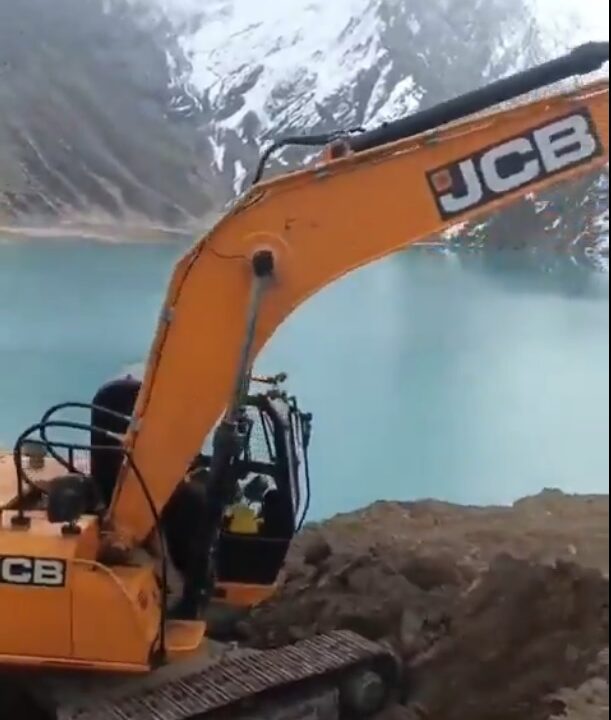
Visuals circulating on social media reportedly show earthmoving machinery operating in the vicinity of the lake. While the exact location, purpose, scale and official permissions related to the work need independent confirmation, the images have triggered an important debate: how much physical intervention can a fragile alpine ecosystem withstand before development begins to undermine the very landscape it is meant to serve?
The concern is not simply about an excavator or a construction site. It is about the vulnerability of a high-altitude ecosystem, the consequences of disturbing mountain terrain, and whether environmental safeguards are being treated as a prerequisite for development or as an afterthought.
Sheshnag Lake controversy: What is known about the construction activity?
The controversy gained momentum after video footage of a crawler excavator working near Sheshnag Lake circulated on social media. The footage reportedly originated from a JCB operator’s social-media account before being removed amid growing criticism.
A report published by The Tribune on November 23, 2026, citing sources, identified the activity as part of a Border Roads Organisation (BRO) project along the existing Amarnath Yatra track. The report said the work was intended to stabilise the track to improve pilgrim safety and was linked to directions associated with a 2012 Supreme Court case. However, the exact work site, engineering scope and environmental safeguards have not been independently established through publicly available project documents in the reporting reviewed.
That distinction matters. Road stabilisation, drainage improvement and slope protection can be necessary in dangerous mountain terrain. But the use of heavy machinery near a glacial lake raises questions about where the work is being carried out, how much land is being disturbed, whether the machinery is operating within an approved footprint, and what measures are in place to prevent sediment or waste from entering the water system.
The debate should not be reduced to whether road work is inherently wrong. The more important question is whether the work is scientifically justified, appropriately designed and environmentally accountable.
Mirwaiz Umar Farooq raises alarm, demands answers
The issue was highlighted by Kashmir’s chief cleric, Mirwaiz Umar Farooq, who expressed concern over reported heavy machinery activity near the lake.
In his remarks, Mirwaiz warned that construction in the glacial zone could add pressure to an already vulnerable Himalayan environment. He linked the concern to glacier retreat and recent glacier-related disasters in the wider Himalayan region, arguing that infrastructure and pilgrim facilities should not come at the expense of ecological protection.
He also made it clear that welcoming Amarnath pilgrims and improving facilities for them was not the issue. His concern was the potential environmental cost of such development.
His demand was for accountability, an explanation from authorities and a halt to the reported activity until concerns were addressed.
The intervention has widened the debate beyond social-media outrage. It has placed the focus on a basic but important issue of public governance: when construction takes place in a sensitive mountain zone, the public should be able to know who authorised it, what it is intended to achieve, and how environmental damage is being prevented.
Why Sheshnag Lake is environmentally sensitive
The environment at such elevations is very different from the plains. Soil formation is slow, plant growth is limited by cold and a short growing season, and recovery after disturbance can take years. In some exposed or unstable areas, a damaged surface may take decades or longer to recover, depending on elevation, soil, slope, moisture and the severity of the disturbance.
That makes large-scale excavation particularly concerning.
A machine operating on a mountain slope does more than remove earth. It can expose loose material, disturb natural drainage patterns, cut through vegetation and destabilise ground that has remained intact for a long time.
The lake itself is not an isolated feature. It is part of a wider hydrological system involving snowmelt, rainfall, surrounding slopes, streams and downstream drainage.
Changes to the surrounding terrain could affect:
-
Water quality: Loose sediment and soil can enter streams or the lake, increasing turbidity and affecting aquatic habitat.
-
Natural drainage: Excavation, road embankments or improperly designed culverts can alter water movement.
-
Slope stability: Cutting into slopes or placing spoil material can increase erosion and, under certain conditions, instability.
-
Alpine vegetation: Slow-growing plants and fragile ground cover may be destroyed by machinery and construction traffic.
-
Waste and pollution: Fuel, lubricants, cement, plastics and construction debris can become hazards if poorly managed.
These are potential risks, not proof that damage has occurred at Sheshnag. Their significance depends on the exact location of the activity, the engineering method, the scale of excavation and the effectiveness of protective measures.
That is precisely why a site-specific environmental assessment is necessary.
A glacial lake in a region facing growing climate risks
Rising temperatures, changing snowfall patterns, accelerated ice loss in some glacier systems, intense rainfall and unstable slopes can combine to create new risks across the Himalayas. These changes do not mean every construction activity will cause a disaster, but they do increase the importance of careful planning in vulnerable locations.
The risk is particularly important around glacial lakes.
A glacial lake can become dangerous if its natural dam, often made of loose moraine material or ice, becomes unstable. Sudden water release can lead to a glacial lake outburst flood (GLOF), potentially carrying water, rocks, debris and sediment downstream.
The Tribune report states that Sheshnag is among 14 high-risk glacial lakes identified in Jammu and Kashmir and that authorities have conducted expeditions to high-risk lakes, including Sheshnag, to assess vulnerabilities and improve preparedness.
What is a GLOF, and why should people be concerned?
A glacial lake outburst flood is a sudden release of water from a glacial lake. It may be triggered by several factors, including:
-
Failure or overtopping of a natural moraine dam.
-
Ice or rock avalanches falling into a lake and generating displacement waves.
-
Rapid snow or glacier melt.
-
Heavy rainfall adding pressure to a lake and its drainage system.
-
Erosion or structural weakening of a natural lake barrier.
A flood of this kind can move rapidly through a mountain valley, carrying enormous quantities of debris. Bridges, roads, buildings, power infrastructure and settlements downstream may be exposed.
Sheshnag’s inclusion in a high-risk glacial lake category makes it especially important that any work in the surrounding terrain is properly assessed. It does not, by itself, establish that the excavator activity shown in the video is increasing the lake’s outburst risk. That would require technical evidence, including site inspection, lake and slope data, drainage analysis and an assessment of the construction footprint.
The question is whether the authorities are adequately integrating these climate and geological risks into the planning and execution of work in the area.
What heavy machinery can do to fragile mountain terrain
In the Himalayas, road and track construction often requires cutting slopes, removing rocks, clearing vegetation, levelling ground and managing drainage. Such interventions can become environmentally damaging if carried out without adequate geological assessment and engineering controls.
The biggest risks are not necessarily visible immediately after the machine leaves.
1. Slope cutting and erosion
Excavation can expose loose soil and fractured rock. Rain, snowmelt and freeze-thaw cycles can gradually weaken these surfaces, causing erosion and potentially small landslides or larger slope failures.
2. Sediment entering water bodies
Construction material, spoil heaps and disturbed soil can be washed downhill. Sediment entering a lake or stream can affect water clarity, aquatic habitat and the natural character of the water body.
3. Altered water movement
Mountain drainage systems are delicate. An improperly designed road, embankment or culvert can redirect water, concentrate runoff or obstruct natural channels. In the wrong location, this can create erosion downstream or waterlogging upslope.
4. Damage to alpine vegetation
High-altitude vegetation has limited growing seasons and often recovers slowly. Bulldozing or excavating beyond the minimum necessary area can leave scars that remain visible long after the construction work is complete.
5. Pollution from machinery
Fuel leakage, hydraulic oil, grease and careless waste disposal can contaminate the surrounding ground. Near a sensitive lake, even small spills require immediate containment and cleanup.
These concerns explain why environmentalists are questioning not just the presence of machinery but the absence of publicly available information detailing the work’s scope, location, technical design and safeguards.
BRO project and pilgrim safety: The other side of the debate
The Pahalgam route is a challenging mountain trail. Pilgrims travel through difficult terrain, and maintaining access, managing drainage, protecting vulnerable sections and improving safety are legitimate public responsibilities.
The Border Roads Organisation has a role in road and strategic infrastructure work in difficult terrain, and news reports identify it as the agency associated with the work shown in the circulating video. The reported project is described as stabilisation of the existing pilgrimage track, rather than a confirmed new road beside the lake.
That distinction is important because the environmental footprint of repairing or stabilising an existing track may be very different from creating a new corridor or expanding a road through undisturbed terrain.
However, describing a project as safety-related cannot automatically settle environmental concerns. Even necessary infrastructure work can create serious damage if it is poorly planned, executed without adequate safeguards or expanded beyond its approved scope.
The challenge for authorities is to demonstrate that pilgrim safety and environmental protection are being addressed together, rather than treating them as competing priorities.
The Supreme Court dimension: What needs to be made public?
The reporting by The Tribune links the track stabilisation work to a 2012 Supreme Court case and says the work was intended to improve pilgrim safety.
That reported legal background is relevant, but it should not be treated as a blanket approval for any construction in the wider Sheshnag area.
The public deserves clarity on the exact court directions, the specific work covered, the responsible implementing agency and the approved scope. A direction to improve safety on an existing track, if that is the basis of the project, would not by itself establish that every form of excavation near a glacial lake is authorised or environmentally acceptable.
The critical documents should include:
-
The precise court order or directions relied upon.
-
The project description and engineering plan.
-
The exact work-site coordinates and distance from the lake and drainage channels.
-
The applicable environmental and forest permissions, if required.
-
The geological or slope-stability assessment.
-
The construction waste and spoil-disposal plan.
-
The environmental monitoring and restoration plan.
Without these records, the public cannot meaningfully assess whether the work is necessary, proportionate and compliant.
Amarnath Yatra infrastructure is expanding. Where are the environmental checks?
The issue comes against the backdrop of continued investment in infrastructure and logistical facilities for the annual Shri Amarnath Ji Yatra.
Preparatory meetings for the 2026 pilgrimage have involved multiple departments, including the administration, public works, the Border Roads Organisation, sanitation, health, power and water supply agencies. A March 2026 report on preparations cited 175 proposed works under Capex and Revex, with an estimated allocation of ₹5,428.43 lakh across sectors including roads, power and water supply.
Such infrastructure is necessary for managing a large pilgrimage in difficult terrain. But the growing scale of works makes environmental oversight even more important.
The higher the pressure to complete works before the pilgrimage season, the greater the need to ensure that deadlines do not weaken scrutiny, site protection or waste-management requirements.
A well-planned project should be able to answer some basic questions:
-
Was the least environmentally damaging option considered?
-
Is the work restricted to the minimum required area?
-
Is excavated material being disposed of at a designated site?
-
Are natural water channels being kept open?
-
Are machinery movement and fuel storage controlled?
-
Is the site being restored after construction?
-
Will an independent team inspect the work?
These are not unreasonable demands against development. They are standard principles of responsible infrastructure planning in ecologically sensitive landscapes.
A fragile lake cannot be protected by promises alone
The protection of such a place requires more than general assurances that construction will be conducted responsibly.
If work is justified on safety grounds, the authorities should release enough information to demonstrate how the safety benefits have been weighed against environmental risks. If environmental permissions or technical assessments are required, their status should be clarified. If the work is found to be outside the approved footprint or damaging natural drainage, corrective action should be taken.
Equally, if the work is properly authorised, limited in scope and supported by appropriate safeguards, the government should make that evidence public instead of allowing speculation to grow around circulating videos.
Transparency would serve both sides: it would help protect the lake and allow legitimate infrastructure work to be judged on evidence rather than assumption.
Kashmir’s environmental dilemma: Development without damaging the landscape
Tourism is a major part of the region’s economy. Pilgrimages, trekking, hotels, road connectivity and seasonal tourism support livelihoods and local businesses. Better infrastructure can improve accessibility, reduce some safety risks and provide essential facilities to visitors.
But mountain tourism also places pressure on the very environment that attracts people.
Road expansion, poorly managed waste, unregulated construction, slope cutting, traffic, sewage and excessive human activity can slowly alter mountain ecosystems. The effects may not appear as one dramatic disaster. They can accumulate over years, gradually degrading water quality, landscape integrity and the natural resilience of the terrain.
Kashmir cannot afford a model in which every environmental warning is treated as opposition to development. Nor can it afford to dismiss genuine safety and connectivity needs.
The objective should be environmentally informed development, particularly in glacial zones, wetlands, river corridors, forests and alpine meadows. In such locations, the burden should be on project agencies to demonstrate that their plans are safe and proportionate.
What authorities should do now
The controversy calls for a transparent response, not merely a statement that the project is necessary or that environmental concerns are exaggerated.
A credible response should include the following steps:
1. Conduct a joint site inspection: Environmental experts, geologists, officials from the district administration, the BRO and relevant environmental departments should examine the exact location where machinery is operating.
2. Publish the project details: The government should disclose the purpose, scope, work-site boundaries, executing agency and permissions applicable to the activity.
3. Assess proximity to the lake: The actual distance between excavation, the lake shoreline, streams and natural drainage channels should be documented. Visual impressions alone cannot establish the precise distance or impact.
4. Review slope and drainage risks: A technical assessment should examine whether excavation, material dumping or altered drainage could increase erosion, destabilise slopes or affect downstream flow.
5. Ensure safe disposal of excavated material: Loose earth, rock and construction debris must not be dumped into water channels, lake margins or unstable slopes.
6. Suspend work if credible risks are identified: If an inspection identifies unauthorised activity or an immediate environmental threat, the relevant work should be halted until the risks are addressed and compliance is established.
7. Restore disturbed areas: Where work is complete, restoration should include slope stabilisation, drainage repair, removal of debris and suitable revegetation, wherever technically feasible.
The bigger question: What kind of development does Kashmir want?
Sheshnag Lake is a reminder that Kashmir’s natural heritage is not an unlimited resource. Mountains, glaciers, rivers and alpine lakes are part of the region’s environmental security, economic future and cultural identity.
The Amarnath pilgrimage deserves safe infrastructure. Pilgrims deserve proper facilities, safer tracks, medical assistance, sanitation and reliable arrangements. But the landscape through which they travel deserves equal consideration.
The latest controversy should therefore lead to a simple but serious question for those responsible for the work: if the project is necessary for safety, can its necessity, location, environmental safeguards and legal authorisation be demonstrated publicly?
That is not an unreasonable demand. It is the minimum transparency expected when construction takes place in an ecologically sensitive Himalayan zone.
The concern raised by Mirwaiz Umar Farooq, environmental activists and citizens should not be dismissed without examination. Nor should conclusions about environmental damage be drawn without a proper investigation.
What is needed now is a transparent site assessment, disclosure of the relevant project documents and a clear explanation from the responsible agencies. Until those answers emerge, the debate over heavy machinery near Sheshnag Lake will remain about more than construction. It will be about whether Kashmir can protect its fragile natural landscapes while meeting the legitimate needs of people who depend on them.