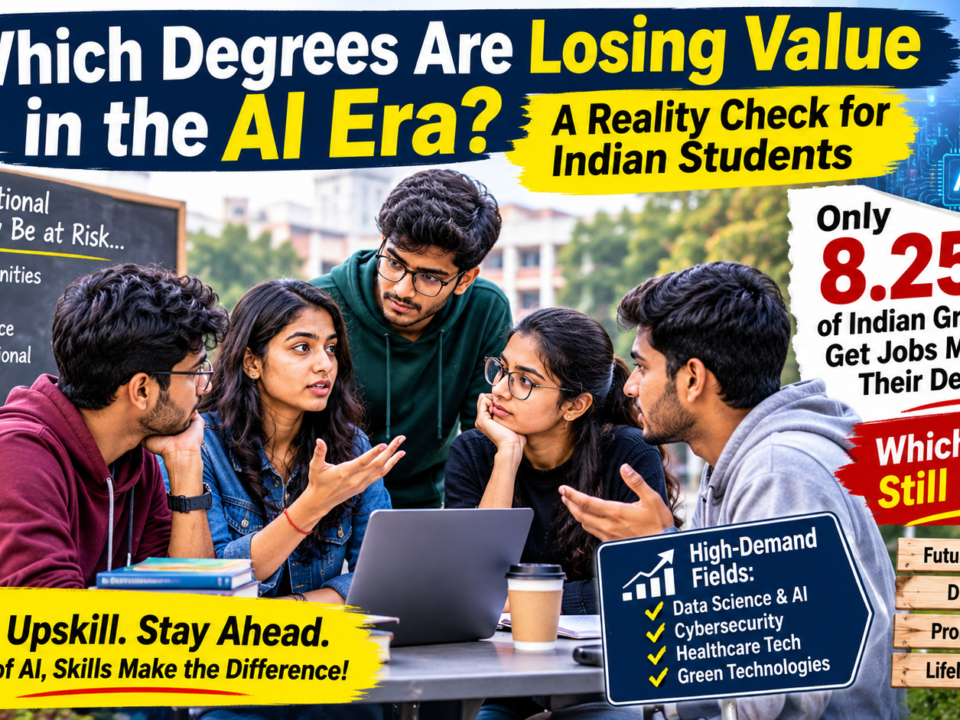
Which Degrees Are Losing Value in the AI Era? A Reality Check for Indian Students
By : Javid Amin | 24 November 2026
No degree is useless. But some are being asked to do far more than they can, in a job market where AI is changing the entry-level rung and India produces more graduates than it can absorb. Here is what the latest data actually says, and what students can do about it.
Key Takeaways
- No major report says that BA, B.Com, MBA or journalism degrees are “obsolete”. The pressure is on undifferentiated versions of them.
- NITI Aayog’s August 2026 skilling report, citing the Economic Survey 2024-25, says only 8.25% of Indian graduates work in jobs aligned with their qualifications.
- The India Skills Report 2026 puts overall employability at 56.35%. Computer Science (80%) and IT (78%) lead, while MBA employability fell to 72.76% from 78%.
- Globally, early-career workers in AI-exposed jobs are feeling the pressure first.
- The winning formula is a “skill stack”: a degree plus data, AI, digital and domain skills.
First, a Myth Check: “Irrelevant Degrees” Is the Wrong Question
Headlines love a list of “dead degrees”. The evidence does not support that. A history graduate who learns data analysis, or a B.Com graduate who learns financial modelling, is a very different candidate from one who relies on the certificate alone.
The better question is this: which degrees are producing more graduates than the market can absorb, while newer skills create higher-paying openings? That is what this article answers, using only figures we could trace to a source.
India’s Reality in Numbers
The mismatch is real. NITI Aayog’s report Reimagining Skilling for Viksit Bharat@2047, released in August 2026, says only 8.25% of graduates are employed in roles that match their qualifications. The figure comes from the Economic Survey 2024-25. The report also notes that of 3.4 crore undergraduate students, about 1.13 crore are enrolled in BA courses alone, and that BA, B.Sc and B.Com together account for more than 2 crore. It suggests redesigning them as applied courses, such as B.A. Hospitality, B.Sc. Applied Technology and B.Com. Analytics.
Employability is improving overall, but unevenly. The India Skills Report 2026 puts national employability at 56.35%, up from about 54.8%. By stream, the report shows:
| Stream | Employability 2026 | Compared with last year |
|---|---|---|
| MBA | 72.76% | Down from 78% |
| B.E./B.Tech | 70.15% | Down from 71.5% |
| MCA | 68.25% | Slightly higher |
| Commerce | 62.81% | Up from 55% |
| Science | 61% | Up from 58% |
| Arts | 55.55% | Small improvement |
Inside engineering, Computer Science (about 80%) and IT (about 78%) stand out.
What this tells us: employability is not a simple “tech good, everything else bad” story. Commerce actually improved. MBA slipped. The report itself reads the MBA decline as a shift toward applied, cross-domain skills. One caution: “employable” is a test score under the report’s method. It does not mean someone has a job.
Five Degree Paths Under Pressure in India
The ratings below are our editorial judgement from the data above, not a ranking published by any report.
1. Generic BA (No Specialisation)
The subjects are not the problem. History, political science, sociology and geography teach valuable thinking. The problem is volume: millions graduate with near-identical profiles and few market-facing skills. NITI Aayog explicitly flags BA, B.Sc and B.Com as often having weak links to jobs.
Pair it with: data analytics, public policy, GIS, behavioural science, digital governance or research tools.
2. Plain B.Com
Bookkeeping, basic reporting and GST filing are increasingly done by software. That makes “simple accounting” a weaker selling point. Yet the 2026 data shows commerce employability rising to 62.81%, so the sensible reading is not “B.Com is dying” but “B.Com needs a digital upgrade”.
Pair it with: financial modelling, Power BI, fintech, business analytics, or professional credentials such as CFA, CPA or CA.
3. Generic MBA from a Weak Programme
The MBA remains one of the highest-scoring streams. But its score fell, and employers are increasingly differentiating by skills, internships and domain depth rather than the title. We found no published data that singles out “Tier-3” institutions, so treat that part as a reasonable inference, not a statistic.
Choose: specialisations such as product management, business analytics, supply chain analytics or fintech, and weigh placement outcomes over brochures.
4. Traditional Journalism Without Digital Skills
AI can now summarise, rewrite and draft routine content. Entry-level content production is the part most under pressure. Reporting, verification, investigation and storytelling remain valuable.
Pair it with: data journalism, fact-checking, multimedia storytelling and audience strategy.
5. Computer Degrees with an Outdated Curriculum
Here is the nuance. Computer Science and IT graduates are India’s most employable engineers. But the same report flags a mismatch between curricula and fast-moving areas like AI, green energy and quantum. The risk is not “computer degrees”, it is old syllabi.
Pair it with: cloud, cybersecurity, data science and applied AI, through projects and internships.
The Global Picture: Where AI Pressure Is Biggest
The World Economic Forum’s Future of Jobs Report 2025 expects 170 million new jobs and 92 million displaced by 2030, a net gain of 78 million. Clerical and administrative roles, such as data entry clerks, are among the fastest-declining. Big data specialists, fintech engineers, AI and machine learning specialists and software developers are among the fastest-growing in percentage terms.
The pressure lands hardest at the start of a career. A Stanford study using US payroll data found a 13% relative employment decline for ages 22 to 25 in the most AI-exposed jobs, such as software development and customer service, while older workers were stable or growing. And a June 2026 WEF-PwC report found that 37% of young workers worldwide are in occupations with medium to high AI exposure. Also, 28% of entry-level workers believe half or fewer of their current skills will stay relevant in three years.
Translation for students: AI is not removing whole degrees, it is raising the bar for the first job.
Fields with the Strongest Momentum
| Field | What the evidence says |
|---|---|
| AI and machine learning | Among the fastest-growing roles globally (WEF 2025) |
| Data science and analytics | Big data specialists lead WEF’s fastest-growing list |
| Cybersecurity | “Networks and cybersecurity” is a top-three fastest-growing skill (WEF) |
| FinTech | FinTech engineers are among the fastest-growing roles (WEF) |
| Renewable energy and EV technology | Renewable and environmental engineers and EV specialists are among the 15 fastest-growing jobs (WEF) |
| Computer Science and IT | Highest engineering employability in India (about 80% and 78%) |
| Health technology | Plausible long-term growth, but no India-specific figure verified here |
| Semiconductors, robotics, quantum | Widely discussed growth areas, but we did not verify specific demand figures, so treat as emerging |
Skill Stack Beats Degree
The strongest idea in this whole conversation is the simplest. A degree opens the door, but a stack of skills gets the job.
- BA + data analytics + a policy internship can beat a plain BA.
- B.Com + Power BI + financial modelling + AI tools can beat a plain B.Com.
- MBA + a specialisation + real projects can beat an MBA with only a title.
The WEF also expects around 39% of workers’ core skills to change by 2030. Learning does not end at graduation.
How to Choose Your Path: 6 Practical Steps
- Do not pick a degree by headline. Look at placement outcomes, curriculum updates and alumni careers.
- Add one “hard” skill every year. Data, coding basics, cybersecurity, analytics or a design tool.
- Learn to use AI as a tool. Employers value people who can direct it and check it.
- Collect proof of work. Projects, internships and a portfolio matter more than marks alone.
- Build human skills. Communication, critical thinking and learning agility keep showing up in employer surveys.
- Check the college, not just the course. A strong programme in a weak institution can still leave you underprepared.
Frequently Asked Questions
Which degrees are at risk in India? No degree is obsolete, but generic BA, plain B.Com, weak MBA programmes, traditional journalism and outdated computer curricula face the most pressure when students graduate without market-ready skills.
Is B.Com still worth it? Yes, if you add digital finance skills. India Skills Report 2026 shows commerce employability rising to 62.81%.
Is an MBA still worth it? It is still among the highest-scoring streams (72.76%), but the fall from 78% suggests employers want specialisation and applied skills.
Which degrees have the best job prospects? Computer Science, IT, data science, AI and cybersecurity lead on employability and global growth signals. Energy-transition and fintech roles are also rising.
Should I skip a BA? Not necessarily. Choose a BA that comes with a specialisation, and pair it with data or digital skills.
Final Thoughts
The era of “any degree, any job” is fading. The era of “a degree plus a skill portfolio” is here. That is good news for anyone willing to learn, because the path is open to students from every stream. Pick a course you can commit to, keep upgrading, and let your skills do the talking.