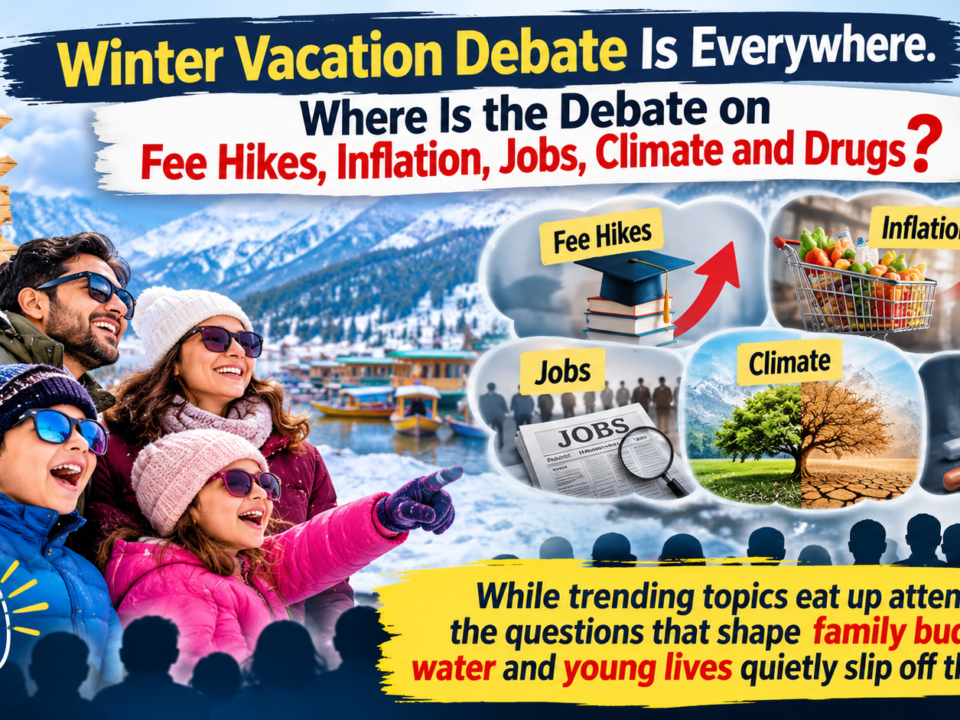
While trending topics eat up attention, the questions that shape family budgets, water and young lives quietly slip off the table.
Kashmir has become a place where every trending term is chewed by thousands of self-styled reporters within hours, while the questions that shape family budgets, children’s futures, the Valley’s water and its young people’s health quietly slip off the table.
By: Javid Amin | 25 November 2026
A Week of Opinions
For the past week, one question has dominated phones, comment sections and family WhatsApp groups across the Valley: when should schools close for winter?
News pages are running polls. Pages with a few thousand followers are making videos. Parents are posting long voice notes. Teenagers are being filmed saying the break should not happen. Fifty-year-olds are explaining why it must. Everyone has a view, everyone is sharing it, and almost nobody is adding a single new fact.
Here is what makes this striking. According to the Kashmir Observer, Education Minister Shameema Firdous said this week that the government is considering a break for nursery to Class 5 from 1 December because of the cold, and that it was receiving mixed responses from parents. Kashmir Life reported earlier that the decision would depend on weather conditions. In other words, the authorities were already weighing it, in the same way they do every year.
And every year, it ends the same way. Last year, the School Education Department issued Order No. 665-JK (Edu) of 2025 on 25 November. Pre-primary classes closed from 26 November, classes 1 to 8 from 1 December and classes 9 to 12 from 11 December. Classes 9 to 12 reopened on 23 February 2026, and the lower classes on 2 March. In December 2024 there was a similar order. In both years, the debate arrived before the order, then disappeared.
Winter vacations will happen. The weather will decide. A week of national-level arguing over it adds heat but no light.
The vacation is only the latest example. Over the past year, official figures have shown prices rising faster than the national average, a seventh straight winter of deficient precipitation, and tens of thousands of people registering for addiction treatment. Few of those issues have been debated with anything like the same energy.
It Is Not That the Topic Is Fake
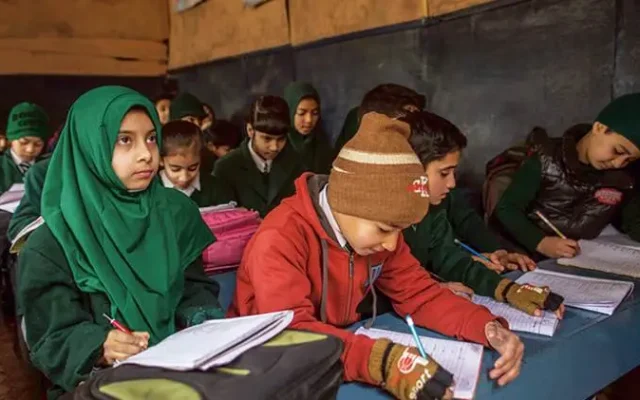
To be fair, this is not a meaningless subject. Children’s health in freezing mornings is a genuine concern. IANS reported last year that no government school in the Valley has adequate classroom heating, and that slippery roads add to the hazard. A parent worrying about a six-year-old in minus-3 degree weather is not wasting anyone’s time.
The real story behind the vacation is heating, school infrastructure, the academic calendar and how to protect learning during a long break. Those are worth debating. But those are rarely what the viral clips are about. They are about who is “for” and who is “against”, which is a debate you can join in ten seconds without reading anything.
That is the pattern worth examining.
What Is Sitting Under the Carpet
While the vacation argument spins, several questions that touch household budgets, children’s futures, the Valley’s water and its young people’s health get far less attention.
Private school fees
This is the clearest example. In December 2025, the Fee Fixation and Regulation Committee (FFRC) had to clarify that the fee structure approved for 2025-26 would remain valid until March 2026, and that any revised fees could be charged only from April. The clarification followed complaints from parents that some schools had issued new fee cards for 2026-27 as soon as the November session rollover began.
In January 2026, the FFRC warned schools against charging above approved rates and spoke of penalties and even de-recognition. By 31 March 2026, BK News was reporting that some private schools had still increased fees arbitrarily, even after the government told the Assembly that no private school may fix, collect or raise fees without the committee’s approval. Parents’ associations in the Valley have raised the same complaint in earlier years too.
There is a legal and policy side as well. A recent High Court ruling reported by Greater Kashmir noted that unaided private schools enjoy substantial autonomy over fees, that scrutiny should be targeted at cases of profiteering or commercialisation, and that the government should revisit the 2022 fee rules to give clear parameters. The court also stressed protecting genuine private schools, especially in rural areas.
The topic therefore has layers: parents who feel squeezed, schools that say their costs are real, a regulator with limited reach, and rules the court wants clarified. It deserves long, careful, document-based coverage. It rarely gets it.
The price of everything
The Economic Survey 2025-26 showed J&K’s headline inflation at 3.60 percent during April to December 2025, more than double the all-India average of 1.72 percent for the same period, as reported by Greater Kashmir on 30 January 2026. The Tribune, reporting on the Survey’s comparison, noted sharp rises in the retail prices of packed mustard oil (26.53 percent) and wheat (8.79 percent). Consumers in Srinagar’s markets have also repeatedly complained about price spikes in vegetables, fruit, poultry and mutton, especially around Ramadan, and Greater Kashmir reported such complaints again in March 2026. In earlier years, shoppers said rate lists were missing and market checks were irregular.
For a household, this is not an abstract number. It is the weekly grocery bill, and it competes with the same family’s school fees. Who monitors prices, how often, and what happens to traders who overcharge are questions with real answers, if someone asks them.
The climate warning behind the snowfall chatter
Between December 2025 and February 2026, J&K received 100.6 mm of precipitation against a normal of 284.9 mm, a 65 percent deficit and the seventh consecutive deficient winter, according to Down To Earth. Official flood-control data showed the Jhelum at Sangam falling to minus 0.86 feet on 5 March 2026. Snow cover across the Hindu Kush Himalaya was nearly 28 percent below the long-term average between November 2025 and March 2026, the lowest in more than two decades, according to a regional snow report cited by the same outlet. Experts quoted in these reports say warming is shifting snow to rain and melting what snow there is earlier. ETV Bharat reported on 6 November 2026 that the outlook for this winter may favour warmer-than-normal temperatures, though forecasters say it is too early to be sure.
Kashmir relies on snow and glaciers as natural reservoirs. That is why paddy fields, orchards, drinking-water schemes, hydropower and winter tourism all depend on what falls in these months. The question the Valley will ask next, “when will it snow?”, is therefore not trivia. The more useful question is: what is our plan if it does not?
A health crisis in plain sight
In February 2026, the government told the Legislative Assembly that 32,517 patients had registered at addiction treatment facilities and government medical colleges across J&K since 2022: 16,759 in the Kashmir division and 15,758 in Jammu, with Srinagar highest at 6,100. Officials told Rising Kashmir that the real numbers may be higher because of stigma. Separately, a Rajya Sabha reply reported by Kashmir Life showed the number of people treated at centres supported by the Union Social Justice Ministry in J&K rising from 5,382 in 2021-22 to 46,491 in 2025-26. The two figures count different things and should not be added together, but both point the same way.
Behind each number is a young person, a family and often a silence. Questions worth asking loudly: How many residential rehabilitation beds exist? What follow-up is there after treatment? How are schools, colleges and employers helping? And how much does the stress of joblessness, such as the 1.61 lakh candidates scheduled to sit for 600 posts on 15 November, feed the problem?
Other questions that deserve more airtime
- How many schools have actually submitted their fee files for approval, and how many have been penalised?
- Why do parents still have to chase refunds, advance charges and unexplained “other heads”?
- What happens to learning during a break of more than two months, especially for children without private tuition?
- Which government schools still have no heating, safe toilets or enough teachers?
These questions are less colourful than a poll about vacation dates. They require RTI applications, documents, calls to several offices and sometimes uncomfortable conversations. They also matter far more to a family’s finances.
Why Trivial Topics Win
The imbalance is not unique to Kashmir, but a few conditions make it sharper.
1. Anyone can publish. A phone and a page are enough. That has opened up valuable space for local voices, but it has also removed the checks that older newsrooms used to apply: verification, sourcing, editing.
2. Speed beats accuracy. When a term starts trending, the first post to carry it gets the reach. So thousands rush to be first, not right.
3. Easy topics are safe. An opinion on vacations asks nothing of the creator and offends no one in power. A story on fee approvals needs documents, may annoy advertisers or acquaintances, and takes days.
4. Everyone can comment. Weather, vacations and snowfall are topics every person feels qualified to discuss, which guarantees engagement and, in the logic of platforms, rewards.
5. Copying feels safe. When one angle works, the next hundred replicate it. The result is a crowd of near-identical posts that each look new to the person making them.
6. Real issues fatigue the audience. People are tired. A light, shareable topic feels like a relief, and platforms notice what people click.
The outcome is a loop: the audience rewards the easy topic, the creator makes more, and the hard topic gets starved of attention until a crisis forces it back.
The Snowfall Forecast Problem
The next wave is predictable. Once the vacation question settles, attention will move to when it will snow, how much, and whether this winter will be harsher than the last. Weather is important to travellers, farmers, power utilities and tourism, which is exactly why it should come from official weather agencies and qualified forecasters, not from whoever posts the loudest prediction.
A small test helps. Before sharing a forecast, ask: Who made this prediction, using what data, and are they accountable if it is wrong? If the answer is “someone online”, it is entertainment, not information.
One caveat: weather is not trivial in Kashmir. The difference is between idle prediction and informed planning, which is why the climate data above matters far more than any influencer’s snowfall guess.
What Good Local Journalism and Creation Look Like
This is not a call to shut down citizen voices. Local creators can add context and reach that no big outlet can. But three habits would raise the standard immediately.
- Add something new. A fact, a document, a quote from the person affected, or a comparison across districts. If the post only repeats others, skip it.
- Verify before you amplify. One call to the right office takes ten minutes and prevents rumours from spreading.
- Follow the story past the trend. After the vacation order, ask whether classrooms were heated, whether fees were collected for the break, and whether children learned anything.
What Parents and Readers Can Do
- Check the approved fee for your child’s school with the FFRC and compare it with the fee card you were given.
- Use the formal complaint route. The committee has asked parents to lodge complaints through the prescribed procedure, so keep receipts, circulars and dates.
- Work together. Parents’ associations can file collective complaints and push for answers more effectively than individual voices.
- Reward depth. Share and comment on the careful, sourced pieces. Platforms pay attention to what you spend time on.
- Pause before posting. Ask whether your post helps anyone decide or do anything. If not, it may be noise.
Final Thoughts
The winter vacation will be announced, the snow will fall, and next week there will be another trending phrase. What will not change on its own is the fee card at your child’s school, the grocery bill, the falling level of the Jhelum, the classroom heater that does not work, or the young person waiting in a de-addiction queue.
The real test of a community’s public conversation is not how loud it is, but what it chooses to be loud about. Kashmir has smart, articulate, connected people. Pointing that energy at the questions that shape ordinary lives would change far more than another round of “yes or no” polls.
Frequently Asked Questions
When will winter vacations be announced in Kashmir this year? As of this week, the Education Minister said the government was considering a break for nursery to Class 5 from 1 December and that weather would be a factor. Wait for the official School Education Department order for the final schedule.
When was the winter break last year? Government Order No. 665-JK (Edu) of 2025 set vacations from 26 November for pre-primary, 1 December for classes 1 to 8 and 11 December for classes 9 to 12, ending in late February.
Can private schools in J&K raise fees on their own? No. The government has repeatedly stated that private schools cannot fix, collect or increase fees without approval from the Fee Fixation and Regulation Committee.
Where can parents complain about unapproved fee hikes? Parents can approach the FFRC through its prescribed complaint process. Keep fee cards, receipts and school circulars as evidence.
Is inflation in J&K higher than the national average? According to the Economic Survey 2025-26, as reported by Greater Kashmir, J&K’s headline inflation was 3.60 percent in April to December 2025, against 1.72 percent for India.
How dry was last winter? J&K recorded a 65 percent precipitation deficit from December 2025 to February 2026, its seventh consecutive deficient winter, according to Down To Earth.
How many people in J&K have sought drug treatment? The government told the Assembly in February 2026 that 32,517 patients had registered at addiction treatment facilities since 2022. That counts registered patients, not the total number of users.