Are We Changing the Sacred Journey to Suit Our Comfort?
By: Javid Amin | 27 November 2026
As modern infrastructure reshapes pilgrimage routes across the Himalayas, an important question emerges: are we making the journey easier, or gradually changing the spiritual experience that made it sacred?
There is something profoundly spiritual about walking through the mountains to reach a sacred destination. The steep trails, cold winds, flowing streams, silence of the wilderness and the uncertainty of the weather are not merely obstacles along the way. For many pilgrims, they become part of the experience itself.
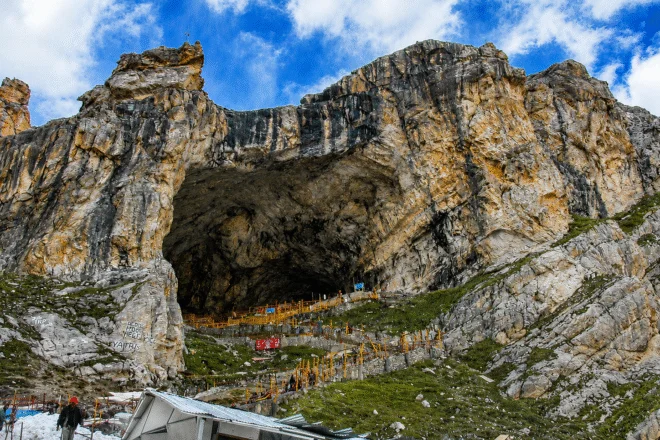
The Amarnath Yatra is more than a journey to a cave shrine. For countless devotees, it is an expression of faith, patience, sacrifice and surrender. The difficult ascent through the Himalayan landscape carries a significance that extends beyond reaching the sacred cave. Every step, every moment of exhaustion and every encounter with nature can become an opportunity for reflection.
Yet, as modern infrastructure increasingly transforms pilgrimage routes, a question deserves deeper consideration: are we improving the pilgrimage experience, or gradually removing the very elements that make the journey spiritually meaningful?
The journey is not merely a road to the shrine
For generations, pilgrims undertaking the Amarnath Yatra have experienced the mountains in their raw and unpredictable form. The journey demands physical effort, patience and respect for nature. The changing weather, difficult terrain, cold temperatures and long walking stretches remind pilgrims of their physical limitations.
In a world increasingly organised around speed, convenience and comfort, such experiences can offer something rare: an opportunity to slow down, disconnect from ordinary routines and become more conscious of one’s surroundings.
The mountain does not bend to human expectations. Weather can change suddenly. Paths can become difficult. Physical exhaustion reminds even the strongest individual of their vulnerability.
Perhaps that is part of the spiritual significance of undertaking such a journey.
Pilgrimage is not always about reaching a destination as quickly as possible. Sometimes, it is about what a person experiences, learns and discovers along the way.
When the journey becomes nothing more than a transportation corridor designed to minimise every inconvenience, we risk overlooking the deeper value of the pilgrimage itself.
The mountain is part of the spiritual experience
The Himalayan landscape surrounding the Amarnath shrine is not simply a backdrop to religious devotion. It is an integral part of the experience.
The mountains, streams, glaciers, meadows, silence and wilderness collectively shape the atmosphere in which pilgrims undertake their journey. The physical environment can evoke humility, gratitude, patience and a sense of awe that is difficult to replicate in ordinary surroundings.
Within Hindu pilgrimage traditions, the concept of Tirtha Yatra carries meanings beyond travelling to a religious location. A pilgrimage can represent a passage towards purification, contemplation and spiritual understanding.
Sacred mountains, rivers, caves and forests are often approached not merely as geographical destinations but as places where the ordinary experience of life encounters something deeper.
The gradual ascent towards Amarnath, therefore, is not simply a challenge to overcome. For many pilgrims, it is part of the act of devotion itself.
Transforming the surrounding landscape purely around the demands of convenience risks changing the character of that experience.
Faith, hardship and the transformation of the self
Spiritual traditions across the world have long associated journeys with inner transformation.
In Islamic spirituality, the physical journey of pilgrimage is often understood alongside the inward journey of the soul. The Quran, in Surah Al-Hajj, describes pilgrims arriving from distant places, while Surah Al-Baqarah emphasises righteousness and God-consciousness as the essential provision of pilgrimage.
The Hajj journey, too, carries lessons of patience, humility, simplicity and surrender. For many pilgrims, travelling through unfamiliar landscapes and leaving behind the comforts of ordinary life becomes an opportunity to reflect on their relationship with faith and the material world.
This is not to suggest that hardship alone makes a journey sacred, or that physical suffering is a requirement for spiritual growth. Rather, it reminds us that pilgrimage has historically carried a meaning beyond convenience, accommodation and transportation.
The value of a sacred journey cannot be measured exclusively by how comfortably a person travels or how quickly they reach their destination.
It may also be measured by how the journey changes the person who undertakes it.
Modern facilities are necessary, but development needs limits
There is no denying that pilgrimage infrastructure has improved significantly over the years. Roads, medical facilities, emergency services, communication networks, shelters and improved access have made religious journeys safer for millions.
These improvements are essential. Pilgrims should not be exposed to avoidable dangers. Elderly devotees, people with disabilities and those with medical conditions deserve opportunities to undertake religious journeys with dignity. Emergency facilities and responsible accessibility measures can save lives.
But there is a difference between improving safety and reshaping fragile landscapes to accommodate every demand for comfort.
The challenge is to determine where necessary infrastructure ends and excessive intervention begins.
A mountain route does not necessarily need to become a motorable road at every point. Every slope does not need to be cut open. Every difficult stretch does not automatically justify widening. In environmentally sensitive regions, even relatively small interventions can have consequences that require careful assessment.
Development should be guided by the nature of the terrain, the ecological sensitivity of the area, actual safety requirements and long-term environmental consequences, rather than convenience alone.
The objective should be to make pilgrimage safer without unnecessarily altering the landscape that gives it meaning.
Sheshnag and the question of ecological responsibility
The ongoing controversy surrounding construction-related activity near Sheshnag Lake has brought these concerns into sharper focus.
Sheshnag lies within a fragile high-altitude Himalayan environment shaped by snow, ice, seasonal freezing and thawing, natural drainage, sediment movement and delicate ecological processes. Such landscapes may appear barren, but their environmental systems can be highly sensitive to disturbance.
Excavation, slope cutting, improper disposal of material and changes to drainage can potentially affect slope stability, water quality and surrounding habitats.
This does not mean that every infrastructure activity automatically causes ecological damage. Nor should environmental concerns be used to reject every development proposal without examining its purpose, design and consequences.
The important question is whether interventions are scientifically justified, proportionate to the need, environmentally assessed and properly monitored.
The Border Roads Organisation has maintained that the work is intended to improve pilgrim safety and that environmental safeguards are being followed. Such claims deserve consideration, but they should also be supported by transparent documentation and independent scientific scrutiny wherever credible environmental concerns arise.
A sacred landscape should not be treated as environmentally expendable in the name of pilgrimage infrastructure.
Protecting the environment is not an obstacle to religious devotion. It is part of the responsibility of preserving the natural surroundings in which that devotion takes place.
The danger of turning pilgrimage into a tourism product
Religious destinations across the world are increasingly surrounded by commercial activity. Luxury accommodation, premium packages, exclusive services, shopping facilities and convenience-driven experiences have become a growing part of the pilgrimage economy.
Tourism itself is not inherently harmful. It provides livelihoods, supports local economies and allows people to experience places they might otherwise never visit.
But when the culture surrounding pilgrimage begins to prioritise comfort, consumption, status and commercial expectations, its spiritual character deserves reflection.
The question is not whether a pilgrim should travel by bus, helicopter, train or on foot. Nor is it about judging those who cannot undertake physically demanding journeys.
The concern is whether we are slowly replacing the spirit of simplicity with the expectations of a holiday, where every discomfort is considered unacceptable and every natural obstacle must be removed.
The Amarnath Yatra should not become a competition in convenience. Its significance lies in faith, devotion and the personal experience of undertaking a sacred journey.
Protecting sacred landscapes must be a shared responsibility
Environmental responsibility should not be confined to one religion, one pilgrimage or one geographical location.
The natural landscapes surrounding Amarnath, Kedarnath, Makkah and other sacred destinations deserve protection wherever development creates environmental risks. The principles of conservation should remain consistent, irrespective of the faith associated with a place or the authority undertaking a project.
Those who speak about environmental protection must be willing to apply the same standards everywhere. Religious devotion and ecological responsibility should reinforce one another, not become competing arguments.
The mountains, rivers, forests and lakes that surround sacred destinations are not temporary assets. They are natural systems that sustain life, communities and future generations.
Protecting them is not simply an environmental obligation. It is also an ethical responsibility.
What should a pilgrim bring back?
Perhaps the most important question about the Amarnath Yatra is not how quickly a pilgrim reaches the cave, but what they carry back after completing the journey.
Has the experience made them more patient? More compassionate? More humble? More tolerant? More conscious of the environment? Less attached to material comforts and the demands of the ego?
A pilgrimage may change a person’s geographical location without necessarily changing their consciousness.
The rituals may be completed. The sacred destination may be visited. Photographs may be taken. Modern facilities may make the journey more comfortable than ever before.
But if the individual returns with the same impatience, arrogance, material attachments and disregard for others, an important dimension of the spiritual experience may remain unexplored.
The mountains offer a reminder that human beings are not in complete control. They remind us of the limits of our strength, the unpredictability of nature and the need for humility.
Perhaps the greatest value of the Amarnath Yatra lies not only in reaching the sacred cave, but in allowing the journey to transform the person undertaking it.
We may preserve the shrine while altering the sacred landscape. We may preserve the rituals while commercialising the experience. We may shorten the physical journey without deepening the spiritual one.
The purpose of pilgrimage should not be lost in our pursuit of convenience.
Are we undertaking sacred journeys to transform ourselves, or are we increasingly transforming sacred landscapes to accommodate our untransformed selves?