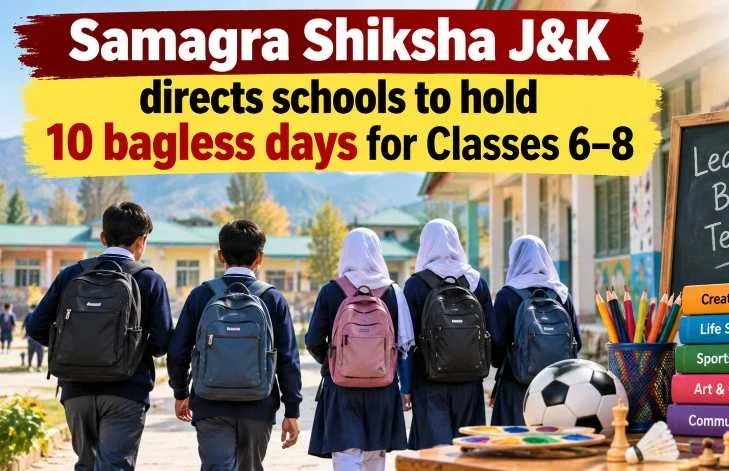
From textbooks to workshops, farms and local workplaces, the initiative aims to bring practical learning into middle-school education. But implementation will determine whether it becomes meaningful reform or another compliance exercise.
By: News Desk | 16 October 2025
Srinagar: Jammu and Kashmir has directed government schools to implement the 10 Bagless Days initiative for students of Classes 6 to 8, marking another step towards integrating vocational exposure and experiential learning into the school education system.
In a communication dated October 14, the Directorate of Samagra Shiksha J&K instructed Chief Education Officers (CEOs) to circulate the guidelines among higher secondary, high and middle schools where Classes 6 to 8 are taught and ensure implementation. Schools have also been asked to submit consolidated monthly progress reports by the fifth of every month.
The initiative is rooted in the National Education Policy (NEP) 2020, which calls for students to experience vocational activities, learn from skilled workers and connect classroom concepts with the world around them.
Under the programme, students are expected to spend ten designated days engaging in practical activities instead of following their usual textbook-centred routine.
The idea is straightforward: education should not only prepare children to answer examination questions. It should also help them understand how things work, develop practical abilities, appreciate different professions and recognise the value of skilled labour.
Yet the real test will begin inside schools, where teachers and administrators must turn the policy into activities that are educationally useful, safe and accessible to students.
What Are the 10 Bagless Days?
Bagless Days are intended to give students structured opportunities to learn outside the conventional classroom environment.
Instead of spending every school day moving between textbooks, notebooks and written assignments, students can participate in workshops, practical demonstrations, supervised visits and interactions with people who use specialised skills in their daily work.
The Ministry of Education and NCERT developed guidance for implementing ten bagless days for students in Classes 6 to 8 under the NEP framework.
The approach does not mean abandoning academic learning. Rather, it seeks to complement classroom teaching with experiences that help students understand the practical application of what they study.
For example, a lesson about plants can be connected with gardening or agriculture. Mathematics can be applied to measuring materials and calculating costs. Science concepts can be explored through supervised demonstrations of simple tools and everyday technology.
The objective is to make learning more connected to the lives students actually lead.
What Will Students Learn?
The activities can be adapted to local conditions, school facilities and the availability of skilled people in the surrounding community.
Potential activities include:
- Traditional crafts: Interacting with potters, carpenters, weavers, artisans and other skilled workers.
- Gardening and agriculture: Learning about soil, seeds, seasonal crops, plant growth and water conservation.
- Basic technical skills: Observing how tools, electrical systems and everyday equipment work under qualified supervision.
- Local heritage: Visiting museums, historical sites, cultural institutions and places of educational importance.
- Community learning: Understanding the work performed by local service providers, healthcare workers and other professionals.
- Practical problem-solving: Measuring, designing, building simple models and applying classroom concepts to real situations.
These are examples of possible activities, not a claim that every school must conduct every activity.
The precise programme should follow the applicable guidelines and reflect the school’s resources, local environment and students’ needs.
For Jammu and Kashmir, this could create opportunities to connect education with the region’s crafts, horticulture, agriculture, tourism, environmental conservation and traditional knowledge.
A school in a rural area might work with local farmers or artisans. An urban school might arrange supervised visits to workshops, public institutions or technical facilities. Schools in remote areas could use nearby community resources where travel is difficult.
The value lies in making learning relevant, not in organising expensive excursions.
Why NEP 2020 Emphasises Practical Learning
The National Education Policy 2020 seeks to move Indian education away from excessive dependence on rote memorisation towards conceptual understanding, competency-based learning and practical application.
Its vocational education framework envisages exposure to different occupations and skills from the middle-school stage. The ten-day bagless programme is one mechanism through which students can explore these areas.
The broader educational reasoning is that children often understand a concept more deeply when they can observe it, test it or use it.
Reading about a craft and watching an artisan at work are different experiences. Studying the principles of plant growth and maintaining a small school garden can reinforce each other. Learning about local history becomes more engaging when students can examine a historical site or speak with people familiar with its heritage.
Such activities can also help children discover interests that conventional examinations may not fully reveal.
A student who struggles with written exercises may demonstrate curiosity, creativity or technical ability during a practical task. That does not make classroom learning less important. It shows why a broader range of learning experiences can be beneficial.
The ‘Head, Hand and Heart’ Approach
The bagless-days framework is associated with the idea of developing the head, hand and heart together.
The head represents understanding, reasoning and intellectual development.
The hand represents practical work, making, repairing, observing and learning through activity.
The heart represents empathy, social responsibility, cooperation and respect for the dignity of labour.
Together, these dimensions challenge the idea that academic success should be measured only through written examinations.
The approach also carries a social message. Students should learn to respect people who work with their hands, whether they are carpenters, farmers, mechanics, artisans or technicians.
Vocational education should not be presented as a second-rate alternative for students who do not perform well academically. Practical and intellectual abilities are complementary, and both contribute to society.
Why the Initiative Matters for Jammu and Kashmir
Jammu and Kashmir has a diverse educational and economic landscape, ranging from urban centres to remote mountain communities.
That diversity offers opportunities to develop locally relevant learning activities instead of relying on a uniform programme that looks identical in every school.
In areas where horticulture is important, students could learn about fruit cultivation, soil health, irrigation and post-harvest practices. In communities with a strong craft tradition, artisans could explain how products are designed, made and marketed.
Schools could also introduce students to environmental challenges in their surroundings, including waste management, water conservation, biodiversity and the protection of local ecosystems.
Local history and cultural heritage could become part of experiential learning through carefully planned visits and projects.
These activities could help students understand that knowledge is not confined to textbooks or examination halls. It is also present in the skills, experience and problem-solving abilities of people in their communities.
However, such programmes must remain educational. Students should not be used as unpaid labour, and visits or workshops should not replace qualified teaching with unstructured observation.
The Biggest Challenge: Implementation
A government directive establishes an administrative requirement. It does not automatically ensure that every school has the people, equipment and partnerships needed to deliver the intended experience.
Schools will need to plan activities, identify suitable resource persons, organise supervision and connect each activity with clear learning objectives.
Teachers may also require guidance on how to prepare students before a visit, facilitate learning during an activity and assess what students have understood afterwards.
Without that preparation, Bagless Days risk becoming little more than a break from routine classes.
The challenge may be particularly pronounced in schools with limited infrastructure, staff shortages or difficult transport access. A school located far from a town may not have easy access to workshops, museums or specialised institutions.
The response should not be to exclude such schools from meaningful participation. Instead, implementation plans should recognise local limitations and make use of nearby resources.
A village craftsman, a farmer, a school garden or a locally available environmental project may offer valuable learning opportunities without requiring a costly trip.
Monthly Reports: Accountability or Paperwork?
The directive requires consolidated monthly progress reports to be submitted by the fifth of every month.
Reporting can help education authorities monitor whether schools are implementing the programme and identify areas where support is needed.
But the number of activities conducted is not, by itself, a reliable measure of educational quality.
A school could report several visits without demonstrating what students learned. Another school could conduct fewer activities but provide students with a deeper, more structured experience.
For that reason, monitoring should examine more than attendance sheets and photographs.
Useful indicators could include the number of students participating, the range of activities offered, the involvement of qualified resource persons, safety arrangements, student reflections and evidence of learning.
Authorities should also record schools that cannot implement activities because of transport, staffing or resource constraints and provide practical support to address those problems.
The purpose of monitoring should be to improve learning, not merely to ensure that a monthly report reaches an office on time.
Safety Must Remain Central
Practical education can involve workshops, tools, field visits and unfamiliar environments. These activities require proper planning.
Schools should conduct risk assessments, obtain parental consent where required, arrange adequate adult supervision and ensure that transport and venue arrangements meet applicable safety standards.
Students must not be allowed to handle hazardous machinery, electrical equipment or dangerous tools without appropriate safeguards and qualified supervision.
Activities should also be inclusive. Children with disabilities and students from economically disadvantaged families should have meaningful opportunities to participate.
No child should be excluded because their family cannot afford additional expenses associated with a school activity.
The programme’s educational value depends partly on ensuring that practical learning remains safe, equitable and accessible.
Will Bagless Days Improve Education Outcomes?
The initiative has potential, but its impact should not be assumed in advance.
Experiential learning can strengthen understanding, curiosity, teamwork and problem-solving when activities are well designed and linked to academic concepts.
However, ten designated days cannot compensate for persistent problems such as teacher vacancies, weak foundational literacy, inadequate facilities or poor access to learning materials.
Nor should the initiative be treated as a substitute for regular classroom teaching.
Its success will depend on how well practical activities complement the curriculum, whether teachers receive appropriate support and whether students gain skills or understanding that they can apply beyond the activity itself.
Education authorities should therefore evaluate the programme through evidence rather than relying exclusively on implementation reports.
Student feedback, teacher observations and examples of completed projects could help identify which approaches work best across different settings.
What Parents Should Expect
For parents, Bagless Days should mean more than students attending school without their usual bags.
They should be able to understand what an activity is intended to teach, how it relates to the curriculum and what arrangements are in place to protect students.
Schools can help by communicating activity schedules in advance, explaining any required materials and ensuring that participation does not create unreasonable financial pressure on families.
Parents should also be encouraged to discuss the experience with their children afterwards. Asking what a student observed, learned or made can help reinforce the connection between practical activity and academic understanding.
The ultimate measure is not whether a child returned home without a schoolbag. It is whether the child returned with a better understanding of something useful.
From Policy to Classroom Practice
Jammu and Kashmir’s directive gives schools a clear implementation task under the broader NEP 2020 framework.
The opportunity is significant: practical learning can expose children to skills, occupations and local knowledge that are often missing from routine classroom instruction.
But the outcome will depend on how schools plan the ten days, how teachers are supported, whether activities are safe and inclusive, and whether authorities assess learning rather than paperwork alone.
If implemented thoughtfully, Bagless Days could help students connect what they read in textbooks with the world around them.
If implemented mechanically, they could become another compliance exercise in an already demanding school calendar.
The difference will be determined not by the directive itself, but by what happens when students step outside the textbook and begin learning through experience.