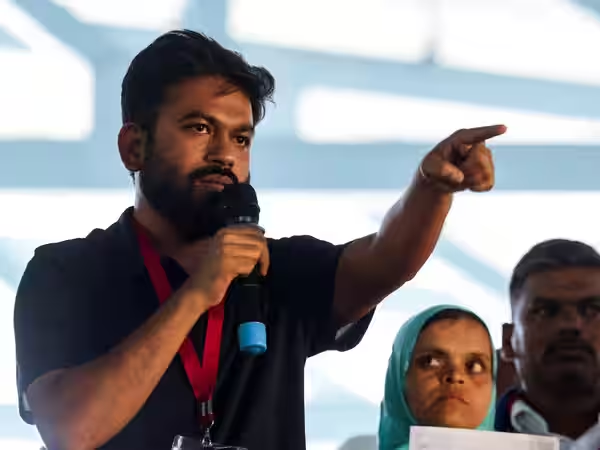
Abhijeet Dipke’s ‘Lehra Do Tiranga’ gathering remains scheduled for 5 pm; traders warn of festive-season losses as Central Park stays shut and security is tightened across Connaught Place
By: Javid Amin | 16 October 2026
New Delhi: The Supreme Court on Friday declined to issue an urgent order stopping the proposed “Lehra Do Tiranga” march called by Cockroach Janta Party (CJP) founder Abhijeet Dipke in Delhi’s Connaught Place, expressing hope that “better sense” would prevail among protesters, authorities and traders amid mounting concerns over public order and business losses during the festive season.
The court’s position does not amount to unrestricted permission for a mass demonstration. Delhi Police has urged the public not to join the proposed gathering and offered to facilitate a symbolic flag-waving event involving only 11 people at a suitable place. Central Park, the venue named by the organisers, is scheduled to remain closed on October 16 and 17, while prohibitory orders under Section 163 of the Bharatiya Nagarik Suraksha Sanhita (BNSS) remain in force in Connaught Place and adjoining areas.
The developments have turned the proposed demonstration into a three-way test involving the organisers’ demand to protest, the administration’s responsibility to maintain public order, and traders’ concerns about losing business during an important shopping period.
What did the Supreme Court say?
A bench comprising Chief Justice of India Surya Kant and Justice Joymalya Bagchi heard an urgent plea concerning the proposed CJP gathering at Central Park in Connaught Place.
The court declined to grant immediate directions against the march and urged all sides to act sensibly. The Chief Justice highlighted the dependence of small shopkeepers and their families on earnings during the festive season, stressing that their livelihoods could not be ignored while dealing with the right to protest.
The court also indicated that compensation could be considered if restrictions or disruption associated with the protests disproportionately affected businesses and livelihoods.
The observations matter because the dispute has moved beyond the question of whether a demonstration should be allowed. It now includes the potential economic consequences of security restrictions, the closure of a public venue and disruption to a busy commercial district.
The Supreme Court has not issued a blanket order authorising the mass march. Nor has its refusal to intervene urgently overturned the existing prohibitory orders. The police remain responsible for regulating the gathering under the applicable law.
The matter is expected to be taken up again around October 26 or 27, according to reports on the proceedings.
Who has been allowed to march? Police offers permission for 11 people
One of the most consequential developments is Delhi Police’s offer to facilitate a symbolic gathering of 11 people to carry the national flag and sing the national anthem at a suitable location.
The offer followed the Delhi High Court’s decision on Thursday to refuse a petition seeking to restrain CJP and Dipke from holding the proposed protest. The High Court recorded the police’s assurance that it would take all possible measures under the law to regulate the gathering and maintain peace.
Police subsequently appealed to the public not to assemble at Central Park, citing the existing restrictions and the civic body’s decision to close the venue.
The distinction between the court’s decision and the police’s offer is important:
-
The Delhi High Court did not prohibit the proposed protest, but recorded the police’s undertaking to regulate it.
-
The Supreme Court declined urgent intervention against the march, expressing hope that all sides would act responsibly.
-
Delhi Police offered to facilitate 11 people for a symbolic flag event at a suitable place.
-
No unrestricted permission for a mass gathering at Central Park has been established.
The 11-person proposal is therefore a limited accommodation, not approval for thousands of people to assemble. Whether the organisers accept it, and what happens when supporters arrive, remains to be confirmed after the scheduled 5 pm start.
Why is Central Park closed?
The New Delhi Municipal Council (NDMC) has announced that Central Park in Connaught Place will remain closed to the public on October 16 and 17, citing administrative reasons.
The closure directly affects the location identified by Dipke for the “Lehra Do Tiranga” march. The park sits above Rajiv Chowk Metro station in the heart of Connaught Place, a major shopping, dining and business district.
The closure has also intensified questions about how the authorities intend to prevent a gathering near the park while managing public movement around the surrounding roads and commercial establishments.
Police have cited the security situation and representations from trader and market associations, which have raised concerns about unlawful assemblies, disruption and financial losses during the festive season.
The authorities’ position is that a large gathering in the area could create law-and-order challenges and affect public and private property. The organisers, meanwhile, have called on supporters to carry the Tricolour and join a symbolic protest.
The park closure does not, on its own, establish that all of Connaught Place is closed. Businesses in the market have indicated that they intend to remain open, although security arrangements and any traffic restrictions could affect access.
Traders fear festive-season losses
The petition before the courts reflects concerns among Connaught Place traders and street vendors that another protest-related disruption could affect their earnings.
The festive season is particularly important for shops, restaurants, street vendors and daily-wage workers, many of whom rely on increased customer spending during this period. Restrictions on roads and footpaths, difficulty accessing shops, and uncertainty over movement can affect business even when establishments remain technically open.
A trader associated with the Connaught Place market has warned that the commercial area should not become a protest site, arguing that demonstrations could impose a heavy cost on people whose livelihoods depend on daily sales.
The Supreme Court’s observations acknowledged that tension. The court did not simply treat the dispute as a question of police deployment; it also recognised the economic vulnerability of small businesses and families dependent on daily earnings.
The possibility of compensation is significant, but it should not be read as an automatic payment order. Any compensation would depend on further judicial consideration and the circumstances established before the court.
For traders, the immediate concern is practical: whether customers can reach the market, whether traffic and pedestrian routes remain accessible, and whether security restrictions spread beyond the protest site.
More than 30,000 security personnel on alert
Delhi has mounted a substantial security operation ahead of the proposed gathering. Reports have cited more than 6,000 Delhi Police personnel for Connaught Place and nearby areas, alongside a broader deployment of Central Armed Police Forces personnel in the capital. The combined figure has been reported at more than 32,000, although other reports have used lower overall estimates depending on the personnel and areas counted.
The preparations include barricades, surveillance cameras and security personnel at strategic locations. Police have also warned of possible traffic restrictions and diversions in central Delhi.
The security arrangements reflect the possibility of a large turnout, but they should not be interpreted as proof that tens of thousands of people will attend. The actual size of the gathering, if it takes place, remains uncertain.
For commuters, the main concern is the potential for delays around Connaught Place and adjoining roads. People travelling through central Delhi have been advised to plan their journeys and follow traffic police instructions.
Why has Abhijeet Dipke called the march?
Dipke announced the “Lehra Do Tiranga” march after CJP co-convenors Saurav Das and Ashutosh Ranka were arrested and sent to five days of judicial custody following their detention at Jantar Mantar.
Police have cited alleged violations of restrictions at the site and related allegations in connection with the action against the activists. The organisers have framed the march as a protest against their detention and as part of the broader campaign demanding Chief Election Commissioner Gyanesh Kumar’s resignation.
The wider agitation concerns allegations of irregularities in the Special Intensive Revision (SIR) of electoral rolls. Critics have questioned the revision process and raised concerns about the deletion of voters, while the Election Commission has denied political bias and said voters wrongly removed can re-enrol.
These allegations remain part of an ongoing political dispute; the protest itself does not establish that electoral wrongdoing has occurred.
For CJP, the Tricolour march is intended to connect its demand for electoral accountability with the right to demonstrate publicly. The administration’s challenge is to respond to the protest without allowing a potentially large gathering to undermine public safety or disrupt the commercial district.
A wider dispute over protest spaces in Delhi
The latest confrontation follows the denotification of Jantar Mantar as a designated protest site and the identification of alternative venues for demonstrations.
That decision has added to the dispute over where citizens, political groups and civil society organisations can assemble. Jantar Mantar has long been associated with public demonstrations, and changes to access arrangements have sharpened concerns about the practical availability of spaces for dissent.
Authorities have cited the need to regulate protests and protect public order. Organisers and supporters have argued that restrictions can make it harder to bring public attention to their demands.
The Central Park episode brings that debate into a busy commercial area. It raises questions about how authorities should balance the right to assemble with the need to protect businesses, commuters and other members of the public.
The answer cannot be reduced to either unrestricted access to every public space or a blanket prohibition on demonstrations. It depends on the applicable legal framework, the availability of alternative venues, the proportionality of restrictions and whether peaceful gatherings can be facilitated safely.
What happens next?
The immediate focus is the proposed 5 pm gathering and whether the police’s offer to facilitate 11 people leads to a limited symbolic event.
Several outcomes remain possible: organisers may accept the limited arrangement, attempt to gather at the announced venue, or change their plans. Until the event unfolds, claims about the number of protesters who will be allowed to participate or whether a march will actually proceed should be treated cautiously.
The Supreme Court’s latest position leaves the police’s existing regulatory responsibilities in place while signalling that the economic impact on traders and workers cannot be ignored. The Delhi High Court, meanwhile, has declined to restrain the protest outright but recorded the police’s undertaking to manage it under the law.
The developments leave all sides facing a difficult balance. CJP wants its message heard; police must maintain order under existing restrictions; and traders want to protect their livelihoods during the festive season.
The real test will be whether the authorities can manage the gathering without unnecessary confrontation, while ensuring that public safety, commercial activity and lawful dissent are all given due consideration.


