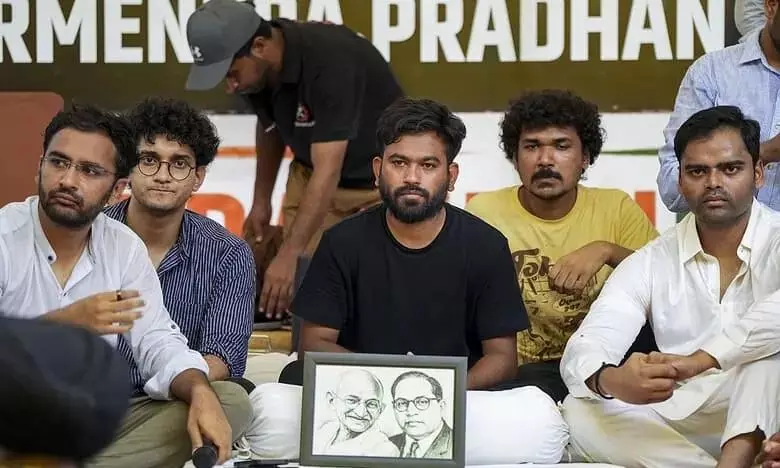
The court declines to stop Abhijeet Dipke’s October 16 protest after Delhi Police assures it will regulate the gathering and maintain public order, as the CJP campaign brings the debate over voter rights and protest freedoms back to the streets.
By: Javid Amin | 15 October 2026
New Delhi— The Delhi High Court on Thursday cleared the way for the Cockroach Janta Party (CJP) to proceed with its proposed Tiranga March at Central Park in Connaught Place on Friday, October 16, after Delhi Police assured the court that appropriate measures would be taken to regulate the gathering and maintain law and order.
The court declined to issue an order stopping the planned demonstration by CJP founder Abhijeet Dipke, who has called on supporters to assemble with the national flag at 5 pm. The decision comes amid an intensifying dispute over the Election Commission of India’s Special Intensive Revision (SIR) of electoral rolls, the detention of CJP activists and restrictions on designated protest venues in the national capital.
The court’s approach leaves the proposed march on the agenda while placing responsibility on the police to manage the gathering in accordance with the law. It should not be interpreted as an unrestricted authorisation to disregard applicable conditions or public-order requirements.
The hearing followed a petition seeking to stop the demonstration, with concerns raised about holding a protest in the heart of Connaught Place during a busy festive period. The High Court considered the concerns alongside the police assurance on maintaining order.
Why CJP has called the Tiranga March
Dipke announced the march after CJP leaders Saurav Das and Ashutosh Ranka were sent to five days of judicial custody following their detention for allegedly entering Jantar Mantar, which authorities had recently de-notified as a designated protest site.
Police have cited alleged unauthorised entry, violation of restrictions and breaches of earlier peace bonds. CJP has disputed the way the action has been characterised and says its activists were targeted for raising political demands while carrying the national flag.
Dipke has framed the planned march around the message that waving the Tricolour is not a crime. His appeal asks supporters to gather at Central Park in Connaught Place with the national flag to demonstrate their opposition to the detention of the two activists.
He has also urged people unable to travel to Delhi to organise Tiranga marches in their own cities.
The CJP’s stated objective is to draw attention to the right to peaceful protest, electoral transparency and demands for accountability from Chief Election Commissioner Gyanesh Kumar. Its claims about the reasons for the activists’ detention remain the party’s account; the police have cited separate allegations concerning entry into the de-notified protest site and compliance with legal restrictions.
What the Delhi High Court’s decision means
The High Court’s decision is significant because it avoids an outright prohibition on the proposed gathering while leaving the police responsible for regulating the event.
The case arose after a plea sought intervention against the planned demonstration at Central Park. The petitioner raised concerns about holding a protest at a prominent commercial and public location, particularly during a busy period in the capital.
The police assured the court that appropriate legal measures would be taken to manage the gathering and maintain public order. The court declined to stop the march on the basis of the proceedings before it.
The distinction between permission to proceed and unrestricted permission is important. The reported decision does not mean that participants can disregard lawful directions, obstruct public movement or violate applicable conditions. Nor does it determine the merits of CJP’s allegations against the Election Commission.
The immediate outcome is narrower: the High Court did not issue the requested order preventing the march, and the police are expected to manage the gathering under the law.
Connaught Place becomes the next focal point
The proposed march carries additional significance because of the recent decision to de-notify Jantar Mantar as a designated protest venue.
For years, Jantar Mantar has been one of India’s most recognisable sites for political demonstrations. The decision to change its status has generated objections from activists who view the location as an important space for making public demands visible to the national political establishment.
Authorities, meanwhile, have cited the need to manage demonstrations through designated venues and maintain public order.
Against this backdrop, Central Park in Connaught Place has become the next focal point for CJP’s campaign. The location is highly visible and centrally situated, but it is also part of a busy commercial district where public gatherings can affect pedestrians, businesses and traffic.
The challenge for the authorities will be to protect public safety while ensuring that lawful political expression is not unnecessarily curtailed. For organisers, the challenge will be to demonstrate that a large public gathering can remain peaceful and comply with applicable directions.
The High Court proceedings have brought these competing considerations into sharper focus without resolving the wider debate over protest venues in Delhi.
The wider dispute over electoral-roll revision
The Tiranga March comes amid growing political opposition to the Election Commission’s SIR exercise.
The revision process has become the subject of allegations concerning voter deletions, additions and modifications, with opposition parties seeking greater transparency and safeguards for eligible voters. The Election Commission’s decisions and procedures are being challenged through political campaigns and legal proceedings.
Rahul Gandhi and several INDIA bloc leaders have approached the Supreme Court seeking judicial scrutiny of the SIR process. The Court has issued notices to the Election Commission and senior election officials, seeking their responses to the allegations.
Those notices mark a procedural step towards examining the dispute; they do not establish that electoral manipulation occurred. The substantive questions will depend on the evidence, the Commission’s response and the Court’s subsequent consideration.
CJP has sought to connect its protest campaign with the same concerns about electoral accountability. Its mobilisation has attracted attention because it combines a challenge to election authorities with a broader message about public participation and the right to dissent.
However, the scale and durability of the movement remain uncertain. A highly visible demonstration can generate political attention, but sustained influence depends on continued participation, organisational capacity and the ability to substantiate claims.
From detentions to a broader protest campaign
The Connaught Place march follows demonstrations in Mumbai and Delhi earlier in October. CJP activists and supporters have called for accountability from the Election Commission and demanded action over alleged problems in electoral-roll revision.
In Delhi, the controversy intensified after police detained CJP activists who allegedly entered Jantar Mantar despite the site’s changed status. Das and Ranka were subsequently sent to judicial custody, while their supporters portrayed the action as an attack on peaceful protest.
The dispute has since drawn wider political attention, including Rahul Gandhi’s public support for the activists. The opposition has used the episode to raise broader questions about electoral transparency and the availability of public spaces for dissent.
The CJP’s latest call is intended to sustain that attention. By centring the march on the national flag, the party is seeking to frame the demonstration around a symbol that carries broad public and constitutional significance.
That message may attract supporters beyond the organisation’s existing base. Yet the response on Friday will be only one indicator of the campaign’s reach, not conclusive evidence of a wider political realignment.
What to watch during Friday’s march
Several developments will determine how the demonstration unfolds and how it is interpreted afterwards.
Participation and public response: The number and diversity of participants will indicate whether CJP can mobilise beyond its core supporters. Any crowd estimates should be attributed to credible sources.
Police arrangements: The deployment and conduct of police personnel, traffic management and compliance with applicable directions will shape the public experience of the gathering.
The organisers’ conduct: Whether the march remains peaceful and follows lawful instructions will be central to assessing its immediate outcome.
The political message: The extent to which participants focus on electoral transparency, voter rights and the detention of CJP leaders will help clarify the movement’s immediate priorities.
The legal position: The High Court’s handling of the petition and any further directions from authorities could affect how similar demonstrations are organised in the future.
The gathering should not be judged solely by its size. Its wider significance will also depend on whether it contributes to a sustained and evidence-based discussion about electoral administration and the right to peaceful assembly.
The broader significance: balancing public order and democratic expression
The case illustrates a recurring tension in democratic governance. Authorities have a responsibility to maintain public order and ensure that crowded urban areas remain accessible and safe. Citizens and political organisations, meanwhile, must have meaningful opportunities to express grievances and seek accountability.
Neither principle automatically overrides the other in every circumstance. The practical question is how restrictions are designed and enforced, whether they are proportionate to legitimate public-safety concerns and whether lawful alternatives remain available.
The CJP controversy has brought this balance into the spotlight because it combines a dispute over the treatment of activists with a wider disagreement about the management of protest venues and the conduct of electoral authorities.
The High Court’s decision not to stop the proposed march leaves room for the demonstration to proceed, subject to the applicable legal framework and public-order arrangements. It does not settle the separate allegations concerning the SIR process or the police case against the detained activists.
Those questions will continue to require scrutiny through the appropriate legal and administrative channels.
Conclusion: a march with implications beyond Connaught Place
The Delhi High Court’s decision has cleared the immediate obstacle to CJP’s planned Tiranga March at Central Park, while leaving Delhi Police responsible for maintaining order and regulating the gathering.
For Abhijeet Dipke and CJP, Friday’s demonstration is an opportunity to keep the debate over voter rights, electoral transparency and the treatment of protesters in the public eye. For the authorities, it is a test of whether a politically sensitive gathering can be managed safely while respecting lawful expression.
The march’s significance will ultimately depend on what happens on the ground: whether the gathering remains peaceful, how authorities respond and whether the issues raised translate into sustained public and institutional scrutiny.
For now, Connaught Place has become the latest stage in a wider national debate over democratic participation, public order and confidence in India’s electoral institutions.