Farooq Abdullah Survives Assassination Attempt at Jammu Wedding: A Wake-Up Call for Political Security in Jammu & Kashmir
By: Javid Amin | 11 March 2026
Farooq Abdullah Survives Assassination Attempt at Wedding in Jammu
In a dramatic and deeply unsettling incident that has sent shockwaves through the political landscape of Jammu & Kashmir, veteran politician Farooq Abdullah narrowly escaped an assassination attempt during a private wedding ceremony in Jammu on March 11, 2026.
The attack, carried out by a gunman who allegedly fired at close range, has reignited concerns about political security in the region, even at private gatherings. Abdullah, now 88 and one of the most influential political figures in Jammu & Kashmir, survived the attempt unharmed due to the swift response of his security personnel.
The accused, identified as Kamal Singh Jamwal, was immediately overpowered and arrested at the scene. Authorities have since launched a comprehensive investigation to determine whether the attack was politically motivated, driven by personal grievances, or influenced by intoxication.
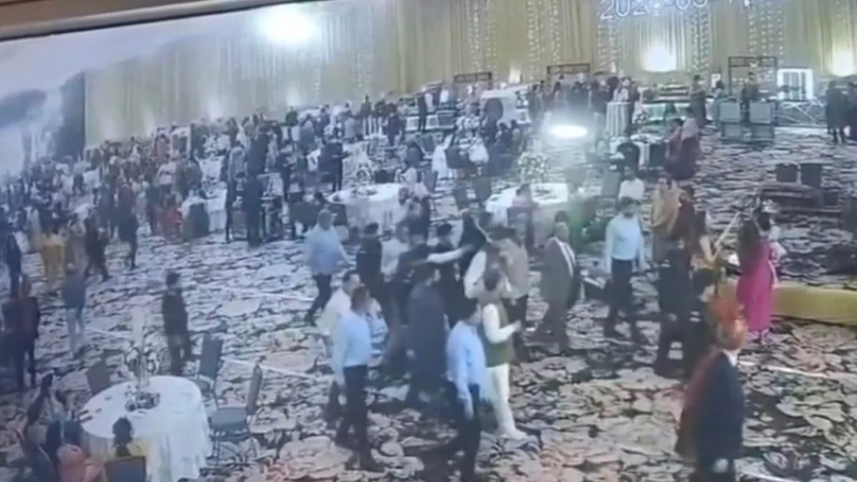
The shocking episode unfolded in the bustling Greater Kailash locality of Jammu, transforming what was meant to be a joyous celebration into a moment of panic and national attention.
A Celebration Turned Into Chaos
The incident occurred at a wedding ceremony attended by several prominent figures from the political and legal community. The event was hosted to celebrate the marriage of a local lawyer’s son, drawing guests from across Jammu’s social and political circles.
Among the attendees were senior leaders, including the Deputy Chief Minister of Jammu & Kashmir, Surinder Choudhary, along with several members of the region’s political elite.
For many guests, the evening had begun as a typical wedding celebration — filled with music, conversation, and ceremonial rituals. Abdullah arrived amid warm greetings and informal interactions, as is common in Kashmir’s close-knit political and social culture.
But within moments, the atmosphere changed dramatically.
According to witnesses, the accused approached Abdullah in what appeared to be a routine interaction. Suddenly, he pulled out a firearm and attempted to shoot the veteran leader at close range.
Panic erupted instantly.
Guests scrambled for safety, and security personnel rushed toward the attacker.
Within seconds, Abdullah’s security detail neutralized the threat, preventing the gunman from firing additional shots.
The quick reaction likely saved lives.
Swift Security Response Prevents Tragedy
Security personnel assigned to protect Abdullah acted with remarkable speed.
According to preliminary reports from local law enforcement, the attacker was immediately subdued by security staff before he could carry out further violence.
The suspect was restrained and handed over to police officers stationed nearby.
Investigators say the rapid intervention prevented what could have become a catastrophic incident involving dozens of civilians present at the wedding.
Senior police officials later confirmed that Abdullah was unharmed and safely escorted from the venue.
Witnesses described scenes of confusion and fear immediately after the incident.
Many guests reportedly rushed toward exits while others took shelter behind tables and structures within the venue.
Despite the chaos, the situation was quickly brought under control.
Authorities soon cordoned off the area and began preliminary questioning of witnesses.
Who Is Kamal Singh Jamwal?
Police have identified the suspect as Kamal Singh Jamwal, a resident of the Purani Mandi area in Jammu.
Initial investigation suggests that Jamwal had harbored resentment toward Abdullah for nearly two decades.
Officials have not yet publicly detailed the exact nature of this hostility, but investigators believe it may stem from long-standing political or personal grievances.
There are also reports indicating that the suspect may have been under the influence of alcohol at the time of the attack.
Authorities are currently verifying this claim through medical testing and forensic analysis.
Police are also examining Jamwal’s background, communications, and social connections to determine whether he acted alone or had accomplices.
While early indications suggest a lone attacker, investigators are leaving no possibility unexplored.
A Veteran Leader Targeted Once Again
For Farooq Abdullah, this is not the first time he has faced threats to his life.
One of the most recognizable political figures in Jammu & Kashmir, Abdullah has been at the center of the region’s turbulent political landscape for decades.
Born into one of Kashmir’s most influential political families, he is the son of legendary leader Sheikh Abdullah.
Farooq Abdullah served multiple terms as Chief Minister of Jammu & Kashmir and remains a central figure in the Jammu & Kashmir National Conference.
Over the years, his outspoken political stance and role in the region’s governance have made him both a powerful leader and a frequent target of hostility.
Even in his late eighties, Abdullah continues to play an active role in politics, often commenting on national and regional issues.
His survival in the latest attack adds yet another chapter to a long history of political danger in the region.
Security Questions Raised
The attempted assassination has raised serious questions about security arrangements for high-profile leaders in Jammu & Kashmir.
Despite being under official security protection, the attacker was able to get close enough to fire at Abdullah.
Security experts say this reflects a recurring challenge: protecting leaders during informal or social events.
Political rallies and official meetings typically have controlled security perimeters.
Private events, however, often involve mixed guest lists, open access areas, and unpredictable environments.
In such situations, even the most experienced security teams face significant challenges.
The Jammu wedding incident highlights the vulnerability of public figures when attending social gatherings.
Authorities are now reviewing security protocols to determine whether additional measures are necessary.
Political Reactions Across Jammu & Kashmir
News of the attack spread rapidly across political circles in India.
Leaders from multiple parties condemned the incident and called for a thorough investigation.
Members of the National Conference expressed shock and relief that Abdullah escaped unharmed.
Several political leaders described the attack as an alarming reminder of the dangers faced by public figures in the region.
Security agencies have also taken note.
Officials have indicated that protective measures for prominent leaders may be reassessed in the wake of the incident.
A Long History of Political Violence in Kashmir
The attempted assassination also highlights the long and troubled history of political violence in Jammu & Kashmir.
For decades, the region has experienced insurgency, militancy, and targeted attacks on political figures, journalists, and civil society leaders.
Throughout the 1990s and early 2000s, several politicians were targeted by militant groups.
Some survived.
Others were not as fortunate.
One of the most notable victims was Abdul Gani Lone, who was shot dead during a rally in Srinagar in 2002.
Another high-profile killing occurred in 2018 when journalist Shujaat Bukhari was gunned down outside his office in Srinagar.
These incidents underscore the persistent threat faced by influential voices in the region.
Timeline: Major Attacks on Political Figures in Jammu & Kashmir
1989 – Attack on Farooq Abdullah’s Convoy
Militants attacked Abdullah’s convoy in Srinagar during the early phase of insurgency. He survived.
1995 – Killing of Ghulam Nabi Lone
Minister Ghulam Nabi Lone was assassinated by militants in Srinagar.
2002 – Assassination of Abdul Gani Lone
Hurriyat leader Abdul Gani Lone was shot dead during a rally in Srinagar.
2003 – Attack on Mufti Mohammad Sayeed
Militants targeted the convoy of Mufti Mohammad Sayeed in Anantnag. He survived.
2005 – Rally Attack on Ghulam Nabi Azad
Militants opened fire at a rally addressed by Ghulam Nabi Azad in Anantnag.
2006 – Grenade Attack on Farooq Abdullah
Militants hurled grenades at a rally attended by Abdullah in Srinagar.
2018 – Killing of Shujaat Bukhari
Prominent journalist Shujaat Bukhari was assassinated outside his office.
2026 – Jammu Wedding Shooting
Gunman Kamal Singh Jamwal attempted to shoot Farooq Abdullah during a wedding ceremony.
Understanding the Motive
One of the most critical questions investigators are now trying to answer is why the attack happened.
Authorities are exploring several possibilities.
These include:
-
Personal grievances against Abdullah
-
Political motivations
-
Influence of alcohol or emotional instability
-
Possible encouragement or support from external actors
Early reports suggest Jamwal had longstanding resentment toward Abdullah.
However, investigators stress that the motive remains unclear.
Police are analyzing phone records, digital activity, and past interactions of the accused to determine whether the attack was planned in advance.
Security Implications for Political Leaders
The incident may lead to a broader review of security arrangements for political figures in Jammu & Kashmir.
Experts say that public appearances and social events represent some of the most challenging environments for security teams.
Leaders often interact freely with guests, supporters, and acquaintances.
This openness can create opportunities for attackers.
Authorities may now consider stricter screening protocols even for private events attended by high-profile figures.
Such measures could include:
-
Enhanced guest verification
-
Expanded security perimeters
-
Metal detectors and surveillance monitoring
-
Increased coordination between local police and personal security teams
The Symbolic Importance of Farooq Abdullah
Farooq Abdullah remains one of the most influential political personalities in Kashmir.
For decades, he has represented the political legacy of the National Conference and the Abdullah family.
His leadership has shaped the political trajectory of the region through periods of conflict, negotiation, and political transition.
Even today, his voice carries significant weight in debates about Kashmir’s future.
An attack on such a figure inevitably resonates far beyond the immediate incident.
It raises broader concerns about political stability and democratic safety in the region.
Public Safety and Civilian Risk
Another troubling aspect of the incident is the risk posed to civilians.
Wedding guests — many of whom had no security protection — were caught in the middle of the attack.
Events like weddings are typically crowded and emotionally charged environments.
If the attacker had fired multiple shots, the consequences could have been devastating.
Security experts say such incidents demonstrate the need for careful planning when high-profile individuals attend large gatherings.
A Narrow Escape That Raises Big Questions
Farooq Abdullah’s survival in the Jammu wedding shooting is widely viewed as a narrow escape.
Had security personnel reacted even a few seconds later, the outcome might have been dramatically different.
The incident now stands as a reminder of the fragile security environment surrounding political figures in conflict-prone regions.
While investigators continue to examine the motives and circumstances behind the attack, the broader implications are already clear.
Political leaders in Jammu & Kashmir remain vulnerable.
Ensuring their safety — while preserving public engagement and democratic openness — will remain one of the region’s most complex challenges.
Conclusion: A Stark Reminder for Kashmir’s Political Landscape
The attempted assassination of Farooq Abdullah at a wedding ceremony in Jammu has shaken political circles and revived memories of past violence in the region.
The arrest of Kamal Singh Jamwal has prevented the immediate threat, but many questions remain unanswered.
Was this the act of a lone individual driven by personal anger?
Or does it reflect deeper political tensions still simmering beneath the surface of Jammu & Kashmir’s complex political landscape?
Investigators will likely take weeks — perhaps months — to reach definitive conclusions.
For now, one fact stands out clearly.
A moment meant for celebration nearly turned into a tragedy that could have altered the course of Kashmir’s political history.
And once again, the region has been reminded that even decades after the peak of insurgency, the shadow of political violence has not completely disappeared.