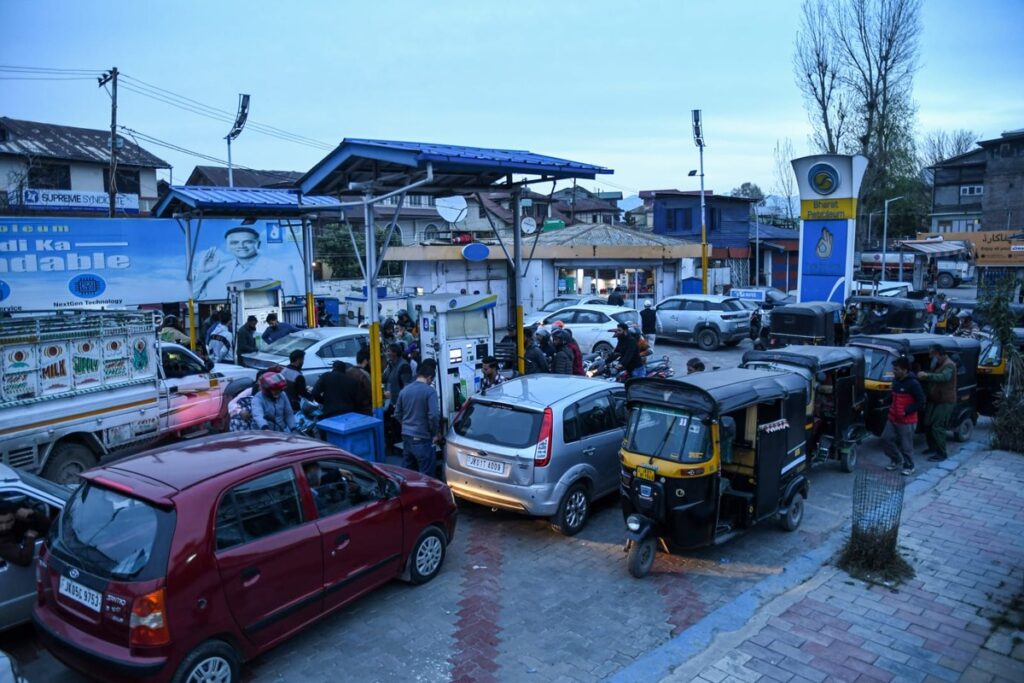
Panic at the Pumps: Rumors Trigger Fuel Buying Frenzy Across Srinagar and Kashmir Valley
By: Javid Amin | 25 March 2026
Fear Moves Faster Than Fuel
On an otherwise routine morning in Srinagar, an unusual sight unfolded—long, winding queues of vehicles stretching outside petrol pumps, tempers rising, and anxiety visible on faces. Within hours, similar scenes were reported across districts like Baramulla and Anantnag.
What triggered this sudden rush? Not an official announcement, not an actual shortage—but a wave of rumors.
Speculation about a possible lockdown, combined with fears linked to the escalating West Asia crisis, sparked widespread panic buying. The result: a temporary breakdown of normal fuel distribution despite authorities insisting that supplies remain stable.
What’s Happening on the Ground
Queues Everywhere: A Valley-Wide Rush
Across Kashmir, petrol pumps witnessed:
- Serpentine queues stretching hundreds of meters
- Waiting times running into hours
- Traffic congestion near fuel stations
In Srinagar, several pumps struggled to manage the surge, while in smaller towns, the situation became even more chaotic due to limited infrastructure.
Temporary Closures Add to Anxiety
Some fuel stations were forced to shut down temporarily—not because they ran out of fuel entirely, but because:
- Demand spiked far beyond daily capacity
- Supply cycles couldn’t keep pace with sudden consumption
- Staff were overwhelmed managing crowds
These closures, even if brief, further fueled panic, reinforcing the perception of scarcity.
The Trigger: Rumors and Social Media Amplification
The root cause lies in the rapid spread of unverified information:
- Messages about an “imminent lockdown” circulated widely
- Claims of “fuel shortages” linked to global tensions gained traction
- Social media acted as a multiplier, spreading fear faster than facts
In a region sensitive to disruptions, such rumors quickly translate into action.
The Global Backdrop: Why People Are Worried
West Asia Tensions and Oil Supply Fears
The anxiety is not entirely unfounded. The ongoing geopolitical tensions involving Iran, Israel, and the United States have raised concerns about global oil supply chains.
A critical chokepoint is the Strait of Hormuz, through which a significant portion of the world’s oil—and a large share of India’s imports—passes.
Any disruption here could:
- Increase global oil prices
- Affect fuel availability
- Trigger economic ripple effects
Even the perception of such risks is enough to influence consumer behavior.
India’s Dependence on Imported Oil
India imports roughly 85% of its crude oil, making it highly vulnerable to global shocks.
This structural dependence means:
- Global crises quickly translate into domestic concerns
- Consumers are highly sensitive to fuel-related news
- Panic buying can be triggered even without immediate shortages
Government Response: Reassurance and Monitoring
Authorities Urge Calm
Officials across Jammu and Kashmir have repeatedly clarified:
- Fuel stocks are adequate
- There is no official plan for a lockdown
- Supply chains remain intact
The key message: there is no need to panic.
Strict Monitoring of Fuel Stations
District administrations have stepped in to:
- Monitor petrol pump operations
- Prevent hoarding and black marketing
- Ensure fair distribution
Law enforcement agencies are also keeping an eye on any attempts to exploit the situation.
The Core Warning: Panic Buying Creates Shortages
Officials have emphasized a critical point:
It is not a lack of supply—but excessive demand—that is causing temporary disruptions.
In other words, the crisis is behavioral, not structural.
Impact Across Stakeholders
Residents: Anxiety and Disruption
For ordinary people:
- Long waiting hours disrupt daily schedules
- Fear of running out of fuel adds stress
- Commuters, especially workers, face uncertainty
Fuel Stations: Operational Strain
Petrol pump operators are dealing with:
- Sudden, unsustainable demand spikes
- Pressure from impatient customers
- Logistical challenges in replenishing stocks
Authorities: Managing Perception vs Reality
The administration faces a dual challenge:
- Ensuring actual supply remains uninterrupted
- Combating misinformation effectively
Businesses: Ripple Effects Begin
Transporters and logistics operators are already feeling the impact:
- Delivery delays due to long queues
- Increased operational costs
- Risk of supply chain disruptions if panic continues
Risks & Emerging Concerns
Supply Chain Pressure
Even with adequate reserves, panic buying can:
- Drain local inventories بسرعة
- Disrupt distribution schedules
- Create artificial shortages
Misinformation أزمة
The rapid spread of rumors highlights a growing issue:
- Social media-driven panic
- Lack of verified information channels
- Difficulty in controlling narrative
Spillover Beyond Kashmir
Reports of similar queues in states like Madhya Pradesh and Gujarat suggest a broader pattern:
- National-level anxiety linked to global events
- Herd behavior influencing consumption
Deeper Insight: The Psychology of Panic Buying
Why People Rush Even Without Shortage
Panic buying is driven by:
- Fear of uncertainty
- Desire for control
- Influence of collective behavior
When people see others rushing, they follow—creating a self-fulfilling cycle.
From Rumor to Reality: How Shortages Are Created
- Rumor spreads
- People rush to buy
- Demand spikes अचानक
- Supply systems get strained
- Temporary shortages appear
- Panic intensifies
This loop is exactly what Kashmir is witnessing right now.
What Happens Next? Possible Scenarios
If Panic Subsides
- Queues will normalize within days
- Supply chains will stabilize
- Confidence will return
If Panic Continues
- Repeated stock-outs at local pumps
- Rising black market risks
- Wider economic disruptions
What Authorities Need to Do Now
1. Strong Communication Strategy
- Frequent updates عبر official channels
- Real-time stock स्थिति disclosure
- Rumor debunking mechanisms
2. Strict Enforcement
- Action against hoarding
- Monitoring unusual buying patterns
- Ensuring fair distribution
3. Supply Chain Optimization
- Faster replenishment cycles
- Priority allocation to high-demand areas
- Coordination with oil companies
What Residents Should Do
- Avoid panic buying
- Rely on official updates
- Purchase only necessary quantities
Conclusion: A Crisis of Perception, Not Supply
The long queues outside petrol pumps in Srinagar and across Kashmir Valley are a classic example of how fear can outpace facts.
✔ Fuel stocks are adequate
✔ Supply chains are functioning
✔ No lockdown has been announced
Yet, the perception of scarcity has created real disruption.
Final Takeaway
This episode is not about fuel shortage—it is about trust, communication, and collective behavior.
If managed well, the situation will pass quickly. If not, panic itself could become the biggest disruptor.
In a globally connected world, local stability increasingly depends not just on supply chains—but on information chains.


