Tanvir Sadiq vs Sunil Sharma: J&K Statehood Debate Heats Up Ahead of Independence Day
By: News Desk | 15 Aug 2026
Independence Day Becomes New Flashpoint in J&K’s Statehood Debate
The political battle between the National Conference and the Bharatiya Janata Party in Jammu and Kashmir has acquired another layer, with Independence Day messaging becoming a point of confrontation over statehood, Article 370 and the region’s constitutional future.
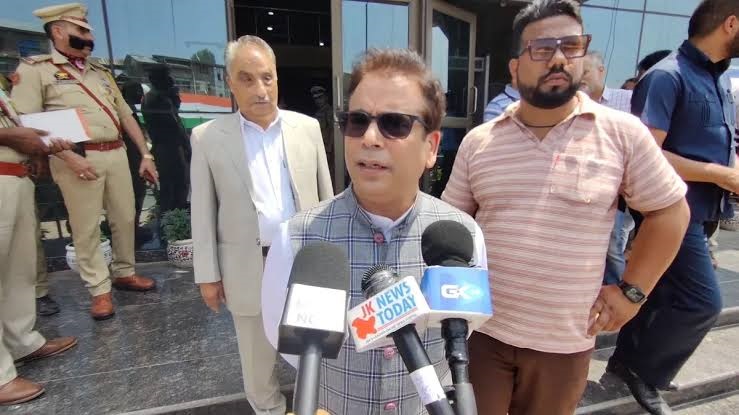
National Conference MLA Tanvir Sadiq has hit back at BJP Leader of Opposition Sunil Sharma over criticism surrounding political references made around Independence Day, asking a pointed question: “If not today, then when?”
The exchange reflects a much deeper disagreement.
For the BJP, Independence Day should primarily reinforce national unity, patriotism and the achievements of independent India.
For the National Conference, however, raising Jammu and Kashmir’s political status on such an occasion is presented as entirely legitimate—particularly when the party continues to campaign for restoration of statehood.
The argument is therefore not merely about one speech.
It is about what Independence Day should mean in today’s Jammu and Kashmir.
Why Sunil Sharma’s Criticism Matters
Sunil Sharma, the J&K BJP’s Leader of Opposition, has repeatedly positioned the BJP as a political counterweight to the National Conference government.
His criticism of political messaging around national occasions fits into a broader BJP argument: issues concerning Jammu and Kashmir’s constitutional history should not be allowed to overshadow the larger national identity represented by Independence Day.
From this perspective, August 15 is intended to be a moment of national unity.
The BJP’s argument is that speeches on such an occasion should concentrate on patriotism, development, national achievements and the sacrifices made during India’s freedom struggle rather than reopening politically divisive constitutional questions.
That position is particularly significant in Jammu and Kashmir, where Article 370 remains one of the most politically sensitive subjects of the past decade.
Tanvir Sadiq’s “If Not Today, Then When?” Counterattack
Tanvir Sadiq’s response represents the opposite political argument.
The National Conference has made restoration of Jammu and Kashmir’s statehood one of its principal political demands.
From the NC’s perspective, therefore, speaking about the region’s political status is not an attempt to undermine Independence Day.
It is part of its continuing democratic campaign.
The phrase “If not today, then when?” captures that argument in simple terms.
The NC’s position is essentially that Independence Day provides an opportunity to discuss not only India’s freedom from colonial rule but also the democratic aspirations of people living in Jammu and Kashmir.
This creates an unavoidable political question:
Can a national celebration and a regional political demand coexist in the same public speech?
The BJP says political restraint is necessary.
The NC says political concerns cannot simply be suspended because the calendar marks a national occasion.
Article 370 Remains the Unavoidable Background
The dispute cannot be understood without the events of August 2019.
The Union government revoked Jammu and Kashmir’s special constitutional status under Article 370 and reorganised the former state into the Union Territories of Jammu and Kashmir and Ladakh.
The BJP has consistently defended the decision as a major step toward integration, development and national unity.
The National Conference has opposed the move and continues to demand restoration of the region’s political status, particularly statehood.
The Supreme Court upheld the constitutional changes in December 2023 while directing that Assembly elections be held and statehood restored “at the earliest.” The Assembly elections were subsequently held in 2024, bringing the National Conference-led government to power.
That sequence is crucial to understanding today’s political argument.
The NC can point to the restoration of elected government as a democratic milestone while continuing to argue that full statehood remains unfinished business.
The BJP, meanwhile, can point to the post-2019 political and administrative changes as evidence of its broader integration agenda.
Why Statehood Has Become the Centre of J&K Politics
Statehood has gradually emerged as the most immediate constitutional demand of the National Conference government.
Omar Abdullah and the NC have repeatedly called on the Centre to restore Jammu and Kashmir’s statehood.
The issue is politically useful for the NC for another reason: it allows the party to frame its opposition to the BJP without simply returning every debate to the pre-2019 Article 370 framework.
The political message is increasingly:
Article 370 may remain a contested historical question, but restoration of statehood is a present-day demand.
That distinction has allowed the NC to build a campaign around an issue that can be presented as directly connected to democratic governance.
BJP and NC Are Fighting Over the Meaning of “Normalcy”
The dispute also exposes competing definitions of normalcy in Jammu and Kashmir.
The BJP’s political narrative stresses that the region has witnessed greater integration with the rest of India, improved connectivity, tourism growth and the strengthening of national institutions.
The NC’s argument is that political normalcy cannot be considered complete while Jammu and Kashmir remains a Union Territory.
For the ruling party, statehood is unfinished democratic restoration.
For the BJP, the emphasis is more likely to remain on development, security, integration and governance.
These competing definitions are now appearing in speeches, protests and public campaigns.
Why Independence Day Is Particularly Sensitive
Independence Day is one of India’s most politically charged national occasions.
The national flag, the national anthem, freedom fighters and the memory of India’s independence form the central themes of public celebrations.
At the same time, political leaders routinely use national-day speeches to discuss government performance, development, social challenges and public policy.
That creates room for disagreement over what constitutes legitimate political speech.
The BJP’s interpretation
The BJP’s position can be summarised as:
- Independence Day should emphasise national unity.
- Political divisions should not dominate the occasion.
- National celebrations should focus on India’s achievements.
- Constitutional disputes should be addressed in appropriate political forums.
The NC’s interpretation
The National Conference’s argument is different:
- Statehood is a democratic issue.
- Jammu and Kashmir’s political status directly affects its people.
- National occasions can provide a platform to discuss democratic aspirations.
- Asking for restoration of statehood is not inherently anti-national.
The clash between these positions explains why even a seemingly routine Independence Day speech can become politically explosive in J&K.
The Larger Omar Abdullah Factor
Chief Minister Omar Abdullah remains at the centre of the statehood debate.
His government was elected in 2024 after Jammu and Kashmir’s first Assembly election following the 2019 reorganisation.
That gives the NC a political argument it did not have during the period of direct central rule: an elected government is now formally asking for restoration of the status associated with a full state.
Omar Abdullah has repeatedly used this position to press the Centre.
For the BJP, however, the Chief Minister’s political messaging provides an opportunity to challenge what it sees as an attempt to keep constitutional grievances alive at the expense of governance.
That tension has increasingly shaped the political relationship between the ruling NC and the BJP opposition.
Tanvir Sadiq’s Role in the Political Counterattack
Tanvir Sadiq has emerged as one of the National Conference’s prominent political voices, particularly on issues involving the BJP and the constitutional debate.
His response to Sharma is therefore significant beyond the immediate exchange.
It reinforces the NC’s broader strategy of refusing to allow statehood to disappear from public debate.
The message is straightforward:
If statehood is genuinely a democratic demand, the NC argues, there is no reason to stop talking about it simply because the country is celebrating Independence Day.
That argument is likely to resonate strongly with the party’s core supporters.
But it also gives the BJP an opportunity to accuse the NC of politicising a national occasion.
And that is precisely where the political contest becomes sharper.
The Political Battle Is No Longer Only About Article 370
One of the most important developments in J&K politics is the gradual shift in the language of confrontation.
Immediately after the 2019 changes, much of the political debate revolved around Article 370 and special status.
Today, the political vocabulary has expanded.
It includes:
- restoration of statehood;
- constitutional safeguards;
- democratic representation;
- governance;
- employment;
- development;
- security;
- investment;
- national integration.
This makes the BJP-NC contest broader and potentially more consequential.
The BJP wants voters to judge the government on performance.
The NC wants voters to continue viewing statehood as an unfinished democratic commitment.
What the Dispute Means for J&K Politics
The latest exchange illustrates how deeply political the statehood issue remains.
1. Statehood will remain central
The NC has little incentive to abandon an issue that provides a clear political distinction between itself and the BJP.
2. BJP will continue to challenge the NC’s framing
The BJP is likely to argue that development and governance should receive greater attention than constitutional confrontation.
3. Independence Day speeches will face greater scrutiny
In Jammu and Kashmir, remarks made from official platforms are likely to be examined for political messaging, particularly when they involve Article 370, statehood or the Centre-state relationship.
4. The debate could influence future elections
Political parties are already building narratives that could eventually become electoral themes.
For the NC, the message is about restoring political status.
For the BJP, the message is about protecting national integration while challenging the ruling party’s governance record.
A Delicate Question: Politics or Democratic Expression?
There is a legitimate distinction between partisan campaigning and political expression by an elected government.
An Independence Day address delivered by a Chief Minister is not simply a party speech.
It is an official public address.
That places a higher expectation on the speaker to represent the entire population.
At the same time, elected leaders routinely use such platforms to discuss governance, public policy and challenges facing citizens.
The real question is therefore not whether politics should ever appear in an Independence Day speech.
It is how far political messaging should go before it begins to undermine the unifying purpose of the occasion.
That boundary is particularly difficult to define in Jammu and Kashmir.
The BJP-NC Conflict Is Likely to Continue Beyond August 15
Even if the immediate controversy fades after Independence Day, the underlying political disagreement will remain.
The National Conference will continue pressing for statehood.
The BJP will continue challenging the NC over governance and development.
Both parties will seek to strengthen their grassroots organisations.
And every major public event will provide another opportunity to communicate their competing political narratives.
That means the latest dispute should be viewed as part of a much larger political contest rather than an isolated exchange.
Conclusion: Independence Day Is Celebrated Nationally, But Politics Remains Local
The clash between Tanvir Sadiq and Sunil Sharma captures a larger contradiction in Jammu and Kashmir politics.
Independence Day is intended to represent a shared national identity.
But Jammu and Kashmir remains a region where questions of political status, constitutional history and democratic representation carry unusually deep significance.
For the BJP, national occasions should reinforce unity and move beyond old constitutional disputes.
For the National Conference, democratic demands such as statehood cannot simply be placed on hold because the country is observing a national celebration.
The argument will almost certainly continue.
And the most important question may not be whether politicians mention politics on Independence Day.
It may be which political narrative voters ultimately consider more relevant to Jammu and Kashmir’s future: the BJP’s emphasis on integration and development, or the NC’s demand for restoration of statehood and political status.
That debate is far from over.