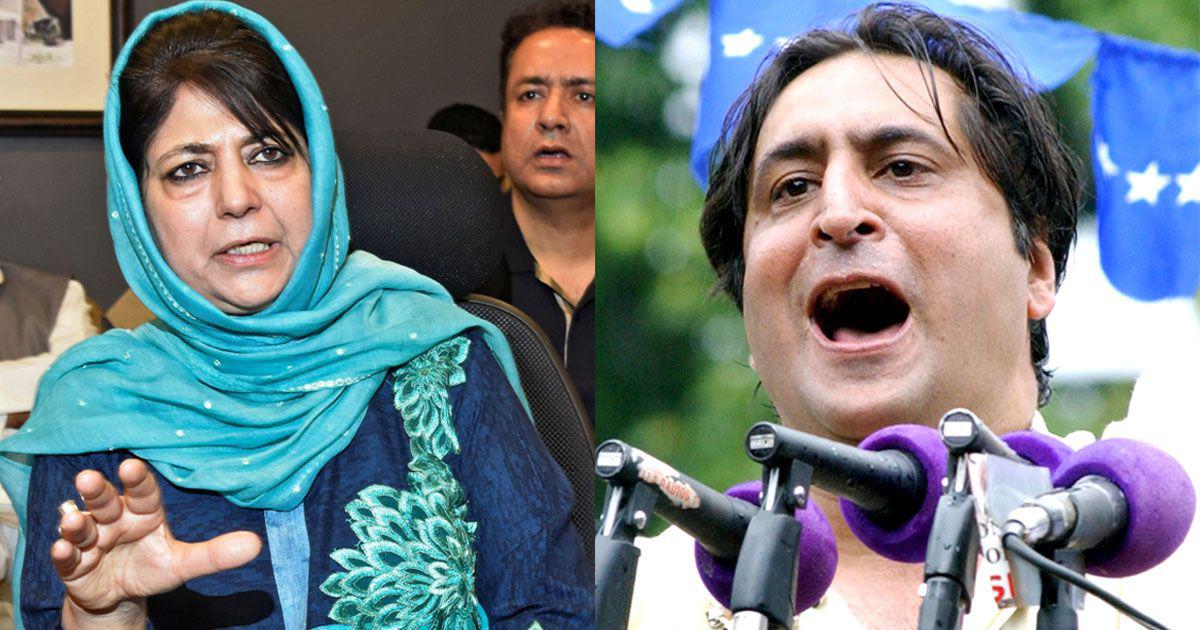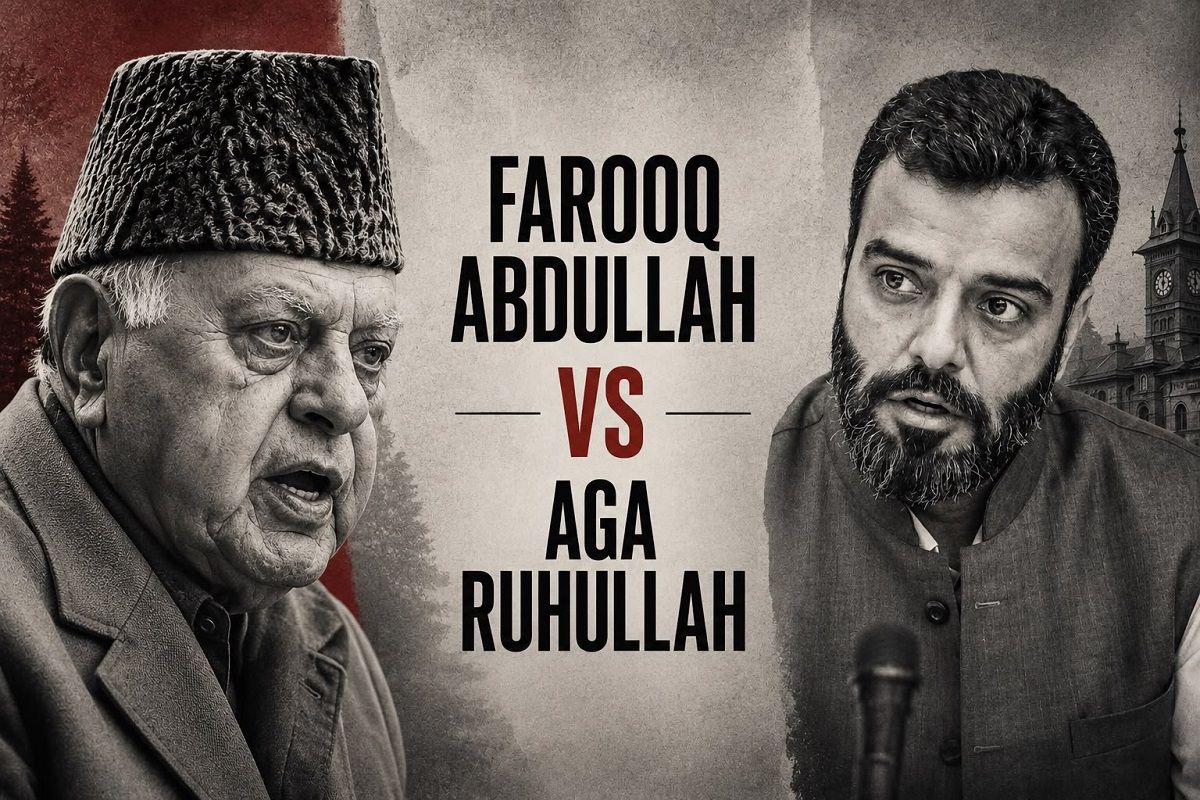
Aga Ruhullah vs Farooq Abdullah: NC Rift Deepens Over Article 370 and Resignation
By: Javid Amin | 28 August 2026
‘Resignation Will Come’ — But Ruhullah Wants the NC to Answer First
The internal dispute inside the Jammu and Kashmir National Conference has crossed another important line.
What began as Aga Syed Ruhullah Mehdi’s criticism of the party’s political strategy has now become a direct confrontation over accountability, the party’s manifesto, Article 370, political identity and the meaning of an electoral mandate.
On Friday, August 28, the Srinagar Lok Sabha MP said his resignation would come—even without Farooq Abdullah asking for it—but insisted that “before that must come accountability.” He said he had written to the NC president in response to Abdullah’s public demand that he resign and was awaiting answers to the questions raised in the letter.
The development is more consequential than another exchange between two NC leaders.
Because on the same day, multiple reports said Ruhullah has decided to resign both from the Lok Sabha and the primary membership of the National Conference in November, with November 3 reported as the date he intends to formally step down. NDTV separately reported that Ruhullah confirmed he would resign on November 3.
That means the question is no longer whether Ruhullah will eventually leave.
The question is now:
What political argument will he leave the NC with—and what happens to the party after he does?
The Letter Turns a Personal Clash Into an Ideological Trial
Farooq Abdullah’s earlier challenge was blunt: if Ruhullah believes the people voted for him personally, he should resign and seek a fresh mandate.
Ruhullah has effectively accepted the challenge.
But he has refused to let the resignation become a simple test of personal popularity.
Instead, he has turned the question back toward the party leadership.
His argument is that before he walks away, the NC must explain why it promised restoration of Article 370 and 35A in its 2024 manifesto if the party now appears to be treating statehood as the practical outer limit of its political demand.
That is the most damaging question in his letter because it does not concern only Ruhullah.
It concerns the credibility of the party itself.
The Question Ruhullah Is Putting to Farooq Abdullah
At the heart of his letter is a simple but politically uncomfortable question:
Were the NC’s 2024 promises genuine commitments—or promises the party knew it could not fulfil?
The distinction matters.
The NC’s 2024 Assembly-election manifesto explicitly said the party would strive to restore Article 370, Article 35A and statehood as they existed before August 5, 2019. The manifesto also spoke of redrawing the Jammu and Kashmir Reorganisation Act and the related Union Territory rules in the interim.
So Ruhullah is not inventing the party’s earlier position.
That is an important fact.
His disagreement is about what happened after the election.
He believes the party’s political horizon has narrowed from restoration of the constitutional arrangement to the restoration of statehood.
The NC leadership can argue that it continues to support Article 370 restoration while prioritising the achievable political demand of statehood.
Ruhullah’s counterargument is much sharper:
If the party publicly promised both, why should one now be treated as a substitute for the other?
That is the ideological fault line.
The 2024 Manifesto Gives Ruhullah a Stronger Case
This is where the dispute deserves more scrutiny than the usual “Ruhullah rebels against Omar” framing.
The documentary record does support part of Ruhullah’s argument.
The NC manifesto was not limited to statehood.
It explicitly promised to strive for restoration of 370, 35A and statehood to the pre-August 5, 2019 position.
The party therefore cannot credibly claim that Article 370 was never part of its electoral platform.
But that does not automatically establish Ruhullah’s larger allegation that the party has “betrayed” its voters.
That remains a political judgment.
The NC could argue that political parties routinely pursue long-term objectives while prioritising immediate constitutional and administrative reforms that are currently attainable.
Ruhullah rejects that logic.
For him, accepting statehood as the political ceiling risks making the August 2019 changes appear permanent.
That is why he describes the shift as more than tactical compromise.
He sees it as a question of political principle.
Ruhullah’s Sharpest Charge: Don’t Reduce Kashmir’s Demands to What BJP Will Give
One of the strongest themes running through the letter is Ruhullah’s rejection of what he sees as a politics of concession.
He argues that elected representatives should not restrict their demands to the maximum that the BJP or the Union government is prepared to concede.
Instead, he says the political horizon should be determined by the constitutional rights and aspirations the party claims to represent.
That argument has considerable political resonance in the Valley.
It also exposes the fundamental difference between negotiation politics and principled opposition politics.
A governing party must calculate what can actually be achieved.
A dissenter can ask what should be demanded regardless of political feasibility.
Ruhullah is increasingly choosing the second position.
The Farooq Abdullah Contradiction Ruhullah Wants Explained
Perhaps the most pointed section of the letter concerns Farooq Abdullah’s own political history.
Ruhullah reminds him that Abdullah was Chief Minister when the Jammu and Kashmir Assembly passed the Autonomy Resolution in 2000.
That resolution sought restoration of the constitutional position that existed before 1953.
The Union government under Prime Minister Atal Bihari Vajpayee rejected it.
Ruhullah’s question is therefore essentially:
If demanding greater constitutional autonomy was once a legitimate NC position, why has demanding constitutional guarantees now become grounds for asking an NC parliamentarian to resign?
This is not an insignificant historical reference.
It is an attempt to place Farooq Abdullah’s present position against his own political record.
The argument is powerful because Ruhullah is not accusing an ideological opponent.
He is asking the NC patriarch to explain an apparent change in political standards.
Farooq’s Own Words Have Come Back to Haunt the Debate
The confrontation also contains an intriguing rhetorical reversal.
Farooq recently spoke about Kashmiris needing to stand on their own feet rather than remain dependent.
Ruhullah says those words resonated with him.
But then he asks:
Why object when I raise the same question about political dependence and constitutional rights?
It is a clever political response.
Ruhullah is effectively taking Farooq’s own language and turning it against the leadership.
If standing on one’s feet is a virtue, he argues, then demanding stronger constitutional protections should not be treated as disloyalty.
The ‘Who Were You Before NC?’ Remark Opens Another Wound
The dispute has also become personal.
Farooq Abdullah reportedly questioned Ruhullah’s political standing before he joined the National Conference.
Ruhullah’s response was unusually emotional.
He described himself as the “proud son of a martyr” and an inheritor of a political tradition marked by sacrifice.
He also reminded Farooq that Abdullah himself had personally invited him into the National Conference.
That exchange reveals how far the relationship has deteriorated.
This is no longer only about Article 370.
It is also about who has the right to define Ruhullah’s political legitimacy.
Farooq’s argument is rooted in the NC organisation and its historic legacy.
Ruhullah’s answer is rooted in his family history, personal political identity and electoral mandate.
The two are now competing sources of legitimacy.
Ruhullah Is Not Simply Rejecting the NC’s History
That distinction is important.
Ruhullah’s letter does not read like an attack on the entire National Conference tradition.
In fact, it repeatedly invokes that tradition.
His argument is that the party has moved away from some of its own historic commitments.
That is why the rebellion is more dangerous for the NC than an attack from outside.
An outsider can be dismissed.
A senior leader who says “I am defending what you used to stand for” is much harder to neutralise.
The Youth Argument Needs a Fact Check
Ruhullah also invokes unemployment, the future of young people, resource issues, cultural concerns and environmental pressures.
Those are legitimate political subjects.
But one numerical claim in the supplied summary requires correction.
The statement that “nearly 65% of J&K’s population is young” should not be presented as a verified J&K-specific demographic statistic.
The approximately 65% figure currently being cited publicly refers to India’s population below the age of 35, including a recent statement by J&K Lieutenant Governor Manoj Sinha.
That does not weaken Ruhullah’s broader political argument about youth.
Jammu and Kashmir clearly has a substantial young population and youth unemployment remains an important political concern.
But an investigative article should distinguish between a national demographic statistic and a J&K-specific figure.
The Unemployment Question Is More Than a Political Slogan
Ruhullah’s decision to link constitutional politics with employment and economic opportunity is also significant.
It suggests that he does not want Article 370 to be treated merely as a historical or symbolic issue.
His argument is that constitutional protections are connected to:
- employment opportunities;
- land and resource rights;
- cultural identity;
- political representation;
- protection of local traditions;
- environmental resources.
Whether all of those outcomes can legally or economically be attributed to Article 370 is a separate question.
But politically, Ruhullah is making a broader argument:
Constitutional status determines the framework within which people believe their economic and cultural future is protected.
That is why the dispute resonates beyond constitutional lawyers and party workers.
The Biggest Political Question: Did the NC Change Course?
There is evidence of a difference in emphasis.
The 2024 NC manifesto explicitly included restoration of Article 370, 35A and statehood.
The party has since placed considerable political emphasis on restoration of statehood, which is also a demand that has broader political support and a different constitutional pathway.
Ruhullah interprets that change in emphasis as dilution.
The NC can interpret it as prioritisation.
Those are not the same thing.
And without a formal declaration from the party saying that Article 370 has been abandoned as an objective, it would be premature to describe the NC’s current position simply as “renouncing” its manifesto promise.
That distinction should remain central to responsible reporting.
The Supreme Court Has Changed the Constitutional Terrain
There is also a legal reality that complicates Ruhullah’s political argument.
In December 2023, the Supreme Court upheld the Union government’s 2019 decision relating to Article 370.
That does not prevent a political party from demanding a change in constitutional policy.
But it does mean that restoration is no longer simply a matter of reversing an executive action.
It would require a radically different political and constitutional pathway.
This is precisely why the NC may be choosing to emphasise statehood.
Statehood is a concrete constitutional and administrative demand that the Supreme Court itself said should be restored at the earliest.
Article 370 restoration is a fundamentally different proposition.
Ruhullah knows this.
His argument is that difficulty should not determine political principle.
The NC leadership appears more focused on what can be achieved within the present political system.
And Now Ruhullah Has Accepted Farooq’s Challenge
This may be the biggest development of August 28.
Farooq Abdullah’s challenge was straightforward:
If you believe the mandate is yours, resign and return to the people.
Ruhullah has now said he will do precisely that.
NDTV reported that he confirmed his intention to resign from the Lok Sabha on November 3, while also leaving the National Conference.
KNS separately reported that November 3 is the death anniversary of his father, Aga Syed Mehdi, giving the decision an intensely personal dimension.
This transforms a party dispute into a potentially extraordinary electoral contest.
November Could Become a Referendum on More Than Ruhullah
If Ruhullah resigns and a by-election follows, Srinagar could become the stage for a much larger political battle.
The question will not simply be:
Do voters support Aga Ruhullah?
It could become:
Do voters support the NC’s present political strategy or Ruhullah’s harder constitutional line?
That distinction could attract voters far beyond the usual NC support base.
A Ruhullah victory would strengthen his claim that his political legitimacy extends beyond the party organisation.
A defeat would give Farooq Abdullah powerful evidence that the NC’s organisational machinery—not Ruhullah personally—was central to the 2024 victory.
Either result would have consequences.
The November Date Is Symbolic, Too
The reported choice of November 3 is not merely procedural.
It is the 26th death anniversary of Ruhullah’s father, Aga Syed Mehdi, who was killed in a terrorist attack.
That makes the resignation potentially more than an administrative act.
It becomes a political statement tied to family history, sacrifice and identity.
For Ruhullah, that symbolism could reinforce his argument that his political journey predates his association with the NC.
For the party leadership, however, the crucial issue remains the same:
He was elected on the NC ticket.
That argument is unlikely to disappear.
What Happens to the NC After Ruhullah Leaves?
The consequences could unfold in several directions.
1. The NC could lose a prominent ideological dissenter
That may make internal discipline easier.
But it could also leave the party without a strong internal voice articulating the harder Article 370 position.
2. Ruhullah could create a new political space
He has not simply announced a resignation.
He has built a political argument around constitutional guarantees, youth, resources, dignity and accountability.
That gives him the ingredients for a broader political platform.
3. The BJP could exploit the rupture
The BJP can argue that the NC’s promises were internally contradictory and that its leaders cannot agree on their own political direction.
4. Other Valley parties could benefit
The PDP and other regional formations may find an opportunity to occupy the space created by an NC dissident campaigning explicitly around constitutional rights.
But Ruhullah Faces His Own Political Test
It would be easy to portray Ruhullah as the clear winner simply because he has accepted Farooq’s challenge.
That would be premature.
Leaving a major regional party is a significant political gamble.
The NC provides:
- organisational machinery;
- workers;
- a recognised election symbol;
- decades of political history;
- established networks across the Valley.
Ruhullah will have to demonstrate that his personal political credibility can survive without that infrastructure.
That is precisely what Farooq’s challenge was designed to test.
The Battle Is Now About Two Kinds of Loyalty
This may be the most revealing aspect of the entire confrontation.
Farooq Abdullah speaks about loyalty to the party and its historic political organisation.
Ruhullah speaks about loyalty to the people and their constitutional aspirations.
Neither side is willing to surrender the language of principle.
That is why the dispute has become so difficult to resolve.
For Farooq, public dissent by a sitting NC MP undermines organisational discipline.
For Ruhullah, silence in the face of what he sees as a political retreat would undermine his credibility with voters.
The two positions are increasingly incompatible.
The NC’s Accountability Problem
Ruhullah’s use of the word “accountability” may ultimately prove more politically important than his resignation itself.
Because he is asking questions the NC leadership cannot easily answer with a simple disciplinary statement:
Why was Article 370 in the manifesto?
Why was 35A included?
Why was pre-August 5, 2019 status promised?
Has that position changed?
If it has changed, when and why?
Is statehood now the party’s practical priority—or its ultimate political objective?
Those are legitimate political questions.
The party may disagree with Ruhullah’s interpretation.
But it will have to explain its own position clearly if it wants to prevent the dispute from becoming a referendum on broken promises.
This Is Bigger Than Omar Abdullah
The conflict is sometimes presented as a Ruhullah-Omar Abdullah feud.
That is no longer sufficient.
The latest exchange is directly between Ruhullah and Farooq Abdullah, the party president.
That changes the institutional significance of the dispute.
Omar remains central because he leads the government.
But Farooq represents the party organisation.
Ruhullah is now challenging both layers:
the government’s political strategy and the party’s ideological direction.
That makes reconciliation substantially harder.
What Could Still Prevent a Full Break?
There remains one narrow possibility.
If Farooq Abdullah answers Ruhullah’s questions substantively and the party clarifies that statehood is not a substitute for its constitutional position, some political space could theoretically reopen.
But the latest reporting suggests Ruhullah has already made a decision to leave in November.
At this point, reconciliation would require more than a private meeting.
It would require a political explanation capable of satisfying a leader who has made accountability itself the condition for his departure.
The Real Test Is Now With the Voters
This is where the NC’s internal battle becomes a democratic contest.
Farooq Abdullah has effectively said:
Let the people decide.
Ruhullah has accepted.
If he resigns and contests again, the voters will have an opportunity to answer a question that neither side can settle through press conferences:
Was Ruhullah’s 2024 mandate primarily an NC mandate, a personal mandate, or a combination of both?
No political analyst can answer that with certainty.
Only an election can provide a new piece of evidence.
And even then, the result will reflect the politics of 2026—not necessarily the reasons voters chose him in 2024.
Conclusion: The Resignation Is No Longer the Story—Accountability Is
Aga Syed Ruhullah Mehdi’s latest letter has changed the character of the NC crisis.
His message is no longer simply:
“I disagree with the leadership.”
It is:
“I will leave, but first the leadership must explain what happened to the commitments on which we sought the people’s mandate.”
That is a much more consequential challenge.
The NC’s 2024 manifesto did explicitly promise restoration of Article 370, 35A and statehood to the pre-August 5, 2019 position.
Ruhullah is now demanding to know whether that commitment remains the party’s political destination—or whether statehood has quietly become the endpoint.
Farooq Abdullah, meanwhile, has challenged him to take his case back to the electorate.
Ruhullah appears ready to accept.
If he follows through in November, the resulting contest could become one of the most revealing political tests in post-2019 Jammu and Kashmir: party organisation versus personal mandate, pragmatism versus principle, and statehood versus the larger constitutional question.
The most important line in Ruhullah’s letter may therefore not be the promise to resign.
It is the sentence that comes before it:
“Before that must come accountability.”
Because once that question has been placed before the public, the NC cannot resolve the controversy simply by asking one dissident to leave.
It has to answer what it stands for.
And, perhaps more importantly, what it told voters it stood for when it asked for their votes in 2024.