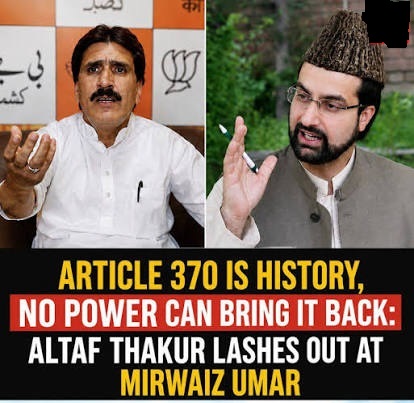
Article 370 Row Intensifies in Kashmir: BJP Says ‘Statehood Will Return, But 370 Will Not’ After Mirwaiz’s Appeal
By: Javid Amin | 30 August 2026
Srinagar: The political debate over Jammu and Kashmir’s constitutional future has taken a fresh turn after Kashmir’s chief cleric Mirwaiz Umar Farooq urged political parties to unite for the restoration of Article 370 and statehood, prompting a sharp response from the Jammu and Kashmir unit of the Bharatiya Janata Party.
BJP spokesperson Altaf Thakur rejected the possibility of restoring Article 370, saying there was “no question” of bringing the provision back. He argued that Parliament’s 2019 decision had fundamentally changed Jammu and Kashmir’s constitutional position and was subsequently upheld by the Supreme Court. At the same time, the BJP maintained that Jammu and Kashmir’s statehood would be restored at an appropriate time.
The exchange is more than another round of political rhetoric. It exposes a widening divide over what the next chapter of Jammu and Kashmir’s politics should look like: statehood without Article 370, or statehood accompanied by a renewed demand for constitutional safeguards?
That distinction is becoming increasingly important as the region’s mainstream political parties struggle to define what they want after the 2019 constitutional changes.
Mirwaiz Umar Farooq Revives Article 370 Debate
Mirwaiz Umar Farooq reignited the issue on August 29 when he called on political parties and organisations in Jammu and Kashmir to collectively raise their voice for the restoration of Article 370, statehood and what he described as the constitutional rights and guarantees of the people.
Speaking to reporters, Mirwaiz argued that political parties had a responsibility to stand up for these demands and honour commitments made to voters. He also criticised the reduction of Jammu and Kashmir from a state to a Union Territory following the 2019 reorganisation.
His intervention came at a politically sensitive moment.
The question of Article 370 is no longer confined to the traditional separatist-versus-New Delhi debate. It has increasingly become entangled with the internal politics of the National Conference, the demand for statehood, the promises made during the 2024 Assembly elections and the question of how much constitutional autonomy mainstream Kashmiri parties are still prepared to demand.
Mirwaiz’s latest remarks therefore landed in an already heated political environment.
BJP’s Sharp Reply: ‘Article 370 Is Not Coming Back’
The response from the J&K BJP was immediate and unequivocal.
BJP spokesperson Altaf Thakur said Mirwaiz should understand that Article 370 would not return. He described the 2019 parliamentary decision as a historic constitutional step and said no political party, leader or pressure group could reverse what he called the new constitutional reality.
Thakur also accused Mirwaiz of attempting to reopen an issue that, in the BJP’s view, had already been constitutionally settled.
The BJP’s political message can be reduced to a simple formulation:
Statehood may return. Article 370 will not.
That distinction is central to the party’s present position on Jammu and Kashmir.
For the BJP, restoration of statehood does not mean a return to the pre-August 2019 constitutional arrangement. Instead, statehood would take place within the constitutional framework established after the abrogation of Article 370 and the reorganisation of the erstwhile state.
What Happened to Article 370 in 2019?
To understand the current confrontation, it is important to separate political language from constitutional history.
On August 5, 2019, the Union government introduced a series of constitutional and legislative measures that effectively ended Jammu and Kashmir’s special constitutional status under Article 370. Parliament also passed the Jammu and Kashmir Reorganisation Act, which divided the erstwhile state into two Union Territories — Jammu and Kashmir, with a legislature, and Ladakh, without one.
The changes fundamentally altered the constitutional relationship between Jammu and Kashmir and the Union.
The issue subsequently reached the Supreme Court.
In December 2023, a five-judge Constitution Bench upheld the Union government’s action concerning Article 370. The court also directed that Assembly elections be held and said statehood should be restored at the earliest and as soon as possible.
This judicial ruling is an important part of the current political argument.
The BJP points to the Supreme Court judgment as confirmation of the constitutional validity of the 2019 changes. Critics of the post-2019 arrangement, meanwhile, continue to argue politically for restoring constitutional protections that existed before the changes.
That means the dispute has not disappeared simply because the legal challenge was decided.
It has moved into the political arena.
‘Parliament Buried Article 370’: What the BJP Actually Means
One phrase used by Altaf Thakur deserves particular attention.
He said Parliament had “buried Article 370 forever.”
The wording is politically forceful, but it should not be mistaken for the language of a court judgment.
The legally significant development is that the Supreme Court, in its December 2023 ruling, upheld the constitutional changes associated with the abrogation of Article 370.
The BJP’s statement therefore reflects its political interpretation of that legal position.
This distinction matters in responsible political reporting.
Saying that Article 370 is “buried forever” is a BJP assertion. Saying that the Supreme Court upheld the 2019 constitutional changes is a verifiable legal fact.
For readers trying to understand the issue rather than simply follow the political contest, the difference is significant.
Why Statehood and Article 370 Have Become Two Separate Political Questions
Perhaps the most interesting development in the latest debate is the growing separation between the demand for statehood and the demand for Article 370.
Jammu and Kashmir remains a Union Territory in August 2026, and restoration of statehood has become a major political demand of the elected government.
Chief Minister Omar Abdullah has repeatedly said his government will continue its efforts until statehood is restored.
The National Conference has also continued to campaign for statehood.
But within the party itself, a sharper disagreement has emerged over whether statehood is enough.
That disagreement has been highlighted by Srinagar Lok Sabha member Aga Syed Ruhullah Mehdi.
Aga Ruhullah’s Challenge Adds Another Layer to the Dispute
Ruhullah has questioned what he describes as a shift in the National Conference’s position.
The party’s 2024 Assembly election manifesto had promised restoration of Article 370 and 35A along with other constitutional safeguards. Ruhullah has now questioned why the party appears to be placing greater emphasis on statehood while the Article 370 demand has become less prominent in its current political campaign.
His criticism is politically significant because it comes from within the National Conference rather than from the BJP or a separatist platform.
Ruhullah has argued that the political aspirations of Jammu and Kashmir should not be limited to what the BJP-led government at the Centre is prepared to concede.
His confrontation with the party leadership has escalated rapidly, with reports indicating that he announced his intention to resign from Parliament and the National Conference after a public disagreement with party president Farooq Abdullah.
Mirwaiz’s decision to back Ruhullah has consequently given the controversy another dimension.
The Article 370 debate is now not merely BJP versus Mirwaiz.
It is also about what the National Conference promised, what it is demanding now and whether those two positions can coexist politically.
Omar Abdullah’s Position: Statehood First
Chief Minister Omar Abdullah has also faced questions over the relationship between statehood and Article 370.
In August, Abdullah argued that statehood has to come first. His explanation was rooted in the constitutional division of powers between the Union and a state government.
He has also expressed frustration over the delay in restoring statehood, saying the issue has cost him political credibility and warning that continued delay could deepen public disappointment.
This position is subtly different from the BJP’s.
The BJP says:
Statehood can return, but Article 370 cannot.
The National Conference government says:
Statehood must be restored, and the political struggle over constitutional rights remains part of the broader question.
And figures such as Ruhullah and Mirwaiz are pushing the argument further by insisting that restoration of statehood should not become a substitute for the demand for constitutional safeguards.
That is where the political fault line is developing.
Why Mirwaiz’s Intervention Matters
Mirwaiz Umar Farooq occupies a unique place in Kashmir’s political and religious landscape.
His statements have historically carried significance beyond conventional party politics because he combines the role of chief cleric at Srinagar’s historic Jamia Masjid with a long-standing political role in the Hurriyat ecosystem.
His latest intervention is notable for another reason: he did not simply criticise the government.
He appealed to political parties to unite.
That puts pressure on mainstream parties that have been attempting to navigate a narrower political space since 2019.
The demand for Article 370 restoration remains politically sensitive, but it has not disappeared from Kashmir’s political discourse. Mirwaiz’s August 2026 remarks demonstrate that the issue still has symbolic and political resonance seven years after the constitutional changes.
BJP’s ‘Peace and Development’ Narrative
The BJP’s response also reveals how it wants the political conversation framed.
Rather than debating the merits of restoring Article 370, the party is attempting to shift the conversation towards development, governance, stability and what it describes as the post-2019 transformation of Jammu and Kashmir.
Thakur argued that statements seeking restoration of Article 370 risk reopening the politics of the past and disturbing the comparatively peaceful atmosphere that has emerged in the Valley after years of violence.
This is consistent with the BJP’s broader political narrative since 2019:
- constitutional integration is presented as irreversible;
- development and investment are emphasised;
- terrorism and separatist politics are framed as belonging to the past;
- statehood is treated as a separate administrative and political question;
- Article 370 restoration is rejected.
For the BJP, accepting a political debate over restoring Article 370 could weaken one of the central arguments it has made about the 2019 decision.
But the Article 370 Question Has Not Disappeared
There is an important distinction between legal finality and political disappearance.
The Supreme Court’s judgment settled the constitutional challenge before it. But a court ruling does not necessarily erase a political demand from public discourse.
That is particularly true in Jammu and Kashmir, where constitutional identity has been tied for decades to questions of autonomy, federalism, representation and relations between the Union and the region.
The latest statements from Mirwaiz, Ruhullah, Omar Abdullah and the BJP demonstrate precisely this contradiction.
The legal position is relatively clear.
The political argument is not.
Statehood Has Become the More Immediate Political Battle
While Article 370 dominates headlines, statehood may be the more immediate political question for the elected government.
Omar Abdullah has repeatedly said his administration will continue pressing the Centre until Jammu and Kashmir’s statehood is restored.
Farooq Abdullah has similarly argued that statehood is important for democracy, federalism and public confidence in elected institutions.
The demand has also received attention from the Congress, which has called for restoration of full statehood.
In other words, there is a broad political consensus that statehood should return, although the parties disagree over timing, strategy and what constitutional safeguards should accompany it.
That is an important difference from the Article 370 question, where the political divide remains considerably sharper.
The Real Political Battle: What Comes After 2019?
The deeper question emerging from the latest controversy is not simply whether Article 370 can return.
It is:
What political settlement does Jammu and Kashmir’s elected leadership want after 2019?
Three broad positions are increasingly visible.
1. The BJP’s position
The constitutional changes of 2019 are final. Article 370 will not return, while statehood can eventually be restored.
2. The mainstream statehood position
Statehood should be restored as promised, with the elected government receiving the powers normally associated with a state.
3. The restorationist position
Statehood alone is insufficient. Jammu and Kashmir should also seek restoration of constitutional safeguards associated with the pre-2019 arrangement.
Mirwaiz and Ruhullah’s recent interventions have strengthened the visibility of the third position.
The National Conference leadership, meanwhile, appears to be concentrating more heavily on statehood as the immediate political objective.
That difference could become increasingly important ahead of future electoral contests.
What Does This Mean for Kashmir Politics?
The latest confrontation reveals at least four important political trends.
First, Article 370 remains politically alive
Seven years after its abrogation, the issue continues to generate statements, protests, internal party disputes and competing political narratives.
Second, statehood has emerged as the common political denominator
Even parties that strongly disagree over Article 370 increasingly acknowledge the importance of restoring statehood.
Third, the National Conference faces an internal ideological test
The dispute involving Aga Ruhullah raises a difficult question for the party: how does it reconcile its 2024 manifesto commitments with its present emphasis on statehood?
Fourth, the BJP is drawing a hard constitutional red line
The party’s latest response leaves little room for ambiguity: it is willing to discuss statehood, but not restoration of Article 370.
The Bigger Question: Can Kashmir Move Beyond the 2019 Fault Line?
For policymakers, political parties and ordinary citizens, the challenge is no longer simply to repeat competing positions.
The harder task is to determine what comes next.
Jammu and Kashmir has an elected government, an Assembly and an active political system, but it remains a Union Territory. The Supreme Court’s 2023 judgment upheld the constitutional changes while also directing that statehood be restored at the earliest and as soon as possible.
The continued delay has therefore become a political issue in its own right.
At the same time, Article 370 remains a powerful symbol for sections of Kashmiri society and political leadership.
For the BJP, revisiting it risks reopening a constitutional settlement that it regards as complete.
For its critics, refusing to discuss it amounts to closing off a legitimate political aspiration.
And for the National Conference, the challenge is particularly delicate: it must balance the immediate practical demand for statehood with the broader constitutional expectations reflected in its electoral promises.
Conclusion: Statehood May Unite Kashmir Politics, But Article 370 Still Divides It
The latest BJP-Mirwaiz confrontation is therefore unlikely to be the final word on Article 370.
The BJP has made its position unmistakable: statehood may return, but Article 370 will not. Mirwaiz, meanwhile, is calling on political parties to continue pressing for both. Within the National Conference, the disagreement has become even more complicated, with Aga Ruhullah challenging what he sees as a dilution of the party’s earlier position.
The legal landscape created by the Supreme Court’s 2023 verdict is clear, but Kashmir’s political conversation remains unsettled.
That is perhaps the most important takeaway.
Article 370 may have been removed from the constitutional framework, but it has not disappeared from Kashmir’s political imagination.
As the debate moves forward, the more consequential question may be whether Jammu and Kashmir can build a political consensus around statehood, democratic authority and constitutional confidence — even while the disagreement over Article 370 remains unresolved.
For now, the message from the BJP is unequivocal, while the response from Mirwaiz and sections of Kashmir’s political class suggests that the debate is far from over.


