Srinagar’s Clean-Air Slide: From 4th in 2023 to 26th in 2026 — What Went Wrong?
By: News Desk | 12 September 2026
From national clean-air success to a warning signal
Srinagar once appeared to be moving in the right direction on urban air management.
In the Swachh Vayu Sarvekshan 2023, the city finished fourth among Indian cities with populations above 10 lakh, scoring 184.6 points. It was placed behind Indore, Agra and Thane and was presented as an example of progress under the National Clean Air Programme (NCAP).
Three years later, the picture looks considerably less encouraging.
In the Swachh Vayu Sarvekshan 2026, Srinagar has fallen to 26th position, with a score of 162.6 points. The city had already slipped to 21st in 2025 with 169.2 points. In other words, Srinagar has lost 22 points compared with its 2023 score and another 6.6 points over the past year.
The numbers should not be read as proof that Srinagar suddenly has the 26th-worst air in India. The survey measures the performance of cities in implementing air-pollution control measures rather than simply ranking ambient AQI readings. Its assessment covers areas including road dust, vehicular emissions, solid and construction waste, industrial pollution and public-awareness measures.
But that distinction should not dilute the warning.
A falling clean-air management score means that Srinagar’s environmental governance is not maintaining the momentum that produced its fourth-place performance in 2023.
And that is a serious urban-policy concern.
The fall is real — but the meaning needs to be understood
The trajectory is revealing:
- 2023: 4th — 184.6 points
- 2025: 21st — 169.2 points
- 2026: 26th — 162.6 points
The 2024 position is difficult to use as a normal year-on-year comparison because Srinagar’s submitted data was not approved by the Air Quality Monitoring Committee, according to reporting based on the PRANA system.
This makes the 2023-to-2026 comparison particularly important.
Srinagar’s score has not merely fluctuated by a few positions. The city has experienced a substantial deterioration in its standing within the million-plus category.
At the same time, the ranking exposes an important misconception about air pollution.
Delhi, for example, finished 21st with 172 points, ahead of Srinagar, despite regularly experiencing extremely poor winter air. That is possible because Swachh Vayu Sarvekshan evaluates pollution-control action and implementation, rather than asking a single question: Which city has the cleanest air?
The lesson for Srinagar is therefore not simply that its air has become “26th worst”.
The more meaningful question is:
Why has the city’s ability to demonstrate and implement sustained pollution-control measures weakened?
Srinagar already knows what its major pollution pressures are
The city’s own air-quality management framework identifies several familiar problems.
The revised CPCB action plan for Srinagar identifies road dust, traffic load, poor road conditions, road construction and inadequate dust suppression as important contributors to particulate pollution. It calls for measures such as regular road cleaning, water spraying, black-topping and plantation to prevent the re-suspension of dust.
This is particularly important in a city undergoing rapid physical transformation.
Road widening, flyovers, excavation, building construction, demolition and movement of heavy vehicles can create a continuous stream of dust unless construction sites are properly enclosed and material is transported under controlled conditions.
The problem is not that Srinagar lacks an air-pollution action plan.
The problem is whether those measures are being implemented consistently, visibly and at sufficient scale.
Traffic is not a minor part of the problem
Srinagar’s traffic burden has increased alongside urban expansion.
Scientific research conducted across high-traffic locations including Dalgate, Jehangir Chowk, Parimpora and Pantha Chowk has documented substantial particulate concentrations, with pollution particularly severe during winter. The study found that particulate levels were highest during winter, when low temperatures, fog, atmospheric stagnation and shallow mixing conditions can trap pollutants close to the ground.
Another long-term study of an urban Himalayan site in Srinagar found annual PM10 and PM2.5 concentrations substantially above Indian ambient-air standards during the study period, with road-dust suspension, fossil-fuel combustion and biomass/coal burning among the important anthropogenic contributors. The valley’s topography and winter meteorology can further aggravate the accumulation of particulate matter.
This creates a difficult combination.
Srinagar does not need Delhi-sized pollution sources to experience serious particulate episodes. Its basin-like geography, winter inversion conditions, traffic, combustion and dust can combine to produce poor local air quality.
That makes prevention more important, not less.
Construction dust is becoming an urban-governance test
Walk through a rapidly expanding city and air pollution is not always visible as a smokestack.
Sometimes it is the fine dust rising behind a vehicle.
Sometimes it is soil deposited on a newly constructed road.
Sometimes it is uncovered construction material.
Sometimes it is demolition debris being transported without adequate containment.
Srinagar’s CPCB action plan specifically identifies construction activity and road dust as areas requiring intervention.
The policy challenge is therefore enforcement.
Dust-control rules mean little if construction sites are not regularly inspected, roads are not cleaned effectively, debris is not transported safely and violations do not produce meaningful consequences.
This is where a city’s clean-air strategy moves from paperwork to governance.
Waste management also matters
Solid-waste management is another component of the national clean-air framework.
The Centre’s NCAP specifically identifies waste and biomass burning, road dust, construction and demolition activities and vehicular emissions among the major thematic areas for city-level clean-air interventions.
For Srinagar, the connection between waste and air quality is straightforward.
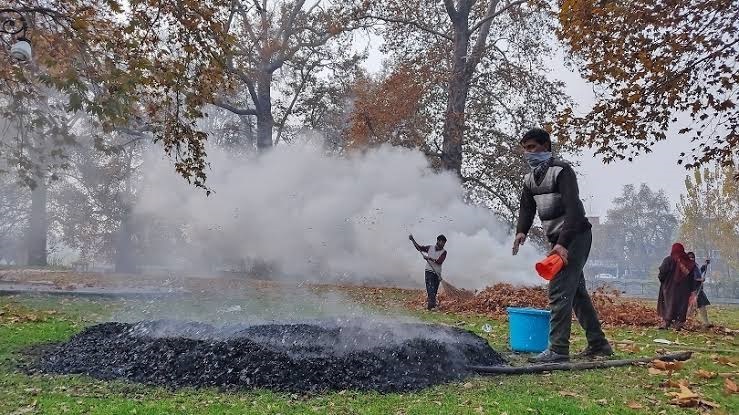
Poorly managed waste can create secondary environmental problems, while open burning can release particulate matter and toxic pollutants.
The objective, therefore, cannot simply be to remove garbage from visible roadsides.
A genuinely clean-air city needs a functioning chain covering collection, segregation, transportation, processing and disposal, combined with enforcement against open burning.
Yet the story is not entirely negative
There is an important counterpoint that should not be lost amid the ranking.
Government data reported in 2026 indicates that Srinagar’s PM10 levels have declined substantially from the NCAP baseline. A reported baseline of about 132 µg/m³ in 2018-19 was said to have fallen to around 81 µg/m³, representing a reduction of roughly 39 percent. The government also reported an average 2025 PM10 level of about 94.75 µg/m³.
This means the city’s environmental record cannot honestly be described as a complete failure.
There has been measurable progress.
The contradiction is more interesting — and more important.
Srinagar can improve pollution levels while simultaneously losing ground in the Swachh Vayu Sarvekshan.
That is because the survey is evaluating a broader package of interventions and implementation rather than measuring one pollutant at one monitoring station.
The falling ranking should therefore be treated as a governance warning rather than as proof that every aspect of Srinagar’s air has deteriorated.
The monitoring question cannot be ignored
A clean-air policy is only as good as the information available to policymakers.
Srinagar has continuous ambient air-quality monitoring infrastructure, including a station at Rajbagh, while the government has said additional monitoring capacity is being considered for the wider region. A source-apportionment study for Srinagar has also been underway to better establish where the city’s pollution originates.
This matters because policymakers need to know whether a particular intervention is actually working.
Is the biggest local problem traffic?
Road dust?
Construction?
Domestic heating?
Waste burning?
Industrial emissions?
Or some combination that changes according to season and location?
The answer cannot be based on perception alone.
Srinagar needs fine-grained, continuous and publicly accessible air-quality intelligence that allows authorities to identify pollution hotspots and measure whether interventions are reducing emissions.
Winter will be the real test
Srinagar’s clean-air challenge becomes more difficult during autumn and winter.
Research has repeatedly identified the colder months as periods when particulate pollution can rise sharply because atmospheric dispersion becomes weaker. Low wind speeds, temperature inversions, fog and the valley’s physical geography can trap pollutants close to the surface.
That means an annual ranking should not encourage complacency during the cleaner months.
A city may appear relatively comfortable during spring and summer and still face serious particulate episodes once winter arrives.
The administration therefore needs to prepare before the pollution season rather than reacting after AQI deteriorates.
That means inspecting construction sites, controlling road dust, enforcing vehicle-emission standards, monitoring waste burning and ensuring heating-related emissions are addressed before winter sets in.
Tourism makes the issue more than an environmental question
For Srinagar, air quality is also an economic and reputational issue.
The city markets itself through its landscape — Dal Lake, gardens, mountains, waterways, clean vistas and a distinctive Himalayan environment.
That image depends upon environmental quality.
Tourists may not read an annual Swachh Vayu Sarvekshan report before booking a trip, but they notice haze, dust, traffic congestion, smoke and visibly degraded urban spaces.
More importantly, residents experience the problem every day.
Srinagar cannot aspire to become a globally competitive tourism city while treating environmental management as a secondary urban function.
Clean streets, clean water, clean air, efficient public transport and well-managed construction are interconnected components of the same urban experience.
The danger is not one bad ranking — it is a pattern of complacency
The biggest lesson from the fall from fourth to 26th is not that Srinagar has suddenly become an environmental disaster.
It is that earlier success cannot be treated as a permanent achievement.
The fourth-place ranking in 2023 demonstrated that Srinagar was capable of performing strongly within the national clean-air framework.
The subsequent decline raises the question of whether those measures were institutionalised deeply enough to survive changing priorities, expanding construction, rising traffic and increasing pressure on urban infrastructure.
Clean air is not achieved through a one-time campaign.
It requires year-round enforcement.
It requires data.
It requires inter-departmental coordination.
And, above all, it requires continuity.
What Srinagar needs now
The response should not be another short-lived cleanliness campaign.
Srinagar needs a measurable clean-air strategy built around several priorities.
1. Put road dust at the centre of urban management
Road cleaning, dust suppression, pothole repair, proper road shoulders and construction-site controls should be treated as air-pollution interventions, not merely road-maintenance activities.
2. Make construction compliance visible
Every major construction and demolition site should be required to demonstrate dust-control measures, covered transportation of debris and proper material storage.
3. Strengthen vehicle-emission enforcement
Pollution-under-control certification, visibly polluting vehicles and high-emission commercial fleets require consistent enforcement rather than periodic drives.
4. Expand public transport and cleaner mobility
Reducing dependence on private vehicles will ultimately be more sustainable than repeatedly attempting to manage congestion after it occurs.
5. Prevent open waste burning
Waste-burning enforcement should be combined with reliable collection and processing systems. Punishment alone cannot solve a waste-management failure.
6. Build a stronger monitoring network
Continuous monitoring should extend beyond a few locations so that pollution hotspots across the expanding urban area can be identified.
7. Publish performance openly
Citizens should be able to see how much money has been allocated, what projects have been completed, which targets have been achieved and where violations have been detected.
A clean-air programme becomes more credible when residents can measure its results.
Srinagar’s ranking should become a wake-up call
The journey from 4th in 2023 to 26th in 2026 is too significant to dismiss as an ordinary fluctuation.
But neither should it be exaggerated into a claim that Srinagar now has among India’s worst air quality.
The evidence tells a more complicated story.
There have been measurable improvements in some pollution indicators, but the city continues to face substantial particulate-pollution pressures from traffic, dust, combustion and urban activity. Its winter meteorology makes those pressures particularly difficult to manage.
The 2026 ranking should therefore be understood as a governance signal.
Srinagar has already shown that it can perform well.
The challenge now is to prove that clean-air management can become a permanent part of urban governance rather than a programme that peaks around awards and rankings.
For a city whose identity and economy are deeply tied to its natural environment, that is not simply an administrative target.
It is a question of what kind of Srinagar the next generation will inherit.