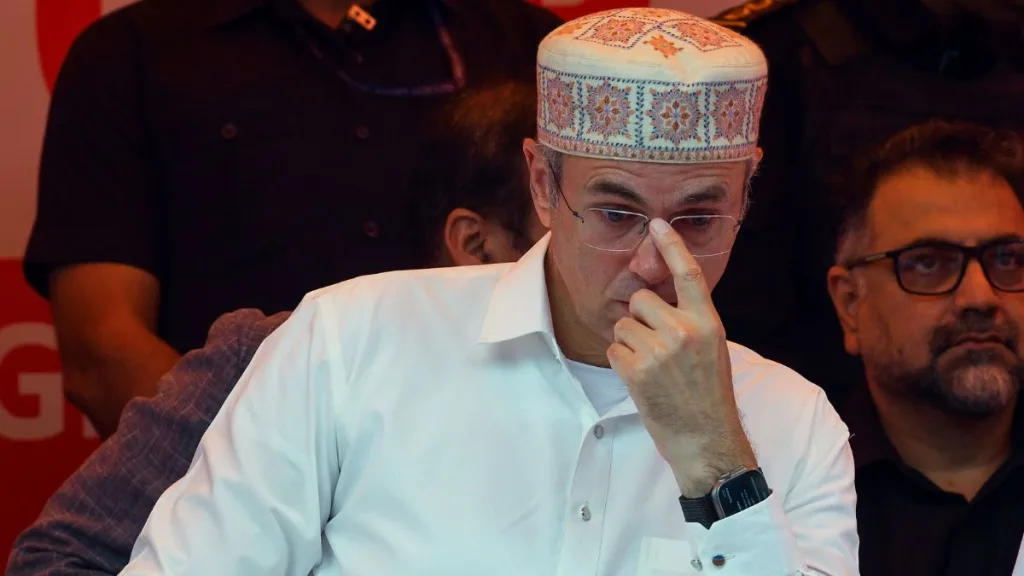
NC Crisis: Omar Abdullah Contains the Rebellion, but the Real Test Begins Now
By: Javid Amin | 06 November 2026
Farooq Abdullah’s intervention has eased tensions inside the National Conference, but assurances to unhappy legislators have yet to translate into concrete political or organisational changes
Srinagar: Omar Abdullah has managed to prevent an internal revolt from turning into an open confrontation within the National Conference (NC). But whether he has actually resolved the crisis is a different question.
The November 6 meeting between Chief Minister Omar Abdullah, NC president Farooq Abdullah and a group of unhappy party legislators ended with public assurances, a show of unity and a promise that their grievances would be addressed in phases. No breakaway faction was announced, no legislator publicly renewed an ultimatum, and the group emerged alongside the party leadership.
For the moment, that is a political reprieve for Omar Abdullah.
But the meeting did not produce a publicly announced cabinet reshuffle, the removal of Chief Minister’s adviser Nasir Aslam Wani, or any confirmed change in the distribution of portfolios. Nor did the leadership announce a time-bound settlement of every demand raised by the legislators.
The most accurate description of the outcome, therefore, is a negotiated pause rather than a permanent settlement.
Farooq Abdullah acknowledged that the legislators’ concerns were genuine and said some would be addressed immediately while others would be taken up gradually. That statement was significant because it recognised that the discontent was not simply a media-created controversy. At the same time, it stopped short of accepting the dissidents’ entire list of demands.
What actually happened behind closed doors?
The meeting at the Abdullah family’s Gupkar residence on November 6 followed several days of growing dissatisfaction within the ruling party.
The immediate trigger was the October 27 cabinet expansion, when Omar Abdullah inducted four new ministers. The expansion was expected to address political and regional considerations after the 2024 Assembly elections. Instead, it aggravated resentment among some senior legislators who believed their experience, seniority and contribution to the party had not received adequate recognition.
The discontent did not remain limited to individual complaints. A group of legislators began meeting separately, discussed their concerns and sought direct intervention from the party leadership.
Their demands reportedly extended beyond ministerial berths. They included a review of cabinet performance and portfolio distribution, greater consultation with elected representatives, a review of Nasir Aslam Wani’s role as the Chief Minister’s adviser, and a more organised push for the implementation of the party’s election promises. Some legislators also wanted a stronger political position on restoration of statehood and the constitutional changes of 2019.
Reports differed on the precise number of legislators involved in the wider dissent and the number who attended the final meeting. The Indian Express reported that at least 10 members of the dissident group met Farooq Abdullah, while PTI-based reports put the number of NC legislators who reached the Gupkar residence at 15. These figures should not be confused with the larger number of legislators reportedly associated with earlier consultations or the memorandum submitted to the leadership.
The distinction matters. A group can have a wider circle of sympathisers than the number of people willing to attend a formal meeting or publicly identify themselves with a dissident position.
1. The dissidents secured something important: recognition
The most consequential outcome was not a new ministerial appointment or an administrative decision. It was Farooq Abdullah’s public acknowledgment that the legislators had raised genuine concerns.
His message was clear: the leadership had listened, examined the issues and would act on some of them quickly, while taking up others later.
That was a meaningful concession.
Before the meeting, the leadership had to contend with reports of a growing internal challenge, repeated meetings among dissatisfied legislators and speculation about the emergence of a separate faction. After the meeting, the party president himself accepted that there were genuine issues requiring attention.
This does not mean the dissidents won their demands. But it does mean their collective pressure secured an audience at the highest level of the party.
Nazir Ahmad Gurezi, one of the legislators who spoke after the meeting, rejected the suggestion that the group intended to split from the NC. He said the legislators had raised political and other concerns with Farooq and Omar Abdullah and had received assurances that these would be addressed in phases.
The dissidents therefore gained recognition as a group whose concerns could not simply be ignored. That is political leverage, even without an immediate change in government positions.
2. Omar avoided a public confrontation, but the questions remain
The meeting also helped Omar Abdullah avoid a politically damaging spectacle.
A failed meeting, a public walkout or a fresh ultimatum would have reinforced the impression that the Chief Minister was struggling to maintain control over his own party. Instead, Omar appeared alongside Farooq and the legislators after the discussions.
The visual message was one of reconciliation. The public statements were equally important: no separate faction had emerged, the legislators had approached the leadership through party channels, and the NC remained united.
But a united appearance is not the same as a resolved dispute.
The central questions remain unanswered. Will cabinet performance be reviewed? Will portfolios be redistributed? Will the party change how ministers and legislators communicate? Will the Chief Minister’s adviser’s role be reconsidered? And will the leadership establish a more credible mechanism for consulting elected representatives?
The meeting bought Omar political breathing space. Whether it restored his authority inside the party will depend on what follows.
3. Farooq Abdullah’s intervention was central
Farooq Abdullah’s role was arguably the most important element of the meeting.
The party president did more than host a discussion. He publicly acknowledged the grievances, reassured the legislators and rejected the possibility of a split. He also appeared alongside Omar and the legislators, presenting a collective leadership position.
His intervention helped move the dispute away from public confrontation and back into the party’s internal political framework.
The distinction between Omar and Farooq’s roles should not be overstated, however. It would be too simplistic to suggest that Omar only handles administration while Farooq controls all political matters. Omar is both Chief Minister and a central figure in the party’s government, while Farooq remains its president and an influential political mediator.
What the episode demonstrated is that Farooq’s authority remains an important instrument for managing internal disagreements. His intervention gave both sides a route to step back without publicly conceding defeat.
The leadership’s message was also directed outside the party. By dismissing reports of a split and appearing together, the Abdullahs sought to prevent internal disagreement from becoming a larger public narrative about the instability of the NC government.
The hidden outcome: no immediate settlement, but a commitment to act
The most important qualification in the post-meeting statements was the promise that some matters would be addressed immediately and others gradually.
That is a commitment, but it is not a detailed settlement.
No public announcement confirmed that Nasir Aslam Wani would be removed or that his responsibilities would be curtailed. No minister was dropped. No fresh cabinet reshuffle was announced. Nor was a formal timeline made public for reviewing portfolios or accommodating the legislators’ organisational demands.
The Indian Express, citing an MLA who spoke anonymously, reported that the possibility of reviewing portfolios within six months to a year had been discussed. It also reported that the role of the Chief Minister’s adviser was raised during the meeting. This is significant, but it remains a reported discussion rather than an announced government decision.
There is another important political consideration. The Council of Ministers in Jammu and Kashmir has a maximum strength of nine, including the Chief Minister. The October expansion took the council to that limit, leaving little room for immediate ministerial accommodation without a resignation, removal or restructuring.
That makes a quick solution through additional cabinet berths difficult. The leadership may have to rely on portfolio changes, organisational appointments, consultation mechanisms or a future reshuffle rather than simply adding more ministers.
In other words, the dissidents may have secured a promise of consideration, but the leadership still has to decide how much it is prepared to change.
Mubarak Gul: The exclusion that became a wider political issue
Among the legislators whose position attracted attention was senior NC leader and Eidgah MLA Mubarak Gul.
Gul’s exclusion from the expanded council of ministers was widely discussed amid reports of dissatisfaction among senior party members. His presence in the November 6 meeting, alongside other legislators and the Abdullahs, gave the episode an added political dimension.
It would be premature, however, to declare him the biggest winner or suggest that his return to the cabinet is now assured.
What can be said is that the meeting restored visibility to the concerns of senior legislators who felt overlooked. Gul’s participation also underlined that the discontent was not confined to one individual or one constituency.
His future role will depend on whether the leadership makes changes in the cabinet or party organisation. Until then, his political position has been strengthened in the limited sense that his concerns formed part of a collective issue requiring presidential-level intervention.
Nasir Aslam Wani: A test of the leadership’s willingness to change
If one name repeatedly surfaced in the reported demands, it was Nasir Aslam Wani, the Chief Minister’s adviser.
The objections reportedly centred on the adviser’s influence and role in government decision-making. Some legislators appeared to believe that elected representatives were not receiving sufficient access or that important decisions were being concentrated within a limited circle.
This is a sensitive issue for Omar Abdullah.
An adviser can provide political and administrative support to a Chief Minister. But when elected legislators begin to question the adviser’s influence, the dispute becomes larger than an individual appointment. It raises questions about accountability, access to the Chief Minister and the relationship between the elected representatives and the executive.
There is no confirmed indication that Wani’s position changed after the meeting. Calling him the biggest loser of the episode would therefore go beyond the available evidence.
Nevertheless, his role has become a public test of whether the leadership is willing to review its decision-making arrangements in response to concerns from within its own legislative party.
The Ruhullah factor: A parallel political challenge, not a proven alliance
The internal disagreement has unfolded against the backdrop of Aga Syed Ruhullah Mehdi’s departure from the National Conference.
Ruhullah’s resignation and his criticism of the party’s approach to Article 370 and the political commitments made before the 2024 Assembly elections have added pressure to the NC’s ideological credibility.
Some of the dissident legislators have also called for a stronger political position on statehood and the constitutional changes of 2019. That overlap makes the timing politically significant.
Farooq Abdullah’s decision to reiterate the party’s commitment to the restoration of statehood, Article 370 and Article 35A after the meeting was therefore important. It allowed the leadership to signal that the NC’s political agenda remained intact even as it tried to settle an internal dispute.
But two separate developments should not be merged into one story.
There is no established evidence that the dissident legislators are coordinating with Ruhullah or preparing to join a political platform led by him. Their public position after the meeting was that they remained NC legislators and had taken their grievances to the party leadership.
Ruhullah’s departure may create a wider political challenge for the NC, particularly among voters who believe the party has not done enough to defend its constitutional commitments. But the legislators’ immediate demands have also concerned cabinet representation, portfolios, access and internal consultation.
The leadership must address both problems, but they are not identical.
Three possible paths for the National Conference
The November 6 meeting has reduced the immediate risk of an open confrontation. The next phase will depend on whether the leadership follows through on its assurances.
The following scenarios are analytical assessments, not predictions based on a statistical model.
Scenario 1: Reconciliation and a period of relative calm
The first and most likely short-term outcome is that the legislators remain within the party and allow the leadership time to act.
This would involve better consultation, more direct access to the Chief Minister, a review of certain administrative arrangements and possibly organisational adjustments. The leadership may also try to address individual grievances without announcing a major cabinet restructuring.
Such an approach would allow Omar to preserve the government’s stability while giving the dissidents a reason to suspend their collective pressure.
The weakness of this formula is that it depends heavily on trust. If the legislators believe the assurances are only intended to buy time, the calm may not last.
Scenario 2: Managed dissent and continued bargaining
A second possibility is that the party remains formally united but internal meetings and negotiations continue.
This may prove more realistic over the medium term if the leadership is unwilling or unable to meet all the demands. The dissidents could remain within the NC while continuing to press for changes in cabinet functioning, portfolio distribution and the role of advisers.
Such an arrangement would not necessarily threaten the government’s survival. It would, however, make internal bargaining a continuing feature of the administration.
For Omar, this would mean governing while managing a dissatisfied legislative group. For the dissidents, it would mean retaining political leverage without taking the risk of a formal break.
Scenario 3: The confrontation returns
The most serious possibility is that the assurances fail to produce visible action.
If the leadership ignores the demand for greater consultation, refuses to review contentious arrangements or allows the legislators to feel marginalised again, the group could resume collective meetings and public pressure.
Ruhullah’s emergence as an independent political voice could add to the pressure on the party’s ideological positioning, particularly if his movement begins attracting support among voters dissatisfied with the NC’s approach.
However, there is currently no confirmed evidence that the dissident legislators are preparing to withdraw support from the government, resign collectively or establish a separate party.
A renewed confrontation is possible, but it should not be presented as an imminent government crisis.
Can Omar afford to ignore the dissidents?
The NC has an important advantage: it returned to power after winning 42 seats in the 2024 Jammu and Kashmir Assembly elections. Its government is not dependent on the dissident group alone for its existence.
But legislative strength does not automatically guarantee internal stability.
A political party can command a majority in the Assembly and still face serious organisational problems. When legislators feel excluded from decision-making, their dissatisfaction can weaken coordination, damage public messaging and create opportunities for political rivals.
For Omar, the challenge is therefore not simply to prevent a split. It is to ensure that elected representatives feel they have a meaningful role in the government they helped bring to power.
There is also a larger political contradiction that the NC cannot avoid. The party campaigned on restoration of statehood and the defence of Jammu and Kashmir’s political and constitutional interests. Its legislators now want the leadership to demonstrate that these commitments remain central to its agenda.
The party has to balance the practical responsibilities of governing a Union Territory with the political expectations of its electorate. That tension is not going to disappear through one meeting.
What should be watched over the next 30 to 60 days?
The real test of the November 6 meeting will be visible in the decisions that follow. Four developments deserve particular attention:
-
Portfolio review: Whether the leadership initiates a review of ministerial responsibilities or redistribution of portfolios.
-
The adviser’s role: Whether Nasir Aslam Wani’s responsibilities are reviewed or the leadership publicly clarifies how the adviser’s office functions.
-
Consultation with MLAs: Whether the party establishes a more regular mechanism for legislators to raise constituency, administrative and political concerns.
-
Manifesto and political commitments: Whether the government and party leadership provide a clearer roadmap for implementing electoral promises and pursuing statehood and constitutional demands.
A joint public appearance may calm speculation, but sustained unity requires more than photographs and assurances.
Final assessment: Omar has contained the crisis, not ended it
The November 6 meeting was a political success for the National Conference leadership in one immediate respect: it prevented an internal disagreement from escalating into a public rupture.
Farooq Abdullah used his standing to bring the legislators and the Chief Minister together. Omar avoided a humiliating confrontation. The dissidents secured recognition of their concerns and an assurance that action would follow.
But neither side has secured everything it wanted.
The leadership has not publicly accepted the full list of demands. The dissidents have not obtained a confirmed cabinet change or a formal restructuring of the decision-making process. The party has restored an appearance of unity, but the underlying questions about representation, access and accountability remain.
Omar Abdullah has won Round One. He has not won the war.
The next 30 to 60 days will show whether the meeting marked the beginning of genuine internal correction or simply a temporary pause in a dispute that could return.
For now, the NC remains together. The more difficult task is making its legislators believe that being together also means being heard.

