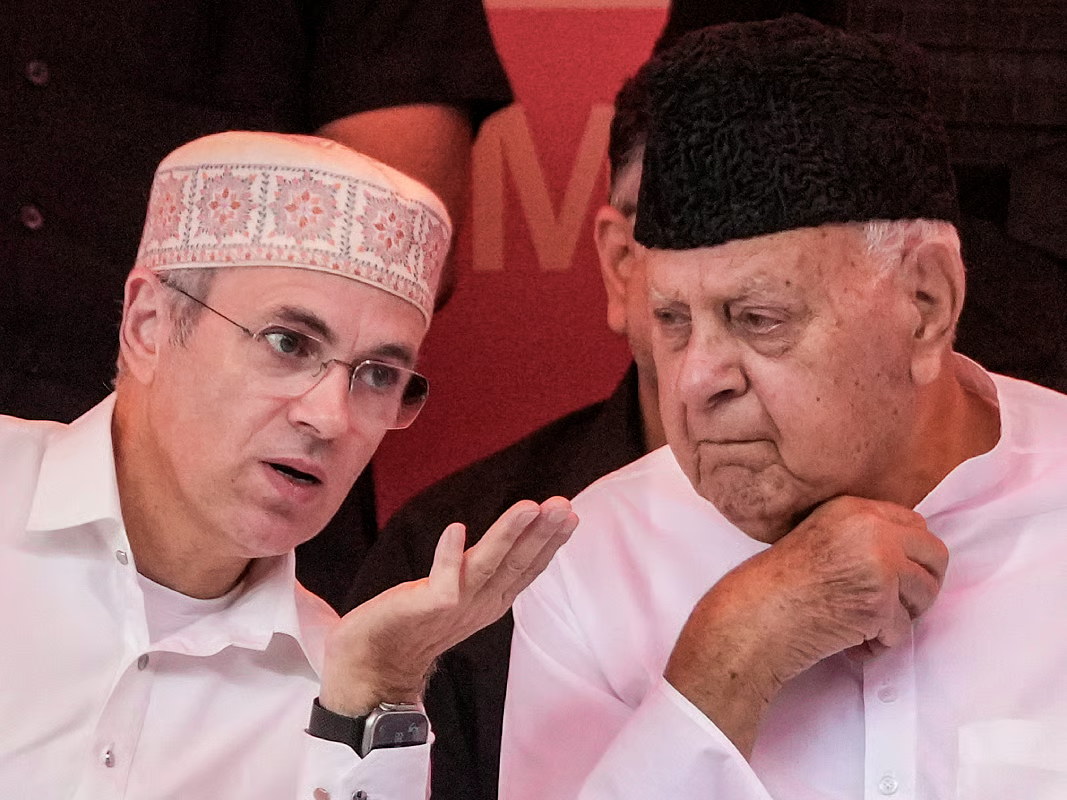
Reconciliation remains the most plausible immediate outcome, but the real test for Omar Abdullah is whether he can address the grievances of dissident legislators without surrendering political and administrative authority
By: Javid Amin | 06 November 2026
Srinagar: Chief Minister Omar Abdullah is facing one of the most uncomfortable internal challenges since the National Conference returned to power in Jammu and Kashmir. What began as dissatisfaction over the October 27 cabinet expansion has developed into a coordinated campaign by a group of legislators seeking changes in the government, the Chief Minister’s advisory team and the party’s internal functioning.
The leadership’s decision to bring Omar Abdullah and party president Dr Farooq Abdullah into direct discussions with the aggrieved lawmakers is an important attempt to prevent the dispute from escalating.
But can the two leaders bring the legislators back on board?
The available indications suggest that an immediate split is not the most likely outcome. The dissidents have continued to operate within the party, prepared a common memorandum and sought a meeting with the leadership rather than announcing a separate political formation. Their demands also concern cabinet performance, representation, consultation and the party’s political direction.
However, a negotiated meeting does not automatically mean the differences will disappear. The legislators have held several rounds of discussions, and their decision to maintain a collective position suggests that they want more than verbal assurances.
Omar may be able to hold the party together in the immediate term. The harder task will be restoring confidence among legislators who believe the government’s decision-making process has become too centralised.
What has brought the NC to this point?
The immediate trigger was the cabinet expansion on October 27, when four new ministers were inducted into Omar Abdullah’s government.
The reshuffle was expected to strengthen the administration, fill political gaps and improve representation. Instead, it generated resentment among several senior leaders who had expected ministerial positions or greater recognition.
The dissatisfaction soon moved beyond individual disappointment.
On October 30, a group of legislators met at the Srinagar residence of Lolab MLA Qaisar Jamshid Lone. Subsequent meetings produced a common set of demands, and 18 NC legislators were reported to have submitted a 10-point memorandum to Omar Abdullah.
The memorandum reportedly sought a cabinet review, ministerial accountability, changes in the Chief Minister’s advisory arrangements, action on alleged governance failures and a stronger political campaign for statehood and Jammu and Kashmir’s constitutional identity.
The group has since continued consultations. On Thursday evening, November 5, another lengthy meeting took place at senior NC leader Hasnain Masoodi’s residence. Reports said 16 legislators were physically present, including 15 NC MLAs and one independent, while four others participated virtually.
The fact that the legislators have continued meeting despite the leadership’s outreach is significant. It suggests that the group wants to negotiate from a position of collective strength.
Scenario 1: Reconciliation and temporary peace
The most likely immediate outcome is a negotiated understanding between the leadership and the dissatisfied legislators.
There are several reasons for this assessment.
First, the dissidents have not announced a break with the National Conference. Their demands have largely been framed as corrective measures within the party and government. They want changes, accountability and greater consultation, but there is no confirmed collective announcement that they intend to withdraw support from Omar Abdullah.
Second, the involvement of Farooq Abdullah gives the reconciliation effort additional political weight. As party president and a senior figure in the organisation, he can mediate between the Chief Minister and legislators who may be reluctant to accept assurances from the government alone.
Third, the leadership has begun reaching out to the aggrieved members. Salman Ali Sagar has publicly rejected the description of the legislators as rebels, saying their differences can be resolved through discussion.
What could a settlement look like?
A compromise does not necessarily require an immediate cabinet reshuffle. The leadership could offer a combination of political and organisational assurances:
-
A review of ministerial performance and departmental functioning.
-
Regular meetings between the Chief Minister and party legislators.
-
Greater consultation before major administrative and political decisions.
-
A review of the role and functioning of advisers.
-
A clearer mechanism for monitoring the implementation of the NC manifesto.
-
Greater involvement of senior legislators in party and government coordination.
A limited adjustment in portfolios or administrative responsibilities could also form part of a negotiated settlement, although no confirmed decision on such changes has emerged.
The important point is that the dissidents need to return with something they can present to their supporters as a meaningful achievement.
A meeting followed by a generic appeal for unity may calm the headlines for a day. It will not necessarily resolve the grievances that brought the legislators together.
Scenario 2: Managed dissent continues
This may prove to be the most realistic longer-term scenario.
The leadership could prevent an immediate confrontation without agreeing to all the dissidents’ demands. The legislators, in turn, could decide that remaining within the National Conference offers them more political influence than leaving it.
Such an arrangement would produce an uneasy peace.
The government would continue functioning, the party would retain its legislative strength, and the dissidents would remain formally within the organisation. But their collective meetings and pressure on the leadership could continue.
In practical terms, Omar Abdullah might find himself governing with a section of his own party constantly demanding greater consultation and accountability.
This is not unusual in coalition politics or large regional parties. Legislators who believe they have been overlooked often use collective pressure to secure greater influence.
However, managed dissent carries costs.
Every cabinet decision could be examined through the lens of factional interests. Portfolio allocations might become politically sensitive. Ministerial performance reviews could be interpreted as attempts to satisfy one group at the expense of another.
Even decisions that have sound administrative reasons could become subjects of internal bargaining.
For Omar, the challenge would be to prevent the government from becoming hostage to continuous negotiations while ensuring that elected representatives do not feel excluded.
This scenario could keep the government stable, but it would not necessarily make the party united.
Scenario 3: Open factional confrontation
A prolonged failure to address the dissidents’ demands could eventually produce an open confrontation.
The risk would increase if the leadership rejects the memorandum outright, refuses to review the disputed arrangements or allows the legislators to believe that their collective concerns are being ignored.
There are several warning signs worth watching:
-
More legislators joining the existing group.
-
Senior NC leaders publicly criticising the Chief Minister or his advisers.
-
Dissidents refusing to participate in party meetings or government programmes.
-
A formal demand for leadership changes rather than administrative corrections.
-
Attempts to build a separate political platform around the dissatisfied legislators.
The departure of Ruhullah Mehdi adds another layer to the political atmosphere. His criticism of the NC’s position on Article 370 and its electoral commitments has created an ideological challenge to the leadership.
There is no established evidence that the dissident legislators are coordinating with Ruhullah or preparing to join his proposed movement. Their grievances have their own origins, particularly the cabinet expansion and internal decision-making.
Nevertheless, his departure could create a wider political environment in which dissatisfied party members feel more confident questioning the leadership.
An open factional confrontation would not automatically bring down Omar Abdullah’s government. But it could weaken the administration, damage the party’s public image and complicate its ability to present a united political position.
Are the percentages in these scenarios reliable?
The suggested estimates of 60–65 per cent for reconciliation, 25–30 per cent for managed dissent and 10–15 per cent for open factional conflict convey a useful editorial sense of relative likelihood. However, there is no polling, statistical model or sufficiently complete evidence to support those figures as measurable probabilities.
For a serious political analysis, it is better to describe the outcomes in qualitative terms:
| Scenario | Assessment | Why |
|---|---|---|
| Reconciliation | Most plausible immediately | Dissidents remain within the party and have sought talks |
| Managed dissent | A substantial medium-term possibility | A compromise may address immediate tensions without resolving all demands |
| Open confrontation | Less likely immediately, but consequential | Continued rejection of demands could harden the factional divide |
This avoids giving readers a false impression that the political situation can be forecast with mathematical precision.
Omar Abdullah’s strengths: why he is not negotiating from a position of weakness
Despite the internal unrest, Omar Abdullah has several advantages.
1. The National Conference remains the dominant Assembly force
The NC won 42 seats in the 2024 Assembly election, making it the largest party in the 90-member elected Assembly.
That gives the Chief Minister a substantial political and legislative base. The dissenting legislators are still operating within the NC framework, and their collective dissatisfaction has not yet translated into a confirmed breakaway group.
The distinction is important: internal pressure is not the same as the loss of legislative support.
Omar’s immediate political challenge is therefore to manage his own party, not to respond to an established alternative government formation.
2. Farooq Abdullah remains an important mediator
Farooq Abdullah’s involvement is one of the leadership’s strongest advantages.
He has decades of experience managing the National Conference’s internal politics and remains an influential figure among its senior leadership. His presence can provide a channel through which disagreements that have become personal or politically sensitive can be addressed.
The meeting also sends a message that the party considers the grievances serious enough to require intervention at its highest level.
However, Farooq’s role has limits. He can facilitate an understanding, but the government must still deliver on any administrative or political commitments made during the discussions.
3. The dissidents do not yet have a clearly established alternative leadership
The group has been able to organise meetings and present common demands. But there is no confirmed evidence that it has developed a separate political command structure or agreed on a leader who could challenge Omar’s authority from outside the existing party framework.
This gives the NC leadership room to negotiate.
A group united by dissatisfaction may not necessarily remain united once individual demands are addressed. Some legislators may prioritise ministerial opportunities, others may want changes in the advisory structure, while some may be more concerned about the party’s political direction.
The leadership could use these differences to build a compromise, provided it does not dismiss the group’s collective concerns.
Omar’s biggest risks
The Chief Minister’s strengths should not obscure the structural problems that have brought the party to this point.
1. The Jammu-Kashmir balance
The cabinet dispute has acquired a regional dimension.
Reports from the dissident meetings have referred to criticism of Deputy Chief Minister Surinder Choudhary and dissatisfaction over ministerial functioning in Jammu, while legislators from Kashmir have raised questions about the replacement of ministers who have completed two years in office.
This makes the dispute more complicated than a straightforward contest between overlooked and newly inducted ministers.
If regional grievances become central to the negotiations, the leadership will have to demonstrate that cabinet decisions are being guided by performance, representation and administrative requirements rather than factional or regional calculations.
2. Article 370 and statehood expectations
The NC’s political identity remains closely connected to the demand for restoration of statehood and the constitutional changes of 2019.
The dissidents’ reported demand for a stronger political campaign on these issues places additional pressure on Omar Abdullah.
The government must balance political expectations with its limited authority as a Union Territory administration.
The Assembly can pass resolutions, demand statehood and apply political pressure, but it cannot unilaterally reverse the constitutional changes upheld by the Supreme Court in December 2023.
That does not remove the political responsibility to pursue the party’s stated commitments. It makes the need for a clear, realistic roadmap even greater.
3. The perception of a closed decision-making circle
Perhaps the most damaging aspect of the current dispute is the criticism directed at the Chief Minister’s advisers and the reported demand for the removal of Nasir Aslam Wani.
The demand suggests that some legislators believe access to the Chief Minister and influence over government decisions are concentrated among a small group.
Whether that perception accurately reflects the government’s internal functioning is a separate question. Politically, however, it has become a source of dissatisfaction.
Elected representatives expect to have a meaningful role in governance, particularly when their party is in power. If they feel that their concerns are being filtered through advisers or an inner circle, resentment can build even among leaders who remain loyal to the party.
Omar must therefore address not only the specific demand concerning Wani but also the wider question of how the government communicates with its legislators.
The most important question: can Omar offer change without appearing weak?
This is the central leadership test.
If Omar agrees to every demand, he could create the impression that collective pressure is enough to dictate government decisions. That could encourage further bargaining within the party.
If he refuses all concessions, he risks turning a manageable dispute into a prolonged confrontation.
The politically smarter approach would be to separate demands into three categories:
-
Governance reforms: Improve communication, introduce regular ministerial performance reviews and create a transparent mechanism for addressing legislators’ concerns.
-
Organisational reforms: Strengthen consultation between the party leadership, elected representatives and grassroots workers.
-
Political commitments: Establish a clear timeline and strategy for pursuing statehood and the party’s other major promises.
Such an approach would allow the Chief Minister to demonstrate responsiveness without surrendering the government’s authority over appointments and administration.
It would also give the dissidents an opportunity to claim that their intervention has produced meaningful corrective measures.
Three signals that will reveal whether the crisis is ending
The outcome of the November 6 discussions should be assessed through developments that follow, rather than the language used in the meeting itself.
1. A joint statement or public show of unity
If the legislators emerge with the leadership and publicly endorse a negotiated understanding, it would indicate that both sides want to contain the dispute.
But a joint appearance alone would not prove that the underlying issues have been settled.
2. Concrete decisions on cabinet and advisory arrangements
Any announcement of a ministerial performance review, portfolio changes, administrative restructuring or changes to the advisory arrangement would provide evidence that the leadership has responded to the grievances.
The absence of immediate changes would not necessarily mean failure, but it would make follow-up assurances important.
3. Whether the dissident meetings continue
This may be the clearest indicator.
If the group stops holding collective meetings and resumes normal party activities, it would suggest that the immediate confrontation has eased.
If the legislators continue meeting regularly, particularly after receiving assurances from the leadership, it would indicate that the dispute remains unresolved.
Political bottom line: Omar can probably contain the crisis, but unity will require more than a meeting
Omar Abdullah is not yet facing a confirmed revolt capable of bringing down his government. The NC retains its substantial Assembly position, the dissidents remain within the party and the leadership has opened direct negotiations.
These are important advantages.
But the crisis has exposed problems that cannot be resolved through appeals for loyalty alone. The legislators are questioning the distribution of political influence, the performance of ministers, the role of advisers and the gap between electoral promises and government action.
The most plausible immediate outcome is a negotiated understanding, possibly followed by a period of managed dissent. A full-scale split remains a less likely immediate development, but the possibility cannot be dismissed if the leadership fails to address the grievances.
Omar Abdullah’s real test is not simply to keep the legislators inside the National Conference. It is to make them feel that they still have a meaningful place in the party they represent.
The meeting may deliver a ceasefire. Whether it delivers lasting unity will depend on what the Chief Minister does after the doors close.


