Mehbooba Mufti Targets NC Over Kashmir’s Trust Deficit, Renews Call for Dialogue With Centre
By: Javid Amin | 02 November 2026
The PDP chief’s attack goes beyond a political exchange with the Abdullah-led party. By revisiting the National Conference’s shifting positions on accession, plebiscite and autonomy, Mehbooba is challenging its claim to represent Kashmir’s political aspirations while presenting dialogue and reconciliation as the way forward.
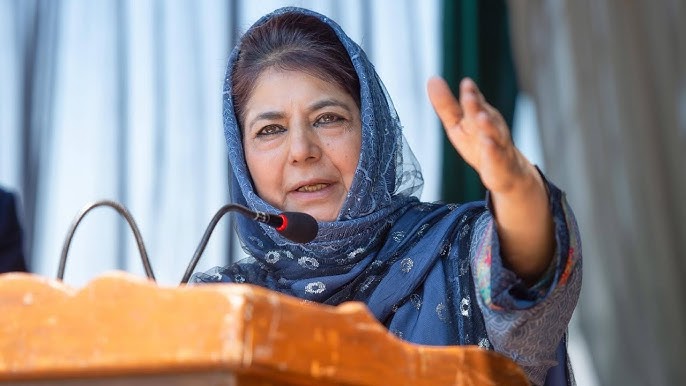
Mehbooba Mufti’s remarks at the PDP Foundation Day gathering in Srinagar have reopened an old but unresolved argument in Jammu and Kashmir politics: who bears responsibility for the widening trust deficit between Kashmir and New Delhi, and what political approach can repair it?
Her speech had two distinct targets. The first was the Union government’s reliance, in her view, on security measures and administrative action instead of sustained political engagement. The second was the National Conference, which she accused of changing its political positions over several decades and leaving Kashmiris caught between promises of political rights and disappointing outcomes.
The distinction matters. Mehbooba was not simply asking the Centre to resume talks; she was also attempting to question the historical credibility of the party currently leading the elected government in Jammu and Kashmir.
What Mehbooba said at the Foundation Day gathering
At the November 2 convention, Mehbooba questioned why Kashmiris continued to face suspicion despite Jammu and Kashmir’s accession to India in 1947. She alleged that young people were being harassed, Kashmiri government officers were losing their jobs, and Gujjar and Bakarwal communities were facing eviction or pressure over land.
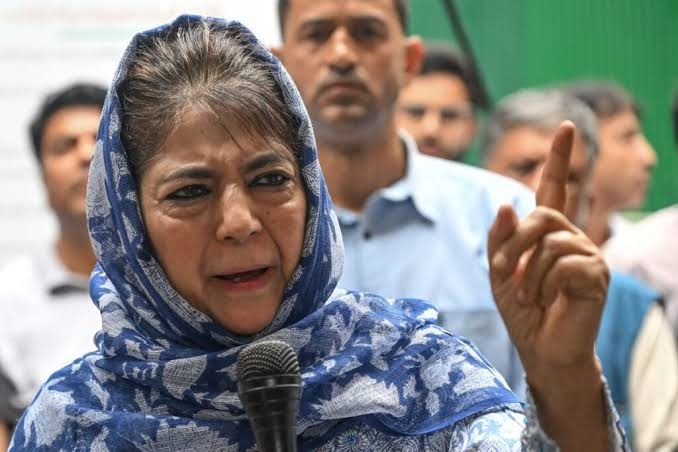
Her criticism was directed at both Srinagar and New Delhi. She accused the NC of sending inconsistent political signals to the Centre, while arguing that the Union government had failed to respond to the region’s political grievances through meaningful engagement.
She also challenged the government’s use of laws such as the Unlawful Activities (Prevention) Act and the Public Safety Act as instruments of governance. Her argument was that security measures may address immediate threats, but cannot by themselves settle questions of political representation, dignity and public confidence. She urged the Centre to reopen dialogue and traditional routes connecting the region with Central Asia.
The speech was delivered against the backdrop of recent remarks by NC president Farooq Abdullah on Pakistan’s role in keeping the Kashmir issue alive internationally. Mehbooba used that controversy to accuse the Abdullah leadership of maintaining one political language in Kashmir and another when addressing New Delhi. That connection gives the speech an immediate political context: it was not only a general appeal for talks, but also a direct intervention in the debate over how regional parties should speak about Kashmir, Pakistan and India.
The historical charge against the National Conference
Mehbooba’s sharpest allegations concerned the NC’s political history. She questioned the party’s movement from its early commitment to accession with India, to the plebiscite demand associated with Sheikh Abdullah and the Plebiscite Front, and then to the 1975 agreement with Prime Minister Indira Gandhi that brought Sheikh Abdullah back to power as chief minister.
Her argument was that these shifts left ordinary Kashmiris uncertain about the political destination being promised to them. She also accused the NC of abandoning its autonomy demand after decades of presenting it as a central political objective.
There is a substantial historical record behind the events she invoked, although the political meaning attached to them remains contested.
The National Conference emerged in 1939 after the All Jammu and Kashmir Muslim Conference was renamed. Sheikh Abdullah became its most prominent leader and headed the movement against Maharaja Hari Singh’s rule. In the years after Partition, Sheikh Abdullah supported the political choice of accession to India, while Jammu and Kashmir’s formal Instrument of Accession was signed by Maharaja Hari Singh on October 26, 1947 and accepted by Governor-General Lord Mountbatten the following day. Sheikh Abdullah did not sign that legal instrument.
That distinction is important because some accounts of the current political argument risk conflating Sheikh Abdullah’s political influence and support for accession with the legal act itself. The Supreme Court’s December 2023 judgment records that it was Maharaja Hari Singh who signed the Instrument of Accession.
The relationship between Sheikh Abdullah and New Delhi subsequently deteriorated. He was dismissed and arrested in August 1953. The political conflict that followed helped shape the emergence of the Plebiscite Front, which campaigned for a plebiscite on the future of Jammu and Kashmir. In 1975, Sheikh Abdullah reached an agreement with Indira Gandhi and returned to office as chief minister.
The 1975 accord did not simply erase Article 370. Its agreed conclusions expressly stated that Jammu and Kashmir would continue to be governed in its relations with the Union by Article 370, while also setting out the constitutional arrangements and limits accepted by both sides. The accord also reflected a major political change: the Plebiscite Front’s position was abandoned, and Sheikh Abdullah returned to electoral and constitutional politics within the Indian Union.
For Mehbooba, that transition represents a broken political promise. For the NC’s defenders, the 1975 agreement can be viewed as a compromise made under changed political circumstances, preserving a measure of constitutional autonomy while ending a prolonged confrontation. The disagreement is not merely over what happened; it is over whether compromise was a pragmatic route back into political life or a retreat from the aspirations previously raised among Kashmiris.
The autonomy question: What did the NC actually do?
The autonomy issue is particularly important because Mehbooba’s charge that the NC abandoned it leaves out a significant part of the party’s record.
After returning to power in 1996, the Farooq Abdullah-led government established a committee to examine the constitutional relationship between Jammu and Kashmir and the Union. On June 26, 2000, the Jammu and Kashmir Legislative Assembly passed a resolution seeking restoration of the state’s pre-1953 constitutional position.
The proposal sought a substantially greater degree of autonomy, including the reversal of several constitutional changes made after 1953. It was rejected by the BJP-led NDA government at the Centre. The irony was that the National Conference was itself an NDA partner at the time. The dispute eventually became one of the major points of friction between the two sides, and the NC withdrew its support to the NDA in July 2003.
This history complicates the claim that the NC simply abandoned autonomy. The party did formally pursue its restoration through an Assembly resolution, but it failed to secure acceptance from the Centre. Its later political compromises and changing priorities are legitimate subjects of criticism, but the record also shows that the autonomy demand was not merely a slogan without any institutional attempt to advance it.
The distinction is important in the present debate. A political demand can remain part of a party’s declared position even when it fails to produce a constitutional outcome. Whether the NC has done enough to pursue that demand is a separate question from whether it abandoned it altogether.
The PDP’s own political journey
Mehbooba’s attempt to present the PDP as a party founded on dialogue and reconciliation also has a clear historical basis.
Mufti Mohammad Sayeed established the PDP in July 1999, positioning it as an alternative regional political platform. The party’s founding objective, as described on its official website, was to persuade the Government of India to initiate unconditional dialogue with Kashmiris to resolve the Kashmir problem. Its political messaging also emphasised dignity, reconciliation, confidence-building and what became known as the healing touch approach.
The PDP’s rise was partly a response to public dissatisfaction with the NC’s long dominance in Kashmir. It sought to create political space for voters who wanted a regional alternative and a different approach to the Centre.
But the PDP’s record, too, needs to be considered in full.
In 2015, Mufti Mohammad Sayeed formed a coalition government with the BJP, a party whose political position on Article 370 and Kashmir’s constitutional status was fundamentally different from that of the PDP. The two parties negotiated an Agenda of Alliance, which was presented as a framework for governance and an attempt to bridge political and regional differences. Mehbooba continued the coalition after her father’s death, becoming Chief Minister in April 2016.
The arrangement was controversial, particularly among sections of the PDP’s traditional support base. The BJP eventually withdrew from the coalition in June 2018, bringing Mehbooba’s government to an end. After the collapse, she defended the PDP’s decision by arguing that the alliance had been intended to advance reconciliation, dialogue and confidence-building, even though it had failed to deliver the expected results.
That history does not invalidate the PDP’s present call for dialogue. It does, however, show that the party has also made difficult political compromises in pursuit of its stated objectives. Its credibility will therefore depend not only on how sharply it criticises the NC, but also on how openly it accounts for its own decisions in government.
Why the speech matters in the present political climate
Mehbooba’s intervention comes at a time when the National Conference is facing pressure on several fronts.
The party is managing internal disagreements over governance, ministerial performance, political accountability and the implementation of its election commitments. At the same time, Aga Syed Ruhullah Mehdi’s public criticism of the leadership has brought questions about Article 370, political prisoners, reservation policy and the party’s ideological direction back into the spotlight.
The PDP chief’s attack adds another dimension to that debate. Rather than focusing exclusively on the performance of the Omar Abdullah government, she has challenged the NC’s historical claim to political leadership in Kashmir.
For the PDP, this creates an opportunity to distinguish its political approach from that of the ruling party. Mehbooba is effectively arguing that the NC has failed to deliver on its historic promises, while the PDP’s original purpose remains relevant because the political relationship between Kashmir and New Delhi is still marked by mistrust.
This is a political positioning strategy, but it is also connected to a larger question: what should the next phase of mainstream politics in Jammu and Kashmir look like?
The NC has traditionally placed emphasis on constitutional autonomy, restoration of statehood and the protection of Jammu and Kashmir’s political identity. The PDP has stressed dialogue, reconciliation and confidence-building alongside its own demands for the restoration of rights and dignity. There is overlap between the two positions, but their political narratives and approaches are not identical.
The challenge for both parties is that neither can claim to have resolved the underlying questions that continue to shape public debate.
Dialogue versus security: The unresolved question
Mehbooba’s call for dialogue raises an issue that goes beyond party rivalry.
Jammu and Kashmir has experienced decades of political conflict, militancy, security operations, restrictions and repeated attempts at political reconciliation. Governments have often presented improved security indicators as evidence of normalcy. Critics, including Mehbooba, argue that a reduction in violence cannot by itself demonstrate that political grievances have disappeared.
Both dimensions matter.
The state has a responsibility to protect civilians and maintain public order. Security concerns cannot simply be dismissed. At the same time, a lasting political settlement cannot depend entirely on policing, restrictions or legal action. Public trust, civil liberties, representative institutions and credible political engagement are essential to any sustainable peace.
The question is not whether security measures or dialogue should exist. It is whether security policy can be accompanied by a meaningful political process that allows people to express grievances and see their concerns addressed.
Mehbooba has also raised specific allegations involving the treatment of young people, government employees and tribal communities. These claims require examination against official records and individual cases rather than being accepted as established facts simply because they were raised at a political gathering. But they point to issues that deserve transparent answers from the authorities.
Her reference to traditional routes connecting Jammu and Kashmir with Central Asia is another part of the argument. Reopening such routes would involve complex diplomatic, security and logistical questions, but the proposal reflects the PDP’s longstanding emphasis on regional connectivity as a confidence-building measure.
Can the PDP turn criticism into a political alternative?
The immediate political impact of Mehbooba’s speech will depend on whether the PDP can turn its criticism into a sustained programme of political engagement.
Attacking the NC’s historical record may attract attention, particularly when the ruling party is dealing with internal dissent. But voters will also want clarity on what the PDP would do differently if it returned to power.
That means addressing several practical questions:
-
What specific political dialogue should the Centre initiate, and with whom?
-
How should statehood and constitutional rights be pursued within the present political framework?
-
What safeguards should protect civil liberties and prevent arbitrary action?
-
How would the PDP address the concerns of young people, government employees and tribal communities?
-
What lessons has the party drawn from its own coalition experience with the BJP?
These questions are important because the political debate in Jammu and Kashmir is no longer limited to which regional party has the stronger historical claim. It is increasingly about which party can offer a credible roadmap for the future.
The NC, meanwhile, cannot rely only on its historical legacy. Its performance in government, its ability to fulfil public commitments and its response to internal criticism will shape how voters judge its present leadership.
What comes next?
Mehbooba Mufti’s Foundation Day speech has sharpened the political contest between the PDP and the NC, but it has also brought a deeper issue back into focus: the distance between electoral politics in Jammu and Kashmir and the unresolved political relationship with New Delhi.
Her attack on the Abdullah family is likely to provoke a political response, especially because it challenges the NC’s historical record rather than merely criticising its current government. But the wider significance of the speech lies in its renewed insistence that peace cannot be sustained through force alone.
The historical record is more complicated than either party’s political narrative suggests. The NC has made compromises, but it has also formally pursued autonomy. The PDP was founded on a promise of dialogue, but it too entered a controversial coalition with the BJP in an effort to advance its agenda.
Neither history should be reduced to a slogan.
For Kashmir, the central question remains whether political parties can move beyond accusations about past decisions and offer a credible path towards trust, dignity, constitutional clarity and lasting peace. Mehbooba has put dialogue at the centre of that argument. The more difficult task will be turning that demand into a political process that produces measurable results.