Ruhullah After Resignation: Another Azad, Another Bukhari—or Kashmir’s Next Political Pole?
By: Javid Amin | 03 November 2026
The resignation has given Aga Syed Ruhullah Mehdi a powerful political opening. But Kashmir’s history offers a warning: breaking with an established party is not the same as building an alternative. The real test will be whether he can turn the public support visible in Budgam into a durable organisation with a programme, leadership beyond himself and a presence across regions.
Ruhullah’s departure from the National Conference is significant not simply because a sitting MP has announced his exit from both the party and Parliament. It is significant because he has chosen to make that break over questions that go to the heart of Kashmir’s post-2019 politics: constitutional identity, political rights, the credibility of election promises and the limits of mainstream political engagement with New Delhi.
His call for a new movement, including an appeal to young people from Jammu, Kashmir and Ladakh, gives the episode a wider ambition. But it also raises the central question: is this the beginning of a new political formation, or another moment of high-profile dissent that struggles to survive once the crowds disperse?
The comparisons with Ghulam Nabi Azad, Altaf Bukhari and Sajjad Lone are useful—but only if they are made carefully. Each emerged from a different political context, with different resources, constituencies and political propositions. Ruhullah’s prospects cannot be measured by headlines or rally attendance alone.
The first victory was narrative control—not yet electoral success
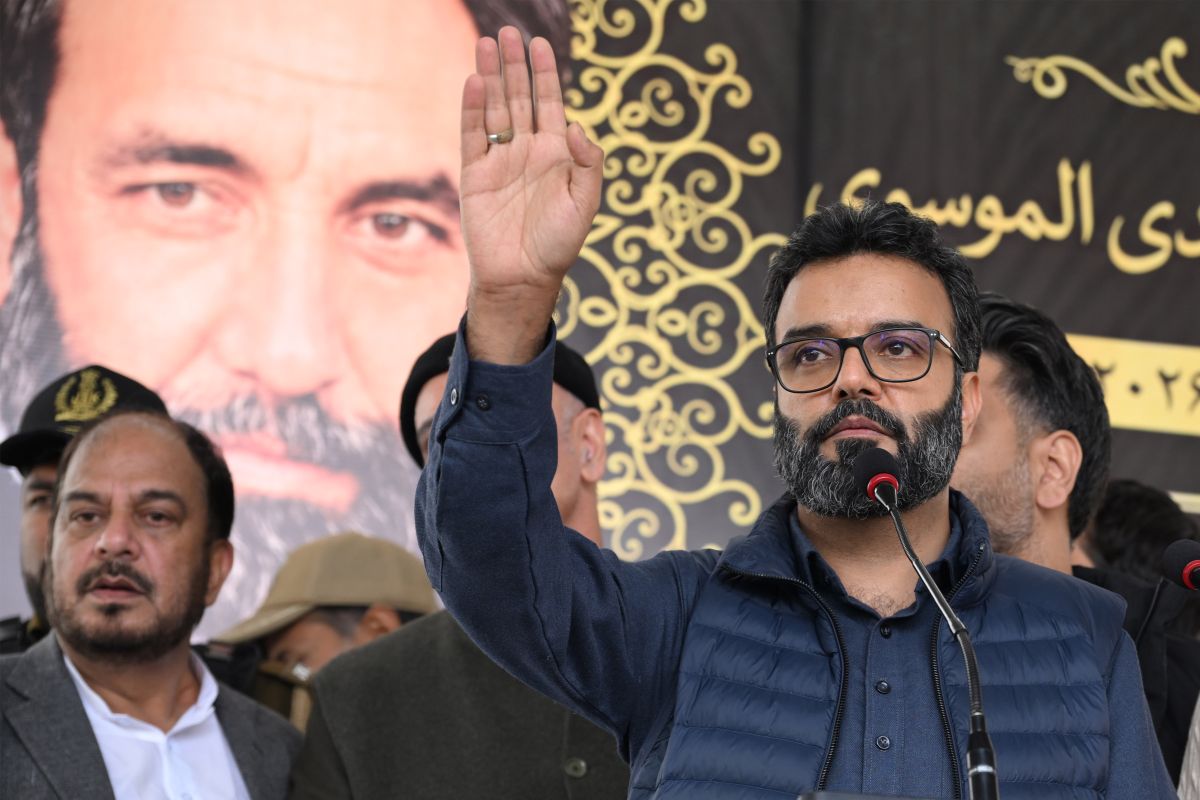
The Budgam gathering gave Ruhullah something that political leaders often struggle to secure after leaving an established party: a dramatic public moment with a clear message. He signed his National Conference resignation in front of supporters, announced that he was leaving Parliament, and used the occasion to call for a political movement centred on rights, dignity and public accountability.
The symbolism was carefully constructed. His father, Aga Syed Mehdi, was assassinated in 2000. The gathering took place on his 26th death anniversary. Ruhullah also handed his party resignation letter to Mohammad Ashraf Mattoo, the father of Tufail Mattoo, whose death in 2010 became a defining episode in the political unrest of that year. His Lok Sabha resignation was sent to Speaker Om Birla.
These were not ordinary procedural details. They connected his departure to family history, political memory and the public grievances he says the NC has failed to represent.
But one point in the draft needs qualification: the gathering was widely described as large, yet its size has not been independently established through an official count. Kashmir Observer, reporting from the venue, described attendance as a few thousand—below the larger turnout some had expected. Ruhullah subsequently said the response exceeded his expectations and that people had travelled from Poonch, Rajouri, Kishtwar and Kupwara at their own expense. That is his account of the gathering, not a verified breakdown of attendance by district.
The distinction does not diminish the political importance of the event. It does prevent a crowd estimate from being mistaken for proof of a new statewide electoral base.
The first phase belongs to Ruhullah in terms of political visibility and control of the public narrative. Whether it amounts to a lasting political victory will depend on what follows.
The Ruhullah advantage: He is not starting from zero
There is a major difference between Ruhullah and several leaders who launched new political organisations after breaking with established parties: he already has a substantial electoral record in the Valley.
He has represented Budgam in the Assembly three times and served as a minister in the Omar Abdullah-led government. In the 2024 Lok Sabha election, he won Srinagar with 356,866 votes, defeating PDP candidate Waheed Ur Rehman Para, who polled 168,450. That was a convincing victory and gave him a parliamentary mandate of his own.
Yet there is an important electoral qualification: he won that parliamentary seat as a National Conference candidate. The NC’s political network, workers, campaign machinery and voter base contributed to the victory. His personal popularity was clearly an asset, but the election did not establish how many of those voters would support him under a new political banner.
That is the central question behind his resignation.
Ruhullah is effectively asking supporters to believe that the political trust they placed in him can survive his separation from the party through which he won. His decision to give up the parliamentary position gives that argument moral force. But the next election, not the resignation speech, will establish its electoral strength.
A political message with emotional resonance
His message is built around a grievance that remains politically powerful in Jammu and Kashmir: the feeling among sections of the population that the 2019 constitutional changes fundamentally altered the region’s relationship with the Union, while subsequent electoral politics has not produced a credible route to restoring the rights and protections they lost.
In his resignation letter, Ruhullah described 2019 as both a political shock and an opportunity to reclaim political space. He argued that the NC was the natural organisation to lead that struggle but had subsequently abandoned the responsibility. At Budgam, he repeated his criticism over Article 370, constitutional rights, reservation policy, political prisoners and the party’s election commitments. These are his political allegations and interpretations; the NC disputes his assessment of its conduct.
This gives him a sharper ideological proposition than a conventional breakaway campaign based only on leadership differences. But a movement cannot survive indefinitely on a single grievance, however deeply felt. It will eventually have to explain what it proposes on employment, education, economic development, local governance, civil liberties, regional representation and the future relationship with New Delhi.
That is where the distinction between a protest platform and a political alternative becomes decisive.
Why Ghulam Nabi Azad is a warning—but not a perfect comparison
The comparison with Ghulam Nabi Azad is unavoidable. Azad was one of the most experienced political figures to break away from a major national party and attempt to build a new organisation in Jammu and Kashmir.
He had served as Union minister, Chief Minister of the erstwhile state and a senior Congress leader with decades of experience in national politics. When he left the Congress in August 2022, he launched the Democratic Progressive Azad Party, presenting it as an independent political alternative.
On paper, Azad appeared to have several advantages that a new regional leader would normally envy:
-
Extensive experience in government and administration.
-
Recognition across Jammu and Kashmir and beyond.
-
Personal relationships with political leaders nationally.
-
A network of former Congress leaders and local politicians.
-
A reputation as an experienced administrator.
Yet those advantages did not translate into a strong electoral organisation.
The 2024 Lok Sabha election exposed the difficulty. All three DPAP candidates in Jammu and Kashmir forfeited their security deposits, according to Election Commission data reported by The New Indian Express. In the 2024 Assembly election, the party contested 23 seats, won none and secured around 1.2% of the total vote.
The lesson is not that Azad lacked political experience. It is that experience, stature and a network of former office-holders cannot automatically create a new voter coalition.
There is, however, a fundamental difference between the two cases.
Azad’s departure was primarily a break with the Congress leadership and its national political direction. Ruhullah’s departure is being framed as a protest against what he sees as the abandonment of Kashmir’s constitutional and political commitments by the regional party that won the 2024 mandate.
Azad entered the field with a formidable administrative résumé. Ruhullah is attempting to build around a more sharply defined political grievance and a claim of personal sacrifice.
That may give Ruhullah a more emotionally resonant starting point among sections of the Valley’s electorate. It does not guarantee that he will avoid the organisational difficulties that weakened Azad’s project.
The Azad comparison is therefore a warning about organisation, not a prediction that Ruhullah must meet the same fate.
Why Altaf Bukhari’s Apni Party offers another lesson
Altaf Bukhari took a different route.
The Jammu and Kashmir Apni Party was launched on March 8, 2020, in the aftermath of the August 2019 constitutional changes and the reorganisation of the erstwhile state. Its founding group included former ministers, legislators and political figures, many of whom had experience in the PDP and other established organisations.
Bukhari’s pitch was pragmatic: peace, development, political engagement with the Centre, protection of local land and employment rights, and a realistic approach to the region’s new administrative circumstances.
That approach gave Apni Party access to political conversations in New Delhi, but it also created a credibility problem among voters who viewed the party as too close to the BJP or insufficiently confrontational over the 2019 changes. Bukhari rejected the idea that his party was simply a proxy for the BJP and argued that engagement was necessary to protect local interests.
The electoral record was unforgiving. In the 2024 Assembly election, Apni Party contested 46 seats, polled approximately 3.36% of the total vote and won none.
The lesson for Ruhullah is almost the reverse of the Azad example.
Azad had experience and political stature but struggled to convert them into a new electoral base. Bukhari had an organised group of experienced political figures and a pragmatic message, but struggled to convince enough voters that his party represented their political concerns.
Ruhullah is trying to occupy the space between those two models: an ideological campaign with a public movement behind it, but without immediately committing to a conventional party structure.
That could be an advantage if it helps him build trust before asking people to vote for a new organisation. It could become a weakness if the movement remains dependent on speeches and symbolism without developing a practical political programme.
Sajjad Lone: The more realistic comparison
Sajjad Gani Lone may offer the more useful comparison because his political journey demonstrates both the possibilities and limitations of building a party around a strong individual identity.
Lone inherited a political legacy shaped by his father, Abdul Gani Lone, and developed a distinct political profile in north Kashmir. His People’s Conference made an electoral breakthrough in the 2014 Assembly election, winning two seats, both in the Kupwara region. Lone won Handwara, defeating a senior National Conference leader.
The party survived subsequent political changes and remained relevant, but it did not expand into a statewide alternative capable of displacing the NC or PDP.
In the 2024 Assembly election, Lone again won Handwara—but narrowly. He received 29,812 votes against NC candidate Chowdry Mohammad Ramzan’s 29,150, a margin of just 662 votes. The People’s Conference won only one Assembly seat.
That record illustrates a critical political reality: a leader can retain a meaningful constituency, survive difficult electoral cycles and remain influential without becoming the head of a mass regional party.
Ruhullah could achieve that kind of independent political space. He could become a consequential voice on constitutional rights and political accountability, attract supporters beyond his original constituency and influence the direction of regional politics without immediately replacing the NC.
But if his ambition is to build a statewide alternative, the Sajjad Lone experience also shows how difficult it is to convert personal appeal into a geographically broad organisation.
The PDP benchmark: How a regional alternative actually becomes powerful
If Ruhullah wants to build something bigger than an influential personal platform, the more ambitious comparison is the rise of the Peoples Democratic Party.
The PDP was founded by Mufti Mohammad Sayeed in July 1999. Its central pitch was to bridge the trust deficit between Kashmir and New Delhi through dialogue, reconciliation and a different style of regional politics. It did not become a major force overnight.
Its electoral growth was gradual but substantial:
| Assembly election | PDP seats |
|---|---|
| 2002 | 16 |
| 2008 | 21 |
| 2014 | 28 |
| 2024 | 3 |
The 2002 result was particularly important. The PDP emerged as a significant challenger to the NC and entered government in alliance with Congress. Over the next two elections, it expanded its influence and eventually became the single largest party in 2014, although it fell short of a majority and formed a coalition government with the BJP.
The PDP’s rise was not based on one leader’s popularity alone. It developed a recognisable political identity, recruited leaders from different areas, established local structures and built a narrative that spoke to voters dissatisfied with the NC.
That is the standard against which Ruhullah’s project will eventually be judged.
There is also a caution in the PDP’s later history. Its 2015 alliance with the BJP created a major credibility challenge among sections of its traditional electorate. The coalition collapsed in 2018, and the party’s electoral strength declined sharply in the years that followed. Its 2024 Assembly tally of three seats shows how quickly a regional party can lose ground when its political identity and voter expectations come apart.
The lesson is two-sided: a new regional party can grow into a serious political alternative, but it must protect the credibility of the political promise on which it was built.
Ruhullah’s emphasis on principles and public commitments appears designed to address precisely that problem. Whether he can sustain it when confronted with the compromises of electoral politics remains unanswered.
The biggest positive signal—and the biggest exaggeration
The most encouraging sign for Ruhullah is that the Budgam gathering was not presented as a meeting confined to one constituency. He appealed to young people from Jammu, Kashmir and Ladakh, and later said attendees had travelled from places including Poonch, Rajouri, Kishtwar and Kupwara.
That matters because a political movement restricted to Budgam or even central Kashmir would have limited room to grow into a region-wide force.
But the claim that his support has already spread beyond traditional Shia constituencies needs more evidence. Attendance by people from different districts is not the same as proof of support across religious, regional and social groups. Nor does a handful of public expressions of solidarity establish a cross-community electoral coalition.
To demonstrate that wider appeal, Ruhullah will need to show that his movement can attract:
-
Young voters and first-time political participants.
-
Professionals, traders, workers and civil society representatives.
-
Political workers from outside his existing constituency.
-
Supporters from Jammu who may have different priorities from voters in the Valley.
-
People in Ladakh, where the political and administrative context is distinct from that of Jammu and Kashmir.
The last point deserves particular attention. Ladakh became a separate Union Territory in 2019 and does not have representation in the Jammu and Kashmir Legislative Assembly. An appeal to young people from Ladakh may have symbolic and political value, but building a common political platform across the three regions requires a programme that recognises their different constitutional arrangements, political demands and local priorities.
A slogan of unity will not be enough. He will need a political framework that explains what common interests bind these regions and how their distinct concerns will be represented.
The NC’s response: A political battle has already begun
The National Conference has not treated Ruhullah’s departure as a quiet disagreement.
After his speech, the party accused him of “mental and moral bankruptcy” and self-obsession. It questioned why he had chosen to raise the 2010 unrest after continuing in the party and serving in the Omar Abdullah government at the time.
Ruhullah responded by challenging Omar Abdullah to acknowledge his own responsibility for the events of 2010, arguing that leaving the NC did not erase the accountability of those who had held positions in the government.
The exchange shows that the dispute has moved beyond the original disagreement over Article 370 and election promises. It is now also a contest over political credibility, past responsibility and the right to claim the public mandate.
The BJP has attempted to distance itself from the NC’s internal dispute. Its national vice-president Ram Madhav said the party had no involvement, while also making a remark that Ruhullah’s gathering had the blessings of “our people”. That comment may fuel political speculation, but it is not evidence of a BJP-Ruhullah understanding or an organisational alliance.
This distinction is essential. A new political initiative in Kashmir will inevitably attract attempts by rivals to define it as either a threat or an opportunity. Ruhullah will have to establish his independence through his decisions and political programme, not merely through statements about independence.
What happens next? Five tests that will determine his political future
The next phase is likely to be slower and less dramatic than the Budgam announcement. Ruhullah himself has indicated that he has not fixed a deadline for building the new platform. Speaking to reporters after the gathering, he said the process could take time: it would move faster if suitable people came forward, but he was not going to impose an artificial timeline.
That statement is significant. It suggests he recognises that a political organisation cannot be created simply by announcing one.
1. Finding a credible second line of leadership
This is the first and most urgent test.
Ruhullah has spoken about identifying honest, committed people from different walks of life. But a movement cannot depend indefinitely on one leader delivering speeches and attracting crowds.
He will need district-level coordinators, local organisers, people capable of developing policy and leaders who can speak credibly on issues beyond Article 370.
The most important question is whether he can bring forward people who have their own public standing rather than simply being known as Ruhullah’s supporters.
A movement built around one personality may attract attention. A movement with multiple credible leaders can survive political setbacks.
2. Turning the Article 370 position into a workable political programme
Article 370 will almost certainly remain central to Ruhullah’s politics. But a serious political initiative must explain how it intends to pursue its constitutional objectives.
The Supreme Court upheld the abrogation of Article 370 in December 2023. A regional movement can campaign for constitutional change, challenge political decisions and demand safeguards, but it cannot simply promise that an elected Jammu and Kashmir government can restore the former constitutional arrangement by itself.
Ruhullah will need to explain the legal, parliamentary and political route he wants to pursue.
He must also show how his proposed movement will address the everyday issues that affect voters: jobs, reservation policy, education, electricity, public services, civil liberties and the treatment of people facing legal proceedings.
If the movement speaks only about constitutional history, it risks becoming a protest platform. If it connects constitutional rights with practical governance, it has a better chance of becoming a political alternative.
3. Establishing support beyond Budgam
The next public meetings will be more revealing than the first one.
Budgam is Ruhullah’s established political base. His three Assembly victories and 2024 parliamentary performance give him a foundation there. But he must now demonstrate that his appeal extends beyond his home constituency.
A serious organisational test would be the emergence of active supporters and coordinators in north Kashmir, south Kashmir, Srinagar, Jammu’s districts and—if he intends to pursue his stated appeal—Ladakh.
The question is not whether people from these areas attend one rally. It is whether they are willing to organise, campaign, recruit and eventually contest elections under a common political programme.
4. Deciding whether to contest the Srinagar by-election
This could become the most immediate electoral test, but only after the parliamentary resignation is formally accepted.
Ruhullah has submitted his resignation to Lok Sabha Speaker Om Birla under Article 101(3)(b) of the Constitution and Rule 240 of the Lok Sabha Rules. The seat becomes vacant only after the Speaker accepts it. As of the reporting available on November 4, I have not found confirmation that the Speaker has accepted the resignation.
If the resignation is accepted, Section 151A of the Representation of the People Act, 1951, generally requires a by-election within six months, subject to specified exceptions.
Ruhullah has indicated that he would consult people once a by-election is announced. That leaves open whether he will contest as an independent, under a newly formed party or through another political arrangement.
A by-election would be a direct test of his claim that his 2024 mandate was rooted in personal trust and political conviction rather than only in the NC’s organisation.
But there is a risk: losing a by-election soon after a high-profile resignation could weaken the momentum of a movement before it has properly taken shape. Contesting without a prepared organisation could turn a potentially valuable political test into an avoidable setback.
5. Deciding what to do about the NC’s dissident MLAs
The NC’s internal crisis may create opportunities for Ruhullah, but it also presents a strategic dilemma.
The legislators who submitted the memorandum to Omar Abdullah have raised demands concerning cabinet performance, consultation, accountability and implementation of election commitments. Ruhullah’s dispute is more fundamental: he argues that the party has abandoned the political struggle it promised to pursue.
There is overlap, particularly on constitutional rights and the party’s election commitments. But the objectives are not identical.
A legislator seeking a cabinet reshuffle may want to remain within the NC and strengthen his position. Ruhullah has made a public break and challenged the party’s political direction.
He should not assume that every dissatisfied NC MLA is a potential recruit. Nor should the public assume that the reported dissident group is preparing to join him.
The more revealing development will be whether any legislator is prepared to leave the NC and accept the political and legal consequences of joining a new initiative.
The five political models—and where Ruhullah stands
| Political model | What it offers | What Ruhullah can learn |
|---|---|---|
| Ghulam Nabi Azad | Experience, stature and national connections | A senior leader’s reputation cannot replace an electoral base |
| Altaf Bukhari | Established political figures and a pragmatic approach | Organisation without public credibility has limited reach |
| Sajjad Lone | A durable personal and regional political space | A leader can remain relevant without becoming a statewide alternative |
| Mufti Mohammad Sayeed | A distinct regional identity and gradual electoral expansion | A new party needs local structures, a wider coalition and a clear political proposition |
| Ruhullah’s emerging initiative | Constitutional rights, political accountability and a movement-first approach | It must convert ideological appeal into organisation and electoral credibility |
My ground assessment: Strong opening, uncertain destination
Ruhullah’s resignation is a major political event, but the claim that he is already stronger than Azad or Bukhari were when they launched their projects is premature.
He has an advantage that should not be underestimated: he is leaving with a substantial electoral record, a recognisable political identity and an issue-based message that has already generated public attention. His decision to surrender his parliamentary position also gives his supporters a powerful argument that he is prepared to sacrifice office for his stated principles.
But he is also entering a difficult political environment.
The 2024 Assembly results offer a sobering reminder of how hard it has become for smaller parties to challenge the established regional and national organisations. The NC won 42 seats, the BJP 29, the PDP three, the People’s Conference one and Apni Party none. The DPAP also failed to win a seat.
A new political movement will have to compete with parties that already possess local workers, election experience, constituency networks and established leadership.
There is another risk: the emotional force of the resignation may gradually fade. If the next few months produce no visible organisational progress, the movement could become identified with one dramatic speech rather than a sustained political campaign.
That is why the next six months may matter more than the first six days.
Three possible outcomes
A credible independent political pole: Ruhullah builds a cross-district network, attracts respected people from different backgrounds, develops a clear programme and eventually contests elections. This is the most ambitious outcome and would require sustained organisation.
A strong issue-based movement with limited electoral reach: He remains influential on Article 370, constitutional rights and political accountability, mobilises public opinion and pressures established parties, but does not immediately become a major electoral force. This is a realistic possibility.
A high-profile breakaway that loses momentum: The initial enthusiasm declines, no strong second line emerges, and the initiative remains dependent on Ruhullah’s personal popularity. This is the risk highlighted by the experience of other breakaway leaders.
These are analytical scenarios, not statistical predictions. The evidence available on November 4 is too limited to assign reliable probabilities.
Final verdict: Another Azad, another Bukhari—or something different?
Ruhullah is not yet Kashmir’s next Mufti Mohammad Sayeed. Nor is he simply another Ghulam Nabi Azad or Altaf Bukhari.
His political proposition is different. He is attempting to build a movement around the argument that the established regional parties have failed to defend the political commitments on which they sought public support after 2019.
That message may find an audience, particularly among young people who feel that mainstream politics has become too cautious. But the political space he wants to occupy is not empty. The NC, PDP, People’s Conference and other groups will compete for the same voters, while the BJP will continue to shape the wider political environment.
The real opportunity lies in building something that does not depend exclusively on the popularity of one leader.
If Ruhullah can bring together credible organisers, develop a clear political programme and demonstrate support beyond Budgam, he could become a new regional political pole. If he cannot, he may remain an influential dissident whose departure shook the NC but did not fundamentally change Kashmir’s political map.
The resignation was the break. The movement is the promise. The organisation—and eventually the ballot box—will deliver the verdict.


