Private Schools, Publishers and Book Vendors Under the Scanner as Parents Face Annual Textbook Changes, Confusing Syllabi and Rising Fees; Government Regulations Exist, But Where Is the Accountability?
By: Zulfiqar Kashmir | 03 November 2026
Srinagar: Another academic session, another round of textbook bills, another set of school instructions and, once again, the same unanswered questions.
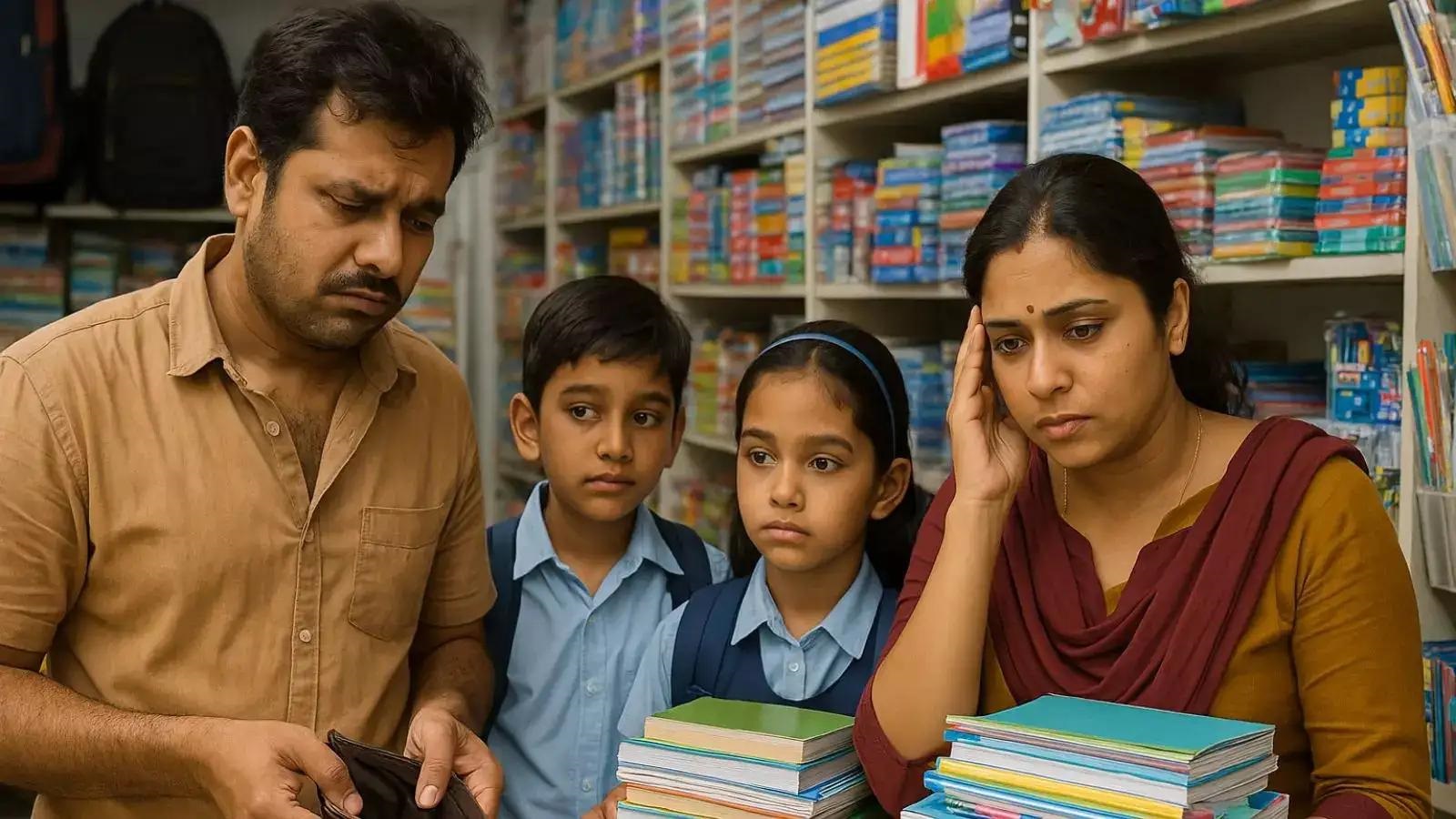
Across the Kashmir Valley, parents are increasingly asking whether sending a child to a private school has become an annual financial battle. Textbook lists change, publishers are replaced, supplementary books multiply, uniforms become more expensive and fee demands arrive with little explanation. Families complain that they are expected to comply first and ask questions later.
The most disturbing part is not simply the money involved. It is the apparent absence of a transparent, publicly verifiable system through which parents can establish why a particular book is compulsory, who approved its inclusion, whether its price is reasonable and whether the school has any commercial relationship with the seller.
The allegation that private-school textbooks represent a business worth approximately ₹240 crore raises the stakes considerably. If that figure is supported by actual market data, it points towards an education-related market of enormous financial significance. But it also demands a basic question: who calculated the figure, what does it include, and where is the money going?
A large textbook market is not, by itself, evidence of corruption. Nor does every expensive book establish wrongdoing. But when parents repeatedly report restricted purchasing choices, frequent publisher changes and unexplained additions to booklists, the administration cannot dismiss the issue as an ordinary disagreement between schools and families.
The question for the Jammu & Kashmir Government, JKBOSE, the School Education Department and the Fee Fixation and Regulation Committee (FFRC) is direct: who is actually monitoring this business, and what has been done to protect parents from unjustified costs?
₹240 Crore: The Numbers Behind Kashmir’s Textbook Economy
The ₹240-crore figure is not a random estimate circulating on social media. It has been reported by Greater Kashmir in an investigation published on November 3, 2026, based on two key figures:
-
Approximately six lakh students enrolled in private schools across Jammu & Kashmir.
-
An estimated average textbook-set expenditure of ₹4,000 per student.
The calculation is straightforward:
₹240 crore
Estimated annual textbook expenditure
6 lakh
Private-school students
₹4,000
Average annual book set
Derived market estimate, not audited industry turnover or verified publisher profits.
That distinction matters.
₹240 crore represents an estimated amount spent by families, not the net earnings of publishers, booksellers or school operators. It also does not establish that the entire amount is being collected through unlawful practices.
Nevertheless, the scale is significant. The estimate excludes uniforms, stationery, school transport, admission charges, activity fees and other educational expenses.
It is also an aggregate for Jammu & Kashmir, not a separately established figure for the Kashmir Valley.
The investigation by Greater Kashmir, published under the headline Private school textbooks: Rs 240 crore business with little government oversight in J&K, contains several particularly serious allegations.
One parent, Sajad Ahmad of Srinagar, claimed that a kindergarten book set costing approximately ₹2,500 to ₹3,000 at designated shops could be obtained for no more than ₹1,500 in the open market.
If that comparison is accurate and the books are identical in edition, quality and contents, the difference is substantial. At the upper end, it represents a price difference of ₹1,500 on a single set.
Multiply such differences across thousands of families and the potential financial impact becomes difficult to ignore.
But where is the independent price audit? Has any government agency compared the MRP, wholesale price and retail selling price of these prescribed books? Has anyone investigated whether schools receive commissions, rebates, sponsorships or other financial benefits from publishers and distributors?
These are not questions that should be answered through assumptions. They require documentary investigation.
The Government Has Rules. It Has Issued Orders. It Has Even Gone to Court. So Why Does the Complaint Return Every Year?
This is where the story becomes considerably more serious.
The documentary record does not support the suggestion that the government has never acted. In fact, Jammu & Kashmir has issued repeated instructions against compulsory book purchases, unapproved textbooks and deviations from prescribed curricula.
The problem is that the instructions have repeatedly been followed by fresh complaints.
1. The 2023 circular: Schools were explicitly told not to force book purchases
A Directorate of School Education, Jammu circular dated April 6, 2023, addressed complaints about private schools compelling parents to purchase books, stationery and uniforms from particular shops.
The instructions were unambiguous:
-
Schools must publish their prescribed subjects and textbooks on their websites.
-
No subject or book beyond the prescribed requirements should be made compulsory.
-
Parents must not be compelled to purchase books or uniforms from a particular shop.
-
Books and uniforms must be available in the open market.
-
Chief Education Officers were instructed to constitute monitoring teams and submit monthly action-taken reports.
The circular warned that violations could invite action under the law, including derecognition or withdrawal of an NOC.
That was not a vague advisory. It established a monitoring mechanism and identified the officials responsible for enforcement.
2. The 2023 High Court judgment: The Board’s authority was upheld
The controversy subsequently reached the Jammu & Kashmir and Ladakh High Court.
In J&K Private Schools United Front v. Union Territory of J&K, LPA No. 241/2023, the Division Bench of Justice Sindhu Sharma and Justice Shahzad Azeem delivered its judgment on June 6, 2026.
The dispute arose from JKBOSE notifications dated August 26, 2022, and January 4, 2023, requiring affiliated private schools to adopt Board-published textbooks for Classes VI to VIII.
The Private Schools United Front challenged the directions, arguing that although the Board could prescribe curricula and textbooks, it could not compel affiliated institutions to use its own publications exclusively.
The government defended the Board’s statutory authority.
The court dismissed the appeal and upheld the earlier September 8, 2023 judgment.
Its reasoning was significant:
-
Section 10 of the J&K Board of School Education Act, 1975, empowers the Board to prescribe courses, curricula, syllabi and textbooks.
-
Section 29 of the J&K School Education Act, 2002, provides the statutory framework for regulating school education.
-
Institutions that voluntarily obtain Board affiliation must comply with its prescribed curricula, syllabi and textbooks.
The court also made clear that the Board’s power to prescribe textbooks includes the authority to determine which books affiliated institutions must use.
This judgment makes one thing clear: affiliated private schools cannot treat the Board’s academic directions as optional.
It also raises a question for JKBOSE: after receiving this judicial backing, how many inspections have actually been conducted to establish whether affiliated schools are following the prescribed requirements?
3. July 9, 2026: Government establishes a four-tier book-audit mechanism
Another important development deserves attention.
Through Circular No. 07-JK(Edu) of 2026, dated July 9, the School Education Department established a four-tier mechanism for academic evaluation, content verification and periodic auditing of books and educational material.
The structure comprises:
-
Institutional Academic and Content Scrutiny Committee, under the Head of Institution.
-
District Academic Review and Verification Committee, under the Chief Education Officer.
-
Directorate Quality Assurance Committee, under the respective Director of School Education.
-
Departmental Review Committee, under the Commissioner Secretary, School Education Department.
The circular required institutions to conduct annual audits and maintain inventories of books examined. It set July 26, 29 and 31, 2026, as successive reporting deadlines for institutional, district and directorate-level submissions.
It also made heads of institutions and supervising authorities personally accountable for compliance.
But here is the crucial distinction.
This circular primarily establishes an academic and content-audit framework. It is not, by itself, a comprehensive price-control mechanism for private textbook sales. It does not answer whether a school is receiving commercial benefits from a publisher, whether a bookseller is overcharging or whether parents are being forced into a particular purchasing arrangement.
The government has created an audit structure. Where are its district-wise audit reports? How many schools submitted their inventories? How many irregularities were identified? How many institutions faced action?
As of November 3, 2026, the publicly accessible records reviewed for this investigation do not establish the consolidated compliance results of this July exercise.
That is an accountability question the School Education Department must answer.
October 14, 2026: Education Minister Announces Another Committee. Parents Have Heard This Before.
There is a particularly important development that must not be overlooked while examining the latest controversy.
On October 14, Education Minister Sakina Itoo chaired a meeting involving representatives of private schools, parents’ associations, civil society groups, NGOs and government officials. The meeting discussed textbook prices, purchasing freedom, uniforms, academic coordination and preparations for the new academic session.
Following the meeting, Itoo publicly stated that no private school should direct parents to purchase books from a particular bookseller.
She also defended the use of additional educational material where it genuinely benefits students, but made an important distinction: additional books should not be imposed merely to extract money from parents.
The minister announced that a committee involving parents’ associations, private-school representatives and NGOs would examine complaints and recommend action wherever violations were established.
This is a welcome intervention. But it also makes the next set of questions unavoidable.
-
Has the proposed committee actually been constituted?
-
Who has been appointed to it?
-
Has it started receiving complaints?
-
How many complaints have been registered?
-
Will it examine the alleged financial relationships between schools, publishers and booksellers?
-
Will its findings be made public before the next academic session?
-
Will the committee have the authority to recommend penalties and refunds, or will it merely submit another report?
The minister has acknowledged the problem. Now the public needs to see action.
There is also a wider concern. The same complaints have appeared in earlier years, and the department has previously issued instructions and constituted monitoring committees. Why, then, does the government need another committee to investigate practices that existing regulations already prohibit?
If the rules are clear, why are parents still being directed towards selected bookshops? If the violations are recurring, why have the responsible authorities not identified and penalised the repeat offenders?
Six Lakh Students or More Than 12.5 Lakh? The Government Must Clarify the Market Size
The ₹240-crore estimate also deserves a closer statistical examination.
The November 3 Greater Kashmir report uses approximately six lakh private-school students as its base.
However, the Ministry of Education’s UDISE+ 2024-25 report presents a different figure.
Its Table 5.4 records 12,55,338 students enrolled in private unaided recognised schools in Jammu & Kashmir, covering pre-primary through Class 12.
6 lakh
Student estimate used in the ₹240-crore market calculation
12.55 lakh
UDISE+ 2024-25 private unaided recognised enrolment
These figures have different reporting bases and years. They cannot be treated as interchangeable without an explanation of coverage.
This discrepancy needs clarification rather than speculation.
Does the six-lakh estimate cover only a particular category of private schools, a subset of students, or a different reporting period? Does it exclude certain recognised institutions or classes?
The government should publish the latest school-wise and management-wise enrolment data, allowing the public to understand the actual number of students exposed to private textbook costs.
There is no justification for using an unclear student base when discussing a market worth hundreds of crores.
Nor should anyone simply multiply 12.55 lakh by ₹4,000 and announce a new market valuation. Not every student purchases the same number or value of books, and the average expenditure needs independent verification.
The lesson is simple: ₹240 crore is a reported expenditure estimate, not an audited market valuation. The underlying enrolment and price assumptions need to be independently established.
The Fee Fixation Committee: Why Is Textbook Regulation Being Treated Separately from School Finances?
The FFRC has an important role in regulating tuition and annual fees charged by private schools.
Under Section 20-C of the Jammu and Kashmir School Education Act, 2002, and the 2022 Private Schools Rules, institutions must submit their proposed fee structures, audited financial statements and supporting justifications for approval. Fee revisions require prior approval.
The committee’s published records also show that it has taken action against non-compliant institutions.
On July 31, 2025, the FFRC issued a notice to 153 private schools in Baramulla for allegedly failing to submit the required fee-regulation documents despite repeated communications. The notice warned of possible suspension of recognition, withdrawal of NOCs and restrictions on fee collection until approval was granted.
The committee’s subsequent circular record includes:
-
August 2025 directions concerning admission fees and security deposits.
-
September 2025 instructions requiring fee heads to be mentioned on receipts.
-
October 2025 action concerning suspension of fee collection by defaulting schools in the Kashmir Division.
-
December 2025 directions concerning advance fees and transport charges.
-
February 2026 directions concerning transport fees during winter vacations.
These are not insignificant interventions.
But there is a fundamental regulatory gap that needs attention.
The FFRC’s fee approval does not automatically establish that every textbook prescribed by a school is reasonably priced, academically necessary or free from commercial influence.
A school could have an approved tuition structure and still face questions about compulsory supplementary books, designated vendors or frequent changes in textbook editions.
That is why coordination between the FFRC, JKBOSE and the School Education Department is essential.
The administration should examine the total financial burden imposed on families, not simply the tuition amount appearing on a fee receipt.
Will the FFRC and the Education Department jointly examine whether textbook purchases are being used as an indirect channel for collecting money outside the approved fee structure?
That question deserves a clear answer.
The Three-Year Textbook Question: Why Must Children Buy New Books Every Year?
One of the most frustrating complaints raised by parents concerns the repeated replacement of textbooks.
Parents allege that schools frequently introduce new publishers, revised editions and additional workbooks even when the subjects and academic requirements appear largely unchanged.
The consequences are obvious.
Older siblings’ books cannot always be passed down. Students cannot easily exchange books with classmates. Families cannot plan purchases around the reuse of existing material.
A parent from Baramulla, Muhammad Waseem, told Greater Kashmir that keeping textbooks unchanged for two or three years would allow families to share books between younger and older students.
But there is an important legal distinction here.
The three-year textbook-retention requirement has been mentioned in the latest reporting, but the specific J&K legal provision establishing that rule could not be independently verified from the statutory materials reviewed for this article. The applicable J&K School Education Rules, 2010, Rule 11, require schools to follow the Board-prescribed curriculum and textbooks, but the provision reviewed does not itself specify a three-year retention period.
The government should therefore clarify the precise order or rule governing textbook replacement.
If a three-year restriction applies, schools should be required to follow it unless a valid exception is approved.
If no such binding provision exists, the administration should consider introducing one with reasonable exceptions for genuine curriculum changes, updated content and educational requirements.
The objective should be straightforward: no family should have to purchase an entirely new set of books merely because a publisher or edition has been changed without a demonstrable academic reason.
Is There a Nexus Between Schools, Publishers and Booksellers?
This is perhaps the most sensitive part of the entire controversy.
Parents have alleged that some private schools prescribe books from particular publishers and direct families towards selected booksellers. Representatives of budget private schools have also questioned why certain influential institutions allegedly continue such practices despite repeated government instructions.
The November 3 investigation by Greater Kashmir records allegations of arrangements involving schools, publishers, wholesale dealers and booksellers. It also carries claims from school representatives that enforcement is uneven and that smaller institutions face scrutiny while some prominent schools allegedly escape it.
These allegations must be investigated rather than casually accepted as established fact.
There are legitimate commercial arrangements in the publishing and distribution industry. Publishers appoint distributors, booksellers earn margins, and schools select learning material.
None of these activities is inherently unlawful.
The concern arises when commercial arrangements influence academic decisions, restrict parents’ purchasing freedom or result in undisclosed financial benefits.
The government should examine the possibility of:
-
Commission payments or rebates linked to compulsory textbook prescriptions.
-
Financial relationships between school managements and book distributors.
-
Exclusive supply agreements that prevent competitive purchasing.
-
Price differences between designated outlets and ordinary market sellers.
-
Frequent publisher changes without academic justification.
-
Compulsory supplementary books that are not genuinely necessary.
An independent investigation should examine invoices, supply agreements, publisher records, school purchase instructions and any relevant financial disclosures.
If a commercial relationship is found to have influenced compulsory purchases, the authorities must determine whether it violates applicable laws and regulations.
And if no such relationship exists, schools and publishers should be given an opportunity to demonstrate that their arrangements are transparent.
An education system cannot operate on suspicion. But neither can it demand that parents blindly trust a system that refuses to disclose how its commercial arrangements work.
The Kashmir Valley’s Bigger Problem: Every School Appears to Have Its Own Interpretation of the Rules
The textbook controversy also exposes a wider problem in private education.
Parents complain that institutions often operate with different interpretations of the academic calendar, curriculum requirements, additional learning material, fee collection and uniform policies.
The issue becomes particularly serious when schools affiliated with the same Board appear to prescribe different combinations of textbooks and supplementary material.
There is nothing inherently wrong with different teaching methods or additional educational resources. Schools need a degree of academic flexibility.
But academic flexibility should not become regulatory independence.
A school cannot simply claim that its internal academic policy overrides the requirements of its affiliating Board.
The June 2026 High Court judgment reinforces precisely this principle: affiliation carries obligations, including compliance with the prescribed curriculum, syllabus and textbooks.
The School Education Department and JKBOSE should therefore publish a comprehensive, class-wise academic compliance framework.
Every parent should be able to check:
-
Which curriculum applies to their child’s school?
-
Which textbooks are officially prescribed?
-
Which additional books are permitted?
-
Which additional books can be made compulsory, if any?
-
What is the justification for changing a publisher or edition?
-
Where can parents report violations?
A common disclosure system would make it much harder for institutions to hide behind confusing or inconsistent instructions.
Authorities Must Answer: Eight Questions That Cannot Be Ignored
The controversy has reached a point where another general assurance will not be enough.
The Jammu & Kashmir Government, School Education Department, JKBOSE and FFRC owe parents specific answers.
The questions parents want answered
1. Where is the ₹240-crore market assessment?
Has the government independently verified the estimated six lakh students and ₹4,000 average textbook expenditure? Who prepared the calculation, and where is the underlying data?
2. Where are the July 2026 audit reports?
Circular No. 07-JK(Edu) of 2026 established a four-tier audit mechanism with deadlines ending July 31. Have the reports been submitted? What did the audits reveal?
3. Has the October 14 committee been constituted?
Who are its members? What is its mandate? How many complaints has it received, and when will its findings be published?
4. Who is checking textbook prices?
Has any department compared publisher prices, printed MRPs, wholesale rates and retail prices for commonly prescribed schoolbooks?
5. Are schools free to change textbooks every year?
What specific legal provision governs textbook retention and replacement? Who authorises changes, and what constitutes sufficient academic justification?
6. Has anyone investigated school-publisher relationships?
Have the authorities examined allegations of commissions, rebates, exclusive vendor arrangements or financial benefits linked to compulsory book purchases?
7. What action has been taken against schools violating the rules?
How many institutions have received notices, faced inspections, been penalised or had recognition-related action initiated for textbook and vendor violations?
8. Why is there no publicly accessible school-wise compliance record?
Can parents access each school’s approved fee structure, prescribed booklist, authorised academic requirements and complaint history?
These questions are not directed against private education as a whole. They are directed at the absence of publicly accessible answers to recurring complaints.
What Should Happen Now? Another Committee Is Not Enough
If the government is serious about ending the textbook controversy, the next steps should be measurable.
1. Conduct a Valley-wide textbook and pricing audit
The Education Department should direct district-level teams to collect booklists from recognised private schools and compare textbook editions, publishers, printed prices and retail availability.
2. Publish a school-wise textbook register
Every school should upload its class-wise booklist, publisher details, editions and supplementary requirements before admissions begin.
3. Establish a textbook price-monitoring mechanism
The government should involve consumer-affairs authorities and examine complaints involving substantial price differences for identical books.
4. Investigate commercial relationships
Where evidence suggests that a school or its management has a financial interest in a particular supplier, the authorities should examine the arrangement under applicable law.
5. Protect the freedom to purchase
Parents should be allowed to purchase prescribed books and matching uniforms from any available seller, without retaliation or discrimination against students.
6. Make textbook changes accountable
A school changing publishers or editions should provide written academic justification and comply with the applicable approval requirements.
7. Publish enforcement outcomes
The government should disclose the number of complaints, inspections, violations established, penalties imposed and cases resolved.
8. Provide a refund mechanism where violations are established
Where an investigation establishes that parents were unlawfully compelled to make payments or purchase material through prohibited arrangements, the authorities should examine appropriate restitution under the law.
The objective should be to move from annual outrage to permanent regulatory accountability.
Private Schools Also Need to Answer
The controversy should not become a blanket indictment of every private educational institution.
Many schools provide quality education, invest in infrastructure, employ qualified teachers and operate within difficult financial conditions.
Private institutions also have legitimate academic interests. They may use supplementary material where it adds value to teaching and learning.
But the sector cannot demand public trust while treating basic questions about textbooks, pricing and purchasing arrangements as an inconvenience.
The Private Schools United Front and other school associations should publicly clarify:
-
Why do some institutions prescribe books beyond the Board’s requirements?
-
What academic standards determine the selection of private publishers?
-
Why do parents report being directed towards particular sellers?
-
Are schools or their managements receiving any commercial incentives from publishers or distributors?
-
Why do textbook lists change, and what safeguards prevent unnecessary replacement?
The associations should also publish their position on the government’s regulatory framework.
If schools are following the rules, transparency should help establish that fact.
If some institutions are violating them, the entire private education sector should not be allowed to suffer reputational damage because of the actions of a few.
The Real Victims Are Children and Their Families
Behind every textbook bill is a household trying to manage its finances.
For some families, ₹3,000 or ₹4,000 may represent a manageable expense. For others, it means adjusting grocery budgets, postponing medical expenses or borrowing money to ensure that their children are not left without books on the first day of school.
The pressure is particularly difficult for families with multiple children.
And there is another consequence that receives far less attention: the psychological burden on students.
Children should not have to experience embarrassment because their parents cannot immediately arrange a particular book or expensive school accessory.
Nor should the quality of a child’s education depend on the family’s ability to purchase every supplementary workbook a school chooses to prescribe.
Education is supposed to reduce social and economic inequalities. It should not create another marketplace in which families with greater purchasing power enjoy an advantage.
The Final Question: Who Will Bell the Cat?
Jammu & Kashmir does not lack regulations, government orders or official committees.
It has the FFRC to regulate private-school fees. It has JKBOSE to prescribe academic requirements for affiliated institutions. It has the School Education Department to supervise implementation. It has district-level officers to monitor schools. It has judicial backing for the Board’s statutory authority.
It now also has a fresh ministerial assurance and a proposed committee to investigate complaints.
Yet the same textbook controversy has returned with the opening of the 2026-27 academic session.
That is the central failure that needs to be confronted.
The government cannot keep responding to annual complaints with another meeting, another circular and another committee while parents continue to pay bills they believe are unjustified.
Nor is it enough to issue instructions against designated bookshops if no one checks whether those instructions are being followed.
The alleged ₹240-crore textbook economy deserves serious scrutiny. Its actual size, pricing structure, beneficiaries and commercial relationships should be established through an independent, transparent investigation.
If there is no organised nexus, the investigation should establish that. If there are violations, those responsible should face action, regardless of the institution’s reputation or influence.
The Education Minister has spoken. JKBOSE has the legal authority. The FFRC has regulatory powers. The School Education Department has monitoring machinery. What Kashmir’s parents are waiting for now is proof that these institutions can act.
How many more academic sessions must pass before a parent can buy a schoolbook from the shop of their choice, understand exactly what their child is required to study and pay a justified price without fear of school-level pressure?
Education must not become a compulsory annual shopping festival. And a child’s future must never be held hostage to a textbook market that nobody appears willing to fully examine.


