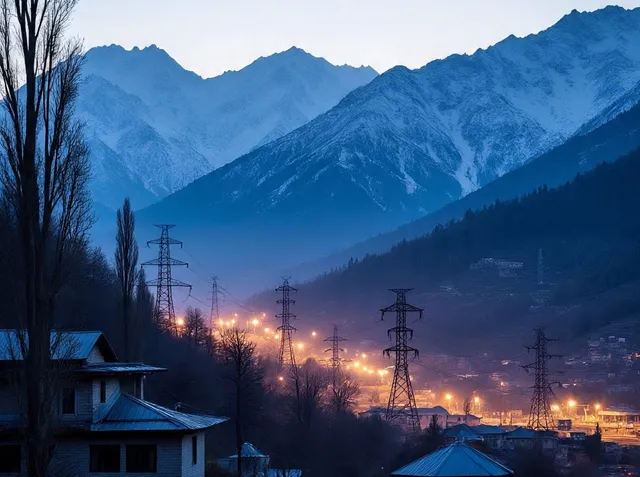
Heavy dependence on imported electricity, declining river flows and complaints of unscheduled outages expose the Valley’s recurring power-sector weakness
By: Javid Amin | 06 November 2026
Srinagar, November 7: Kashmir is entering the winter season with an increasingly fragile electricity supply situation. Demand is rising as temperatures fall and households turn to electric heating, while hydropower generation is declining because of reduced river discharge. The result is mounting pressure on the power system, more frequent load shedding and growing frustration among consumers who say electricity cuts are often longer than the officially notified schedule.
The latest figures reported by Greater Kashmir underline the scale of the challenge. A senior official of the Kashmir Power Development Corporation Limited (KPDCL) put the Valley’s current peak demand at around 1,500 megawatts (MW). Separately, power-sector data for November 3 recorded a combined Jammu and Kashmir load of 2,318 MW, including 1,426 MW for Kashmir and 893 MW for Jammu.
The same data showed approximately 1,950 MW of power imports, 373 MW of state-sector generation and 226 MW of central-sector generation. These are reported figures from a particular operating snapshot, not a complete, independently reconciled electricity balance. They nevertheless illustrate how heavily the Union Territory relies on power procured from outside its own generating stations.
The immediate problem is seasonal. The deeper problem is structural: Jammu and Kashmir has substantial hydropower resources, but its electricity requirements cannot be met consistently through local generation, particularly during the months when demand is at its highest.
Demand is rising just as hydropower generation declines
Winter creates a difficult combination for Kashmir’s electricity system.
As temperatures drop, electricity consumption increases. Electric heaters, water boilers, heating appliances and other domestic equipment add to household demand. The increase is particularly pronounced during early mornings and evenings, when people return home, heating requirements rise and the distribution network faces heavier loads.
At the same time, river discharge begins to decline. Hydropower stations depend on the availability of water to generate electricity, and reduced flows can significantly lower their output.
A senior official quoted by Greater Kashmir said generation from J&K-owned projects had fluctuated between approximately 250 MW and 300 MW during the preceding week. That is considerably below the installed capacity of the Union Territory’s own generating projects.
The contrast is important. Installed capacity represents the maximum electricity a power station can produce under suitable operating conditions. It does not mean that the same quantity is available throughout the year. In a hydropower-dependent region, actual generation can change substantially with water availability.
The situation becomes more challenging when several generating stations experience reduced output at the same time. The electricity deficit then has to be managed through central allocations, purchases from power exchanges and restrictions on consumption.
The numbers behind Kashmir’s power shortage
The latest reported figures offer a useful picture of the pressure on the system.
Reported power-sector figures — November 3, 2026
2,318 MW
Combined J&K load
1,426 MW
Kashmir load
1,950 MW
Reported power imports
373 MW
State-sector generation
226 MW
Central-sector generation
1,500 MW
Kashmir peak-demand estimate
Source: Power-sector data reported by Greater Kashmir. The figures represent reported demand, imports and generation readings; they should not be added together as a reconciled supply balance.
One distinction is particularly important. The 1,426 MW figure represents Kashmir’s recorded load on November 3, while the 1,500 MW figure is an official estimate of peak demand during the period. They are not contradictory: one is a recorded reading and the other is an approximate peak-demand assessment.
Similarly, the reported imports and generation figures should not be treated as a simple mathematical equation for the total electricity consumed. The available report does not provide enough detail about the exact accounting period, procurement categories and scheduling arrangements to reconcile every component.
What the figures do establish is that local generation is insufficient to meet the Union Territory’s requirements on its own, making external procurement essential.
The bigger problem: Jammu and Kashmir’s dependence on imported electricity
The recurring winter crisis raises a larger question: how can a region with considerable hydropower resources continue to face electricity shortages every winter?
The answer lies partly in the difference between generating potential and dependable supply.
Jammu and Kashmir has an identified hydropower potential of approximately 14,867 MW, according to the Economic Survey 2025-26 figures cited in the latest reporting. However, only around 3,540 MW, or 23.81 per cent, has been harnessed.
This leaves a substantial portion of the identified potential undeveloped. Even the capacity already installed cannot guarantee consistent generation when water flows decline.
The result is a system that depends heavily on electricity sourced from outside the Union Territory.
That dependence has several consequences:
-
Seasonal vulnerability: Falling hydropower generation increases the need for external electricity precisely when demand is rising.
-
Procurement exposure: The availability and cost of electricity purchased from outside can influence how much power the administration can arrange.
-
Transmission constraints: Electricity must be transported through the wider grid and delivered through local transmission and distribution infrastructure.
-
Limited flexibility: When demand rises sharply or available supply falls, authorities may have to impose curtailment to maintain grid stability.
The issue is therefore not simply whether Jammu and Kashmir produces enough electricity annually. It is whether sufficient power is available at the right time, particularly during peak winter hours.
Why the announced curtailment schedule is not satisfying consumers
The anger among residents is not limited to the existence of power cuts. It is increasingly about the difference between the official schedule and the actual supply experienced by households.
KPDCL introduced a revised Load Curtailment Plan from October 17, linking scheduled outages to the Aggregate Technical and Commercial (AT&C) losses recorded on individual feeders.
Under the reported arrangement:
| Feeder AT&C losses | Scheduled daily curtailment |
|---|---|
| Above 65% | 8 hours |
| 40.5%–65% | 6 hours |
| 15%–40.5% | 3 hours |
| 0%–15% | 30 minutes |
The plan also expanded the number of feeders receiving round-the-clock electricity. According to the report, 85 additional feeders were brought into the 24-hour supply category, taking the total to 214.
Essential feeders supplying hospitals, medical institutions and water-supply installations have separate arrangements. Certain industrial feeders have also been exempted from scheduled curtailment.
The policy is intended to link better electricity supply with improved revenue collection and lower distribution losses. But its effectiveness depends on whether the notified schedule is followed and whether the electricity available to the distribution network is sufficient.
Residents in parts of Srinagar and Ganderbal, including Lar, Wayil, Kangan and Gund, have complained of outages lasting eight to ten hours a day. Consumers say interruptions sometimes continue beyond the notified timings, affecting household routines, businesses and students preparing for examinations.
These are reported consumer complaints, not a verified measurement of outages across the entire Valley. Nevertheless, they raise a legitimate accountability question: when electricity is cut beyond the published schedule, are consumers being informed whether the reason is a supply shortage, grid constraint, feeder fault or local distribution problem?
A published curtailment plan can only build public confidence if consumers can understand why it is not being followed.
The 623 MW deficit: A warning, not a confirmed daily shortage
The concerns extend beyond the immediate supply situation.
A November power-supply assessment for Jammu and Kashmir and Ladakh projected a combined peak deficiency of approximately 623 MW. The two Union Territories were expected to require around 3,813 MW against anticipated availability of 3,190 MW during peak solar and non-solar hours.
The assessment also projected an energy deficit of approximately 189 million units for November.
These are projections for the combined power system of Jammu and Kashmir and Ladakh. They should not be presented as a confirmed 623 MW shortage in Kashmir alone or as proof that the deficit will occur at every hour of the month.
Separate official estimates reported by news organisations put Kashmir’s peak demand at approximately 1,300–1,350 MW during earlier assessments, against availability fluctuating between 1,000 MW and 1,150 MW. That suggested a potential shortfall of around 250–300 MW during those particular periods.
The figures are not directly interchangeable with the November 3 demand reading of 1,426 MW or the current peak-demand estimate of 1,500 MW. They relate to different reporting snapshots and assessments.
The broader warning, however, is consistent: electricity availability may struggle to keep pace with demand as winter advances.
Why 330 MW of additional central power may not end the crisis
There is some relief expected from December.
Officials have said that the Ministry of Power has allocated approximately 329–330 MW of additional electricity from the central pool to Jammu and Kashmir for December 2026, January 2027 and February 2027.
The additional allocation is intended to compensate, at least partly, for the seasonal decline in hydropower generation. It could improve availability during the months when heating demand is expected to rise further.
But it is not a complete solution.
Officials have also warned that November and March could remain vulnerable periods. The November allocation position and the additional December-to-February allocation are separate arrangements, and the actual electricity received can depend on generating-station output, scheduling and other grid conditions.
The reported allocation of additional power should therefore be seen as a measure to bridge part of the seasonal gap, not a guarantee that consumers will receive uninterrupted electricity.
The distinction is important because an allocation on paper does not automatically translate into reliable supply at every household connection.
Electrification has improved living standards, but also increased winter pressure
Another factor behind the growing demand is the changing pattern of electricity consumption.
More households depend on electricity for daily domestic needs. Electric heating appliances, water heaters and other equipment have become increasingly important, particularly during the colder months.
This reflects improved access to electricity and changing living standards. But it also creates a demand challenge for a system that has not expanded dependable supply and distribution capacity at the same pace.
The problem is especially visible during morning and evening peak hours. When thousands of households switch on heating appliances simultaneously, the load on local feeders and receiving stations rises sharply.
That can create two different kinds of problems:
-
Supply shortage: The electricity available to the system is insufficient to meet demand, requiring grid-level curtailment.
-
Distribution constraints: Local infrastructure may struggle to deliver the available electricity because of overloading, faults or technical limitations.
These problems can occur together, but they are not the same. A power shortage cannot explain every local outage, just as a distribution fault cannot explain the wider seasonal deficit.
Distinguishing between the two is essential if authorities want to improve reliability rather than simply announce revised schedules.
The untapped hydropower question
The longer-term solution lies partly in making better use of Jammu and Kashmir’s hydropower resources.
The fact that only 23.81 per cent of identified potential has been harnessed points to substantial room for development. But expanding installed capacity alone will not eliminate winter shortages.
Hydropower projects must be evaluated for their seasonal generation profile, water availability, environmental impact, construction timelines and ability to contribute dependable electricity during peak demand.
There is also a question of ownership and the economic benefits of generation. Some major projects operating in the region belong to the central sector, while others are owned by Jammu and Kashmir or independent producers. The distinction matters when discussing how much electricity is generated locally, how much is available to the Union Territory and what financial returns accrue to it.
The debate should therefore move beyond the headline figure of installed capacity. What matters to consumers is how much electricity is actually available during the hours they need it.
Political implications: Electricity is becoming a test of governance
Power supply has long been one of the most sensitive public issues in Kashmir. Every winter, electricity becomes central to household expenses, business activity, education and the daily functioning of public services.
For the elected government, the challenge is particularly significant because consumers judge electricity supply not only by the overall availability of power but also by the fairness and predictability of its distribution.
A household may accept a notified curtailment schedule more easily than repeated, unexplained interruptions. A business can plan around announced outages; it cannot easily manage unpredictable electricity cuts. Students preparing for examinations are similarly affected when power disappears during evening study hours.
The government and power utilities therefore face two parallel responsibilities: arranging sufficient electricity and ensuring that available power is distributed transparently.
If outages continue beyond the published schedule, authorities need to explain whether the problem is generation, procurement, transmission or local distribution. Without that information, public frustration is likely to grow regardless of how much additional electricity is allocated.
What needs to change?
The immediate priority is to manage the winter deficit. But a lasting improvement will require more than seasonal procurement.
Several steps deserve attention:
-
Transparent outage information: Utilities should communicate the reasons for interruptions beyond notified curtailment hours.
-
Better peak-load management: Demand forecasting and load management should focus on morning and evening heating periods.
-
Distribution upgrades: Overloaded feeders, transformers and receiving stations need timely maintenance and capacity improvements.
-
Improved revenue collection: Reducing technical and commercial losses can improve the financial position of distribution utilities and support more reliable supply.
-
Long-term generation planning: Hydropower development should focus on dependable seasonal output, not merely increasing installed capacity.
-
Clear procurement planning: Consumers and legislators should be able to understand how much electricity has been allocated, purchased, scheduled and actually received.
These measures would not eliminate every winter shortage, but they would make the system more accountable and better prepared.
Bottom line: Kashmir’s power crisis is bigger than winter load shedding
The current electricity shortage is being driven by three pressures: rising winter demand, declining hydropower generation and dependence on electricity procured from outside Jammu and Kashmir.
The expected additional central allocation from December offers some relief, but November remains a vulnerable period, and the coming winter could still bring difficult supply conditions.
The deeper concern is that this is a recurring problem. Jammu and Kashmir has considerable hydropower potential, yet consumers continue to face seasonal shortages and unpredictable outages.
Kashmir does not simply need more electricity allocated on paper. It needs dependable power when demand peaks, stronger distribution infrastructure and a transparent system that explains every prolonged outage.
Until those weaknesses are addressed, winter power cuts will remain an annual test of both the electricity sector and the government’s ability to deliver reliable public services.


