
The Digital World Has a Weak Point: What the Microsoft 365 Outage Reveals About Corporate Dependence
By: Javid Amin | 13 November 2026
A widespread Microsoft 365 disruption has exposed an uncomfortable reality of the modern digital economy: businesses may have more technology than ever, but many depend on the same handful of companies to keep their operations running.
For millions of employees, the working day begins with a familiar routine. Open Outlook, check emails, join a Teams meeting, access documents on SharePoint and perhaps use Copilot to speed up a task.
It is a seamless digital workplace, designed to make business faster, easier and more productive.
But what happens when several of these services become unavailable at the same time?
That question became particularly relevant on November 12 and 13, 2026, when a major Microsoft 365 outage disrupted access to Outlook, Exchange Online and several connected Microsoft services across different parts of the world.
What initially appeared to be an email connectivity problem developed into a much wider disruption. Businesses struggled to communicate, users encountered difficulties accessing work data, and services dependent on Microsoft’s enterprise infrastructure experienced knock-on effects.
The incident has once again brought an important technology and business issue into focus: cloud concentration risk.
The problem is bigger than one company’s technical failure. It raises questions about how modern organisations build their digital infrastructure, how much control they retain over critical operations and whether their backup arrangements can genuinely protect them when a major technology provider experiences a prolonged outage.
In an economy increasingly powered by cloud computing, artificial intelligence and interconnected software platforms, the reliability of one provider can become a concern for thousands of organisations.
And that is where the real story begins.
What Happened During the Microsoft 365 Outage on November 12–13?
The disruption began on Thursday, November 12, with users reporting difficulties accessing their Outlook mailboxes and other Microsoft 365 services.
According to Microsoft’s incident updates, the Exchange Online disruption began at approximately 16:17 UTC. A separate Microsoft 365 service incident was recorded at approximately 18:26 UTC.
The problems were not limited to one geographical location. Reports emerged from users and organisations across multiple countries.
Downdetector recorded nearly 130,000 Outlook-related problem reports shortly after 1 p.m. US Eastern time. These were user-submitted reports, not a verified count of affected customers, but they illustrated the scale of the disruption.
How the disruption unfolded
The incident developed through several stages:
-
Initial connectivity problems: Users experienced difficulties opening Outlook, accessing mailboxes and sending or receiving messages.
-
Wider service impact: Microsoft identified problems affecting multiple services connected to Exchange Online.
-
Infrastructure investigation: The company reported elevated infrastructure load across multiple regions and began restarting and repairing affected systems.
-
Recovery difficulties: Some servers remained unresponsive even after recovery attempts, making it difficult to restore normal service.
-
Gradual restoration: Microsoft began redirecting traffic, isolating affected infrastructure and testing alternative recovery approaches.
Microsoft’s incident reports also indicated that some recovery measures were not producing the expected results. The company subsequently investigated recent configuration changes and considered rebuilding affected servers using an earlier software configuration.
The important distinction is that identifying a technical symptom is not the same as establishing the final root cause.
At the time of this article’s reporting, Microsoft’s incident records listed the root cause as not yet established. Consequently, it would be premature to attribute the outage conclusively to a particular network configuration change.
Which Microsoft services were affected?
The disruption extended beyond traditional email services.
| Microsoft service | Reported impact |
|---|---|
| Exchange Online | Mailbox access and email delivery problems |
| Outlook | Difficulty accessing and using email |
| Microsoft Teams | Problems with selected chat, calendar and meeting functions |
| SharePoint Online | Disruptions to certain connected workflows |
| Microsoft 365 Copilot | Problems accessing Copilot experiences and organisational data |
| Microsoft Defender | Disruptions to selected security and portal functions |
| Microsoft Purview | Problems affecting selected compliance and data protection features |
| Microsoft Graph | Failures or timeouts in requests involving Exchange data |
An important technical detail emerged from Microsoft’s own service updates: not every feature within every affected product stopped working. Functions that did not depend on Exchange Online could continue operating.
This distinction matters because it shows how a disruption in one shared service can affect multiple products without necessarily bringing down every component of those products.
Why an Email Outage Became a Much Bigger Technology Problem
To understand the wider impact, it is necessary to look beyond Outlook.
Modern enterprise software is rarely a collection of completely independent applications. Instead, services communicate with one another, share identity systems, exchange data and rely on common infrastructure.
Microsoft 365 is a good example of this interconnected model.
An employee may use Outlook to receive a meeting invitation, Teams to attend the meeting, SharePoint to access its documents and Copilot to summarise relevant information.
Although these appear to be separate applications, their underlying workflows can depend on shared services.
Exchange Online, for instance, supports more than conventional email. Its integration with calendars, organisational data and other Microsoft 365 functions means that an interruption can affect activities that users might not immediately associate with email.
This creates what technology specialists often describe as a dependency chain.
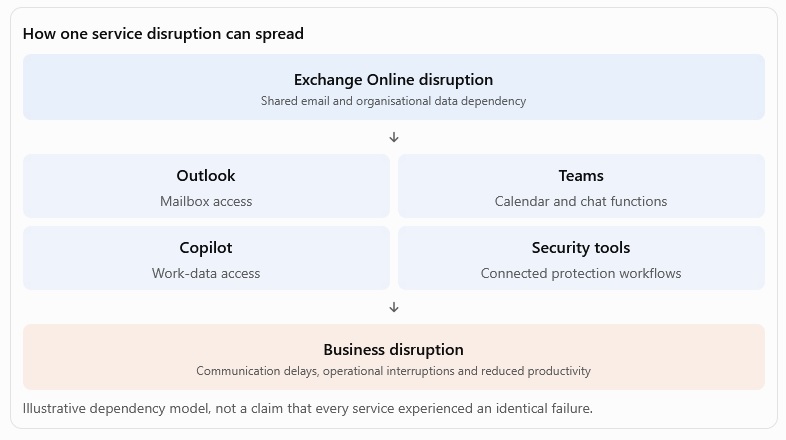
This is the hidden complexity of integrated technology ecosystems.
The more services an organisation connects to a shared platform, the more important that platform becomes to its daily operations.
Integration creates efficiency, but it can also create a larger failure radius.
The Real-World Impact: When Digital Infrastructure Stops Working
The consequences of a major technology outage become clearer when we examine what organisations actually do when their everyday systems become unavailable.
For a small business, losing email access might mean delayed customer responses and missed orders. For a bank, it could interrupt internal communication and transaction-related workflows. For a hospital, it could complicate administrative coordination, although clinical systems may continue operating independently.
For governments and public institutions, the consequences can extend to citizen services and official communication.
The November incident provided several real-world examples.
Governments and public institutions caught in the disruption
The disruption reached government organisations in the United States, Japan and Australia, among other countries.
In Australia, the government activated arrangements with Microsoft intended to prioritise the restoration of critical services. The country’s intelligence and federal police organisations also reported disruption.
Japan’s government acknowledged significant effects on its IT infrastructure, while the UK’s National Health Service reported problems with Outlook and Teams in some organisations.
One particularly important example came from NHS organisations advising patients to use telephone channels rather than email because messages might not be received.
These examples demonstrate why digital continuity is not simply an IT department concern. It can become a public-service issue.
Businesses forced to return to traditional communication
Some of the most revealing developments came from financial and corporate operations.
Reuters reported that a Taiwanese company cancelled a planned bond repurchase, while another trading organisation resorted to fax communications to confirm transactions.
Elsewhere, businesses experienced delays in publishing financial results and communicating with customers.
Airlines also reported communication difficulties, although the outage did not translate into a general grounding of flights.
These examples offer an interesting contrast.
Organisations have spent decades replacing paper-based processes with cloud platforms, automated workflows and digital communication. Yet, when those systems became unreliable, some had to fall back on older methods.
The lesson is not that traditional technology is inherently better. It is that an organisation needs an alternative way to operate when its preferred digital channel becomes unavailable.
The disruption reached beyond Microsoft’s own products
Another important aspect was the effect on services connected to Microsoft infrastructure.
Reuters reported that connectors used by AI services from OpenAI and Anthropic were also affected.
This illustrates a growing feature of the technology industry: one company’s infrastructure can become an essential dependency for another company’s product.
A user may believe they are using an independent AI platform, communication application or business service. However, the underlying product may rely on a third-party identity system, cloud platform, API or productivity service.
The branding may be different. The infrastructure dependency may not be.
The Bigger Issue: What Exactly Is Cloud Concentration Risk?
The Microsoft 365 incident brings us to a concept that deserves greater attention in boardrooms, government departments and technology planning meetings.
It is called cloud concentration risk.
In simple terms, cloud concentration risk occurs when a large number of organisations depend on a relatively small number of cloud service providers or shared technology platforms.
Cloud computing has made it possible for businesses to access sophisticated infrastructure without purchasing and maintaining their own servers.
Instead of building expensive data centres, organisations can rent computing power, storage, databases and software services from established providers.
This model has transformed the technology landscape.
Start-ups can launch digital products without investing heavily in hardware. Banks can scale services. Hospitals can manage information systems. Governments can modernise administrative operations.
But there is a trade-off.
As more organisations move their operations to a handful of major technology ecosystems, their dependencies become increasingly interconnected.
How cloud concentration creates a single point of failure
Imagine a country where thousands of companies use the same provider for their email, identity management, document storage and collaboration systems.
Each company may have its own employees, customers, applications and business processes.
But a critical part of their technology infrastructure is shared.
If that common provider experiences a serious failure, the impact can spread across organisations that otherwise have no direct relationship with one another.
This is known as a shared dependency.
It can affect:
-
Airlines managing operational communication.
-
Banks coordinating internal business processes.
-
Hospitals accessing administrative systems.
-
Government departments exchanging official correspondence.
-
Media companies publishing and distributing content.
-
Small businesses managing customer relationships.
-
Technology companies providing services built on third-party platforms.
The important point is that the failure does not need to originate inside every affected organisation.
A single external disruption can create multiple operational problems simultaneously.
Are Microsoft, Amazon and Google monopolies?
This question requires a little nuance.
The global cloud infrastructure market is dominated by a relatively small number of large providers. However, describing all of them as legal monopolies would be inaccurate.
According to Synergy Research Group’s April 2026 market assessment, Amazon held approximately 28% of the worldwide cloud infrastructure services market in the first quarter of 2026.
Together, these three providers accounted for approximately 63% of the market measured by that research firm.
Global cloud infrastructure market share — Q1 2026
Synergy Research Group estimates
Amazon Web Services – 28% | Microsoft – 21% | Google – 14% | Other providers – 37%
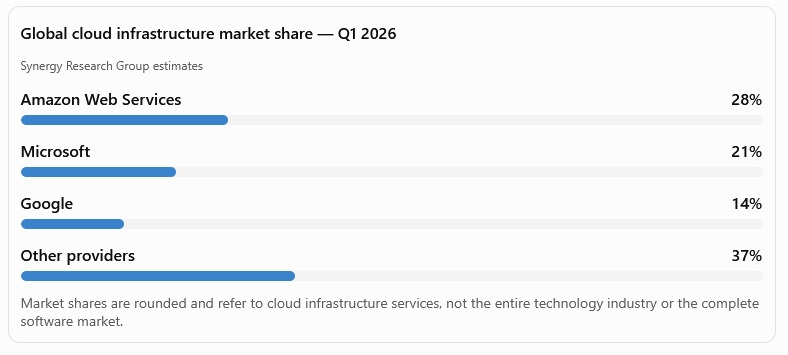
These figures reveal the concentration of market power, but they do not establish that every organisation uses the same infrastructure or that a failure at one provider automatically affects the others.
Nor does market share alone establish systemic risk.
The more important question is how many critical services depend on the same provider, technology component or interconnected group of services.
A market can remain competitive while its infrastructure dependencies become concentrated.
That distinction is central to understanding the Microsoft outage.
Why Companies Chose Consolidation in the First Place
If concentration creates such significant risks, why have organisations continued to consolidate their technology operations?
The answer is straightforward: consolidation offers genuine business advantages.
For years, corporate technology strategies have focused on simplifying infrastructure, reducing costs and improving productivity.
Instead of managing multiple vendors, companies prefer integrated platforms that offer several services under one commercial and technical arrangement.
Consider a typical enterprise technology environment.
| Business requirement | Consolidated solution |
|---|---|
| One enterprise email provider | |
| Meetings | One collaboration platform |
| Documents | One cloud storage ecosystem |
| Identity | One central authentication provider |
| Security | One integrated security platform |
| AI productivity | One connected AI ecosystem |
This arrangement can reduce administrative overhead, simplify employee training and improve integration between applications.
It can also provide centralised security policies and more consistent management.
For a growing organisation, these benefits are attractive.
The problem begins when convenience gradually becomes dependence.
The efficiency-versus-resilience dilemma
Imagine two companies.
Company A uses a single integrated cloud ecosystem for almost everything. It has lower management costs, fewer vendors and a streamlined working environment.
Company B uses multiple providers for selected critical services. Its infrastructure is more complicated and potentially more expensive, but it has independent alternatives for essential operations.
Under normal conditions, Company A may appear more efficient.
During a major provider outage, Company B may have more options.
Neither model is automatically superior. A poorly designed multi-vendor environment can introduce additional security vulnerabilities, inconsistent policies and management problems.
The objective should not be diversification for its own sake.
It should be the ability to maintain essential business operations when a critical dependency fails.
That is the difference between an efficient technology architecture and a resilient one.
This Was Not the First Warning: Lessons From Previous Technology Outages
The Microsoft incident did not emerge in isolation.
The technology industry has experienced several major disruptions in recent years, each highlighting a different weakness in modern digital infrastructure.
1. CrowdStrike outage — July 2024
On July 19, 2024, a faulty CrowdStrike Falcon content update caused widespread Windows system crashes.
Airlines, hospitals, banks, government services and other organisations experienced serious disruption.
The incident was particularly significant because CrowdStrike’s security software operated at a privileged level within Windows systems.
A defective update therefore affected machines across multiple sectors.
According to Parametrix, the direct financial losses for US Fortune 500 companies, excluding Microsoft, were estimated at approximately $5.4 billion. The estimated insured portion was only around $540 million to $1.08 billion.
The lesson: A trusted security product can itself become a source of widespread operational risk when its deployment affects thousands of interconnected systems.
2. AWS outage — October 2025
Amazon Web Services experienced a significant disruption in its US-East-1 region on October 19–20, 2025.
According to AWS’s post-incident explanation, the initial problem involved DNS resolution issues affecting regional DynamoDB service endpoints.
The incident then affected additional AWS services and internal systems.
Although AWS mitigated the original DNS issue, some services required further recovery measures. Normal operations were restored after a prolonged recovery process.
The lesson: Even a geographically specific cloud incident can affect a broad range of digital services because modern applications rely on shared cloud components.
3. Microsoft Azure Front Door disruption — October 2025
The October 2025 Azure Front Door incident is also relevant when examining the risks associated with configuration changes and shared infrastructure.
However, the precise duration and root-cause details in the supplied summary should not be treated as independently established without a primary incident report.
The broader lesson remains important: configuration management, change validation and recovery procedures are essential parts of cloud reliability.
4. Microsoft 365 disruption — January 2026
The supplied summary describes another major Microsoft 365 incident in January 2026 involving Outlook and other enterprise services.
It should be included in the final historical timeline only after its incident record and duration have been independently verified. A similar incident does not automatically establish that the two events had the same technical cause.
What these incidents have in common
The incidents involved different companies, technologies and failure mechanisms.
CrowdStrike involved a defective security update. AWS identified a DNS-related failure. The November Microsoft disruption involved server availability, infrastructure load and an authentication/routing configuration component.
They should not be treated as technically identical.
But they share an important characteristic: modern organisations depend on external technology providers whose services can become critical to everyday business operations.
That is the systemic issue worth examining.
Why Technology Outages Are Becoming a Boardroom Risk
Traditionally, IT outages were considered technical problems.
The IT department was expected to investigate the issue, restore services and report the incident.
That approach is no longer sufficient.
When a company’s entire communication environment, document management system, security platform and business applications depend on external providers, technology reliability becomes a business continuity issue.
It affects revenue, customer confidence, regulatory compliance and corporate reputation.
The financial cost goes beyond lost working hours
The financial consequences of an outage are often difficult to calculate.
A company may lose productivity, but the wider costs can include:
-
Delayed transactions.
-
Missed sales opportunities.
-
Customer service interruptions.
-
Contractual penalties.
-
Regulatory reporting delays.
-
Reputational damage.
-
Additional recovery and support expenses.
-
Employee overtime and operational backlogs.
Some losses may never appear as a separate line item in an IT budget.
For example, a delayed customer response may result in a lost contract. A postponed transaction may affect a financial opportunity. An unavailable document may delay an entire project.
These costs are difficult to measure because they are spread across different departments.
The insurance question: Can businesses recover their losses?
Cyber insurance and business interruption insurance can provide financial protection in certain circumstances.
However, coverage depends on the policy wording, the nature of the incident, the insured business and the applicable waiting periods.
A critical distinction is whether the policy covers disruption caused by a third-party technology provider.
An organisation should not assume that every cloud outage automatically qualifies for an insurance claim.
Businesses need to examine:
-
Whether third-party cloud service failures are covered.
-
Whether a minimum interruption period applies.
-
Whether contingent business interruption is included.
-
What evidence is required to demonstrate financial loss.
-
Whether exclusions apply to particular infrastructure or service failures.
Insurance can help absorb financial losses, but it cannot replace a working continuity strategy.
Five Critical Lessons Corporate Leaders Must Learn From the Microsoft Outage
The biggest takeaway from the November disruption is not that Microsoft experienced a technical failure.
It is that organisations have allowed essential business operations to become increasingly dependent on a relatively small number of technology providers.
This is a strategic issue that deserves attention at the highest levels of corporate leadership.
1. Monopolies and dominant platforms can create single points of failure
The greater the number of organisations depending on one critical provider, the larger the potential impact of a failure.
A single technical disruption can affect thousands of customers simultaneously.
This is particularly concerning when organisations use the same provider for several essential functions.
However, market dominance and technical concentration are not identical. Even competing providers can share underlying infrastructure or dependencies.
The real task is to identify where critical dependencies exist and how they can be isolated.
2. Don’t put all your eggs in one basket
For years, businesses have been encouraged to consolidate their technology environments.
One cloud provider. One email platform. One security system. One identity provider. One collaboration ecosystem.
This can work extremely well under normal circumstances.
But if several essential business functions depend on the same infrastructure, an outage can affect all of them together.
Organisations should consider independent alternatives for their most critical operations.
That does not mean duplicating every application. It means ensuring that the failure of one provider does not completely stop the business.
3. Resilience is more important than short-term cost savings
Technology procurement decisions often prioritise:
-
Lower subscription costs.
-
Vendor discounts.
-
Easier administration.
-
Integrated applications.
-
Reduced infrastructure expenditure.
These are legitimate considerations.
However, decision-makers must also calculate the potential cost of downtime.
A cheaper technology arrangement may become considerably more expensive if it creates a single point of failure.
Corporate leaders should evaluate technology investments not only on their operating costs but also on their ability to support business continuity.
4. A backup system must actually work
One of the biggest mistakes organisations make is assuming that having a backup means they are prepared for an emergency.
A backup system that has never been tested is simply an unverified assumption.
Consider a company that uses Outlook for email and Teams for communication.
If both services depend on the same underlying provider, switching employees from Outlook to Teams may not provide meaningful protection during a provider-wide disruption.
A proper continuity plan must account for shared dependencies.
Organisations should maintain:
-
Independent communication channels.
-
Offline access to essential information.
-
Tested data recovery arrangements.
-
Alternative operational procedures.
-
Secondary infrastructure for critical workloads.
-
Documented procedures for emergency operations.
The US National Institute of Standards and Technology (NIST) provides guidance on contingency planning, including alternate equipment, alternative processing methods and recovery at alternate locations.
5. Convenience creates dependency — and dependency creates strategic risk
Integrated technology ecosystems are attractive because they simplify everyday work.
Employees can communicate, share documents, access information and automate tasks without switching between multiple platforms.
But every integration introduces a relationship that needs to be understood and managed.
A business may believe it has purchased five independent services when, in reality, several of them depend on the same identity, data or cloud infrastructure.
The solution is not to abandon integrated technology.
It is to understand the architecture behind it.
What Businesses Should Do Now: A Practical Digital Resilience Strategy
The November outage should encourage organisations to review their technology infrastructure before another major disruption occurs.
The following measures can help businesses reduce their exposure to cloud concentration risk.
1. Conduct a technology dependency audit
Start by identifying every critical technology provider.
Do not limit the exercise to the company’s main software subscriptions.
Include:
-
Cloud infrastructure.
-
Email and collaboration services.
-
Identity and access management.
-
DNS and domain services.
-
Security platforms.
-
Payment gateways.
-
Database services.
-
APIs and external integrations.
-
AI services and third-party connectors.
For every critical business process, ask:
If this provider becomes unavailable for 12 or 24 hours, what happens?
This exercise can reveal dependencies that are often invisible to senior management.
2. Consider a multi-cloud strategy
A multi-cloud approach involves using services from more than one cloud provider.
For example, a business might use Microsoft Azure for selected workloads, AWS for another application and Google Cloud for particular data or analytics requirements.
The benefits can include:
-
Reduced dependence on one provider.
-
Greater flexibility in workload placement.
-
Alternative infrastructure options.
-
Improved negotiation flexibility.
-
Better disaster recovery possibilities.
But multi-cloud is not automatically safer.
Managing several cloud environments increases complexity, security responsibilities and operating costs.
A business must ensure that its secondary provider is genuinely independent of the failure affecting the primary provider.
3. Establish independent communication channels
Every organisation should have a communication method that remains available when its main productivity platform fails.
Possible alternatives include:
-
Independent business messaging services.
-
Emergency telephone communication.
-
SMS-based notification systems.
-
Secure external collaboration channels.
-
Predefined employee contact lists.
For critical operations, these arrangements should be documented and tested.
4. Maintain offline access to essential information
Not every important business document needs to be accessed exclusively through a cloud application.
Companies should identify information that must remain accessible during an outage.
Examples include:
-
Emergency contact details.
-
Business continuity procedures.
-
Customer escalation information.
-
Essential operational records.
-
Regulatory and compliance documents.
-
Critical system recovery instructions.
The objective is to maintain controlled, secure access to essential information even when the primary cloud environment is unavailable.
5. Conduct regular disaster recovery exercises
An organisation should not wait for a real outage to discover that its recovery plan is ineffective.
Conduct practical exercises involving different failure scenarios.
For example:
| Scenario | Question to test |
|---|---|
| Email unavailable | Can employees communicate independently? |
| Cloud storage unavailable | Can critical documents be accessed? |
| Identity provider failure | Can authorised emergency access be established? |
| Security platform unavailable | Can alternative security procedures operate? |
| Primary cloud unavailable | Can essential workloads be restored elsewhere? |
| Extended outage | Can the business operate manually for 24 hours? |
These exercises should involve management, IT teams, security professionals, operations and customer-facing departments.
The aim is to establish whether the organisation can continue functioning, not simply whether its IT team can restore a server.
6. Review vendor contracts and exit strategies
Technology contracts should address more than service availability and subscription pricing.
Businesses should examine:
-
Service-level agreements.
-
Incident notification commitments.
-
Data portability.
-
Recovery responsibilities.
-
Support escalation arrangements.
-
Contract termination conditions.
-
Migration assistance.
-
Vendor exit procedures.
Moving away from a major provider can be difficult, especially when applications, data and employee workflows are deeply integrated.
An exit strategy should therefore be planned before it becomes necessary.
Why Regulators Are Also Concerned About Technology Concentration
Cloud concentration is not simply a corporate management issue.
It has become an important subject for financial regulators and international policy organisations.
The reason is straightforward: when financial institutions, payment systems and other critical services depend on a limited number of technology providers, an incident at one provider can create risks beyond the original customer.
The Financial Stability Board (FSB) has examined the implications of financial institutions’ dependence on third-party cloud services.
Its work highlights the importance of identifying critical providers, managing third-party relationships and understanding potential systemic dependencies.
The FSB has also developed a framework to help financial institutions and regulators strengthen third-party risk management and oversight.
Europe’s DORA framework
The European Union’s Digital Operational Resilience Act (DORA) is another important development.
DORA establishes requirements intended to strengthen the digital operational resilience of financial entities.
It also introduces an oversight framework for critical ICT third-party providers.
The European Supervisory Authorities coordinate this oversight, helping address systemic and concentration risks arising from financial institutions’ reliance on a limited number of technology providers.
Importantly, this does not remove the responsibility of individual financial institutions to manage their own technology risks.
This regulatory direction reflects an important shift.
Technology providers are no longer viewed only as external suppliers. For many organisations, they have become essential components of the operational infrastructure on which critical services depend.
What Does This Mean for India and Its Growing Digital Economy?
India’s digital transformation makes the issue particularly relevant.
Businesses across the country increasingly depend on cloud-based email, digital payments, online marketplaces, enterprise applications, SaaS platforms and AI-powered productivity tools.
Banks, government departments, hospitals, educational institutions, start-ups and small businesses are all becoming more digitally connected.
These developments bring enormous opportunities.
However, greater digital adoption also means greater responsibility for managing technology dependencies.
Small businesses are not immune
Large corporations may have dedicated cybersecurity departments, disaster recovery teams and enterprise risk managers.
Smaller businesses often do not.
A digital marketing agency, online retailer, travel company or consultancy may depend on a combination of cloud email, website hosting, payment gateways, customer management software and online communication platforms.
If one critical provider fails, the business may struggle to respond to customers, process enquiries or access important records.
For smaller organisations, a practical resilience strategy need not involve expensive infrastructure.
It can begin with:
-
Keeping independent access to essential contact information.
-
Maintaining secure backups of important business records.
-
Having an alternative communication channel.
-
Documenting essential operational procedures.
-
Testing recovery arrangements periodically.
The objective is to make sure that a business does not become completely dependent on a single online service.
India’s digital future needs resilience, not just expansion
India’s growing digital economy is often discussed in terms of innovation, connectivity, digital payments and artificial intelligence.
These are important measures of progress.
But digital maturity should also be measured by how effectively organisations manage disruption.
A country can have advanced digital infrastructure and still face operational vulnerabilities if too many essential services depend on a small number of external platforms.
The long-term objective should be a digital ecosystem that combines innovation with reliability, security, interoperability and independent recovery capabilities.
The Next Challenge: AI Is Creating Another Layer of Technology Dependency
There is another dimension to this discussion that deserves attention.
Artificial intelligence is rapidly becoming part of everyday business operations.
Companies are integrating AI assistants into email, document management, customer support, software development, research, analytics and decision-making.
These systems are not always independent applications.
They may rely on cloud infrastructure, external APIs, identity services, data connectors and third-party software platforms.
This creates another layer of dependency.
Imagine a business that uses:
-
Cloud-hosted customer databases.
-
AI-powered customer support.
-
Automated email responses.
-
Cloud-based document management.
-
AI-driven business analytics.
-
Integrated payment and accounting systems.
If several of these services depend on the same underlying provider, a single outage could interrupt multiple automated workflows.
The business may not lose access to its entire technology environment, but it could lose access to the processes that make its operations efficient.
AI adoption must include an AI continuity plan
As organisations adopt AI, they should consider questions such as:
-
Can employees complete essential tasks if the AI assistant becomes unavailable?
-
Is there an alternative model or service for critical workflows?
-
Are important business records accessible outside the AI platform?
-
Can automated processes be paused safely?
-
What happens when an external API stops responding?
-
Can the organisation switch to manual operations without losing control of its data?
AI can improve productivity, but businesses should avoid making essential operations dependent on a single automated system without a recovery mechanism.
The future of enterprise AI should not simply be about automation.
It should also be about dependable automation.
The Bigger Picture: Efficiency Loves Centralisation, Resilience Demands Diversification
There is an important distinction between blaming a technology company for an outage and understanding the risks created by the way businesses use technology.
Microsoft is one of the world’s largest enterprise software providers. Its products are deeply integrated into corporate operations, government systems and the daily working lives of millions of people.
Its reliability is therefore important.
But the same principle applies to Amazon, Google, major cybersecurity providers, identity platforms and other technology companies.
No provider can realistically promise that every service will remain available at every moment.
Complex infrastructure will experience failures. Software changes can introduce unexpected problems. Hardware can malfunction. Network routes can become unavailable. Security incidents can disrupt services.
The real measure of a resilient organisation is not whether it can avoid every disruption.
It is whether it can continue functioning when disruption occurs.
This is why corporate technology strategy needs to evolve.
For years, the focus was on moving everything online, connecting every application and simplifying operations through integrated ecosystems.
The next phase must give equal importance to independence, interoperability, recovery and resilience.
The goal should not be to eliminate dependence on technology providers. That would be unrealistic.
The goal should be to avoid becoming helpless when one provider becomes unavailable.
Editorial Perspective: The Outage Was Not the Biggest Problem
The November 2026 Microsoft 365 outage is a reminder of how much of the modern economy operates on shared digital foundations.
A failure that begins inside one technology ecosystem can affect organisations thousands of kilometres away, even when they have different customers, different business models and different operational requirements.
The real issue is not simply that a technology giant experienced a technical problem.
It is that many organisations discovered how closely their everyday operations were connected to the same underlying infrastructure.
Technology companies earn trust by delivering reliable services. Businesses, in turn, build their operations around that reliability.
But reliability should never be confused with guaranteed availability.
The strongest organisations will be those that combine the efficiency of integrated platforms with the independence of well-tested recovery systems.
There is an old business principle worth remembering:
Efficiency loves centralisation. Resilience demands diversification.
A single technology outage can be temporary.
But the vulnerabilities it exposes can remain long after the services are restored.
And perhaps that is the most important lesson for corporate leaders:
The biggest problem was not discovering that one technology company could fail.
It was discovering how many critical services were standing on the same foundation.
THE CORPORATE TECHNOLOGY LESSON
Build systems that can survive the failure of the systems you depend on.
Frequently Asked Questions (FAQs)
1. What is cloud concentration risk?
Cloud concentration risk refers to the possibility that many organisations depend on a small number of cloud providers or shared technology platforms. If one critical provider experiences an outage, multiple businesses and services may be affected simultaneously.
2. What caused the Microsoft 365 outage in November 2026?
Microsoft reported that servers became unavailable and that core processes on affected infrastructure were becoming overwhelmed. It subsequently reported positive results after applying an upstream authentication/routing configuration component patch. The final root cause had not yet been established in the incident updates available at the time of writing.
3. Which Microsoft services were affected?
The disruption affected Exchange Online, Outlook and selected functions across Microsoft Teams, SharePoint Online, Copilot, Defender, Purview and other connected Microsoft 365 services. Not every feature was affected equally.
4. Was the Microsoft outage caused by a cyberattack?
Microsoft stated that it was not aware of malicious activity causing the incident. This points towards an infrastructure or engineering-related disruption rather than a confirmed cyberattack.
5. What is a single point of failure in IT infrastructure?
A single point of failure is a component whose failure can interrupt an entire system or critical business process because no sufficiently independent alternative exists.
For example, if a company uses one identity provider to authenticate every employee and application, an outage affecting that provider could prevent access to multiple business systems.
6. Does using multiple cloud providers eliminate outage risks?
No. Multi-cloud strategies can reduce dependence on one provider, but they introduce additional complexity and costs. They also require genuinely independent infrastructure, tested recovery arrangements and compatible applications.
7. What is the difference between cloud backup and disaster recovery?
Cloud backup primarily protects data by maintaining recoverable copies.
Disaster recovery focuses on restoring systems, applications and business operations after a disruption.
Having backups does not automatically mean an organisation can continue working during an outage.
8. How can small businesses protect themselves from technology outages?
Small businesses can begin by maintaining independent communication channels, securely backing up important information, keeping essential contact records available offline and documenting alternative working procedures.
9. Why is business continuity planning important?
Business continuity planning helps organisations maintain essential operations during unexpected disruptions. It reduces operational downtime, protects customers and employees, and supports faster recovery.
10. What is the biggest lesson from the Microsoft 365 outage?
The biggest lesson is that digital efficiency must be balanced with operational resilience. Businesses should understand their technology dependencies and ensure that the failure of one provider does not bring essential operations to a complete standstill.